Transportation providers face ADA obligations every day, whether they run airport shuttles, university circulators, hotel vans, event parking lots, employee commuter buses, or private mobility services. In this ADA guide for shuttle operators, parking services, and private transit, the goal is practical compliance: understanding who must provide accessible service, what equipment and policies are required, and how to reduce legal risk while serving passengers safely and consistently. The Americans with Disabilities Act is the primary federal civil rights law prohibiting disability discrimination, while related Department of Transportation regulations in 49 CFR Parts 37 and 38 set operating and vehicle accessibility rules for many transportation services. For operators, ADA compliance matters because transportation is often the gateway to employment, education, healthcare, tourism, and public life. A missed pickup, inaccessible shuttle stop, or poorly trained driver can quickly become both a civil rights problem and an operational failure.
In practice, transportation accessibility is broader than wheelchair lifts. It includes equivalent service for people with mobility, sensory, cognitive, and psychiatric disabilities; effective communication for riders who are deaf, hard of hearing, blind, or low vision; safe securement procedures; non-discriminatory eligibility and reservation policies; and accessible paths from parking areas to boarding points. I have worked with shuttle fleets and parking operators that assumed ADA compliance began and ended with owning one lift-equipped vehicle. That assumption creates avoidable exposure. Regulators and plaintiffs look at the whole service chain: websites, dispatch scripts, boarding assistance, maintenance logs, signage, complaint handling, and contractor oversight. This hub article covers the transportation landscape comprehensively so operators can identify what rules apply and where deeper guidance is needed for specific fleet types, facilities, and service models.
Which transportation businesses must comply and what laws usually apply
Most shuttle operators, parking services, and private transit providers are covered by some combination of the ADA, DOT rules, and sometimes Section 504 if federal funding is involved. The exact obligation depends on whether the service is public or private, fixed route or demand responsive, and whether the entity primarily transports people or offers transportation as part of another business such as hospitality, healthcare, education, employment, or entertainment. Public entities generally fall under ADA Title II. Private businesses open to the public, including hotels, airports through contractors, casinos, hospitals, private campuses, and event venues, are typically assessed under Title III, with transportation-specific requirements triggered when they operate demand responsive or fixed-route systems.
A simple starting point is to ask four questions. First, who operates the service: a city agency, contractor, nonprofit, or private company? Second, what is the mode: bus, van, tram, golf cart, parking shuttle, or on-demand vehicle? Third, how do passengers access it: scheduled stops, reservations, employee badge access, or valet request? Fourth, is the operator purchasing, leasing, remanufacturing, or merely dispatching vehicles? These facts determine whether accessible vehicles are required, whether equivalent service can satisfy the rule, and how service policies must be written. For example, a hotel that operates an on-call airport shuttle generally cannot deny service to a guest using a wheelchair and may need an accessible vehicle or equivalent service that is truly equivalent in response time, fares, geographic area, hours, trip purpose, and capacity availability.
Parking services also have ADA obligations even when they do not think of themselves as transportation providers. If a parking operator manages shuttle routes from remote lots, the shuttle service must be accessible. If it controls pedestrian routes from accessible parking spaces to a pickup shelter, that path must meet accessibility standards for slope, width, surface stability, and curb ramp design. If it offers valet service, it must not impose eligibility screens or practices that disadvantage disabled patrons. In short, compliance attaches to the customer journey, not just the vehicle title.
Vehicle accessibility standards for shuttles, vans, buses, and similar fleets
Accessible transportation starts with vehicle specifications. DOT accessibility standards in 49 CFR Part 38 address lifts, ramps, door clearances, securement systems, circulation paths, handrails, priority seating, stop request systems, signage, and public information features. The standard that applies depends on vehicle type and service category. In fleet planning, I advise operators to document every purchase decision against service need, route constraints, and boarding environment, because retrofitting bad procurement choices is expensive. A van with a nominal ramp may still fail operationally if its deployed slope is too steep at common curb conditions or if interior turning space is unusable once luggage is loaded.
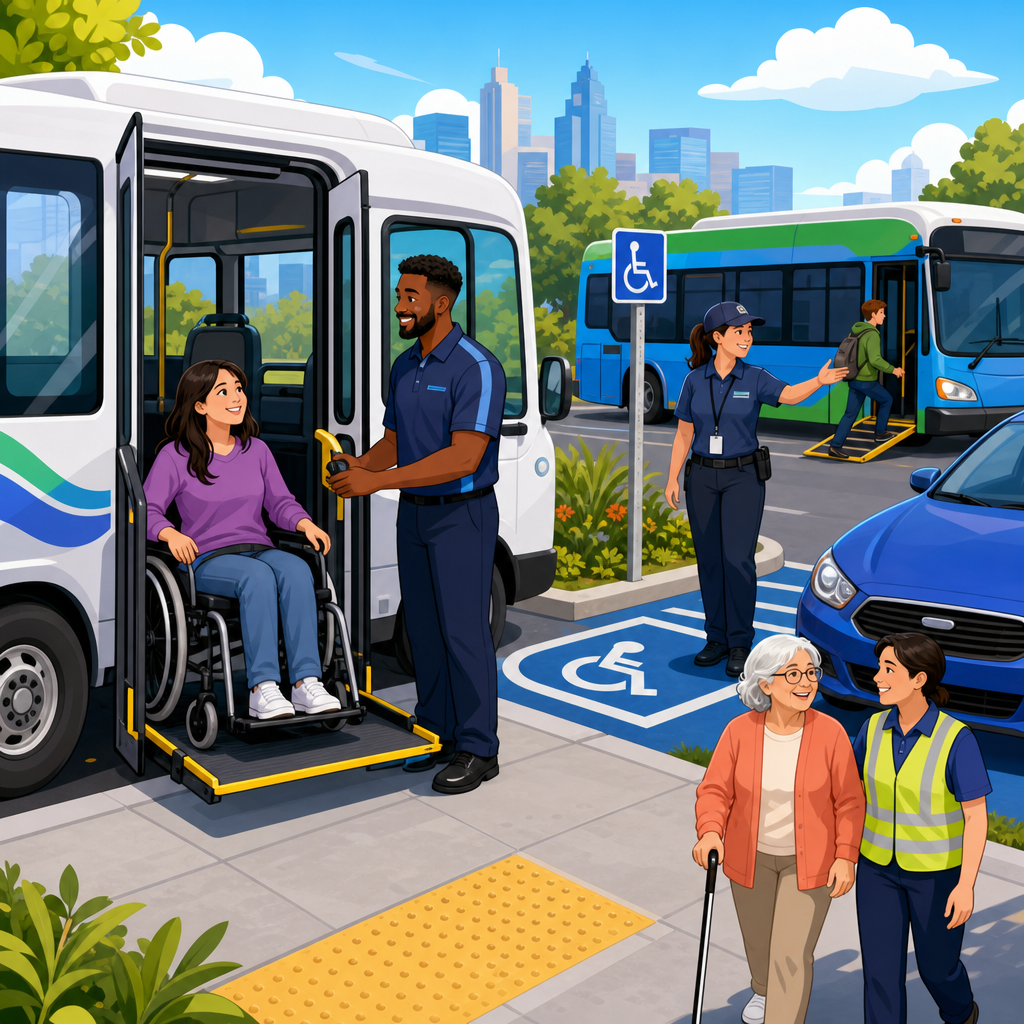
Operators should pay close attention to lift and ramp reliability. An accessible vehicle that is frequently out of service creates the same customer harm as having none. Preventive maintenance logs, pre-trip inspections, and prompt repair protocols are essential. Drivers need to know how to deploy lifts manually, secure wheelchairs without damaging mobility devices, and position passengers safely. They also need clear rules on when a mobility device can be declined, which is rare and typically limited to legitimate safety or size constraints grounded in actual equipment specifications, not assumptions. DOT guidance has repeatedly emphasized that common wheelchairs and scooters must be accommodated if the vehicle and securement area can physically handle them.
| Fleet type | Typical ADA concern | Operational priority |
|---|---|---|
| Airport or hotel shuttle van | Equivalent service failures, luggage interference, delayed accessible pickups | Accessible dispatch protocol and backup vehicle plan |
| Parking lot shuttle bus | Boarding from uneven surfaces, lift maintenance, stop signage | Level boarding areas and documented daily inspections |
| Private campus circulator | Route announcements, stop access, inconsistent driver assistance | Standardized driver training and accessible stop design |
| Demand-responsive van | Reservation screening, no-show policy, securement practices | Neutral booking criteria and rider assistance procedures |
Another recurring issue is overreliance on a single accessible vehicle. If one lift-equipped bus serves an entire operation, breakdowns or scheduling conflicts can undermine equivalency. Strong programs maintain backup capacity through reserve vehicles, reciprocal vendor agreements, or dispatch rules that protect accessible trip availability. Operators should also verify that replacement vehicles in temporary rental scenarios remain accessible when accessibility is required by the service model.
Service policies, reservations, and equivalent service in real operations
For many private transportation systems, the hardest ADA problems come from policy design rather than hardware. Reservation cutoffs, minimum notice requirements, same-day availability, escort rules, and luggage policies can unintentionally discriminate. Equivalent service means a rider with a disability should receive service that is substantially comparable to riders without disabilities across key dimensions: response time, fares, hours and days, geographic coverage, trip purpose restrictions, information access, booking capacity, and availability of reservations. If a non-disabled hotel guest can request a shuttle with fifteen minutes’ notice, the wheelchair user cannot be told to schedule twenty-four hours in advance unless the operator can still deliver genuinely equivalent service, which is uncommon.
Dispatch teams need scripts that avoid unlawful screening. Staff may ask what assistance is needed to complete the ride safely, but they should not probe into diagnosis or require unnecessary proof. Service animal rules are another common failure point. Drivers and attendants may ask only whether the animal is required because of a disability and what work or task it has been trained to perform when the need is not obvious. They should not demand documentation, certification, or special vests. Likewise, operators cannot charge extra for boarding assistance, mobility device securement, or transporting service animals.
No-show and late-cancellation policies should account for disability-related barriers. A rider delayed because an elevator was out, a caregiver arrived late, or weather made a curb cut impassable may need policy flexibility. That does not mean operators must absorb all disruptions; it means rules should be individualized, documented, and applied consistently. Complaint systems are equally important. Every operator should have a defined ADA complaint channel, response timeline, investigation protocol, and record retention standard. When a pattern appears, such as repeated missed accessible pickups at one terminal or venue gate, treat it as a system defect, not an isolated customer service issue.
Driver training, communication access, and day-to-day passenger assistance
Training is where written compliance becomes actual accessible service. Drivers, dispatchers, supervisors, valet attendants, and parking ambassadors all need role-specific instruction. Core topics include respectful interaction, person-first or identity-first language depending on rider preference, boarding assistance, lift and ramp operation, wheelchair and scooter securement, communication with deaf or blind passengers, service animal handling, evacuation procedures, and complaint escalation. Refresher training matters because skill decay is real; I have seen operators with excellent written manuals fail audits because newer drivers copied shortcuts from peers rather than following formal procedures.
Communication access deserves focused attention. Riders who are blind or low vision may need audible stop announcements, verbal orientation at pickup zones, and driver identification when multiple vehicles are present. Riders who are deaf or hard of hearing may rely on written instructions, text notifications, visual signage, or app-based updates. Cognitive accessibility also matters: reservation instructions, pickup locations, and complaint forms should use clear language and predictable steps. In high-noise environments such as airports, stadiums, and large garages, a printed route card or digital message can prevent missed trips.
Assistance must be offered appropriately, not forced. Drivers should ask before touching a mobility device and should not separate riders from canes, walkers, oxygen, or communication aids unless safety requires a specific securement method. Seatbelt use and mobility device securement policies should be explained consistently and tied to manufacturer and vehicle requirements. If a rider declines a recommended transfer from wheelchair to fixed seat, the operator should follow applicable policy and safety guidance, not improvise. Good training reduces injuries, customer complaints, and avoidable confrontations.
Parking facilities, pickup zones, and the accessible path of travel
Transportation accessibility often fails before the vehicle arrives. Parking operators and venue transportation managers must ensure that accessible parking spaces, passenger loading zones, walkways, curb ramps, shelters, call boxes, payment devices, and boarding areas work together as one accessible path of travel. The 2010 ADA Standards for Accessible Design remain the benchmark for many built-environment questions, including access aisle dimensions, vertical clearance, signage, ramp geometry, and accessible route continuity. For shuttle operations, boarding surfaces should be stable, firm, slip resistant, and level enough for safe ramp deployment and wheelchair maneuvering.
Remote parking lots create special risk. I routinely see accessible spaces installed correctly near the lot entrance while the actual shuttle stop sits across broken pavement or behind an unprotected traffic lane. That layout is not functionally accessible. The rider must be able to travel from the accessible space to the waiting area and board safely. Weather protection, lighting, snow and ice removal, and temporary construction detours also matter. An accessible stop blocked by cones, parked carts, or sandwich boards is still inaccessible.
Payment and information systems need review as well. Kiosks, intercoms, QR-based instructions, and mobile apps should be usable by people with vision, hearing, or dexterity limitations. If a garage requires app-based shuttle requests, there must be an accessible alternative for riders who cannot use the app. Signage should identify accessible pickup areas clearly and consistently. For larger campuses, hospitals, and airports, wayfinding should be tested with actual users, not only facility managers.
Risk management, documentation, and how this hub connects to deeper transportation guides
The strongest transportation ADA programs combine operations, facilities, procurement, and legal review. Start with an inventory: vehicle types, service model, routes, stops, reservation methods, driver roles, vendor relationships, and complaint history. Then map each touchpoint against applicable requirements. Review purchase specifications, maintenance records, driver training logs, incident reports, and customer communications. Use mystery rider testing, including riders with disabilities, to validate whether policies work in the field. Internal audits should check measurable items such as lift uptime, accessible trip response times, missed-trip rates, and securement-related incidents.
Contracting deserves special attention because many hotels, airports, universities, and parking owners outsource transportation. The entity customers see may not own the vehicles, but it still faces reputational and often legal exposure if the contractor fails. Contracts should require ADA compliance, training standards, maintenance documentation, complaint reporting, indemnity language, and audit rights. Insurance carriers increasingly ask for evidence of formal accessibility procedures after high-severity boarding and securement claims.
As the hub for transportation within industry-specific ADA guidance, this page should anchor deeper articles on airport shuttles, hotel transportation, parking lot design, valet operations, campus transit, healthcare transport, event venue mobility plans, websites and booking systems, and driver training programs. The key takeaway is straightforward: ADA compliance in private transit is an end-to-end service obligation, not a single vehicle feature. Operators that invest in accessible vehicles, thoughtful policies, trained staff, and compliant pickup environments deliver more reliable service to everyone. Review your transportation system now, document the gaps, and prioritize the fixes that most directly affect a rider’s ability to book, reach, board, and complete the trip safely.
Frequently Asked Questions
Which shuttle operators and private transportation providers are covered by the ADA?
The ADA reaches far more transportation providers than many operators realize. Coverage does not stop with large public bus systems. Depending on how the service is structured, the ADA can apply to airport shuttles, hotel vans, employee commuter routes, university circulators, event transportation, casino shuttles, senior living transportation, parking lot trams, and on-demand private mobility services. Public entities are generally covered under Title II of the ADA, while private companies that provide transportation to the public are commonly covered under Title III. In addition, private businesses that are not primarily transportation companies may still have ADA obligations if they operate vehicles as part of the services they offer to customers, guests, patients, tenants, or employees.
A key practical question is whether the service is open to the public, offered on a fixed route, demand-responsive, or tied to a place of public accommodation such as a hotel, airport facility, medical campus, or entertainment venue. Those operational details affect what accessible service must be provided and when accessible vehicles are required. Even where a provider uses contractors, transportation network partners, or third-party fleet managers, ADA responsibility does not simply disappear. The entity offering the service may still be responsible for ensuring passengers with disabilities receive equivalent access.
For shuttle operators and parking service companies, the safest compliance approach is to assume ADA obligations exist unless qualified counsel determines otherwise. Operators should review who they transport, how rides are scheduled, whether the service is public or restricted, what vehicle types are used, and whether accessibility is built into dispatch, equipment, training, and passenger communication. The ADA is fundamentally about equal opportunity to use the service, so if a passenger without a disability can get from the parking lot, terminal, hotel, campus, or event venue to a destination, the provider should be prepared to offer a usable, safe, and reasonably comparable option for passengers with disabilities as well.
When does a shuttle or van service need wheelchair-accessible vehicles?
This is one of the most important compliance questions because the answer depends on the type of service and the vehicle acquisition decision. In general, when covered entities purchase or lease new vehicles for certain transportation services, the ADA may require those vehicles to be accessible, or require the operator to ensure equivalent accessible service is available. Fixed-route systems have especially strong accessibility requirements. Demand-responsive services also have obligations, but the compliance path may differ depending on fleet composition, service model, and whether equivalent service is truly being provided in practice rather than just promised on paper.
For shuttle operators, “accessible” usually means more than simply having a large doorway. It often involves a functioning lift or ramp, proper securement systems, adequate clear floor space, compliant signage, and boarding features that allow a passenger using a wheelchair or other mobility device to enter, ride, and exit safely. Operators should also remember that accessibility is not limited to wheelchair users. Vehicle features and service practices may affect riders with vision, hearing, cognitive, or ambulatory disabilities as well.
A common mistake is assuming that an operator can avoid purchasing accessible vehicles by relying on ad hoc alternatives, calling another vendor only when needed, or requiring advance notice that effectively limits spontaneous travel. Regulators and courts often look at whether the accessible option is genuinely equivalent in response time, fares, hours, geographic coverage, convenience, capacity, and service quality. If non-disabled passengers can board frequent shuttles immediately, but passengers who use wheelchairs must wait hours or reserve days ahead, that can create serious ADA risk.
From a practical risk-management standpoint, operators should evaluate accessibility before buying, leasing, or retrofitting vehicles. Procurement documents should address ADA specifications, lift or ramp compatibility, maintenance support, driver usability, and passenger securement needs. A transportation provider that builds accessibility into fleet planning from the beginning is typically in a much stronger legal and operational position than one trying to patch together accommodations after complaints arise.
What policies and procedures should shuttle operators and parking services have to stay ADA compliant?
Accessible vehicles are only part of compliance. Just as important are the written policies that control how service is delivered day to day. Every operator should have clear ADA-related procedures covering boarding assistance, use of lifts and ramps, wheelchair securement, service animal acceptance, stop announcements where applicable, communication with passengers who have hearing or vision disabilities, complaint handling, and procedures for service interruptions involving accessible vehicles or equipment. These policies should be written in plain language, shared with staff, and applied consistently.
Training is essential because many ADA problems begin with frontline misunderstandings rather than bad intent. Drivers, dispatchers, supervisors, parking attendants, and customer service representatives should know when they must assist a passenger, what they can and cannot ask about a disability, how to handle mobility devices respectfully, and how to respond if a lift fails or a passenger requests reasonable assistance. Staff should also understand that they generally cannot impose extra conditions on riders with disabilities, such as requiring a companion, refusing service because boarding takes longer, or denying access to a legitimate service animal.
Parking operators that run shuttle systems should also focus on the full passenger journey, not just the ride itself. That means looking at accessible parking spaces, curb ramps, boarding locations, pedestrian routes to pickup points, signage, lighting, and communication methods for requesting service. If an accessible van exists but the passenger cannot safely reach the loading zone, the service may still fail in practice. Likewise, reservation systems, mobile apps, websites, and phone lines used to request transportation should be usable by people with disabilities.
Finally, complaint documentation and internal audits matter. Operators should track requests for accessible service, equipment failures, denied boardings, missed trips, and customer complaints. Patterns in those records often reveal training gaps, maintenance issues, or policy conflicts before they turn into litigation or agency enforcement. Strong policies are not just legal paperwork; they are the operating system for consistent, defensible, passenger-friendly ADA compliance.
How should operators handle wheelchairs, mobility devices, and service animals during transportation?
Operators should approach these issues with a safety-first, rights-aware mindset. Passengers who use wheelchairs, scooters, walkers, canes, and other mobility aids must generally be allowed to use the service if they can be transported safely and if the vehicle and equipment can accommodate them within applicable rules. Drivers should be trained to deploy lifts or ramps correctly, provide reasonable boarding assistance, and use securement systems properly. Refusing a rider because a driver is uncomfortable with the process or unfamiliar with the equipment is a major compliance red flag.
Wheelchair securement is especially important. Even where a passenger may decline certain securement features if policy and law allow, operators should still have consistent procedures for offering securement, positioning the chair, and explaining safety options. Equipment must be maintained in working condition, and out-of-service lifts or ramps should be repaired promptly. A broken accessibility feature is not a minor inconvenience; it can effectively deny service. Operators should also have backup procedures so that if an accessible vehicle fails, the passenger is not stranded or pushed to the back of the service line.
Service animals are another frequent point of confusion. In general, a passenger with a disability who uses a service animal must be allowed to travel with that animal. Staff should not demand certification papers, require the animal to sit in a special area, or deny boarding because of generalized concerns about allergies, shedding, or other passengers’ preferences. Limited questions may sometimes be permitted when the disability or the animal’s function is not obvious, but staff training is critical here because overstepping can quickly create legal exposure.
Operators should also plan for less visible disabilities. Some passengers may need extra time, verbal guidance, help identifying the correct vehicle, or patience during boarding and communication. ADA compliance is not just about having hardware on the bus or van. It is about creating a transportation environment where mobility devices are handled properly, service animals are welcomed appropriately, and passengers with disabilities can travel with dignity, safety, and as few unnecessary barriers as possible.
What are the biggest ADA compliance risks for shuttle operators, and how can they reduce legal exposure?
The biggest risks usually come from gaps between written promises and actual operations. An operator may say accessible transportation is available, but then fail to provide equivalent wait times, usable booking methods, trained staff, maintained lifts, or reliable backup service. Other common risk areas include refusing passengers with mobility devices, mishandling service animals, inaccessible pickup points in parking facilities, inconsistent driver assistance, and poor documentation when incidents occur. In many cases, complaints escalate not because of a single error, but because the provider has no system for fixing recurring problems.
Another major exposure point is fleet procurement. Buying or leasing vehicles without evaluating ADA requirements can lock an operator into years of avoidable noncompliance. The same is true for outsourced transportation arrangements. If a hotel, university, employer, venue, or parking company contracts with a private operator, the contracting entity should not assume the vendor alone bears the risk. Accessibility responsibilities should be addressed in contracts, service standards, indemnity language, training expectations, and maintenance obligations, with active oversight rather than passive reliance.
To reduce legal exposure, operators should conduct regular ADA reviews of vehicles, routes, pickup areas, reservation systems, websites, dispatch practices, and employee training. Maintenance logs for lifts, ramps, and securement systems should be current and complete. Complaint procedures should be easy to use, and management should