Service animals in hospitals raise practical questions that sit at the intersection of disability rights, infection control, patient safety, and everyday clinical operations. In this subtopic, “service animals” generally means dogs, and in limited situations miniature horses, individually trained to do work or perform tasks for a person with a disability under the Americans with Disabilities Act. “Mobility devices” includes wheelchairs, scooters, walkers, canes, crutches, transfer aids, and other equipment people use to move safely and independently. Hospitals must understand both categories because they often appear together: a patient may arrive with a service dog and a power chair, or a visitor may use a walker while relying on a dog for balance support, item retrieval, or medical alerting.
I have seen hospital teams handle these situations well when policies are specific and staff are trained on the exact questions they may ask, where access can be limited, and how to manage sanitation without excluding the person. I have also seen confusion create unnecessary conflict at admissions desks, in emergency departments, and on inpatient units. The stakes are high. A service animal can be essential to a person’s safety and independence, while a blocked wheelchair route or poorly considered room assignment can delay care, increase fall risk, and expose the hospital to complaints or enforcement action. This hub article explains the core rules and operational issues that shape service animals and mobility devices in hospitals, with a focus on infection control, patient rooms, and safety.
Why this matters is simple: hospitals are highly regulated environments, but disability access is not optional inside them. The ADA, Section 504 of the Rehabilitation Act for entities receiving federal financial assistance, and in many cases state nondiscrimination laws require hospitals to provide equal access unless a specific legal exception applies. At the same time, hospitals must follow infection prevention practices grounded in evidence, such as Standard Precautions from the Centers for Disease Control and Prevention and environment-of-care standards commonly surveyed through accrediting bodies like The Joint Commission. The operational challenge is not choosing one obligation over the other. It is designing workflows that honor both. That begins with understanding what hospitals must allow, what they may restrict, and how staff should respond in real situations.
What hospitals must allow for service animals and mobility devices
Hospitals generally must permit a person with a disability to be accompanied by a service animal in areas where patients, visitors, and members of the public are allowed to go. The two questions staff may ask when the need is not obvious are narrowly limited: whether the dog is required because of a disability and what work or task the dog has been trained to perform. Staff should not demand documentation, require a special vest, ask the person to disclose a diagnosis, or insist on a demonstration of the task. This matters at registration desks and triage stations, where well-meaning employees sometimes reach for paperwork that the law does not require.
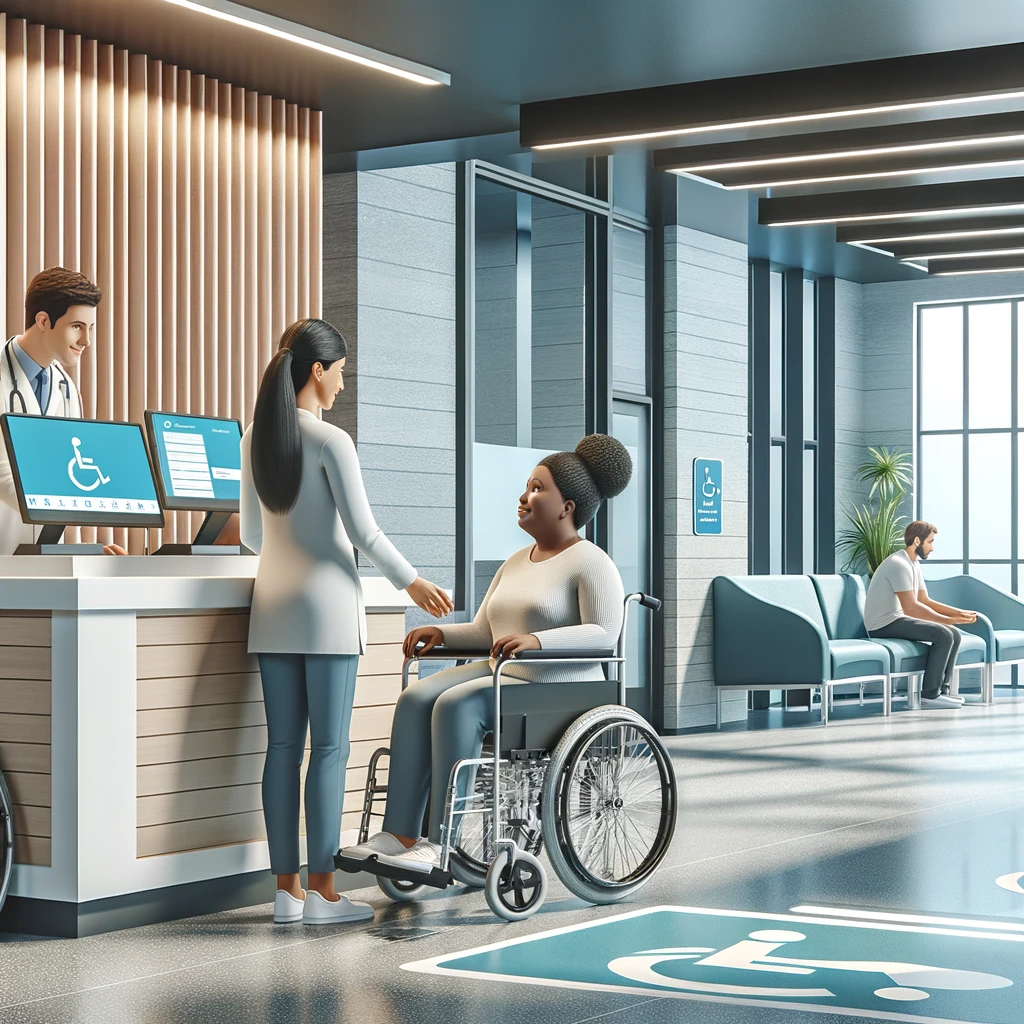
Mobility devices are governed by similar access principles, although the operational details differ. Wheelchairs and manually powered aids must be allowed in virtually all accessible spaces. Other power-driven mobility devices can also be required in some settings unless the hospital can show that a specific device cannot be operated safely in that space based on legitimate safety requirements. In practice, hospitals should focus on actual hazards such as hallway width, oxygen storage areas, emergency egress, and the turning radius needed around beds, not on assumptions about appearance or convenience. A blanket statement that scooters are not allowed on a unit is usually a policy failure, not a legal one.
Real-world examples make the distinction clearer. A visitor using a power chair to see a family member on a medical-surgical floor should be able to travel the same public path of travel as other visitors. A patient using crutches should be allowed to keep them reasonably available, subject to fall-prevention planning. A person with diabetes whose service dog is trained to alert to blood glucose changes should be admitted with the dog unless a legally recognized exclusion applies. Equal access means access integrated into normal hospital life, not segregated to a waiting room or lobby.
When access can be limited without violating disability rights
Not every area of a hospital is open to a service animal, and understanding the limits prevents overreach in both directions. Hospitals may exclude a service animal from spaces where the animal’s presence would compromise a sterile field or create a direct threat that cannot be mitigated. Operating rooms, burn units with strict sterile procedures, and certain invasive procedure areas are common examples. The reason is not a generalized concern that animals carry germs; humans do too. The reason is that some environments require controlled conditions that do not permit any unnecessary source of contamination or distraction.
The direct threat standard is specific and evidence-based. Staff cannot exclude a service animal because another patient says they are uncomfortable around dogs or because someone on the unit prefers an animal-free environment. They must identify a real, significant risk that cannot be reduced by reasonable modifications. A dog that is housebroken, under control, and quietly lying beside the handler in a private patient room does not usually meet that threshold. By contrast, a dog that lunges, barks repeatedly, blocks clinical care, or eliminates inappropriately can be removed if the handler does not take effective action to control it. The person must still be offered services without the animal present.
Miniature horses require an additional assessment because size, weight, and facility type matter. Hospitals should evaluate whether the animal is housebroken, under the owner’s control, can be accommodated based on size and weight, and whether its presence compromises legitimate safety requirements. In older facilities with narrow rooms, crowded emergency bays, or small elevators, accommodation may be harder. The analysis must still be individualized. The facility should document why the restriction is necessary in that location rather than relying on a generic “no large animals” rule.
Infection control: what actually matters in hospital practice
Infection control is the most common concern raised about service animals in hospitals, and it is often misunderstood. There is no general infection-control basis for excluding a healthy, vaccinated, housebroken service dog from public areas or standard patient care settings. Standard Precautions already assume that organisms are present in the environment and focus on hand hygiene, cleaning and disinfection, safe handling of equipment, and appropriate use of personal protective equipment. In routine practice, the biggest risks are not that a service dog is present, but that staff fail to clean surfaces, wash hands, or manage shared equipment correctly.
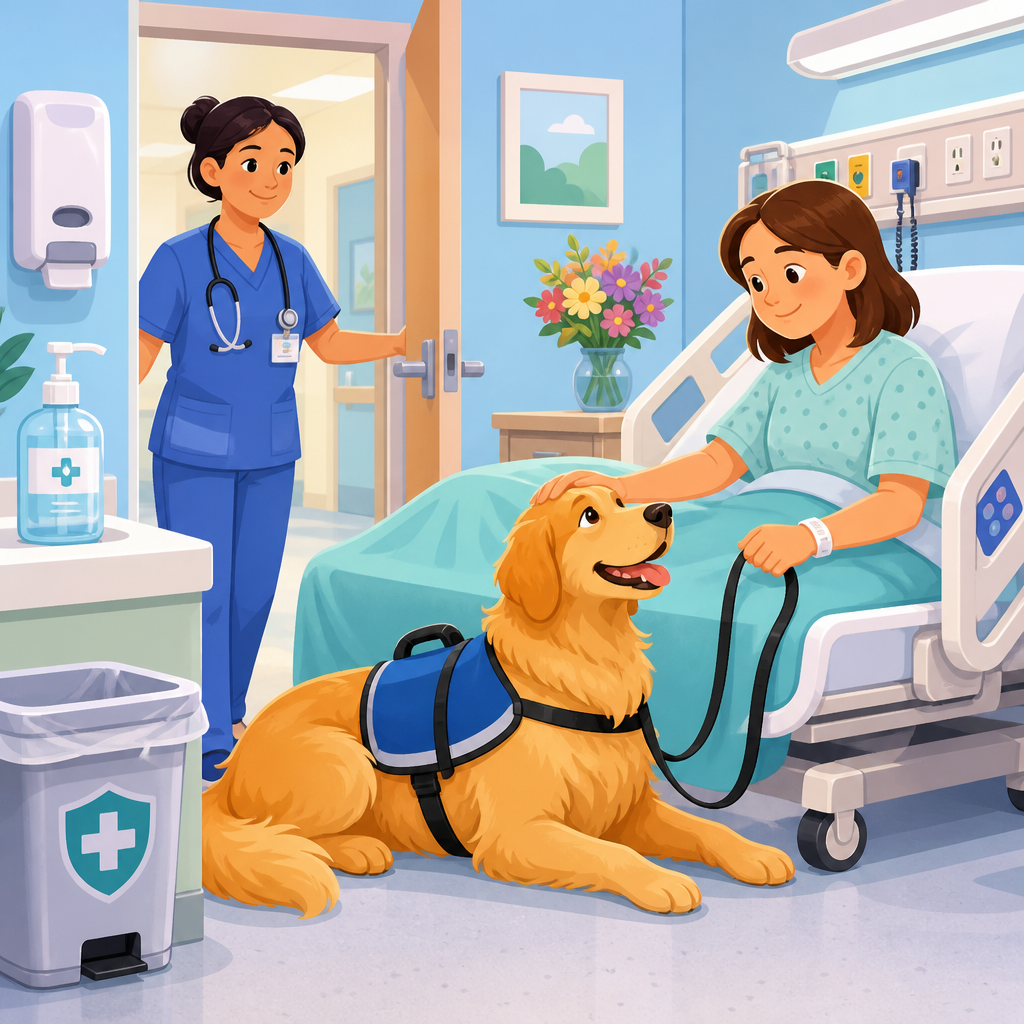
I advise teams to separate theoretical concern from actual transmission pathways. If a service dog lies on the floor beside the handler’s bed, the relevant controls are environmental cleaning of high-touch surfaces, not speculative fears about airborne spread from the animal. If a patient uses a wheelchair or walker, the relevant controls include disinfecting device touchpoints when contamination is likely and preventing equipment from obstructing housekeeping or emergency care. If an animal accident occurs, the response should mirror any other body substance spill: isolate the area, use appropriate disinfectant based on the surface and soil load, don gloves, and document completion according to the hospital’s environmental services protocol.
| Issue | What hospitals should do | What hospitals should avoid |
|---|---|---|
| Service dog in patient room | Allow access unless a specific safety or sterile-field exception applies; reinforce hand hygiene and room cleaning | Creating a blanket ban based on generalized infection fears |
| Allergies or fear of dogs | Separate individuals, adjust room assignments, and use scheduling or route changes when feasible | Automatically excluding the handler and animal |
| Animal accident | Follow body substance cleanup and disinfection procedures; reassess whether the animal remains housebroken | Treating the event as proof that all service animals are unsanitary |
| Wheelchair or scooter contamination | Clean touchpoints when visibly soiled or after exposure risks; maintain clear storage and charging practices | Confiscating devices or leaving users without safe mobility |
Recognized guidance supports this practical approach. The CDC’s healthcare infection prevention framework centers on route-specific controls and environmental hygiene, not categorical exclusion of disability aids. Accrediting surveys likewise examine whether the hospital has workable policies, staff education, and documentation of cleaning and safety practices. Hospitals that build infection prevention into access workflows usually perform better than hospitals that try to solve uncertainty by saying no.
Patient rooms, roommates, and unit-level safety decisions
Patient rooms are where legal requirements and operational realities meet most directly. In many cases, the service animal remains in the patient’s room and the handler, family, or another designee handles feeding, toileting, walking, and supervision. Hospital staff are not required to walk, feed, groom, or relieve the animal. That boundary should be built into the admission conversation so nurses are not left improvising during a busy shift. A simple checklist helps: who will care for the dog, where supplies will be kept, which exit route will be used for toileting, and what backup plan applies if the patient goes to imaging, surgery, or the ICU.
Shared rooms require thoughtful balancing. If a roommate has a severe dog allergy, asthma triggered by dander, or a phobia that affects care, the hospital should try to separate the patients. Usually the answer is a room reassignment, not exclusion of the service animal. The same logic applies in waiting areas, infusion bays, and rehabilitation gyms. Competing disability-related needs should be accommodated by modifying placement, timing, or route whenever feasible. Documentation should show the alternatives considered and the least restrictive solution chosen.
Safety within the room is equally important for mobility devices. Wheelchairs cannot block emergency egress, crash cart access, oxygen shutoffs, or the path needed for transfers and rapid response teams. Charging a power chair or scooter may require review by facilities or biomedical engineering if batteries, cords, or electrical load present hazards. On behavioral health units, devices and animals may require heightened individualized assessment because ligature risks, elopement risk, and unit design differ from general medical floors. Again, the analysis should be patient-specific and tied to actual conditions on that unit.
Operational policies, staff training, and linked topics across this hub
A strong hospital policy on service animals and mobility devices should answer frontline questions in plain language. It should define a service animal, distinguish it from emotional support animals, state the two permissible questions, identify restricted sterile or high-risk areas, explain cleanup and incident reporting, and clarify that staff are not responsible for routine animal care. For mobility devices, the policy should address storage, charging, transfer support, emergency evacuation, and when a hospital-owned device can temporarily substitute without taking away the person’s own equipment unnecessarily.
Training matters because most failures happen in the first five minutes of contact. Registration staff need scripts. Security needs to know that a vest or certificate is not required. Nurses need a process for roommate conflicts, toileting routes, and handoff when the patient leaves the unit. Environmental services needs a documented procedure for animal-related spills. Risk management should review complaints for patterns, because recurring confusion in one department usually means the policy is not being translated into practice.
As the hub for Service Animals & Mobility Devices under Rights and Protections, this page connects the subtopics hospitals most often struggle with: emergency department intake, inpatient rooming, sterile area restrictions, allergies and competing access needs, wheelchair access routes, scooter charging, evacuation planning, and documentation standards. Each of those deserves its own deeper article, but the governing principle is consistent across them. Hospitals should start from access, then apply only those restrictions that are individualized, evidence-based, and necessary to maintain safety or clinical integrity.
Common mistakes hospitals make and how to prevent them
The most common mistake is treating every animal as a pet issue instead of a disability access issue. That leads to demands for vaccination records at the front desk, blanket no-animal signs, or instructions that the dog must stay outside while the patient receives care. The second mistake is relying on infection-control language without identifying a real pathway of risk. The third is forgetting the mobility side of the equation: a patient may technically be admitted with a service dog yet still be denied meaningful access because hallways are cluttered, lifts are unavailable, or personal devices are taken away without a workable substitute.
Prevention is straightforward. Write precise policies, train staff with scenarios, audit incidents, and coordinate disability access with infection prevention, nursing, facilities, and security. Use individualized assessments, not assumptions. Document the reason for any restriction and the alternative offered. When hospitals do this well, they reduce complaints, avoid unsafe improvisation, and support patient dignity at the exact moments people are most vulnerable.
Service animals in hospitals do not require a choice between safety and access. The law expects both, and good operations make both possible. Hospitals should allow service animals and mobility devices in the broad range of areas open to patients and visitors, limit access only when a specific sterile-field or direct-threat concern exists, and manage infection prevention through the same disciplined practices that protect every patient: hand hygiene, environmental cleaning, safe equipment handling, and clear documentation. Patient rooms, roommates, and unit workflows are where these principles become real, so policies must address who cares for the animal, how conflicts are resolved, and how mobility equipment is stored and used safely.
The central benefit of getting this right is not just compliance. It is continuity of care. People who depend on service animals and mobility devices can navigate admissions, treatment, and discharge with less risk, less delay, and more independence when hospital teams understand the rules and the practical steps behind them. Use this hub as the starting point for your policies, staff education, and linked procedures across emergency, inpatient, surgical, and outpatient settings. Then review your current process and fix the first access barrier you find today.
Frequently Asked Questions
Are service animals allowed in hospitals, and what kinds of animals qualify?
Yes. In general, hospitals must allow a service animal to accompany a patient or visitor with a disability in areas where members of the public, patients, or visitors are normally permitted to go. Under the Americans with Disabilities Act, a service animal is usually a dog that has been individually trained to do work or perform tasks for a person with a disability. In limited situations, a miniature horse may also qualify if it has been individually trained and the facility can reasonably accommodate it. The key point is that the animal must be trained to perform specific tasks directly related to the person’s disability, such as guiding, alerting, retrieving, stabilizing, or interrupting certain medical or psychiatric symptoms.
Hospitals are not required to treat pets, comfort animals, or emotional support animals as service animals under the ADA if they are not individually trained to perform a disability-related task. Staff may usually ask only two limited questions when the need for the animal is not obvious: whether the animal is required because of a disability, and what work or task the animal has been trained to perform. They generally should not demand documentation, require the animal to demonstrate the task, or ask detailed questions about the person’s diagnosis. In practice, this means hospital staff need a consistent process that respects disability rights while also addressing infection control, patient flow, and safety concerns in a clinical setting.
Can a service animal go into patient rooms, treatment areas, and other hospital spaces?
Often yes, but not everywhere. A service animal may generally accompany its handler into patient rooms and many common hospital areas if those spaces are open to patients or visitors and there is no legitimate safety-based reason for exclusion. For example, a patient with a disability may usually have a service dog remain with them in their room, and a visitor with a service animal may generally enter areas where visitors are ordinarily allowed. The hospital should assess access based on the actual function and risks of the area rather than on broad assumptions about animals in healthcare settings.
That said, some hospital locations may be restricted because of the need to maintain a sterile field, protect vulnerable patients, or prevent a direct safety hazard. Operating rooms, burn units, certain intensive care environments, sterile procedure areas, and some isolation settings may justify excluding the animal if its presence would fundamentally alter infection control procedures or create a significant risk that cannot be reduced through reasonable measures. The analysis should be specific to the area and the circumstances, not automatic. When the animal cannot enter a particular space, staff should work with the patient or visitor to find an alternative that preserves access as much as possible, such as arranging temporary separation, identifying a safe waiting location, and making sure the person still receives effective assistance and communication.
How do hospitals balance infection control with the rights of patients and visitors who use service animals?
Hospitals should approach service animals the same way they approach other access issues in clinical environments: by using evidence-based infection prevention practices, individualized assessment, and clear operational protocols. The presence of a service animal does not automatically create an infection control problem. Instead, staff should focus on practical measures such as hand hygiene before and after contact, keeping the animal under control, preventing the animal from contacting sterile equipment or clean supply areas, and ensuring that environmental services can address any soiling promptly and according to standard procedures. Routine presence in ordinary patient care areas is usually manageable when these controls are in place.
If a patient is in transmission-based precautions or an area with highly specific infection risks, the hospital should evaluate the situation carefully with infection prevention and clinical leadership. Important questions include whether the animal’s presence would interfere with personal protective equipment protocols, whether the patient can safely care for the animal during the stay, whether the room setup supports sanitation and movement, and whether the animal could be exposed to or transmit contaminants in a way that creates a real risk. Hospitals should avoid blanket bans and instead document the reason for any limitation. Good policy also helps: written procedures for admission, room placement, toileting routes, waste cleanup, and staff responsibilities reduce confusion and support both safety and legal compliance.
Who is responsible for feeding, toileting, supervising, and controlling a service animal during a hospital stay?
In most cases, the handler is responsible for the service animal’s care and supervision. That includes feeding, walking, toileting, grooming, and maintaining control of the animal through a leash, harness, tether, or effective voice and signal control when physical devices are not possible because of the handler’s disability. Hospital staff are not generally required to provide animal care, take the dog outside, clean up routine waste, or supervise the animal if the patient is unable to do so. This is an important operational issue, especially for admitted patients whose medical condition may limit mobility, alertness, or ability to manage the animal independently.
For that reason, discharge planners, nurses, case managers, and admissions personnel often need to address logistics early. If the patient cannot care for the animal temporarily, a family member, friend, or outside support person may need to help. Hospitals should communicate clearly about what they can and cannot provide, while still avoiding unnecessary barriers. If the animal is out of control, not housebroken, or poses a direct threat that cannot be mitigated, the hospital may require its removal. Even then, the person with a disability should still be offered access to care and services without the animal present. A well-run process focuses on problem-solving rather than confrontation, with attention to patient dignity, staff workload, and safety for everyone in the care environment.
What should happen if another patient or staff member has allergies, fears, or safety concerns related to a service animal?
Allergies and fear of dogs are common concerns, but they do not automatically justify excluding a service animal. Hospitals should try to accommodate everyone through practical separation measures. That may include assigning different rooms, adjusting seating in waiting areas, using alternate pathways when feasible, limiting unnecessary contact, and reinforcing hand hygiene and environmental cleaning. The goal is to manage competing needs without denying access to the person who uses the service animal. In many situations, thoughtful room assignments and communication between nursing, infection prevention, and patient relations can resolve the issue effectively.
Safety concerns should be evaluated based on actual behavior and actual risk, not assumptions about breed, size, or the fact that the setting is clinical. A service animal that is calm, trained, under control, and not interfering with care can often remain present even when others are uncomfortable. On the other hand, if an animal is barking repeatedly, lunging, blocking staff movement, contaminating the environment, or preventing safe use of mobility devices, emergency equipment, or clinical workflows, staff may have grounds to intervene. The best practice is to address the specific problem, document what occurred, and explore alternatives that preserve access whenever possible. That balanced approach protects patient rights while supporting a safe, orderly hospital environment.