Accessible voting information, polling places, and election services under the ADA shape whether millions of Americans can participate in civic life on equal terms. The Americans with Disabilities Act, especially Title II, requires state and local governments to ensure that people with disabilities have equal access to public services, programs, and activities, including voter registration, election notices, early voting, polling places, curbside processes, ballot marking equipment, and post-election complaint systems. In practice, accessibility in elections means more than a ramp at the front door. It includes effective communication for voters who are blind, low vision, Deaf, hard of hearing, have mobility disabilities, cognitive disabilities, speech disabilities, mental health disabilities, or use assistive technology. It also covers digital access, because voting information now lives on websites, apps, PDFs, online registration portals, sample ballots, and interactive polling place tools.
This topic matters because elections are time-sensitive and unforgiving. If a bus stop is inaccessible, a voter may be late. If a sample ballot is posted as an unreadable image-only PDF, a screen reader user may never review candidates. If poll workers do not understand reasonable modifications, a voter may be forced to disclose private information, accept unwanted help, or leave without voting independently. I have worked through accessibility reviews of public service websites and service counters, and election access stands out because every barrier carries a constitutional and practical cost. Unlike many government services, voting happens on a fixed calendar, often with long lines, changing locations, and high stress.
As a hub for public services and civic access, this article explains the legal foundation, the service areas covered, and the operational standards that agencies should apply. It also points to connected issues readers often need next: accessible transportation to government sites, effective communication in public meetings, website accessibility for online forms, language access coordination, service animal rules in public buildings, and grievance procedures for discrimination complaints. The core principle is simple: governments must provide voters with disabilities an equal opportunity to obtain information, navigate the process, cast a private and independent ballot where required, and receive assistance or modifications when needed. Equal access is not a courtesy. It is a legal duty and a basic condition of democratic participation.
What the ADA Requires for Voting and Election Services
Title II of the ADA applies to state and local government election offices, boards of elections, counties, municipalities, and any public entity operating election programs. Section 504 of the Rehabilitation Act may also apply when federal funding is involved. The Department of Justice has long stated that public entities must make voting accessible, and the Help America Vote Act adds important requirements for at least one accessible voting system in each polling place used in federal elections. Together, these rules address physical access, communication access, policy changes, and auxiliary aids and services.
In plain terms, election officials must look at the whole voting journey. Can a voter register online with a keyboard and screen reader? Can they read the election notice in accessible digital text? Can they arrive at an accessible entrance, travel a stable route, and check in at a usable table height? Can they mark a ballot privately using accessible equipment? Can they ask questions through relay services or receive large print and plain language materials? If a standard procedure creates a barrier, the agency usually must modify that procedure unless doing so would fundamentally alter the program or create an undue burden. Those defenses are narrow and fact specific. They are not excuses for poor planning.
Government agencies should also understand that accessibility is not limited to permanent architecture. Temporary polling sites in schools, churches, libraries, and community centers still must be usable. The Department of Justice’s ADA Checklist for Polling Places remains a practical field tool because it translates legal requirements into observable conditions: parking, passenger drop-off, exterior route, entrance, interior route, and voting area. When I assess public service access, the recurring problem is not ignorance of standards but failure to test the voter experience end to end. A site may have an accessible parking space yet place check-in behind a tight queue line or run cords across the accessible route.
Accessible Voting Information and Digital Civic Access
For many voters, the first barrier appears long before Election Day. Election information must be accessible online and in alternative formats. That includes registration instructions, deadlines, ID rules, polling place locators, candidate lists, sample ballots, absentee and mail ballot instructions, cure processes for rejected ballots, and complaint procedures. The most reliable benchmark for digital accessibility is conformance with WCAG 2.1 AA, which addresses keyboard navigation, text alternatives, color contrast, form labels, error identification, heading structure, and compatibility with assistive technologies.
Common failures are easy to identify and damaging in practice. Image-only PDFs block screen reader access. Unlabeled form fields make registration impossible for blind users. Countdown timers can interrupt users with cognitive disabilities. Maps without text directions leave blind voters stranded. Videos explaining voting changes often lack captions, transcripts, or sign language interpretation. In my experience, the highest-value fixes are also the most basic: publish information as accessible web pages first, use accessible document templates only when PDFs are necessary, write plain-language instructions, and test critical pages with keyboard-only navigation and a screen reader such as NVDA, JAWS, or VoiceOver.
Agencies should present election content in multiple formats because disabilities and preferences vary. Large print helps many low vision voters. Plain language improves comprehension for voters with intellectual or developmental disabilities and for first-time voters. Captioned videos support Deaf and hard of hearing users, while transcripts help people who prefer text or use refreshable braille displays. Mobile access matters because many voters rely on phones, not desktop computers. A polling place tool that works on a county office monitor but fails on a phone is not truly accessible public service delivery.
Polling Place Accessibility: From Parking to the Voting Booth
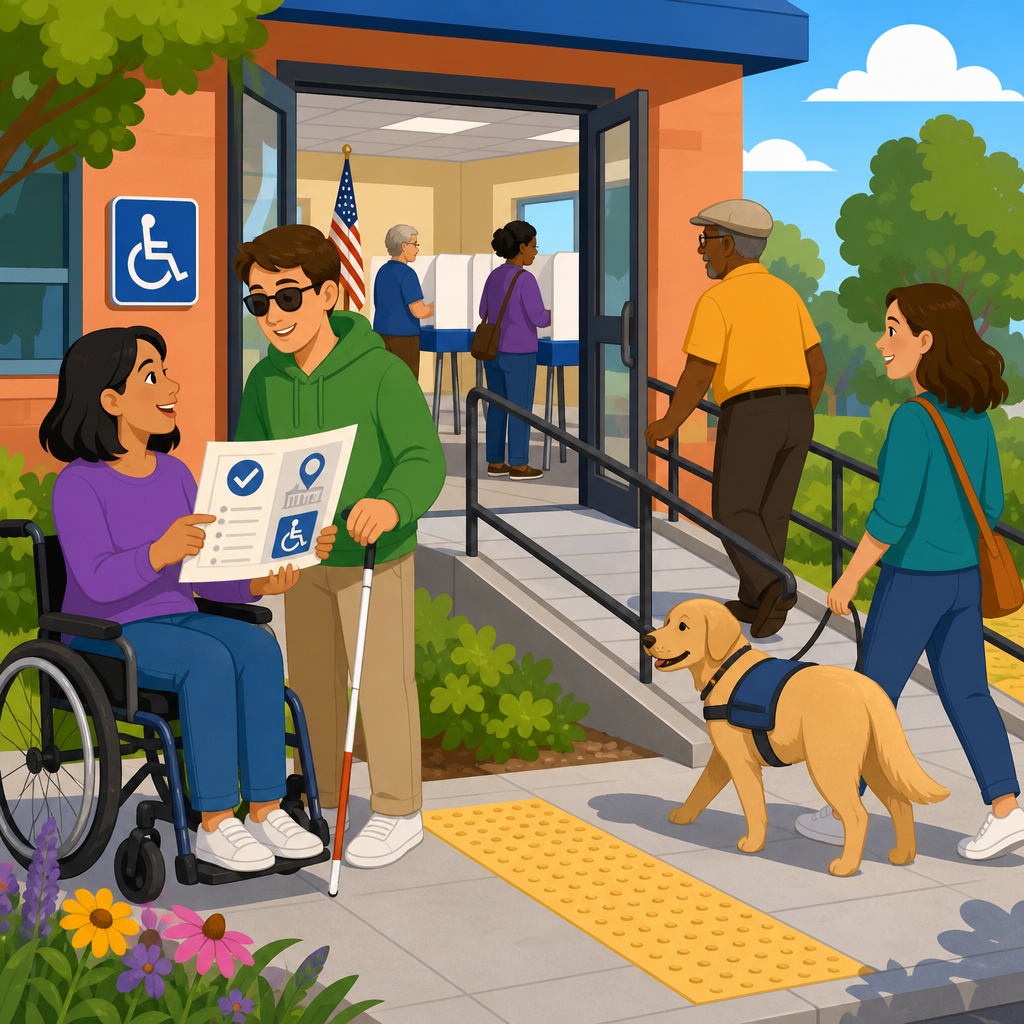
Physical accessibility determines whether a voter can enter, move through, and use a polling place with dignity. The accessible route should begin where voters arrive, not at the front door. That means accessible parking with proper access aisles, curb ramps where needed, firm and stable surfaces, adequate width, and manageable slopes. Entrances should have usable door hardware, sufficient clear width, and threshold heights that do not stop wheelchairs, walkers, or scooters. Inside, the route to check-in and voting stations must stay clear of boxes, signs, cords, and furniture.
Small barriers often become complete barriers on Election Day. I have seen excellent building entrances undermined by temporary signs placed in the middle of corridors, folding chairs narrowing the route, and ballot secrecy screens mounted too high for seated voters. Check-in tables may need a lower section or clipboards to permit comfortable signing. Voting booths should provide knee and toe clearance and enough space for turning. Lighting matters for low vision voters, and acoustics matter for voters using hearing aids in noisy gyms or cafeterias.
When a site has limitations, election officials should use temporary remedies backed by training and checklists. Portable ramps, propped-open doors when safe and lawful, clear directional signage, queue management that preserves accessible routes, and relocation of voting functions to the accessible floor can solve many problems. However, temporary fixes must be reliable and supervised. A ramp stored in a closet does nothing for a voter who arrives before staff notice the barrier.
| Polling Place Element | Common Barrier | Practical ADA-Aligned Fix |
|---|---|---|
| Arrival and parking | No marked accessible spaces or blocked access aisles | Stripe compliant spaces, post signs, monitor cones and vehicles |
| Exterior route | Broken pavement, steep slope, missing curb ramp | Repair path, add temporary matting, direct voters to usable route |
| Entrance | Heavy door or steps only | Use accessible entrance, install temporary ramp, assign trained greeter |
| Check-in area | Table too high, cramped queue, poor lighting | Provide lower surface, widen path, add task lighting |
| Voting station | Insufficient space or inaccessible ballot marking device | Reconfigure layout, test equipment before opening, keep backup plan |
Accessible Voting Equipment, Assistance, and Effective Communication
Accessible voting is not achieved by building access alone. Voters must be able to receive information, communicate with staff, and mark or cast a ballot privately and independently when required by law. HAVA requires each polling place in federal elections to have at least one voting system accessible for individuals with disabilities, including nonvisual accessibility for blind and visually impaired voters. In practice, that often means a ballot marking device with audio output, tactile controls, adjustable contrast, sip-and-puff compatibility, or other assistive features depending on the jurisdiction’s system.
Equipment is only as accessible as its setup and support. Headphones must be available and sanitary. Privacy screens should not block wheelchair approach. Staff must know how to start the accessible interface, adjust audio speed, and troubleshoot basic issues without taking over the voter’s choices. Too often, counties purchase compliant machines but fail to train poll workers, charge batteries, or test ports before the polls open. A legally sufficient system on paper becomes useless in the field.
Assistance rules also matter. Voters with disabilities may bring a person of their choice to assist them, subject to common limits such as not using the voter’s employer or union representative where state law reflects federal protections. Poll workers should address the voter directly, not the companion, and should ask what assistance is wanted rather than assuming incapacity. Communication access may require qualified interpreters in some interactions, real-time text options, relay services for phone support, note writing for short exchanges, or materials in braille, large print, or accessible electronic formats. The right aid depends on the context and the voter’s communication method.
Absentee, Mail, Early Voting, and Voter Registration Access
Election access extends beyond the traditional polling place. Voter registration offices, early voting centers, drop boxes, absentee ballot application systems, signature cure notices, and ballot tracking tools are all public election services that must be accessible. During recent election cycles, many jurisdictions expanded mail voting and online services, which created new opportunities and new barriers. A county can improve access by offering an online absentee request portal, but if the form uses CAPTCHA without an accessible alternative or times out without warning, disabled voters are excluded just as surely as if a doorway were blocked.
Remote accessible vote-by-mail systems are especially important for some blind and print-disabled voters. These systems may allow a voter to receive and mark a ballot electronically using their own assistive technology, then print and return it according to state rules. They do not eliminate all access issues, because printing, signing, and return deadlines can still present barriers, but they can significantly improve privacy and independence compared with hand-marking assistance from another person.
Early voting sites should be evaluated with the same rigor as Election Day locations. Drop boxes should be reachable from an accessible route and mounted at usable heights. Registration outreach events held at libraries, campuses, shelters, or community festivals still fall within the broader duty of equal access when operated by public entities. If your county promotes same-day registration, accessible signage, trained staff, alternative formats, and digital accessibility become even more critical because voters have less time to recover from an error.
Complaints, Enforcement, and Best Practices for Agencies
Voters who encounter barriers can file complaints with local election officials, a county ADA coordinator, the Department of Justice, or in some cases state protection and advocacy organizations. Documentation helps: note the location, time, names if known, photos where appropriate, the barrier encountered, and the remedy requested. Because elections are time-sensitive, agencies should provide rapid escalation paths on voting days, not only a standard grievance form answered weeks later. A hotline, roving troubleshooter, and authority to relocate equipment or open an alternative route can prevent disenfranchisement in real time.
For agencies, the best practice is continuous accessibility management rather than last-minute compliance. Build accessibility into procurement for websites, e-poll books, voting systems, and document platforms. Audit every election site with a standardized checklist. Train poll workers on disability etiquette, auxiliary aids, service animal rules, and problem solving. Coordinate with disability organizations for user testing and feedback. Publish accessibility contacts and accommodation procedures clearly before every election. The strongest programs treat accessibility as election administration, not as a side issue delegated to one specialist.
This hub matters because public services and civic access rise or fall on operational details. Accessible voting information, polling places, and election services under the ADA are not isolated legal topics; they connect to transportation access, website accessibility, public building design, effective communication, emergency planning, and fair complaint systems. When those parts work together, voters with disabilities can register, learn, travel, enter, communicate, vote, and resolve problems without surrendering privacy or independence. When one part fails, equal participation breaks down quickly.
The key takeaway is straightforward: election accessibility must cover the full voter journey, from online information and registration through arrival, check-in, ballot marking, assistance, and post-election remedies. Agencies should use recognized standards, test real conditions, train staff thoroughly, and fix barriers before voters encounter them. Voters and advocates should document problems and request prompt solutions. If you manage election services or support disability rights, review your local process now and identify the next accessibility improvement before the next deadline arrives.
Frequently Asked Questions
What does the ADA require when it comes to accessible voting information, polling places, and election services?
The Americans with Disabilities Act, particularly Title II, requires state and local governments to provide people with disabilities an equal opportunity to participate in all aspects of the voting process. That does not just mean the moment a ballot is cast. It includes voter registration, public notices about elections, sample ballots, websites, call centers, early voting, election-day polling places, ballot marking systems, curbside voting procedures, and post-election processes that involve public participation. If an election office offers a service, program, or activity to the general public, it must be accessible to qualified voters with disabilities unless doing so would fundamentally alter the service or create an undue administrative or financial burden, which is a high standard.
In practice, this means election officials must look at both physical and communication access. Physical access may involve accessible parking, an accessible route into the polling place, doors wide enough for wheelchair users, usable check-in stations, accessible voting equipment, and an accessible path to cast a private and independent ballot. Communication access may require accessible websites, large-print or plain-language materials, effective communication for voters who are blind, have low vision, are Deaf or hard of hearing, or have speech or cognitive disabilities, and reasonable modifications to standard procedures when needed. The ADA focuses on equal access, dignity, privacy, and independence, so election systems should be designed to avoid forcing voters with disabilities to rely unnecessarily on others.
What makes a polling place accessible under the ADA?
An accessible polling place is one that a voter with a disability can approach, enter, and use in a way that is comparable to other voters. That usually begins with basic site access: designated accessible parking spaces, curb ramps where needed, stable walking surfaces, and a continuous accessible route from parking or drop-off areas to the building entrance. Once inside, doors, hallways, ramps, and voting areas must allow people using wheelchairs, scooters, walkers, canes, or other mobility devices to move through the space safely. Temporary barriers such as propped-open heavy doors, cords, furniture placement, or poor signage can also create access problems, so accessibility is not only about building design but also about setup and operations on election day.
The voting area itself must also be usable. Check-in tables should be reachable, seating should be available for voters who cannot stand for long periods, and at least one voting system should permit private and independent voting for people with disabilities. Accessible features should not be hidden, blocked, or available only after a voter makes repeated requests. Clear signage directing voters to accessible entrances and routes is often essential, especially when the main entrance is not the accessible one. Election workers also need training to recognize and fix common access barriers quickly, such as repositioning cones, opening alternate entrances, or implementing backup procedures. Accessibility is measured by whether the voter can actually use the polling place in real-world conditions, not simply whether the location was labeled accessible in advance.
Do voters with disabilities have the right to accessible absentee voting, early voting, and ballot-marking technology?
Yes. The ADA’s equal-access principles apply across the voting process, not just inside a polling place on election day. If a jurisdiction offers absentee voting, vote-by-mail support, early voting, online information, or in-person ballot marking options, those services must be accessible to voters with disabilities on an equal basis. That may include accessible electronic delivery of ballots where permitted by law, accessible instructions, compatible online systems, in-person accessible ballot marking devices, and effective help for voters who need modifications to ordinary procedures. A voter should not be forced to give up privacy or independence simply because a jurisdiction chose to provide a service in a way that is inaccessible.
Accessible voting technology plays an important role here. Ballot-marking devices and other assistive systems can allow voters who are blind, have low vision, have limited dexterity, or have other disabilities to review and mark a ballot privately and independently. But having equipment available is not enough if it is not set up, powered on, tested, or understood by poll workers. Early voting sites and absentee-related processes should be examined for the same barriers that affect election-day locations, including inaccessible websites, unreadable PDFs, phone systems without relay compatibility, and forms that cannot be completed by screen-reader users. The core legal principle is that when election services are offered, voters with disabilities must have meaningful and usable access to them.
Can a voter with a disability bring someone to help them vote or request changes to standard election procedures?
In many situations, yes. The ADA generally requires reasonable modifications to policies, practices, and procedures when necessary to avoid discrimination on the basis of disability, unless the change would fundamentally alter the nature of the service. In the election context, that can mean adjusting how a voter checks in, allowing extra time, permitting a voter to remain seated, communicating in an alternative format, or using curbside or other alternative processes when necessary and legally available. The point is not to give special treatment, but to make sure the voter can participate equally.
Voters with disabilities are also commonly allowed to receive assistance from a person of their choice, subject to limits set by applicable election laws, such as restrictions on assistance by an employer or union representative in some jurisdictions. That help can include reading the ballot, marking choices, or navigating the polling place. Poll workers should communicate directly with the voter whenever possible, respect the voter’s preferences, and avoid making assumptions about capacity or need. If a voter requests an accommodation or modification, election staff should focus on solving the access problem promptly and respectfully. The ADA favors practical, individualized responses that preserve the voter’s privacy, autonomy, and equal opportunity to cast a ballot.
What should a voter do if election information or a polling place is not accessible?
If a voter encounters barriers, the first step is often to notify local election officials as soon as possible, ideally before election day if the problem is discovered in advance. Many issues can be corrected quickly, such as providing an alternate entrance, moving a voting station, offering accessible equipment, or making materials available in a usable format. On election day, the voter should ask to speak with the chief poll worker, site supervisor, or local election office if front-line staff do not understand the request. Documenting the barrier can also be helpful, including the time, location, names of officials if available, photographs of physical barriers, and notes about what access was denied.
If the problem is not resolved, voters may have additional options through state election complaint processes, disability rights organizations, protection and advocacy agencies, or the U.S. Department of Justice. Depending on the circumstances, barriers may also implicate other laws in addition to the ADA, including federal voting rights laws and state accessibility requirements. Reporting problems matters not only for the individual voter, but also for future elections, because inaccessible information, equipment, and locations often affect many people. The ADA is designed to ensure that voting is not merely theoretically open to people with disabilities, but actually accessible in practice, and voters have the right to raise concerns when that standard is not being met.