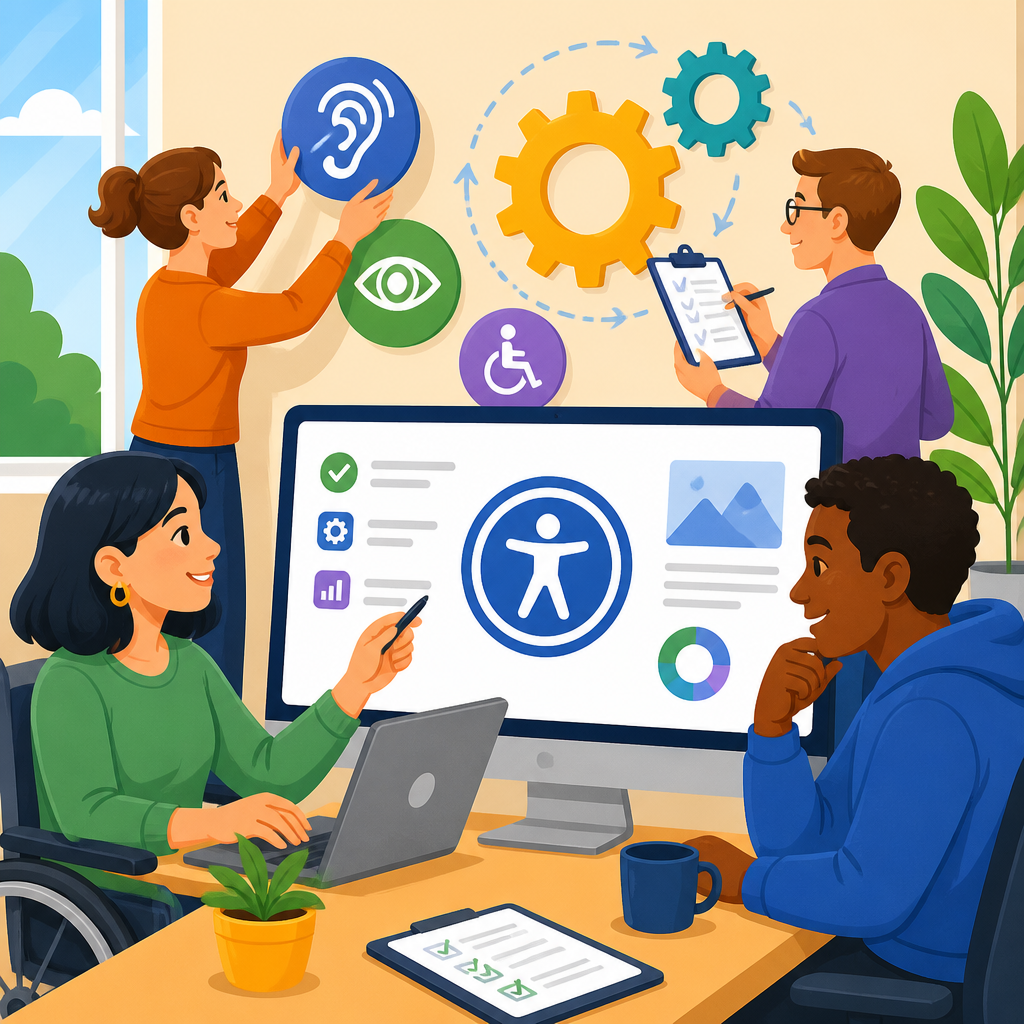
Accessibility statements used to be treated as static website notices, often copied from a template, posted in a footer, and forgotten until a complaint arrived. That approach no longer works. Across digital products, public websites, mobile apps, kiosks, PDFs, procurement portals, and software platforms, accessibility statements are becoming operational documents that reflect how an organization actually manages accessibility day to day. In practical terms, an operational accessibility statement is not only a declaration of intent. It is a current, evidence-based summary of standards followed, testing performed, known limitations, reporting channels, remediation timelines, and governance ownership.
This shift matters because the legal, technical, and business environment has changed. ADA developments in technology and accessibility have expanded the number of touchpoints where disabled users interact with organizations, while enforcement expectations have grown sharper. At the same time, standards such as WCAG 2.1 and WCAG 2.2, procurement requirements tied to Section 508, and European rules including the European Accessibility Act have pushed teams to document accessibility as an ongoing operational function rather than a one-time compliance project. I have seen this change firsthand in audits and remediation programs: the strongest statements now resemble service documentation, not marketing copy. They connect policy to practice, and they give users a clear path to get help when something fails.
As a hub for ADA developments in technology and accessibility, this article explains why accessibility statements are becoming more operational, what changed in law and technology, what a modern statement should include, and how organizations can use statements to support governance, risk management, and user trust across their broader accessibility program.
Why the role of the accessibility statement has changed
An accessibility statement has traditionally answered one simple question: does this organization care about accessibility? Today, users, regulators, procurement teams, and plaintiff attorneys ask a harder question: how is accessibility being managed right now? That is the central reason the document has become operational.
Several forces are driving the shift. First, digital ecosystems are far more complex than they were even five years ago. A typical enterprise experience may include a CMS-driven website, third-party widgets, customer portals, embedded video players, account creation flows, live chat, downloadable documents, native mobile apps, and transactional emails. Accessibility performance depends on multiple teams and vendors. A brief statement saying “we are committed to accessibility” does not explain what standard is used, how issues are found, or who resolves them.
Second, accessibility has moved from a specialist concern into mainstream operational risk. Organizations now track privacy, cybersecurity, AI governance, and accessibility in parallel because each affects legal exposure, brand trust, and customer experience. In mature programs, the accessibility statement functions like a public-facing control summary. It signals whether the organization has testing cadences, defined escalation paths, and remediation ownership.
Third, user expectations are clearer. Disabled users do not just want a promise; they want actionable information. Can they request an accessible PDF? Is there a phone number if checkout breaks with a screen reader? Are captions available for recent webinars? An operational statement answers these questions directly, reducing friction and demonstrating accountability.
How ADA developments in technology and accessibility raised the stakes
The ADA predates the modern web, but its application to digital experiences has become one of the most important accessibility developments in the United States. Courts, settlements, and Department of Justice positions have steadily reinforced the expectation that websites and apps should be accessible when they function as gateways to goods, services, education, employment, or civic participation. Even where legal theories vary by jurisdiction, the practical direction is consistent: inaccessible digital experiences create real risk.
Technology developments increased that risk because digital services now mediate essential tasks. Healthcare intake forms, online banking, telehealth platforms, job applications, classroom portals, and travel bookings all rely on interfaces that must work with screen readers, keyboard navigation, voice input, zoom, captions, and sufficient contrast. When a critical function fails, the issue is not cosmetic. It blocks access to the service itself.
Modern accessibility statements increasingly reference recognized standards because organizations need a common benchmark. WCAG is the dominant technical framework in web and app accessibility, and many statements now identify the specific conformance target, such as WCAG 2.1 AA or WCAG 2.2 AA. That specificity matters. It tells users and procurement reviewers what standard guides design, development, testing, and remediation. It also helps internal teams align release criteria, defect severity rules, and vendor requirements.
The rise of AI-powered interfaces adds another layer. Chatbots, automated image generation, personalization engines, and dynamic content systems can introduce new accessibility barriers if they produce unlabeled controls, misleading alt text, or inconsistent reading order. Because these features evolve quickly, the accessibility statement can no longer be a static annual artifact. It has to reflect changing product realities.
What makes an accessibility statement operational
An operational accessibility statement is grounded in evidence and linked to process. In my experience, the strongest statements share several traits: they identify the digital properties covered, name the standards used, summarize testing methods, acknowledge known limitations, provide a response channel, and indicate how quickly issues are reviewed. They are also date-stamped and maintained by a named function, usually digital accessibility, compliance, product operations, or a cross-functional governance group.
Just as important, they avoid absolute claims. Saying a site is “fully accessible” is risky and often inaccurate, especially in large environments with frequent content changes and third-party dependencies. Better language explains the organization’s objective, current level of conformance, and active remediation efforts. That balance is more credible and more useful.
| Statement element | Why it matters operationally | Example of strong practice |
|---|---|---|
| Scope | Defines which websites, apps, documents, and services are covered | Lists the main domain, portal, and mobile apps by name |
| Standard | Sets the technical benchmark for design and testing | States WCAG 2.2 Level AA as the current target |
| Assessment method | Shows whether claims are based on real evaluation | Mentions automated scans, manual keyboard testing, and screen reader review |
| Known limitations | Provides transparency and helps users plan alternatives | Notes legacy PDFs awaiting remediation and offers accessible versions on request |
| Feedback channel | Creates a route for issue reporting and accommodation requests | Includes email, phone, and form options with response expectations |
| Maintenance date | Indicates whether the information is current | Shows last review date and update cadence |
These elements transform the statement from a symbolic page into a public extension of the accessibility management system. They also create internal discipline. Once response times, standards, and known issues are public, teams must maintain them.
From legal disclaimer to governance tool
Many organizations first created accessibility statements to reduce legal exposure. Ironically, the statements that work best today are not defensive disclaimers. They are governance tools. They create a bridge between public commitments and internal controls.
For example, a university with dozens of decentralized web properties may use its statement to define systemwide expectations: all new pages must meet WCAG 2.2 AA, high-priority transactional paths receive quarterly manual audits, and reported barriers are triaged through a central service desk. A hospital network may explain how patient forms, appointment tools, and telehealth platforms are assessed, while providing an alternate contact route for immediate assistance. A retailer may disclose that certain third-party marketplace components are under remediation and provide customer service support for inaccessible checkout blockers.
In each case, the statement supports governance by clarifying ownership. Someone must approve the language, validate the testing summary, and monitor incoming reports. That usually requires coordination among legal, product, engineering, design, content, procurement, support, and compliance teams. The statement becomes a forcing function for operational maturity because vague ownership quickly breaks down when real users start reporting real barriers.
This is especially important in enterprise procurement. Buyers increasingly ask vendors for VPATs, audit summaries, remediation roadmaps, and public accessibility commitments. A detailed, current statement helps procurement teams evaluate whether accessibility is embedded in operations or handled reactively.
Technology changes that require continuous updates
Accessibility statements are becoming more operational because digital environments now change continuously. Agile releases, design system updates, content publishing workflows, and third-party integrations can all alter accessibility status week to week. A statement written once a year cannot keep pace with this release reality.
Consider a financial services site that adds biometric login to its mobile app, an identity verification vendor to onboarding, and AI-generated help content to support pages. Each change introduces accessibility questions. Does biometric setup have clear labels and alternatives? Is the identity flow keyboard accessible? Are support articles structured correctly for assistive technology? If the statement claims conformance without reflecting these moving parts, it becomes less trustworthy over time.
Operational statements therefore depend on operational inputs. Teams need issue tracking, severity classification, retesting protocols, and change management links. Common tooling includes axe DevTools for developer testing, WAVE for page evaluation, Accessibility Insights for guided assessment, Jira for remediation tickets, and design system documentation that maps components to accessibility requirements. None of these tools alone proves accessibility, but together they support a living process that the statement can summarize accurately.
The same principle applies to documents and multimedia. Organizations now know that inaccessible PDFs, webinar recordings without captions, and social media videos without transcripts can trigger complaints just as readily as website barriers. A strong statement reflects this expanded content reality.
What users and regulators expect to see now
Users and regulators expect specificity, timeliness, and functional support. Specificity means the statement should identify the standard used, the kinds of testing performed, and the communication channels available for assistance. Timeliness means the page should show when it was last reviewed and should not describe long-finished remediation as current work. Functional support means reported issues should reach people who can actually investigate and resolve them.
The Department of Justice has repeatedly emphasized that businesses and public entities should ensure effective communication and equal access, and settlement patterns consistently reward documented accessibility programs. In practical review work, I have seen the same pattern: when an organization can show assessments, training, procurement controls, and responsive issue handling, it is in a far better position than one relying on a generic footer statement.
Users also notice tone. The most effective statements are direct, respectful, and solution oriented. They do not shift blame to assistive technology or browsers. They explain available alternatives without forcing disabled users into inferior channels whenever a digital option should have worked. That distinction matters. Offering a phone number may be necessary as a temporary support path, but it is not a substitute for fixing a broken accessible workflow.
How this hub connects the broader subtopic
As a sub-pillar hub for Updates and Developments, this page sits at the center of several related articles on ADA developments in technology and accessibility. The operational accessibility statement touches nearly every related issue: website compliance trends, mobile app accessibility, document remediation, third-party vendor management, design systems, accessibility overlays, AI interface risks, higher education obligations, healthcare communication access, and procurement due diligence.
That is why the topic deserves hub treatment. Accessibility statements condense signals from all of those domains into one public document. If a company struggles with PDFs, its statement should address document access. If it relies on a chatbot, the statement should reflect how that feature is tested. If its mobile app roadmap is ahead of its website remediation, the statement should distinguish between properties rather than blur them together.
In other words, the statement is becoming a status page for the organization’s accessibility operations. It is not the whole program, but it reveals whether a program exists, whether it is current, and whether leadership is willing to be transparent about progress and limitations.
Accessibility statements are becoming more operational because digital accessibility itself has become operational. The old model treated accessibility as a policy sentence and a legal precaution. The current model treats it as an ongoing discipline shaped by standards, engineering practices, content workflows, vendor oversight, and real user feedback. That change reflects the broader direction of ADA developments in technology and accessibility: digital access is now part of core service delivery, not an optional enhancement.
For organizations, the practical lesson is clear. A strong accessibility statement should be current, specific, evidence based, and connected to internal ownership. It should name the standards followed, define the properties covered, explain how accessibility is assessed, acknowledge known limitations honestly, and provide responsive contact paths for help and remediation requests. When those elements are present, the statement supports trust, improves governance, and reduces the gap between public promise and user experience.
If you manage a website, app, portal, or digital service, review your accessibility statement as an operational asset, not a footer formality. Update it to match how your teams actually test, fix, and support accessibility today, then use it as the hub that connects every part of your broader accessibility program.
Frequently Asked Questions
Why are accessibility statements becoming more operational instead of staying as simple legal notices?
Accessibility statements are becoming more operational because organizations can no longer treat accessibility as a one-time publishing task or a passive compliance message. In the past, many statements were little more than generic website notices placed in a footer and rarely reviewed again unless a complaint surfaced. That model breaks down when accessibility obligations extend across websites, mobile applications, digital documents, self-service kiosks, procurement systems, customer portals, and internal software. A static statement does not reflect the reality of how accessibility is maintained, monitored, escalated, and improved across these environments.
An operational accessibility statement works differently. It explains how accessibility is handled in practice, including who owns it, how users can report barriers, what response process exists, how testing is performed, what standards are being used, and how known issues are managed. This makes the statement a living part of governance rather than a decorative disclaimer. It also helps align legal, product, design, engineering, procurement, and support teams around a shared public commitment. In that sense, the statement becomes evidence of an accessibility program in motion, not just a promise that may or may not be backed by real activity.
What makes an accessibility statement “operational” in practical terms?
An operational accessibility statement is one that accurately reflects the organization’s day-to-day accessibility practices and can be maintained as those practices evolve. Practically speaking, that means the statement is tied to actual internal processes rather than copied from a generic template. It typically identifies the relevant digital properties it covers, the accessibility standards or benchmarks being used, the methods used to evaluate accessibility, and the channels people can use to request help or report problems. It also makes clear what users should expect after they contact the organization, such as response timelines, escalation options, or alternative access arrangements.
Operational statements are also grounded in ownership and accountability. Someone is responsible for updating them, validating their accuracy, and coordinating with the teams that manage accessibility testing, remediation, customer support, and compliance. If the organization supports multiple products or platforms, the statement may distinguish between them instead of pretending everything is at the same level of accessibility maturity. This is important because credibility matters. A statement that openly explains current efforts, known limitations, and planned improvements is often more useful and defensible than one that makes broad claims with no operational backing.
Another practical feature is regular review. Because digital products change constantly, accessibility statements need update triggers tied to releases, audits, procurement changes, policy reviews, or feedback trends. In other words, an operational statement is maintained like other important business documentation: intentionally, collaboratively, and with enough structure that it stays aligned with reality.
What information should organizations include in an operational accessibility statement?
A strong operational accessibility statement should provide enough detail to help users understand both the organization’s commitment and the practical support available to them. At a minimum, it should identify the scope of the statement by clarifying which websites, apps, documents, portals, or services it covers. It should also reference the accessibility standard or framework the organization is using, such as WCAG, and explain the level of conformance being pursued or assessed. This gives the statement a measurable foundation instead of relying on vague language about caring deeply about accessibility.
It should also describe how accessibility is managed in practice. That can include information about testing methods, use of automated tools and manual reviews, involvement of accessibility specialists, user feedback channels, and integration of accessibility into design and development workflows. If there are known limitations, they should be described honestly and specifically enough to be useful. Users generally benefit more from a transparent explanation of current barriers and workarounds than from an unrealistic claim that everything is fully accessible at all times.
Equally important is the support and response section. The statement should explain how someone can report an issue, request accessible materials, or ask for assistance using a product or service. It should include relevant contact methods, such as email, phone, or support form options, and ideally indicate expected response times. If there is an escalation route or formal complaint path, that should be included as well. Finally, the statement should show signs of maintenance, such as a review date, update date, or ownership function. These details signal that the document is active, current, and part of a real accessibility program.
How do operational accessibility statements help with compliance, risk management, and user trust?
Operational accessibility statements help with compliance because they connect public-facing commitments to internal processes that can be demonstrated and improved. Regulators, customers, procurement teams, and legal stakeholders increasingly want to see more than broad statements of intent. They want evidence that accessibility is being governed, measured, and addressed through repeatable processes. A statement that explains standards, testing approaches, support channels, and remediation practices helps show that accessibility is being managed as an ongoing obligation rather than treated as an afterthought.
From a risk management perspective, operational statements reduce exposure by setting up clear pathways for issue reporting and response. When users encounter barriers, a well-designed statement gives them a practical way to get help quickly. That can prevent frustration from escalating into formal complaints, lost business, or reputational damage. It also helps the organization capture useful data about recurring barriers, response performance, and high-risk areas across products and services. Over time, that feedback can inform prioritization, budgeting, vendor oversight, and product planning.
Trust is another major benefit. Users can usually tell the difference between a generic statement and one that reflects genuine operational maturity. A transparent, specific, well-maintained statement signals that the organization takes accessibility seriously and is prepared to engage with users when barriers arise. That trust matters not only for disabled users, but also for enterprise buyers, public sector clients, advocacy groups, and partners evaluating whether accessibility commitments are credible. In many cases, the statement becomes a visible marker of organizational seriousness and accountability.
How often should an accessibility statement be updated, and who should be responsible for it?
An accessibility statement should be updated whenever the underlying accessibility reality changes in a meaningful way. That can happen after major website redesigns, mobile app releases, accessibility audits, remediation projects, vendor changes, policy updates, complaint trends, or expansion into new digital channels such as kiosks or procurement platforms. Many organizations also benefit from a scheduled review cycle, such as quarterly, biannually, or at minimum annually, to confirm that the statement still matches current practices, support contacts, and known issues. A statement that is technically published but operationally stale can create confusion and undermine credibility.
Responsibility should never sit with one isolated person who is expected to guess what is happening across the organization. The best model is shared ownership with clear accountability. Typically, one function, such as digital accessibility, compliance, legal, digital governance, or customer experience, acts as the formal owner of the statement. That owner should coordinate with product teams, engineering, design, QA, procurement, document owners, and customer support to keep the content accurate. If the organization has separate digital properties with different accessibility profiles, it may need multiple statements or a structured statement framework rather than one generic page covering everything vaguely.
In mature programs, the statement is treated like a controlled operational asset. It has a named owner, a review schedule, defined update triggers, and a process for verifying that contact channels, support commitments, and coverage details remain accurate. That structure matters because the quality of the statement depends on operational discipline behind it. When ownership is clear and review is built into governance, the statement becomes a reliable reflection of how accessibility is actually being managed every day.


