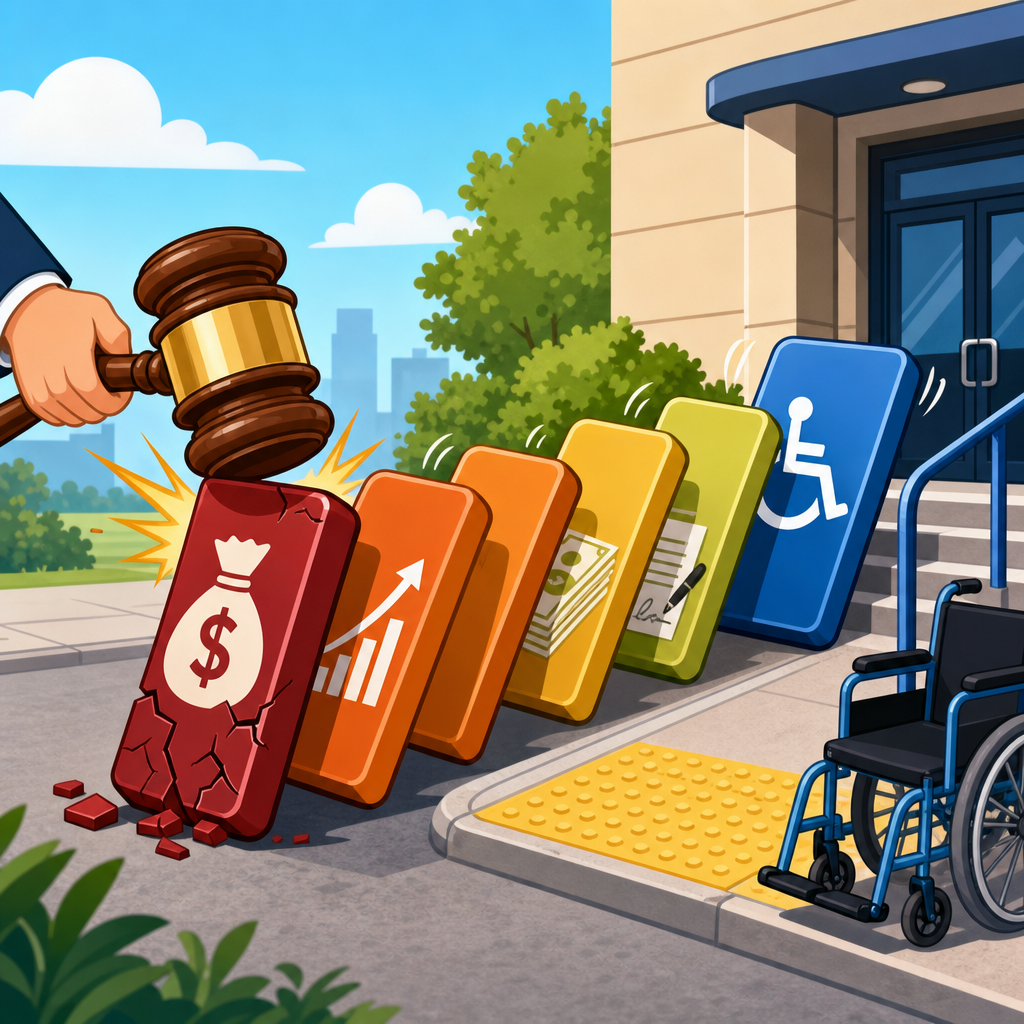
When state law damages claims increase ADA exposure, the stakes of a website accessibility dispute change immediately. A complaint that might have been limited to injunctive relief under the Americans with Disabilities Act can become a far more expensive case once a plaintiff adds claims under state or local statutes that permit monetary damages, statutory penalties, attorneys’ fees, or all three. For businesses that operate consumer websites, mobile apps, retail stores, healthcare portals, or online reservation systems, understanding this overlap is now essential risk management rather than a niche legal issue.
The ADA is the federal baseline. Title III generally prohibits disability discrimination in places of public accommodation and, in digital accessibility cases, is often used to demand that a business remove barriers and bring its website or app into conformance with recognized accessibility standards. The key point many business owners miss is that federal law does not exist in isolation. State and local lawsuits often travel with an ADA claim, and those companion claims can materially increase litigation value, settlement pressure, and defense costs.
In practice, I have seen the same alleged accessibility barrier produce very different litigation outcomes depending on jurisdiction. A claim filed in one state may focus on remediation timelines and policy changes. The same factual pattern in another state may trigger statutory damages per visit, per denial of access, or per transaction, creating immediate leverage for plaintiffs’ counsel. That difference affects early case assessment, insurance notice, budgeting, vendor remediation priorities, and board-level reporting.
This hub article explains how state and local lawsuits expand ADA exposure, which legal theories commonly appear alongside federal claims, how courts and plaintiffs frame damages, and what businesses should do before a demand letter arrives. It also serves as a foundation for deeper articles within the broader legal and technological frontiers of accessibility compliance, including venue trends, recurring plaintiff strategies, remediation evidence, and the relationship between technical standards and litigation defensibility.
Why state and local laws change the economics of ADA litigation
The most important practical distinction is remedy structure. In many Title III cases, the plaintiff seeks injunctive relief, declaratory relief, and attorneys’ fees. Even without direct damages, those cases can be costly. However, when a complaint adds a state statute that authorizes monetary recovery, the economics shift. Plaintiffs gain a clearer damages narrative, defendants face greater settlement risk, and the cost of litigating motions or standing issues may exceed the cost of resolving the case early.
California is the clearest example because plaintiffs frequently pair ADA claims with the Unruh Civil Rights Act and, in some matters, the Disabled Persons Act. The Unruh Act has been central to accessibility litigation because it can support statutory damages, commonly cited at a minimum of $4,000 per violation, plus attorneys’ fees in qualifying cases. That number changes executive attention quickly. New York cases often rely on the New York State Human Rights Law and the New York City Human Rights Law, which create their own exposure profile. Other states and municipalities use consumer protection statutes, disability rights laws, or public accommodation provisions to pursue money damages where federal law alone would not.
That is why state and local lawsuits matter beyond pure doctrine. They influence forum selection, class allegations, settlement brackets, and even whether a plaintiff’s firm sends a pre-suit demand or files immediately. They also shape the evidence a defendant needs. Once damages are in play, questions about notice, prior audits, user complaints, vendor contracts, and remediation timing become more important because they may affect willfulness arguments, credibility, and fee petitions.
Common state and local claims that accompany ADA allegations
Most accessibility complaints do not rely on one theory. They are layered pleadings designed to survive dismissal and maximize leverage. The federal ADA count usually sets the non-discrimination framework, while state or local counts add remedies or broader definitions. Plaintiffs commonly allege denial of full and equal enjoyment, failure to provide effective communication, inaccessible digital interfaces, or barriers that deterred access. In digital matters, they may point to screen reader incompatibility, missing form labels, low color contrast, keyboard traps, inaccessible PDFs, or checkout flows that cannot be completed without a mouse.
Businesses should understand that local laws can be even more plaintiff-friendly than state statutes. City human rights ordinances may define public accommodations broadly, interpret disability protections expansively, and allow compensatory damages or civil penalties. Plaintiffs’ lawyers know these differences well and draft around them. A retailer with a national website may therefore face exposure not only where it is headquartered, but where the user encountered the alleged barrier and where the relevant local statute offers favorable remedies.
| Jurisdiction pattern | Typical companion claim | Why exposure increases |
|---|---|---|
| California accessibility suit | Unruh Civil Rights Act | Statutory damages and attorneys’ fees can raise settlement value sharply |
| New York accessibility suit | State or city human rights law | Broader remedial schemes may support compensatory relief and strong fee claims |
| Consumer transaction dispute | State consumer protection statute | Plaintiffs may frame inaccessible checkout or pricing flows as deceptive or exclusionary |
| Public-facing service complaint | State disability access law | Independent rights of action can exist apart from federal injunctive theories |
The legal labels differ, but the pattern is consistent: state and local lawsuits increase ADA exposure by adding money, procedural leverage, or broader liability theories. That is why a complaint review should never stop at the federal count. The real risk often sits in the companion causes of action.
How damages theories are framed in accessibility cases
Plaintiffs do not need a complex damages model to create pressure. In statutory-damages jurisdictions, the argument can be straightforward: the plaintiff encountered an inaccessible website or app, was denied equal access, and is entitled to a prescribed amount. The next fight is usually over what constitutes a violation. Is it one visit, one transaction, one occasion, or a series of separate encounters? Those questions matter because multiplication changes valuation fast.
In jurisdictions allowing compensatory damages, plaintiffs may allege frustration, humiliation, wasted time, inability to complete a purchase, loss of independence, or the need to seek assistance from another person. Some complaints add deterrence allegations, asserting that the plaintiff intends to use the service but is dissuaded by known barriers. Courts analyze these theories differently, but they are common and should be anticipated.
Attorneys’ fees are another major driver. Even where direct damages are modest, fee-shifting can produce significant exposure. If a defendant delays remediation, litigates weak technical arguments, or lacks documentation showing prompt good-faith efforts, the fee tail can exceed the underlying damages number. I have seen relatively small accessibility defects become expensive because the organization had no centralized process for preserving audit reports, accessibility tickets, or release notes demonstrating active remediation.
For digital properties, damages disputes also intersect with technical standards. Plaintiffs often anchor allegations to WCAG 2.1 AA or, increasingly, WCAG 2.2 AA as a practical benchmark, even though not every statute expressly codifies those versions. Defendants should be careful here. Arguing that no statute explicitly names a standard does not eliminate exposure if the site still contains obvious barriers and the plaintiff can describe them concretely.
Industries and fact patterns with the highest state-law risk
Some businesses face elevated exposure because their user journeys generate frequent transactions, urgent access needs, or repeated customer interactions. E-commerce is an obvious example. An inaccessible product page, cart, or payment form can affect many users and create a record of attempted transactions. Hospitality is another high-risk sector because reservation systems, room descriptions, booking engines, and third-party integrations have been recurring targets. Healthcare providers face additional sensitivity because patient portals, intake forms, telehealth tools, and prescription workflows can implicate both access and effective communication concerns.
Education, financial services, restaurants, and grocery delivery platforms also attract claims. In each category, the same legal principle applies: when a digital barrier blocks a core service, plaintiffs can frame the issue as denial of equal access rather than a minor technical defect. State and local lawsuits amplify that framing by attaching damages to routine consumer interactions.
Physical and digital access issues often appear together. A retailer may be sued over both parking or path-of-travel barriers and an inaccessible website. A hotel may face allegations about room booking accessibility online and features of the property itself. These combined cases are especially important for hub-level analysis because they show how accessibility risk is no longer siloed. Compliance teams need legal, facilities, product, procurement, and engineering functions working from the same playbook.
Defenses, limitations, and common misconceptions
Not every accessibility lawsuit is meritorious, and not every alleged defect supports damages. Standing remains a critical threshold issue in federal court, particularly where the plaintiff cannot plausibly allege intent to return, actual deterrence, or a concrete failed interaction. Mootness can also matter if remediation is completed thoroughly and documented well, though courts scrutinize whether fixes are durable and comprehensive rather than temporary patches.
Businesses sometimes assume a plugin, widget, or overlay solves the problem. It does not. Overlays rarely remediate underlying code defects such as missing semantic structure, inaccessible modals, broken focus order, unlabeled form controls, or noncompliant custom components. Courts and plaintiffs are familiar with this. A better approach is a documented accessibility program: manual audits, automated scanning, issue prioritization, engineering remediation, regression testing, and governance tied to product releases.
Another misconception is that a demand letter can be ignored because the site is being redesigned. Redesigns often take months, while litigation deadlines arrive quickly. Moreover, redesigns can introduce fresh defects if accessibility acceptance criteria are absent. The stronger position is to preserve evidence, notify counsel and insurers where appropriate, initiate targeted remediation immediately, and evaluate state-law exposure based on the plaintiff’s location, filing venue, and asserted companion statutes.
What a defensible compliance and response program looks like
The most effective way to reduce state and local lawsuit exposure is to treat accessibility as an operational discipline. Start with a credible standard, usually WCAG 2.1 AA at minimum and increasingly WCAG 2.2 AA for new work. Then build controls around that standard. In mature programs, every new feature receives design review, keyboard testing, screen reader testing, color contrast review, captioning review where applicable, and defect tracking in Jira, Azure DevOps, or a similar system. Procurement contracts require third-party vendors to meet accessibility obligations and cooperate in remediation.
Documentation matters as much as code. If challenged, you want dated audit reports, remediation tickets, release notes, accessibility statements, training records, and escalation procedures. Named tools can help, including axe DevTools, WAVE, ARC Toolkit, Lighthouse, NVDA, JAWS, VoiceOver, and TalkBack, but tools alone are insufficient. Manual testing by experienced practitioners remains indispensable because many serious barriers involve workflow logic, focus management, error handling, or screen reader announcements that scanners miss.
From a litigation-readiness standpoint, companies should map their properties, owners, and vendors. Many organizations do not know how many microsites, PDFs, campaign pages, or embedded booking tools they operate until after a complaint arrives. That lack of inventory slows remediation and weakens declarations. A practical response plan identifies decision-makers, outside counsel, internal engineering leads, and a process for triaging issues by severity and user impact.
How this hub supports broader state and local lawsuit strategy
As a hub within legal and technological frontiers, this page sets the framework for understanding why state and local lawsuits are now central to ADA exposure analysis. The deeper articles connected to this subtopic should examine specific statutes, venue trends, serial plaintiff activity, pre-suit demand practices, remediation evidence, and digital accessibility standards in greater detail. Businesses need that layered view because risk is created at the intersection of law, product design, content publishing, and procurement.
The central takeaway is simple. Federal ADA claims are only the starting point. State law damages claims, local human rights provisions, and companion consumer statutes often determine the true value of the case. Organizations that understand this early can budget realistically, prioritize the right fixes, and avoid false comfort from superficial compliance measures.
If you manage a website, app, or customer-facing platform, review your exposure now. Identify the jurisdictions that matter most, audit the user journeys that generate revenue or provide essential services, and build a documented remediation program before a complaint tests your preparation. That work reduces legal risk, improves usability, and puts the business in a stronger position whether the next issue arrives as a customer complaint, a demand letter, or a filed lawsuit.
Frequently Asked Questions
How do state law damages claims increase exposure in an ADA website accessibility case?
State law damages claims can dramatically change the value and urgency of an ADA accessibility dispute because the federal ADA often focuses on injunctive relief, while state and local laws may allow a plaintiff to seek money damages, statutory penalties, attorneys’ fees, costs, or multiple forms of relief at once. In practical terms, that means a case involving an allegedly inaccessible website, mobile app, patient portal, online reservation system, or digital checkout process may no longer be about simply fixing barriers. It may become a higher-stakes financial dispute with broader settlement pressure from the start.
This matters because a business that might otherwise view remediation as the primary issue must suddenly evaluate litigation exposure in dollars, not just compliance obligations. In some jurisdictions, a plaintiff may pair an ADA claim with consumer protection statutes, disability rights laws, unfair business practice claims, or local ordinances that create independent remedies. That combination can increase the number of claims asserted, expand the available recovery, and make a complaint more expensive to defend even before liability is decided.
State law also affects leverage. Plaintiffs and their counsel often assess whether local statutes provide a path to recover monetary relief that is unavailable or limited under federal law alone. If the answer is yes, the lawsuit may carry more settlement value, especially where the alleged barriers affected repeated visits, transactions, reservations, purchases, or access to important services such as healthcare, banking, education, or retail. For businesses, the key takeaway is simple: once damages-based state claims are added, ADA exposure is no longer just a compliance question. It becomes a risk management, litigation strategy, and financial forecasting issue.
What kinds of businesses are most at risk when state damages statutes are added to ADA accessibility claims?
Businesses with public-facing digital platforms are especially vulnerable, particularly those that rely on websites or mobile apps for customer interaction, account access, reservations, purchases, scheduling, communication, or delivery of core services. Retailers, restaurants, hotels, healthcare providers, e-commerce companies, financial institutions, universities, landlords, entertainment venues, and multi-location consumer brands often face elevated risk because their digital assets are central to how customers engage with the business. If those systems include accessibility barriers, plaintiffs may argue that the barriers affect many users across many touchpoints.
Healthcare and financial services organizations can face particularly sensitive exposure because inaccessible portals may interfere with access to records, appointments, billing, account information, and legally significant communications. Hospitality businesses may be targeted where online booking features are inaccessible. Retail and e-commerce businesses may face claims involving product browsing, cart functionality, payment forms, promotional offers, loyalty features, or customer service tools. In each of these settings, the plaintiff may allege not just inconvenience, but denial of equal access to a commercial service.
Companies operating in multiple states should be especially cautious because their exposure may vary significantly depending on where they do business, where the plaintiff is located, and which state or local laws are pleaded. A business may have a nationwide website but face heightened litigation risk in jurisdictions with disability statutes that allow damages or fee shifting. Even businesses with brick-and-mortar operations only in one region can face digital accessibility claims if their online services are available more broadly. The more important the website or app is to the customer journey, the more seriously a business should treat the possibility that state law remedies could amplify ADA exposure.
What types of remedies can plaintiffs seek under state or local laws beyond the federal ADA?
Depending on the jurisdiction, plaintiffs may seek several categories of relief beyond what is typically available under the federal ADA. These can include actual damages, statutory damages, civil penalties, reimbursement of litigation costs, and attorneys’ fees. Some laws may also support claims for declaratory relief, restitution, or remedies tied to unfair competition or consumer protection theories. The availability of these remedies can make a major difference in how a case is valued and defended.
Statutory damages are especially important because they may not require the same proof of financial loss that would be necessary for a traditional damages claim. In some states, a plaintiff may argue that each qualifying incident, visit, transaction, or encounter with an accessibility barrier gives rise to a recoverable amount. Whether that argument succeeds depends on the law and facts, but even the allegation can increase pressure. Attorneys’ fees are another powerful driver because they can raise the cost of litigation substantially and influence settlement strategy early in the case.
In addition, plaintiffs may use state statutes to broaden the factual narrative. Instead of alleging only that a website was inaccessible under general accessibility principles, they may claim the inaccessibility denied full and equal enjoyment, constituted discriminatory business conduct, or violated consumer-facing legal obligations. That broader framing can make the dispute more complex and more expensive. For businesses, understanding the available remedies in the relevant jurisdiction is critical because the legal landscape often determines whether the matter is a routine remediation dispute or a potentially costly damages case.
How should a business respond if it receives an accessibility demand letter or lawsuit that includes state law damages claims?
The first step is to treat the matter seriously and move quickly. A business should preserve relevant records, route the claim to legal counsel familiar with ADA and accessibility litigation, and assess insurance notice obligations if applicable. It is also important to identify exactly which digital properties are involved, such as the main website, mobile app, third-party booking tool, payment platform, portal, kiosk interface, or embedded service. Many cases become more difficult because organizations initially investigate too narrowly and later discover the alleged barriers extend across multiple systems.
At the same time, the business should begin a privileged accessibility assessment with qualified internal and external stakeholders. That typically includes legal counsel, IT, development teams, product owners, UX personnel, compliance leaders, and, where appropriate, an independent accessibility consultant. The goal is to understand what barriers are alleged, whether they can be replicated, how severe they are, whether they affect core user flows, and how quickly they can be remediated. Prompt remediation does not erase all past exposure, especially where damages claims are asserted, but it can meaningfully improve litigation posture and reduce ongoing risk.
Businesses should also avoid common mistakes, such as sending informal responses without legal review, making broad admissions about noncompliance, assuming that a quick plugin or overlay resolves the issue, or focusing only on the homepage while ignoring account creation, forms, checkout, search, video content, PDFs, or app functionality. A strategic response usually combines legal analysis, technical investigation, documentation, and a realistic settlement evaluation. When state law damages claims are in play, the right response is not merely to fix the site eventually. It is to manage exposure immediately, remediate intelligently, and create a defensible record of action.
What can companies do proactively to reduce the risk that state law damages claims will increase ADA exposure?
The most effective strategy is to build accessibility into governance, design, development, procurement, testing, and maintenance rather than treating it as a one-time legal project. That means adopting a formal digital accessibility policy, assigning responsibility to specific leaders, training relevant teams, and using recognized technical standards as the basis for implementation and auditing. Businesses should evaluate not only their primary website, but also mobile apps, account portals, reservation systems, embedded widgets, PDFs, videos, chat tools, and any third-party services that users must access to complete important tasks.
Regular testing is essential. Automated scans can help identify recurring technical issues, but they are not enough on their own. Strong programs also include manual testing, keyboard-only review, screen reader evaluation, testing of major user journeys, and periodic reassessment after redesigns, content updates, platform migrations, or vendor changes. Documenting these efforts matters. If a dispute arises, evidence that the business has an active accessibility program, a remediation roadmap, and ongoing monitoring can be valuable in showing good-faith efforts and narrowing issues.
Vendor management is another major part of risk reduction. Many accessibility claims involve third-party tools that businesses integrate into their customer experience. Contracts, procurement checklists, accessibility representations, indemnity provisions, and testing requirements can all help reduce risk before a problem reaches litigation. Finally, companies should monitor where they operate and where they face customer-facing legal exposure, because state and local remedies differ significantly. A proactive accessibility program will not guarantee that a business avoids claims, but it can reduce the likelihood of serious barriers, improve response speed, and lessen the chance that a state law damages claim turns an ADA dispute into a much more expensive case.


