Deferred maintenance is usually discussed as a facilities issue, a budgeting headache, or a sign of aging infrastructure, but it also becomes an accessibility problem when worn systems, postponed repairs, and outdated equipment limit safe, equitable use of a building. In practice, I have seen organizations treat accessibility as a separate compliance line item while roofs, elevators, door operators, wayfinding signs, restrooms, and parking surfaces quietly deteriorate. That separation is a mistake. Accessibility depends on reliable building performance. If an automatic door fails intermittently, if tactile signage is missing after a renovation, or if a lift is constantly out of service, disabled users do not experience a minor maintenance lapse; they experience exclusion.
Deferred maintenance means delaying planned repairs or replacement beyond the point when work should reasonably occur. Accessibility, in this context, means whether people with mobility, sensory, cognitive, or other disabilities can approach, enter, use, and exit a facility with comparable independence and dignity. Budgeting, prioritization, and governance are the management systems that determine whether those conditions improve or degrade over time. This matters because accessibility obligations are ongoing. Under the Americans with Disabilities Act, Section 504 in covered programs, the Fair Housing Act in applicable residential settings, and related state codes, organizations cannot rely on good intentions if physical barriers remain in use day after day.
The core issue is not only whether a building met code when it opened. The real test is whether accessible elements are maintained in operable working condition, whether capital plans account for barrier removal, and whether leadership has a governance process for deciding what gets fixed first. This article serves as the hub for budgeting, prioritization, and governance within compliance and implementation. It explains how deferred maintenance creates accessibility risk, how to evaluate competing needs, what standards and tools support decisions, and how to build a repeatable process that connects facility condition, legal exposure, user impact, and funding strategy.
How deferred maintenance turns into an accessibility barrier
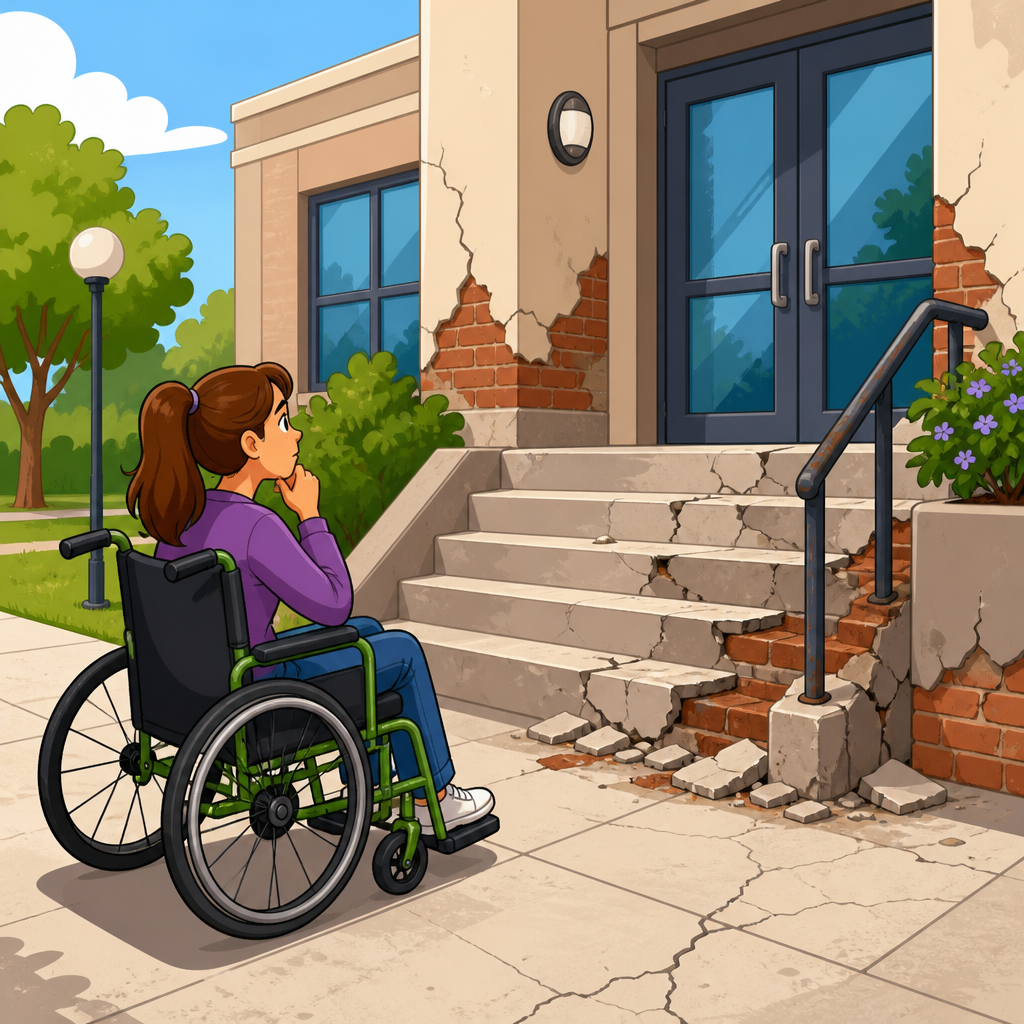
Deferred maintenance becomes an accessibility barrier when postponed work affects the features people with disabilities depend on to access a site or service. Common examples include cracked accessible parking routes, slopes that exceed permitted tolerances after settlement, heavy doors with failed closers, inoperable platform lifts, peeling high-contrast markings on stair nosings, broken audible pedestrian signals, and restrooms where grab bars or accessible hardware are loose or missing. None of these failures looks dramatic on a spreadsheet, yet each one can make a facility effectively unusable for some visitors or employees.
Maintenance-related barriers often emerge gradually. A paved route may start with minor heaving from tree roots, then become a tripping hazard, then force a wheelchair user into vehicle traffic. An elevator that is frequently reset but not modernized creates recurring service interruptions. Lighting levels can decline as fixtures age, affecting people with low vision and increasing fall risk. Signage can become inconsistent after small projects completed by different contractors. Because these conditions develop over months or years, organizations normalize them. They become “known issues” rather than urgent access failures.
There is also a hidden operational pattern: when maintenance backlogs grow, staff rely on workarounds. Someone props open a heavy door, escorts visitors through a service entrance, or posts a phone number asking users to request assistance. Those workarounds may seem practical, but they rarely provide equal access. They depend on staffing, break down after hours, and can compromise privacy or dignity. In audits I have supported, the presence of a workaround is often the clearest sign that the organization already understands there is an accessibility failure and has chosen to manage the symptom instead of correcting the cause.
What laws, standards, and policies require from owners and operators
Accessibility compliance is not limited to new construction. The ADA Standards for Accessible Design require accessible features to be maintained in operable working condition, except for isolated or temporary interruptions due to maintenance or repairs. That distinction matters. A door operator that is down for a day while a part is replaced may qualify as a temporary interruption. A lift that is out of service repeatedly for months because replacement was never budgeted does not. Similar expectations appear in program accessibility requirements, local building codes, housing rules, school guidance, health care accreditation practices, and internal risk management policies.
Owners and operators should distinguish among several categories of work. Code-triggered alterations may require upgrades to the altered path of travel. Barrier removal obligations may apply where removal is readily achievable or otherwise required by program rules. Maintenance obligations apply even when no major renovation is planned. That means a facility cannot avoid responsibility by saying, “We are waiting for the next capital project.” If the accessible route is deteriorating now, the maintenance obligation exists now.
Recognized tools help translate legal expectations into facility action. The 2010 ADA Standards, ICC A117.1 technical criteria used in many codes, the U.S. Access Board’s guidance, ASTM references for walking surfaces, and manufacturer specifications for door force, lift servicing, and emergency communication devices all provide measurable benchmarks. Governance improves when organizations define which standard governs each asset class, who verifies compliance, and how exceptions are escalated.
Budgeting for accessibility within maintenance and capital planning
The most effective accessibility budgets do not isolate disability-related work in a small special fund. They integrate accessibility into preventive maintenance, corrective maintenance, renewal forecasting, and capital improvement planning. When I review portfolios with persistent barriers, the root problem is usually budgeting structure. Door automation is funded only through capital requests, signage through departmental operating budgets, restroom repairs through reactive work orders, and site circulation through grounds contracts. No one sees the full access pathway, so small failures accumulate across multiple cost centers.
A better model starts with asset inventories tied to accessible functions. Instead of listing only “automatic operator, east entrance,” classify it as part of the primary accessible entrance. Instead of listing “elevator cab controls,” classify them within vertical access continuity. This framing changes prioritization because the asset is evaluated by its user impact, not just replacement age. Lifecycle costing also matters. Replacing a failing operator before repeated emergency service calls often costs less over five years than patching it while users encounter outages.
Contingency funding is essential. Accessibility failures rarely appear on a clean annual cycle. Weather damage, vandalism, supply chain delays, and hidden conditions uncovered during repairs can all affect accessible elements. Mature organizations therefore reserve a defined portion of facilities budgets for urgent accessibility corrections, separate from general contingency, so teams are not forced to choose between a roof leak and an unusable accessible restroom stall with no approved funding path.
How to prioritize projects when every need looks urgent
Prioritization should be based on consequence, not volume of complaints or the visibility of a defect. The right question is not “What is most broken?” but “Which condition most restricts safe, independent, equitable use?” A failed accessible entrance typically outranks cosmetic finishes. An unreliable elevator in the only public vertical route typically outranks office-area repairs. A noncompliant curb ramp serving the main visitor path may outrank parking lot resurfacing elsewhere, even if the paving distress is broader in square footage.
Use a scoring model that combines user impact, legal exposure, safety risk, service criticality, repair complexity, and time sensitivity. User impact measures who is affected and whether there is a comparable alternative. Legal exposure considers whether the element is part of a required accessible route, a reasonable accommodation commitment, or a previously identified barrier with documented notice. Safety risk captures falls, entrapment, and emergency egress concerns. Service criticality asks whether the barrier blocks access to a core function such as classrooms, patient care, housing, voting, or public services.
| Priority factor | What to assess | Example |
|---|---|---|
| User impact | How many people are affected and whether independent use is lost | Main entrance operator fails, requiring staff assistance |
| Legal exposure | Whether the barrier affects a required accessible feature or prior commitment | Only accessible restroom on a floor is out of service |
| Safety risk | Likelihood of injury, entrapment, or blocked emergency function | Uneven accessible route creates wheelchair tip hazard |
| Service criticality | Impact on core programs, housing, health care, education, or civic access | Lift failure blocks access to public meeting room |
| Cost efficiency | Whether early action avoids larger replacement or claim costs | Replacing door hardware before frame damage spreads |
Documenting this scoring method creates governance discipline. It reduces ad hoc decision-making and gives finance teams a defensible rationale for why one project moved ahead of another. It also supports communication with disabled users and advocacy groups because the organization can explain the criteria, timeline, and interim measures clearly.
Governance: who decides, who verifies, and who is accountable
Accessibility problems persist when governance is vague. Facilities may assume compliance belongs to legal, legal may assume facilities knows the standards, and program leaders may focus only on service delivery. Effective governance assigns ownership at three levels. First, an executive sponsor sets policy, approves funding thresholds, and receives regular reporting. Second, an operational lead coordinates inventories, inspections, work orders, and project delivery. Third, technical reviewers verify standards, inspect completed work, and confirm that temporary measures do not become permanent substitutes.
A practical governance framework includes a barrier reporting channel, response time targets, a risk-ranking method, approval authority for urgent corrections, and a closeout process that documents what was fixed. It also requires procurement controls. Many accessibility failures enter the backlog because low-bid replacements ignore technical compatibility. For example, a contractor may install hardware that technically fits a door but increases opening force, interferes with clear width, or places controls outside reach ranges. Standard specifications, approved product lists, and post-installation verification prevent those avoidable regressions.
Cross-functional review is particularly important in portfolios with many small projects. Tenant improvements, security upgrades, IT installations, and finish refreshes can all affect accessibility. I have seen card readers mounted too high after security projects and furniture layouts block turning space after occupancy changes. Governance should therefore require accessibility review at design, procurement, construction, and turnover, not just after complaints.
Building an implementation roadmap that survives real-world constraints
A credible roadmap balances immediate corrections with long-term capital planning. Start with a baseline assessment of accessible routes, entrances, vertical circulation, restrooms, signage, alarms, assembly areas, service counters, parking, and digital interfaces tied to physical use, such as kiosks or intercoms. Then categorize findings into immediate operational fixes, near-term repairs, scheduled renewals, and major capital projects. This prevents every issue from being treated the same way.
Immediate operational fixes are low-cost actions that restore function quickly: adjusting closers, repainting markings, replacing missing signage, repairing call buttons, or removing storage from required clearances. Near-term repairs address active failures needing funded work orders within the current budget year. Scheduled renewals align accessibility-sensitive assets with lifecycle replacement plans, such as restroom modernization or elevator controls. Major capital projects cover site regrading, entrance reconstruction, or full circulation redesign where piecemeal repair will not solve the underlying problem.
Interim measures should be specific and temporary. If one accessible parking area is closed during repairs, the alternate route, signage, and communication plan must be in place before closure. If an elevator outage is unavoidable, staff procedures, temporary relocation of services, and public notice should be defined in advance. The goal is continuity of access, not merely notice of disruption. Organizations that plan these steps early avoid the common failure of announcing barriers after users have already arrived on site.
Metrics, audits, and communication that keep the program working
What gets measured gets funded. The strongest programs track more than backlog dollar value. They monitor accessible asset uptime, average days to correct high-priority barriers, percentage of work orders closed with verification, repeat failure rates, complaint volume by asset type, and capital spending allocated to access-related renewal. These metrics reveal whether the organization is fixing root causes or simply cycling through the same failures. For example, repeated service calls on one entrance operator usually signal misapplication, environmental exposure, or end-of-life condition, not bad luck.
Periodic audits are also necessary because not all barriers generate complaints. Many users simply stop coming, use another entrance, or rely on others. Annual or semiannual reviews of high-risk elements catch silent failures before they become claims. Include disabled employees, students, residents, patients, or visitors where possible. Their observations often identify issues that checklists miss, such as confusing acoustics at service counters, poor contrast on temporary signs, or the practical difficulty of navigating a route during rain, snow, or crowding.
Communication closes the loop. Publish how to report barriers, acknowledge reports promptly, and explain what will happen next. Internally, give finance, operations, and leadership a dashboard that links conditions to user impact and compliance risk. Externally, provide timely updates on closures, alternate access, and repair schedules. Clear communication does not replace correction, but it builds trust and reduces the perception that barriers are being ignored.
Deferred maintenance becomes an accessibility problem when organizations allow essential access features to age, fail, or drift out of compliance without a disciplined response. The solution is not a one-time audit or a separate accessibility wish list. It is a management system that connects legal obligations, asset condition, user impact, budget structure, project prioritization, and executive accountability. When those pieces work together, accessibility is protected not only during new construction, but throughout the life of the facility.
The main benefit of this approach is practical and measurable: fewer barriers, fewer service interruptions, lower long-term cost, and better access for employees, visitors, residents, patients, and customers. Start by identifying the accessible elements most critical to daily use, assign ownership, score risks consistently, and fund the highest-impact corrections first. Then build those rules into maintenance, capital planning, procurement, and reporting so access is sustained instead of rediscovered after each failure.
If this article is your entry point into budgeting, prioritization, and governance, use it as the hub for your next steps: review your backlog through an accessibility lens, map decision rights, and create a funded implementation roadmap that keeps compliance operational every day.
Frequently Asked Questions
How does deferred maintenance turn into an accessibility problem?
Deferred maintenance becomes an accessibility problem when building systems and site features that people rely on for safe, independent use are allowed to deteriorate past the point of reliable performance. Accessibility is not limited to whether a building once met a code standard or passed an inspection years ago. It is an ongoing operational condition. A power door operator that works intermittently, an elevator with frequent outages, a cracked accessible parking aisle, a restroom grab bar that has loosened over time, or wayfinding signage that has faded into illegibility can all create real barriers even if the original installation was technically compliant.
The reason this matters so much is that accessibility depends on consistency. A route that is accessible only some of the time is not meaningfully accessible for a person who needs it every time. When organizations treat deferred maintenance as a general facilities issue and accessibility as a separate compliance category, they miss how closely the two are connected. Roof leaks can damage flooring and create slip hazards. Settlement can affect door clearances and thresholds. Poor lighting maintenance can make navigation harder for people with low vision. Worn hardware can increase opening force or make controls difficult to operate. In other words, neglect in ordinary maintenance often shows up first as unequal access.
From a risk and service standpoint, this is where deferred maintenance becomes more than an inconvenience. It can limit participation, compromise dignity, reduce safety, and expose an organization to complaints or legal scrutiny. More importantly, it undermines the idea that a building is intended to serve everyone equitably. That is why accessibility should be built into maintenance planning, not treated as a separate issue to revisit only during renovations or formal audits.
What building components most commonly create accessibility barriers when maintenance is postponed?
Some of the most common problem areas are the ones people use every day and therefore wear down gradually enough that the decline feels normal until it becomes a serious barrier. Elevators are a major example. Frequent shutdowns, inaccurate leveling, delayed door timing, failed audible signals, or unreliable call buttons can make vertical circulation inaccessible very quickly. Automatic door operators are another frequent issue. When sensors drift out of calibration, openers fail intermittently, or push plates stop responding consistently, people who cannot easily open manual doors are left without dependable entry.
Restrooms are also high-risk areas for deferred maintenance. Loose grab bars, broken dispensers, damaged lavatory insulation, malfunctioning flush controls, and doors that no longer close or latch properly can all affect usability. Accessible parking and exterior routes are equally important. Faded striping, settled pavement, ponding water, snow and ice management failures, and crumbling curb ramps can make arrival difficult or dangerous. Inside the building, worn flooring, curled mats, poor lighting, damaged handrails, and out-of-service lifts are common examples of routine maintenance failures with direct accessibility consequences.
Wayfinding and communication features are often overlooked as well. Missing room signs, burned-out illuminated exit markers, inaudible announcements, malfunctioning visual notification devices, and outdated directories can all interfere with equitable use. The important point is that accessibility does not depend on one feature alone. It depends on a chain of maintained conditions working together: parking, path of travel, entrances, doors, restrooms, signage, lighting, and vertical access. If any one of those links degrades enough, people can be effectively excluded even when the building appears functional to others.
Why is it a mistake to separate accessibility from regular maintenance and capital planning?
Separating accessibility from maintenance and capital planning is a mistake because it frames access as a one-time compliance achievement instead of a day-to-day operational responsibility. Buildings do not stay accessible automatically. They remain accessible only when the systems that support access are inspected, repaired, replaced, and funded with the same seriousness given to life safety, mechanical reliability, and general upkeep. When accessibility is isolated as a special project or reserved only for major renovations, organizations tend to miss the cumulative impact of minor failures that affect real users immediately.
In practical terms, this separation often leads to poor prioritization. A facilities team may log recurring issues with doors, elevators, signage, lighting, or parking surfaces, but if those issues are not recognized as accessibility concerns, they may be deferred repeatedly in favor of projects seen as more urgent or more visible. Over time, the building may drift into a condition where access is technically present on paper but unreliable in practice. That gap between documentation and lived experience is where many accessibility failures occur.
Integrating accessibility into maintenance and capital planning produces better decisions. It helps organizations identify which routine repairs have the greatest equity impact, rank deferred work based on how it affects independent use, and avoid creating larger compliance and service problems later. It also encourages a more realistic budget strategy. Replacing a failing operator, repairing route surfaces, or refreshing tactile signage at the right time is usually more effective and less disruptive than waiting until complaints mount or a major renovation is required. Accessibility works best when it is treated as part of asset stewardship, not as a side file or last-minute correction.
What are the risks for organizations that ignore accessibility-related deferred maintenance?
The risks are operational, reputational, financial, and legal. Operationally, ignored accessibility-related maintenance can prevent people from using the building safely and independently. That can affect employees, tenants, students, patients, customers, and visitors in direct ways, from missed appointments to delayed services to unsafe navigation conditions. A broken elevator, an unreliable entry system, or a deteriorated path of travel can interrupt normal building use just as seriously as a mechanical outage, especially for people who have no equivalent alternative route.
Reputationally, these failures send a clear message about who was considered in the care of the facility. People notice when basic access features are chronically out of service, poorly maintained, or treated as optional. That can erode trust quickly, especially when an organization publicly emphasizes inclusion but does not support it through building operations. In many settings, a visible pattern of neglect can also affect staff morale and public confidence.
Financial and legal risks follow closely behind. Deferred maintenance usually becomes more expensive over time because small issues spread into larger failures. An uneven accessible route can become a trip hazard claim. An ignored door operator issue can require full replacement instead of a modest repair. Repeated elevator outages can trigger emergency response costs and service disruptions. Depending on the jurisdiction and building type, organizations may also face complaints, enforcement actions, settlement costs, or mandated corrective work if inaccessible conditions persist. The broader lesson is simple: treating accessibility-related maintenance as deferrable often creates higher costs and greater exposure than addressing it early and systematically.
What is the best way to identify and prioritize deferred maintenance that affects accessibility?
The best approach is to evaluate accessibility as a lived user journey rather than as a checklist of isolated features. Start with the full path people take: arrival, parking or drop-off, exterior route, entrance, interior circulation, restrooms, service counters, meeting spaces, vertical access, and exits. Then assess each element for reliability, not just presence. An accessible parking space that floods, a compliant restroom with a broken accessory, or a door with an opener that works only part of the time should all be flagged as meaningful access failures.
From there, organizations should combine routine inspections, maintenance records, user feedback, and capital planning data into one prioritization process. Work orders can reveal recurring trouble spots. Complaint logs can show where building performance is failing actual users. Staff who interact with the public often know which features are unreliable long before leadership does. Formal accessibility reviews are useful, but they are most effective when paired with operating data and field observation. This creates a more accurate picture of which deferred items are actively limiting equitable use.
Prioritization should focus first on barriers that affect safety, entry, primary circulation, restroom access, and access to core services. In most facilities, that means giving immediate attention to elevators, automatic doors, route surfaces, lighting, handrails, signage, and restroom functionality. The next step is to embed those priorities into preventive maintenance schedules and capital reserve planning so the same failures do not keep returning. The strongest programs also assign clear ownership, define response times for accessibility-critical repairs, and track downtime for essential access features. When organizations do this well, accessibility stops being a reactive compliance topic and becomes part of how the building is responsibly operated every day.