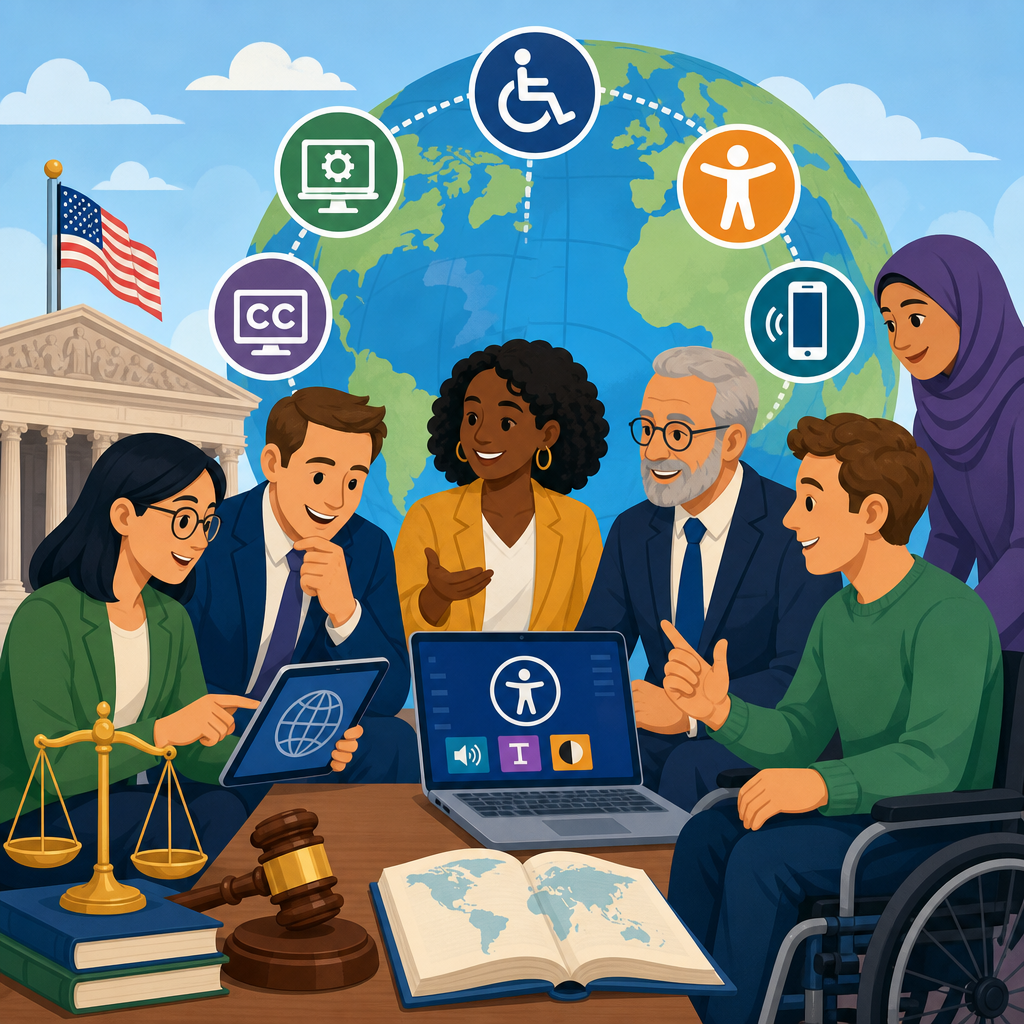
What U.S. courts might learn from international digital accessibility policy is not a narrow procedural question. It reaches into civil rights law, web design standards, procurement rules, platform governance, and the practical realities of how disabled people use digital services every day. Digital accessibility means designing websites, apps, documents, kiosks, and online workflows so people with visual, auditory, motor, cognitive, speech, and multiple disabilities can use them effectively. Disability rights policy, in this context, means the legal duties, enforcement systems, technical standards, and institutional habits that make accessibility either routine or optional.
I have worked on accessibility reviews where a single unlabeled form field prevented a blind user from applying for housing, and where a missing caption track made public health guidance unusable for deaf viewers. Those failures were not abstract compliance issues. They blocked access to essential services. That is why this topic matters to courts. When judges decide whether digital barriers violate disability law, they are deciding whether equal participation keeps pace with how modern life is actually delivered.
This hub page examines the future of global accessibility and disability rights through an international lens, with a focus on what U.S. courts can draw from other jurisdictions. Across Europe, Canada, Australia, the United Kingdom, and parts of Latin America and Asia, policymakers have moved beyond the old debate over whether digital spaces count as public accommodations or public services. Many systems now assume they do. The harder questions concern scope, technical baselines, timing, remedies, and accountability. Those are the areas where comparative analysis is most valuable.
For U.S. readers, the immediate legal backdrop includes the Americans with Disabilities Act, Section 504 of the Rehabilitation Act, Section 508 for federal technology, and a growing body of state laws and settlement practice. Yet litigation has often turned on threshold disputes: whether a website must connect to a physical place, whether a mobile app is covered, whether standards such as the Web Content Accessibility Guidelines should be treated as persuasive or controlling, and what businesses must do when technology changes faster than regulations. International policy offers tested answers to each of those questions.
This article serves as a hub for the broader subtopic, The Future of Global Accessibility and Disability Rights. It maps the major policy models, explains how technical standards became legal benchmarks, highlights enforcement strategies that produce better outcomes, and identifies emerging issues that courts will increasingly confront, from AI interfaces to cross-border digital platforms. The central lesson is straightforward: the most effective systems treat accessibility as an ongoing design obligation backed by clear standards, not as a one-time lawsuit defense.
Why international accessibility policy matters to U.S. courts
U.S. courts do not import foreign law into domestic disability cases, but comparative policy still matters. Judges routinely look for persuasive reasoning when statutes are broad, technology evolves quickly, and agency rules do not answer every practical question. Digital accessibility law presents exactly that situation. The ADA was enacted in 1990, before ecommerce, app stores, streaming media, and cloud software became essential gateways to work, education, health care, and civic participation. International frameworks show how rights-based systems have adapted those older equality principles to newer digital realities without losing legal clarity.
A key global reference point is the United Nations Convention on the Rights of Persons with Disabilities. The convention frames accessibility as a precondition to independent living, education, employment, political participation, and access to information. Even where the convention is not directly enforceable in domestic courts, it has influenced legislation, regulatory guidance, and judicial reasoning worldwide. The important shift is conceptual: inaccessible technology is treated as discrimination because it excludes people from systems that society has made essential. That framing can help U.S. courts move beyond technical debates and focus on functional exclusion.
International policy also demonstrates that legal certainty improves when governments specify recognized standards. In practice, the most common benchmark is WCAG, developed by the World Wide Web Consortium. Versions 2.0, 2.1, and increasingly 2.2 organize accessibility around principles that content be perceivable, operable, understandable, and robust. Courts benefit when standards are concrete. A caption is either present or absent. Keyboard focus is either visible or not. Error identification either helps a user complete a form or leaves them stranded. These are manageable facts for adjudication.
How other jurisdictions solve the coverage problem
One persistent U.S. issue is whether disability law clearly covers websites and apps independent of any physical location. Other jurisdictions have addressed that directly. The European Union’s Web Accessibility Directive covers public sector websites and mobile applications, while the European Accessibility Act extends accessibility obligations to important private sector products and services, including ecommerce, banking, transport information, and certain communications services. The legal premise is not that digital tools are accessories to physical spaces. It is that they are service environments in their own right.
The United Kingdom has taken a similarly functional approach. Public sector bodies must meet accessibility requirements for websites and mobile apps, publish accessibility statements, and explain exceptions. That statement requirement seems modest, but in practice it changes behavior. Teams must document known issues, remediation plans, and contact routes, which creates a record of accountability before litigation begins. I have seen organizations improve faster when they know they will need to describe barriers publicly in plain language rather than bury them in an audit spreadsheet.
Canada offers another useful model. The Accessible Canada Act and related provincial regimes, including Ontario’s Accessibility for Ontarians with Disabilities Act, combine broad rights language with phased standards and reporting duties. The result is less time spent arguing over whether digital access counts and more time spent measuring whether access exists. For U.S. courts, the lesson is that coverage disputes can consume enormous judicial energy while doing little to remove barriers. A service-based interpretation aligns better with how users experience digital exclusion.
What clear standards change in litigation and compliance
Courts function best when they can evaluate conduct against defined expectations. International digital accessibility policy often succeeds because it links legal obligations to explicit technical standards while leaving room for updates. That combination reduces ambiguity for organizations and provides judges with a practical yardstick. In my work, the difference is immediate. When a client adopts WCAG 2.1 AA as the operational baseline, product teams can translate legal duty into tickets, acceptance criteria, and regression tests. Without that baseline, accessibility becomes a vague aspiration discussed after launch.
Standards do not solve every problem. WCAG does not automatically address usability for every cognitive disability, and conformance can be undermined by third-party widgets, PDFs, or custom components. Still, clear standards substantially improve outcomes because they make preventable failures visible early. A procurement contract can require accessible document templates, captioned video workflows, semantic heading structures, color contrast thresholds, and keyboard operability. A court then reviews whether the defendant ignored known practices that were widely recognized, feasible, and material to equal access.
| Jurisdiction | Primary digital accessibility approach | Lesson for U.S. courts |
|---|---|---|
| European Union | Public sector mandate plus broader market rules under the European Accessibility Act | Treat digital services as independently covered environments |
| United Kingdom | Mandatory accessibility statements and monitoring for public bodies | Transparency obligations can support evidence and accountability |
| Canada | Rights framework combined with staged standards and reporting | Compliance improves when obligations are measurable and scheduled |
| Australia | Disability discrimination principles applied to web access through enforcement practice | Functional exclusion can establish discrimination without novel theory |
Australia is especially instructive because it demonstrated early that inaccessible websites can violate anti-discrimination law in practical terms. The Maguire v Sydney Organising Committee for the Olympic Games matter remains a landmark because it showed that web barriers were not speculative harms. They prevented blind users from obtaining information and participating in a major public event. U.S. courts can draw a simple principle from that history: if digital design blocks access to information or transactions offered to everyone else, the injury is real, concrete, and legally cognizable.
Enforcement models that produce better accessibility outcomes
Litigation alone rarely creates a mature accessibility culture. The stronger international systems combine private complaints with regulatory monitoring, procurement controls, public reporting, and administrative enforcement. That mix matters because many barriers are systemic, not isolated. If a government agency buys an inaccessible content management system, dozens of departments may reproduce the same failures for years. Procurement rules can stop that chain at the source. Section 508 plays this role in the United States for federal technology, but international practice suggests wider adoption across state and local government would be powerful.
Monitoring is another area where U.S. courts can learn indirectly from policy design abroad. The EU model includes periodic testing and reporting on public sector websites and apps. Monitoring does not eliminate disputes, but it generates evidence about recurring problems such as missing alternative text, inaccessible documents, poor keyboard navigation, and unlabeled form controls. Courts benefit when accessibility is not evaluated only through adversarial snapshots prepared after a complaint. A historical record of audits, issue logs, and remediation plans reveals whether an organization treated accessibility as a serious operational duty.
Remedies also differ in useful ways. Some systems emphasize corrective action plans, deadlines, and institutional accountability rather than only damages or dismissal fights. From a user perspective, the most valuable outcome is often not compensation but access: the ability to complete a job application, refill a prescription, attend a virtual class, or submit a benefits form independently. U.S. courts already use injunctive relief in accessibility cases, but comparative practice supports a more structured approach, requiring governance measures such as policy adoption, training, periodic audits, and executive oversight.
Emerging issues shaping the future of global accessibility and disability rights
The future of global accessibility and disability rights will be shaped by technologies that do not fit old categories neatly. Artificial intelligence can improve accessibility through live captioning, image description, and reading support, but it can also create new barriers. Auto-generated captions still misidentify speakers, technical terms, and accents. AI summaries can omit legally important details. Voice interfaces may fail users with speech disabilities or noisy environments. Courts should resist assuming that innovation is inherently accessible. International policy is moving toward the opposite rule: new systems must prove they preserve equivalent access.
Another major issue is accessibility in platform ecosystems. A retailer may rely on payment processors, embedded maps, chat tools, and user-generated content. A university may use a learning management system, proctoring software, and third-party video tools. Responsibility becomes diffuse, but users experience one combined service. European and Canadian approaches increasingly recognize this reality by assigning obligations across the supply chain, not only at the final interface. That perspective could help U.S. courts assess whether defendants can avoid responsibility by pointing to vendors while still benefiting from inaccessible systems.
Cross-border digital services add pressure for convergence. Multinational companies rarely build entirely separate accessibility architectures for every market. When the EU or another major jurisdiction establishes clear requirements, those rules often shape global product decisions. That means international standards can influence U.S. accessibility in practice even before a domestic appellate court resolves every doctrinal dispute. For organizations, the sensible strategy is to build once to a high standard. For courts, the implication is that accessibility is usually more feasible than defendants claim, because many companies already support it elsewhere.
Practical lessons for judges, lawyers, and institutions
The strongest lesson from international digital accessibility policy is that ambiguity helps nobody. Disabled users face delay, organizations face inconsistent demands, and courts face repetitive threshold litigation. A better approach starts with four principles. First, treat websites, apps, digital documents, and transactional interfaces as covered channels when they deliver goods, services, education, employment, or civic participation. Second, use recognized technical standards as the baseline for evaluating reasonableness and remediation. Third, examine governance evidence, not just isolated defects. Fourth, focus remedies on timely, durable access.
For lawyers, this means building records around user journeys and technical facts. Show how a screen reader interacts with headings, labels, focus order, and error messages. Document whether captions are synchronized, whether PDFs are tagged, whether authentication requires gestures some users cannot perform, and whether customer support offers an equivalent path. For judges, the comparative insight is that accessibility disputes become more manageable when framed as service access cases supported by standards, rather than philosophical debates about whether the internet is a place.
This hub page introduces the core ideas behind The Future of Global Accessibility and Disability Rights: broader coverage, clearer standards, mixed enforcement, supply-chain responsibility, and skepticism toward unsupported claims that accessibility is too difficult or too novel. U.S. courts can learn from international policy without abandoning domestic doctrine. They can interpret existing disability law in ways that reflect current digital life, rely on established standards where appropriate, and prefer remedies that remove barriers systematically. The next step is practical: review your digital services against recognized accessibility standards and treat every barrier as a rights issue that deserves prompt correction.
Frequently Asked Questions
Why would U.S. courts look to international digital accessibility policy at all?
U.S. courts may look to international digital accessibility policy because it offers practical examples of how other legal systems translate broad equality principles into real digital obligations. In many accessibility disputes, the central question is not whether disabled people deserve equal access, but how that access should be defined, measured, implemented, and enforced in online environments. International frameworks can help illuminate those issues. They often show how governments have addressed recurring problems such as inaccessible websites, mobile apps that do not work with screen readers, PDF forms that cannot be completed without a mouse, or self-service kiosks that exclude users with visual, motor, or cognitive disabilities.
Courts in the United States are not bound by foreign law when interpreting domestic statutes like the Americans with Disabilities Act, Section 504, or Section 508. Still, international policy can be persuasive in a broader sense. It can demonstrate that digital accessibility is neither speculative nor technologically unrealistic. It can show that accessibility requirements are already being implemented at scale through procurement systems, technical standards, public-sector mandates, and platform rules in other countries. That matters because one recurring defense in accessibility litigation is that compliance is too vague, too expensive, or too difficult to operationalize. Comparative examples can weaken that argument by showing that structured compliance models already exist and are functioning.
International approaches may also help courts understand digital accessibility as a civil rights issue rather than merely a customer service preference. Many foreign accessibility regimes frame digital inclusion as part of equal participation in education, employment, healthcare, voting, transportation, and government services. That framing can be useful in U.S. cases where judges must decide whether inaccessible digital systems create meaningful barriers to participation. In short, international policy offers context, tested models, and a reminder that accessibility is an ordinary part of digital governance in many jurisdictions, not an extraordinary burden.
What kinds of international accessibility policies are most relevant to U.S. judges?
The most relevant international policies are usually the ones that connect legal rights to concrete technical and administrative standards. A strong example is the use of the Web Content Accessibility Guidelines, or WCAG, in national and regional regulatory systems. While WCAG itself is not a law, many governments around the world adopt it as the benchmark for website and app accessibility. That makes it especially relevant to U.S. judges who are often asked whether there is any workable standard for determining if a digital service is accessible. International policies that formally incorporate WCAG help answer that question with a clear yes.
Another important category is public procurement policy. In many countries, accessibility is built into government purchasing rules for software, digital services, and information technology. That approach is highly instructive because it treats accessibility as something that should be planned at the design and contracting stage, not added later after litigation. U.S. courts examining whether accessibility is feasible may find procurement-based systems persuasive because they show how institutions can normalize accessibility through vendor requirements, testing protocols, and contract enforcement.
Judges may also find value in international human rights frameworks, especially where they emphasize equal access to information, communication, and public life. These frameworks can help explain why digital barriers have legal significance even when the barrier is not physical in the traditional architectural sense. In addition, platform governance rules, mobile accessibility regulations, and enforcement models involving audits, reporting, complaint systems, or regulatory oversight can provide examples of what meaningful compliance looks like beyond a one-time technical fix. The most useful international policies are therefore those that combine rights language, technical standards, implementation mechanisms, and accountability tools.
How could international policy influence the way courts think about web accessibility standards?
International policy could influence judicial thinking by reinforcing the idea that web accessibility standards are not too indefinite to apply in legal disputes. One of the major challenges in U.S. accessibility litigation has been disagreement over what standard should govern digital access. Businesses sometimes argue that there is no clear rule, while plaintiffs often point to WCAG as the most widely recognized benchmark. When courts see that governments across multiple jurisdictions have adopted WCAG or closely related standards in legislation, regulation, or procurement rules, it becomes harder to treat digital accessibility as an area without practical guidance.
International models also show that standards can evolve without making enforcement impossible. Accessibility is not static. Websites change, mobile interfaces update, multimedia formats expand, and assistive technologies continue to develop. Foreign legal systems often address this by tying compliance to recognized technical standards while allowing periodic updates as the standards improve. That is important for U.S. courts because it suggests a way to think about accessibility obligations as durable but adaptable. A legal requirement can be stable in principle while flexible in technical implementation.
Just as important, international policy tends to emphasize usability in real-world conditions, not merely formal compliance checklists. That perspective can help courts focus on whether disabled users can actually complete key tasks such as applying for benefits, booking travel, attending online classes, accessing medical records, reading legal notices, or checking out on an e-commerce site. In other words, the lesson is not simply that a standard exists, but that the purpose of the standard is functional equality. Courts that absorb that lesson may be more inclined to evaluate digital accessibility through the lived experience of users rather than through abstract debates over code alone.
What practical lessons from other countries might improve U.S. accessibility enforcement?
One major lesson is that enforcement works better when accessibility is treated as an ongoing governance obligation rather than a one-off litigation issue. In several international systems, accessibility duties are supported by monitoring requirements, public reporting, designated enforcement bodies, and complaint procedures that do not depend entirely on private lawsuits. That kind of structure can reduce uncertainty for organizations and improve outcomes for users. For U.S. courts, the takeaway is that accessibility becomes more manageable when it is integrated into compliance programs, testing cycles, procurement practices, and organizational accountability rather than addressed only after harm occurs.
A second lesson is the value of proactive design. International policy often encourages or requires accessibility from the start of a digital project. That means including disabled users in testing, using accessible design systems, training developers and content teams, and evaluating third-party software before deployment. Courts could draw from this by recognizing that accessibility is most effective when embedded upstream. This matters in legal analysis because it undermines the notion that accessibility problems are inevitable or exceptionally burdensome. In many cases, they are the predictable result of preventable design and purchasing choices.
A third lesson is that accessibility enforcement should account for the full digital ecosystem. Users do not experience a website, app, downloadable form, chatbot, payment portal, and kiosk as separate legal abstractions. They experience them as one service journey. International policy often reflects that reality by covering multiple digital touchpoints under a single accessibility framework. U.S. courts may find that approach useful, especially in cases where access fails not on the homepage but in a critical workflow like identity verification, appointment scheduling, document submission, or checkout. The broader insight is that meaningful accessibility requires looking beyond surface-level compliance and assessing whether the entire service is actually usable.
Does looking abroad mean U.S. courts should import foreign rules wholesale?
No. Looking abroad does not mean U.S. courts should copy foreign law without regard to American statutes, constitutional structure, or institutional limits. The U.S. legal system has its own sources of authority, and courts must interpret domestic law on its own terms. What international digital accessibility policy can provide is not a substitute for U.S. law, but a comparative reference point. It can help judges evaluate what is technologically feasible, what kinds of standards are administrable, how digital rights can be operationalized, and what successful compliance systems look like in practice.
That distinction matters because comparative insight is most valuable when used carefully. Courts can learn from how other jurisdictions define digital barriers, incorporate technical standards, regulate public-facing services, and create incentives for accessible design. But they still must decide cases based on U.S. legal text, agency guidance, precedent, and factual records. International examples are most useful where domestic law contains broad anti-discrimination principles and the dispute turns on implementation details. In those circumstances, foreign policy experience can help inform reasoning without controlling it.
In practical terms, the best lesson may be methodological rather than doctrinal. U.S. courts can observe that many jurisdictions have moved beyond asking whether digital accessibility matters and have focused instead on how to institutionalize it. That shift encourages a more mature legal conversation: one centered on standards, procurement, testing, remediation timelines, user impact, and accountability. So the point is not to import foreign rules wholesale. It is to recognize that international experience offers credible evidence that digital accessibility can be defined, measured, enforced, and normalized as a routine part of equal access in modern society.