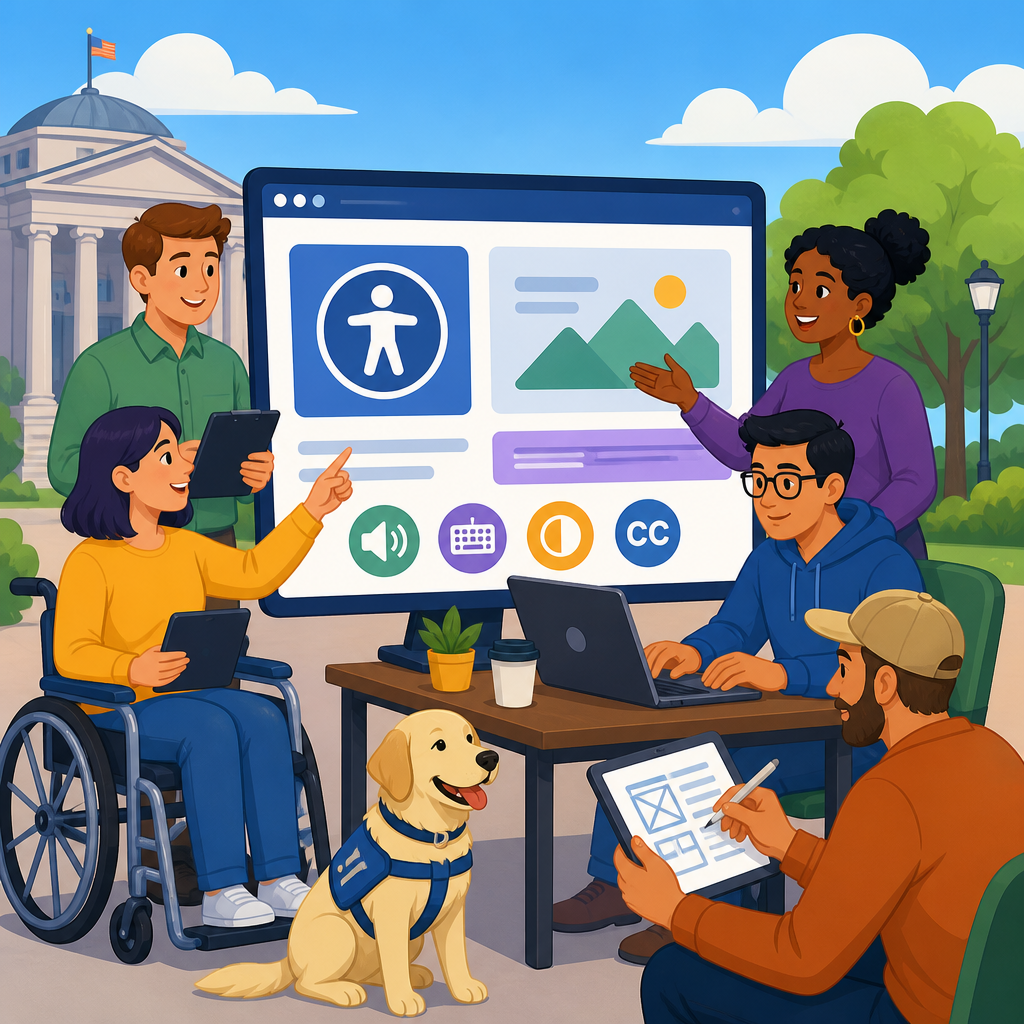
Title II web accessibility now sits at the center of public sector digital compliance, and contractors are increasingly responsible for whether residents can use government websites, mobile apps, online forms, maps, payment portals, and document libraries. Title II of the Americans with Disabilities Act applies to state and local governments and requires equal access to programs, services, and activities. When those services are delivered digitally, accessibility is not optional. Updated federal guidance and the Department of Justice rulemaking have made that expectation far more concrete, especially for agencies that rely on outside vendors to design, host, remediate, or maintain digital services.
In practice, that means municipalities, school districts, transit agencies, public hospitals, and higher education institutions must treat web accessibility as an operational requirement, not a late-stage quality check. I have worked with public entities and their contractors through audits, procurement reviews, and remediation projects, and the biggest failures rarely come from bad intent. They come from unclear contracts, inaccessible third-party platforms, PDFs published without review, and teams assuming the vendor “handles accessibility” without defining what that means. Updated guidance matters because it closes that ambiguity. It clarifies who is covered, what technical standard is expected, and how responsibility extends across procurement, content publishing, and ongoing support.
This article serves as a hub for recent ADA updates and developments affecting Title II web accessibility and contractors. It explains the latest compliance direction, what changed, how timelines work, and what contractors should do differently now. It also frames the broader trend: enforcement is moving away from abstract accessibility principles toward measurable digital requirements tied to recognized standards. For agencies, the consequence is legal and reputational risk. For contractors, it is a delivery, pricing, and governance issue that affects statements of work, acceptance criteria, defect handling, indemnity, and long-term support obligations.
Several key terms shape the discussion. “Title II” covers state and local government entities. “Web accessibility” means digital content and functionality can be used by people with disabilities, including those using screen readers, keyboard navigation, voice input, captions, magnification, or other assistive technology. “Contractors” include developers, SaaS vendors, content managers, document remediation firms, system integrators, and managed service providers. The central technical benchmark in current federal guidance is Web Content Accessibility Guidelines, commonly called WCAG, specifically version 2.1 Level AA for most public-facing digital services. That benchmark gives agencies and vendors a common target for testing and acceptance.
What changed in recent ADA updates for Title II digital accessibility
The most significant recent development is the Department of Justice rule establishing specific accessibility requirements for web content and mobile apps used by state and local governments. Instead of leaving public entities to infer obligations from general nondiscrimination principles, the rule identifies WCAG 2.1 Level AA as the standard for covered digital content and services, with limited exceptions. This is a major shift because it replaces “make it accessible” with a named technical benchmark that can be tested, documented, and enforced.
For contractors, this change affects every phase of delivery. Discovery must identify accessibility requirements up front. Design systems must support color contrast, focus order, keyboard access, error identification, and responsive reflow. Development must account for semantic structure, programmatic labels, form instructions, and compatibility with assistive technologies. Quality assurance can no longer treat accessibility as a best-effort add-on. It must be included in definition of done, user acceptance testing, defect severity, and release readiness. If a vendor supplies a platform used by a city or county, accessibility conformance becomes part of the core product obligation.
The updated direction also matters because it addresses a common misconception: a government entity does not avoid responsibility by outsourcing digital services. If a resident applies for benefits through a third-party portal or accesses course materials through a vendor-hosted system, the public entity still has obligations under Title II. That means agencies are revisiting contracts, procurement questionnaires, and oversight practices. Contractors should expect more detailed accessibility exhibits, VPAT review, code scanning requirements, manual testing expectations, and post-launch remediation timelines than they saw even two years ago.
How contractors fit into compliance responsibility
Contractors are not merely peripheral to compliance; they often control the codebase, content workflow, hosting environment, or software configuration that determines whether accessibility succeeds. In many projects I have reviewed, the public entity owned the policy, but the vendor owned the practical levers: CMS templates, design components, JavaScript widgets, PDF generation, media players, or authentication flows. When those components are inaccessible, a written commitment from the agency does not fix the user experience.
Responsibility usually breaks into three layers. First is product conformance: the platform or custom build must meet the technical standard. Second is implementation quality: configuration, theming, templates, and integrations must not introduce barriers. Third is content governance: uploaded documents, embedded videos, alt text, and form labels must remain accessible after launch. Different contractors may own different layers, which is why finger-pointing is common after complaints. The fix is precise allocation of responsibilities in the contract and a governance model that includes accessibility checkpoints throughout the service lifecycle.
A practical example is a county website running on a commercial content management system. The CMS vendor may provide an accessible editor and template framework, but the implementation partner can still create inaccessible navigation, unlabeled forms, and low-contrast design tokens. Then the county’s communications team may upload scanned PDF agendas that screen readers cannot interpret. Each failure has a different owner, but the resident experiences one inaccessible service. Updated guidance pushes agencies to manage the full chain, and contractors should expect to be evaluated based on how well they support that chain rather than on product claims alone.
WCAG 2.1 AA in real terms: what agencies and vendors must deliver
WCAG 2.1 Level AA is the operative standard because it translates accessibility from policy language into testable requirements. In plain terms, users must be able to perceive content, operate controls, understand interactions, and rely on compatible markup that assistive technology can interpret. Common problem areas include missing text alternatives for images, poor heading structure, keyboard traps, inaccessible modal dialogs, auto-playing media without controls, form errors announced only by color, and PDFs lacking tagged reading order.
For contractors, the standard has immediate implementation consequences. Front-end teams need semantic HTML, ARIA only where native elements are insufficient, visible focus indicators, and predictable interaction patterns. Design teams need color contrast ratios that meet minimum thresholds, scalable text, and layouts that reflow at smaller viewports without loss of content or function. Content teams need captions, transcripts where appropriate, descriptive link text, and consistent headings. Document teams need properly tagged PDFs or accessible alternatives in HTML. Accessibility is not one feature; it is a production discipline spanning design, code, content, QA, and support.
| Area | Typical Barrier | Contractor Action | Useful Validation |
|---|---|---|---|
| Navigation | Menus unusable by keyboard | Build semantic menus and clear focus states | Keyboard-only testing |
| Forms | Missing labels and unclear errors | Associate labels, instructions, and error messages programmatically | Screen reader and form-flow testing |
| Documents | Scanned PDFs with no tags | Remediate PDFs or publish accessible HTML versions | Acrobat accessibility checker plus manual review |
| Media | Videos without captions | Add synchronized captions and accessible player controls | Caption review and keyboard testing |
| Components | Custom widgets lacking roles or states | Use native controls first, then ARIA patterns carefully | Assistive technology compatibility testing |
Procurement, contracts, and vendor oversight after the updated guidance
The fastest way for a public entity to reduce accessibility risk is to change procurement language before a project starts. Agencies should require vendors to disclose accessibility conformance, provide a current VPAT based on the appropriate Accessibility Conformance Report format, identify known issues, and explain remediation practices. They should also require testing methods, including automated scanning and manual review with assistive technology. A VPAT is helpful, but it is not proof of compliance. I treat it as a starting point for diligence, not a substitute for validation.
Contracts should define the standard, scope, acceptance criteria, and remediation obligations in plain language. That includes which digital assets are covered, whether mobile apps are included, how defects are prioritized, how quickly barriers must be fixed, and whether accessibility regressions block release. Strong agreements also address subcontractors, third-party integrations, and content migration. If a booking engine, payment service, mapping widget, or identity provider is integrated into a public-facing service, the contract should state who evaluates it and who fixes resulting issues.
Oversight matters after award. Agencies need recurring testing, not a one-time certification. Contractors should expect periodic scans with tools such as axe DevTools, WAVE, or Siteimprove, along with manual testing using NVDA, JAWS, VoiceOver, keyboard navigation, zoom, and mobile accessibility features. Accessibility bugs should enter the same tracking system as security and functional defects, with named owners and due dates. This is where mature contractors distinguish themselves: they can show design reviews, component inventories, issue logs, and remediation workflows instead of generic assurances.
Common exceptions, limits, and gray areas contractors should understand
Updated accessibility rules are more specific than older guidance, but they do not erase nuance. Some limited exceptions exist for certain archived web content, preexisting conventional electronic documents in narrow circumstances, and third-party content that is not posted because of a contractual, licensing, or other arrangement with the public entity. Contractors should not overread these exceptions. Most content used to deliver current services, communicate with the public, or support participation in government programs should be treated as in scope.
One gray area involves legacy systems that public entities cannot replace quickly. An agency may still face budget, procurement, and operational limits while moving toward compliance. That reality affects timelines and remediation sequencing, but it does not make barriers acceptable indefinitely. In practice, agencies prioritize high-use services, transactional workflows, emergency information, and student or patient-facing systems. Contractors supporting legacy platforms should propose phased remediation plans, accessible workarounds, and replacement roadmaps rather than arguing that old technology makes accessibility impossible.
Another gray area is the difference between technical conformance and usable access. A page can pass many automated checks and still frustrate screen reader or keyboard users if the interaction model is confusing. That is why manual testing and, where feasible, user feedback are essential. Contractors who understand this distinction tend to produce better outcomes. They do not chase scores alone; they test real tasks such as paying a bill, filing a complaint, registering for classes, or downloading meeting minutes in a format people can actually use.
Building a durable compliance program for recent ADA developments
The best response to recent ADA updates and developments is not a one-time remediation sprint. It is a repeatable accessibility program that survives staff turnover, redesigns, and vendor changes. For public entities, that means policy, training, procurement controls, testing cadence, issue tracking, and executive accountability. For contractors, it means accessibility requirements embedded in design systems, component libraries, CI pipelines, QA scripts, and content workflows. Accessibility becomes durable when it is operationalized, measured, and assigned to roles.
A strong program usually starts with an inventory of digital assets: websites, subdomains, mobile apps, PDFs, portals, kiosks, and embedded third-party services. Next comes risk ranking based on transaction volume, essential services, and complaint exposure. Then teams establish a remediation backlog tied to the technical standard and validate fixes with both automated and manual testing. Training follows close behind. Content authors need to understand headings, alt text, tables, and document tagging. Developers need patterns for accessible forms, dialogs, and dynamic updates. Procurement staff need to evaluate vendor claims critically.
This sub-pillar hub connects to the wider landscape of recent ADA updates and developments. Public agencies and contractors should track enforcement activity, DOJ technical materials, evolving procurement practices, accessible document standards, and mobile app obligations because these topics now intersect. The central lesson is simple: Title II web accessibility is no longer a vague aspiration. It is a defined compliance requirement with direct implications for contractors. Review your contracts, test your digital services against WCAG 2.1 AA, fix governance gaps, and make accessibility part of every delivery cycle now.
Frequently Asked Questions
What does Title II require from government contractors working on websites, apps, and other digital services?
Title II of the Americans with Disabilities Act applies directly to state and local governments, but contractors play a critical role because they often design, build, host, maintain, or update the digital tools those governments use to deliver public services. In practical terms, that means a contractor cannot treat accessibility as a secondary feature or a post-launch fix. If a resident uses a city website to pay a bill, complete an application, access public records, review maps, submit a request, or use a mobile app for transit or emergency information, that digital experience must be accessible to people with disabilities.
For contractors, the key compliance takeaway is that accessibility obligations are operational, not merely theoretical. A vendor that develops templates, uploads PDFs, integrates third-party tools, configures online forms, or manages document libraries may directly affect whether the public entity can meet its Title II duties. Updated federal guidance has made clear that digital access is part of equal access to government programs, services, and activities. As a result, contractors should expect accessibility requirements to appear in procurement documents, statements of work, technical specifications, acceptance criteria, and ongoing support obligations.
Contractors should also understand that accessibility extends beyond the visible interface. It includes navigation, keyboard usability, screen reader compatibility, color contrast, captions, transcripts, form labels, error identification, document structure, meaningful link text, alternative text for images, accessible authentication flows, and compatibility with assistive technologies. In short, if a contractor contributes to the public-facing digital experience, that contractor is helping determine whether the government entity is accessible under Title II.
Are contractors legally responsible for accessibility if Title II applies to the government entity rather than the vendor?
Title II places the primary legal obligation on the state or local government, but that does not mean contractors are insulated from responsibility. From a legal, contractual, and operational standpoint, contractors can face serious consequences if their work causes or contributes to noncompliance. Public entities increasingly shift accessibility obligations into vendor contracts through representations, warranties, remediation duties, indemnification provisions, service-level commitments, and testing requirements. That means even when the statute applies to the agency, the contractor may still carry substantial contractual liability.
There is also a practical reality: government clients expect vendors to know how to deliver accessible digital products. A contractor that launches an inaccessible payment portal, posts unusable PDFs, deploys a map that cannot be navigated by keyboard, or installs inaccessible third-party components may trigger complaints, project delays, corrective action demands, reputational harm, and lost future business. In many cases, the contractor becomes the first party the agency turns to when residents encounter barriers.
The safest approach is to treat accessibility as a core deliverable and risk area. Contractors should document conformance goals, define testing methods, maintain remediation workflows, train project teams, and avoid overpromising accessibility without evidence. They should also be cautious about relying on generic accessibility statements from subcontractors or software publishers. If a vendor supplies a product into a Title II environment, that vendor should assume its accessibility practices will be examined closely and should be prepared to demonstrate how accessibility was addressed throughout design, development, procurement, and maintenance.
What kinds of digital content and platforms are covered under Title II accessibility expectations?
Coverage is broad. Title II accessibility expectations reach far beyond a government homepage. They apply to the digital points where residents interact with public programs, services, and activities, including official websites, mobile applications, online forms, scheduling tools, GIS and mapping platforms, payment portals, case-management interfaces, public meeting content, event registration systems, digital kiosks, document repositories, and downloadable files such as PDFs, Word documents, and spreadsheets. If the public uses a digital channel to obtain information or participate in a government function, accessibility should be part of the analysis.
This broad scope matters for contractors because barriers often arise in places teams overlook. A website redesign may be mostly accessible, but embedded vendor widgets, scanned meeting packets, image-based announcements, inaccessible CAPTCHA tools, unlabeled form fields, or poorly structured permit applications can still prevent effective access. Similarly, a mobile app may look polished while remaining unusable for screen reader users or people who rely on text resizing, voice control, or sufficient contrast. Accessibility problems are frequently distributed across content, code, integrations, and workflows rather than confined to one system.
Contractors should therefore evaluate the full digital ecosystem, not just isolated pages or templates. That includes uploaded content, archived materials still in active use, multimedia, transactional pathways, authentication steps, and any third-party service linked into the user journey. A resident does not experience accessibility in silos. If one critical step in applying for housing assistance, paying a utility bill, or finding emergency shelter is inaccessible, access to the underlying government service may be effectively denied. That is why contractors supporting Title II entities need a system-wide accessibility mindset.
How can contractors show that they are meeting updated accessibility guidance in practice?
Demonstrating accessibility requires more than a statement of intent. Contractors should be able to show a repeatable process for building and maintaining accessible digital services. That usually starts with accessibility requirements at the planning stage, including technical standards, content rules, design constraints, user experience expectations, and documented acceptance criteria. Accessibility should be incorporated into wireframes, design systems, component libraries, content templates, procurement reviews, and development workflows rather than deferred until the end of a project.
Testing is equally important. A credible accessibility program typically includes automated scanning, manual expert review, keyboard-only testing, screen reader testing, mobile accessibility checks, document accessibility review, and issue tracking with severity levels and remediation deadlines. Contractors should preserve records of audits, test results, code fixes, retesting, and approvals. If a government client asks how accessibility was validated, the contractor should be ready with evidence, not assumptions.
Strong contractors also build governance around accessibility. That can include assigning internal ownership, training developers and content authors, reviewing third-party integrations before deployment, maintaining accessible document creation procedures, and establishing a process for responding quickly to reported barriers. In addition, vendors should use careful contract language that defines the scope of accessibility work, identifies applicable standards, and sets expectations for maintenance after launch. Updated guidance has increased scrutiny on whether accessibility is ongoing, measurable, and integrated into operations. The best proof of compliance readiness is a mature process backed by documentation and consistent execution.
What are the biggest accessibility risks for contractors supporting public sector clients, and how can they reduce them?
Some of the biggest risks are also the most common: assuming accessibility is limited to homepage design, relying solely on automated tools, ignoring documents and forms, failing to test with assistive technology, deploying inaccessible third-party plugins, and treating remediation as optional maintenance rather than a core service issue. Another major risk is fragmented responsibility. When one team designs interfaces, another uploads content, another manages documents, and an outside vendor provides payment or scheduling functions, accessibility gaps can fall between the cracks. Public sector clients are increasingly aware of this problem, and contractors that cannot coordinate accessibility across teams may face significant exposure.
Document accessibility is an especially frequent weakness. Many agencies continue to publish notices, applications, agendas, reports, and policy materials as PDFs or other files that are not tagged properly, are scanned as images, or lack logical reading order and descriptive headings. Likewise, interactive services such as tax payments, permit submissions, benefits screening, transit tracking, and emergency alerts often contain accessibility barriers because they involve multiple systems and high-volume user interaction. These are exactly the types of services that can generate complaints quickly when access fails.
Contractors can reduce risk by taking several concrete steps: build accessibility into procurement and project scoping; review all user journeys, not just surface pages; establish accessibility checkpoints before launch; require conformance information from subcontractors and platform providers; test documents, maps, forms, and mobile features specifically; maintain a clear remediation plan; and train both technical and content teams. Just as important, contractors should create a process for ongoing monitoring because accessibility can degrade over time as content changes, software updates, and new integrations are added. For public sector work, the most reliable strategy is simple: treat accessibility as an essential performance requirement tied directly to residents’ ability to use government services.


