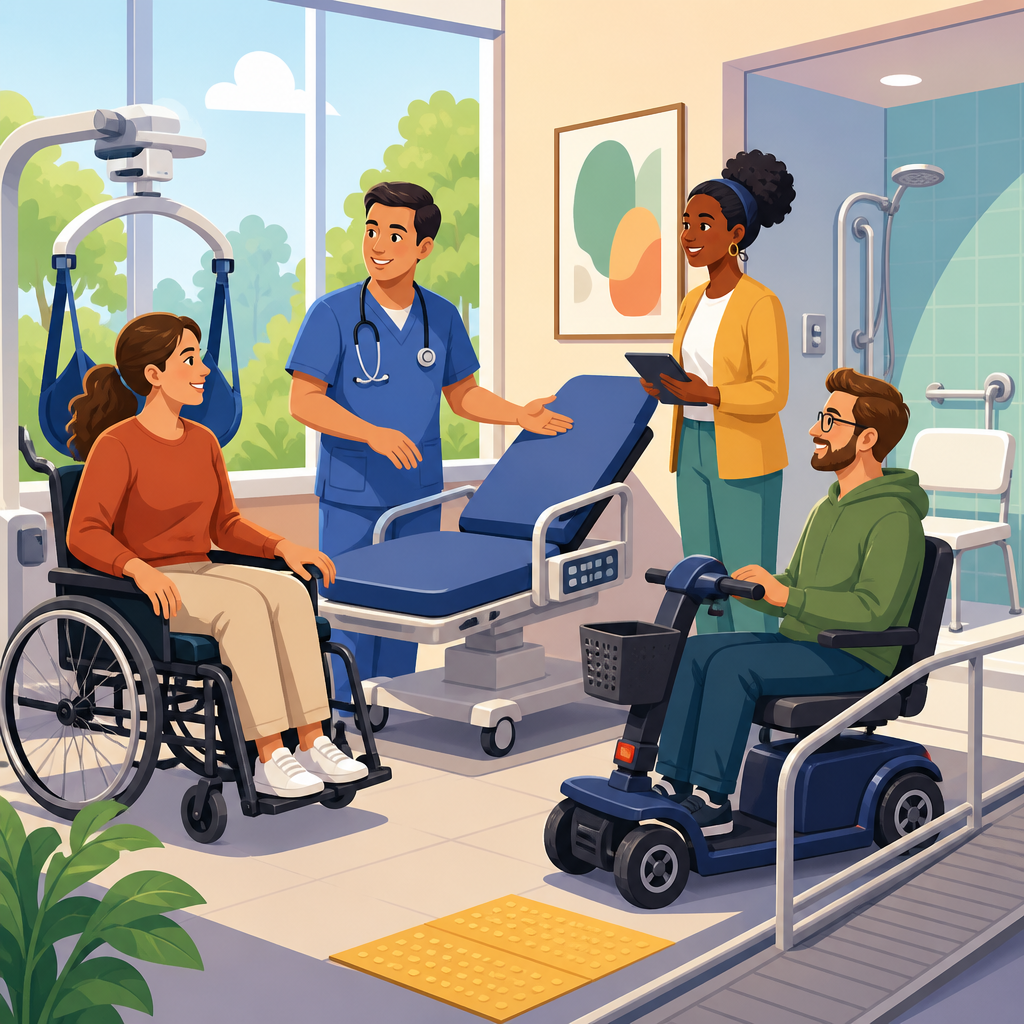
ADA developments in health care equipment accessibility are reshaping how hospitals, clinics, imaging centers, and physician offices deliver care to patients with disabilities. In practical terms, this topic covers the rules, technical standards, enforcement trends, and operational changes that determine whether a patient can get onto an exam table, transfer to a weight scale, position for diagnostic imaging, or communicate effectively during treatment. I have worked with provider organizations reviewing exam rooms and procurement standards, and the pattern is consistent: accessibility gaps are rarely abstract compliance issues. They affect missed screenings, delayed diagnoses, avoidable staff lifting injuries, and patient distrust. That is why recent ADA updates and developments matter far beyond legal departments.
Health care equipment accessibility refers to the design and availability of medical diagnostic and treatment equipment that people with mobility, sensory, dexterity, or communication disabilities can use safely and with comparable ease. Common examples include height-adjustable exam tables, wheelchair-accessible weight scales, accessible mammography positioning, transfer supports, clear floor space, and accessible controls. The legal framework is broader than one rule. The Americans with Disabilities Act applies to public hospitals through Title II and to private health care providers through Title III. Section 504 of the Rehabilitation Act applies to federally funded entities, and Section 1557 of the Affordable Care Act adds nondiscrimination obligations in many clinical settings. Equipment accessibility also intersects with building access, effective communication, staffing policies, procurement, and patient handling protocols.
The current wave of attention comes from several developments. The U.S. Access Board issued Medical Diagnostic Equipment Standards in 2017, creating technical benchmarks for equipment used in examinations, procedures, imaging, and weight measurement. The Department of Justice has continued emphasizing equal access to medical care under the ADA, while the Department of Health and Human Services has strengthened disability nondiscrimination expectations under Section 504 and related health care rules. At the same time, plaintiffs, advocates, accreditors, and risk managers are focusing less on whether a facility has a ramp and more on whether a patient can actually receive the service. For organizations tracking recent ADA updates and developments, health care equipment accessibility has become one of the clearest examples of compliance moving from architectural basics to full care-path accessibility.
What changed in recent ADA developments for health care equipment
The most important shift is that equipment accessibility is no longer treated as optional best practice. Providers have long known that an inaccessible exam table can amount to unequal care, but recent ADA developments and related disability rights actions have pushed organizations to document how they will provide accessible equipment, train staff, and modify policies. The 2017 Medical Diagnostic Equipment Standards, while not self-executing ADA design standards by themselves, gave the industry concrete specifications to work from. Those standards cover transfer surface height, transfer supports, standing supports, stirrups, lift compatibility, wheelchair spaces, and operable parts for several categories of equipment. In plain language, they answer a question providers often asked for years: what does accessible equipment actually look like?
Regulators and enforcement agencies have also become more explicit that manual lifting by staff is not an adequate substitute for accessible equipment in many circumstances. I have seen organizations rely on “we will assist the patient” as their default accommodation, but that approach creates safety risks and can still deny equal access if the patient is not examined in the same way or with the same dignity as others. A patient who cannot be weighed because the office lacks a wheelchair-accessible scale is not receiving equivalent care. A patient who must remain in a wheelchair because the clinic has only fixed-height exam tables may receive a less thorough musculoskeletal or abdominal exam. Recent enforcement logic centers on this functional reality.
Another major development is integration with broader disability nondiscrimination rulemaking. HHS updates under Section 504 and Section 1557 have reinforced obligations in federally funded health programs and entities receiving federal financial assistance. Although the legal source may differ from the ADA, the operational takeaway is the same for many providers: accessible medical equipment, effective communication, and nondiscriminatory policies must be part of routine care delivery. This matters because many health systems operate across mixed funding streams and multiple facility types. They cannot treat accessibility as an isolated facilities issue anymore; it is a governance, procurement, and clinical operations issue.
The standards providers should know and how they apply
Any serious review of ADA developments in health care equipment accessibility should start with the U.S. Access Board’s Medical Diagnostic Equipment Standards. These standards address four broad equipment categories: examination tables and chairs, weight scales, imaging equipment used in supine, prone, side-lying, seated, or standing positions, and other diagnostic equipment. The standards specify technical features such as transfer surface size, height ranges that facilitate wheelchair transfer, transfer supports positioned for independent or assisted transfer, and unobstructed floor space for mobility devices and patient lifts. Manufacturers increasingly design products around these benchmarks because providers need a defensible basis for purchasing decisions.
Providers should also understand the distinction between technical standards and enforceable obligations. The ADA requires equal access and reasonable modifications, but not every technical document becomes automatically mandatory through the same mechanism. Still, these standards carry major practical weight. When I assess equipment plans, they are the benchmark risk managers, procurement teams, and plaintiff attorneys all reference. They help determine whether a provider took reasonable steps, whether alternatives are effective, and whether a facility can support safe independent transfer for patients with mobility disabilities. In disputes, specificity matters. A policy that says “staff will help transfer patients” is weaker than one tied to accessible equipment specifications, safe patient handling procedures, and a documented acquisition schedule.
| Equipment type | Common accessibility issue | Current best-practice response |
|---|---|---|
| Exam tables | Fixed height prevents lateral wheelchair transfer | Use height-adjustable tables with transfer supports |
| Weight scales | No platform for wheelchair users | Install wheelchair-accessible scales in primary care and specialty settings |
| Mammography units | Positioning difficult for seated patients | Select systems supporting seated imaging and train technologists |
| Dental chairs | Transfer space and supports inadequate | Pair adjustable chairs with transfer aids and clear floor space |
| Imaging rooms | Room layout blocks lift use or wheelchair approach | Coordinate equipment purchase with room design and lift paths |
Standards from other sources also shape expectations. Safe patient handling guidance from OSHA and professional associations influences transfer practices. Accreditation considerations from organizations such as The Joint Commission can reinforce patient rights, safety, and communication requirements even when they do not prescribe exact equipment dimensions. Procurement officers should also look to manufacturer conformance statements, service manuals, and maintenance requirements. An accessible table that is frequently out of service or used as storage effectively stops being accessible. In implementation, maintenance and availability are as important as acquisition.
Where health care organizations are focusing now
Most provider organizations are prioritizing five areas: primary care exam rooms, specialty clinics, imaging services, women’s health, and outpatient surgery pre-op and recovery workflows. Primary care is the first focus because inaccessible routine exams create downstream inequities in preventive care. If a patient cannot transfer for a skin exam, foot exam, gynecological exam, or accurate weight measurement, the medical record becomes less complete and the quality gap compounds over time. Large systems are now standardizing a minimum number of accessible exam rooms per site and setting replacement cycles for fixed-height tables.
Imaging is the second major focus because accessibility barriers can make technically possible studies operationally impossible. CT, MRI, radiography, mammography, and DEXA workflows involve transfer, positioning, communication, and emergency procedures. I have seen imaging departments solve one problem by buying a transfer device yet still fail because the room lacked turning radius, the controls were not reachable, or staff were not trained on seated positioning. Recent ADA developments have pushed systems to map the entire patient journey rather than judge equipment in isolation. Scheduling scripts, arrival procedures, transport, and recovery all need to work together.
Women’s health deserves separate attention. Disability advocates have documented for years that inaccessible mammography, OB-GYN exams, and reproductive health services produce measurable disparities. Height-adjustable exam tables with stirrups, positioning supports, and accessible mammography systems directly affect whether patients receive standard screenings. Recent policy pressure has made this a board-level issue in some systems because missed preventive services increase clinical risk and discrimination exposure at the same time.
How enforcement, litigation, and policy are influencing decisions
Enforcement trends matter because they show how regulators interpret equal access in real care settings. Department of Justice settlements involving hospitals, health systems, and outpatient providers have repeatedly emphasized accessible exam tables, accessible scales, staff training, policy changes, and grievance processes. These resolutions often require more than equipment purchase. They may include nondiscrimination notices, centralized accommodation procedures, audits, and periodic reporting. The lesson is straightforward: regulators expect systems, not one-off fixes.
Private litigation has produced similar pressure. Disability rights cases often arise from everyday failures that providers underestimated: inability to obtain an accurate weight, refusal to assist with transfer using appropriate equipment, inaccessible gynecological care, or cancellation of appointments because the office says it “cannot accommodate” a patient. Courts and settlement negotiations increasingly look at whether the provider considered reasonable modifications, whether alternatives were clinically equivalent, and whether inaccessible equipment effectively denied meaningful access. For health systems, the reputational impact can exceed the legal cost because these stories are easy for the public to understand.
Policy updates at the federal level have added momentum. Revised disability nondiscrimination rules in health care settings are sharpening expectations around accessibility, program access, and equitable treatment. States are also active. Some Medicaid agencies, hospital associations, and licensing bodies are issuing guidance or tying accessibility to quality initiatives. Even where a state has not enacted equipment-specific mandates, procurement standards are changing because large buyers want consistency across their enterprise. Once a system adopts accessible equipment specifications in its capital planning, vendors and affiliates tend to follow.
What compliance looks like in practice for hospitals and clinics
Effective compliance starts with an inventory, not a memo. Organizations should identify each site, service line, and piece of diagnostic equipment; map which patients use it; and note barriers such as fixed heights, blocked clearances, nonadjustable supports, inaccessible controls, or missing transfer devices. That inventory should be paired with a policy review covering scheduling, accommodation requests, companion policies, service animals, communication access, and emergency response. In my experience, accessibility problems often sit between departments. Facilities assumes clinical operations owns transfers, nursing assumes procurement owns equipment, and procurement assumes legal will tell them what to buy. Strong programs assign executive ownership and deadlines.
Training is equally important. Staff need more than a general ADA overview. They need scenario-based instruction on respectful communication, transfer options, use of lifts and supports, when to reschedule versus when to modify the process, and how to document accommodations without stigmatizing the patient. Front-desk and scheduling teams should know how to identify equipment needs before arrival. Clinicians should know the medical consequences of skipping standard exam components. Biomedical and facilities teams should know which maintenance failures create accessibility failures. Accessibility works when it is operationalized as part of patient safety and quality.
Procurement should be updated as a standing control. New equipment requests should ask whether a product aligns with recognized accessibility standards, whether room layout supports use by patients with disabilities, whether accessories are required, and whether staff training is included. Replacement cycles should prioritize high-impact gaps such as exam tables and scales in primary care and specialty clinics. Capital planning should also account for distribution. One accessible room hidden in a large campus is often inadequate if demand is spread across multiple departments or if scheduling systems cannot reliably assign that room.
Common mistakes and the next stage of ADA accessibility work
The most common mistake is assuming accessibility is satisfied by staff assistance alone. Assistance may be necessary, but it does not replace accessible equipment, and it can compromise dignity, privacy, and safety. Another frequent error is buying one accessible device without changing room layout, appointment workflows, or staff competencies. I have also seen organizations overlook specialty areas such as cardiology, dermatology, orthopedics, and dialysis, where transfer and positioning needs are significant. Accessibility fails when planning is siloed.
The next stage of ADA developments in health care equipment accessibility will likely center on measurable implementation. Expect more detailed internal audits, stronger links to quality and patient experience metrics, and closer scrutiny of digital scheduling and accommodation pathways. As telehealth matures, in-person accessibility will remain critical because screenings, imaging, procedures, and hands-on exams cannot be virtualized away. Providers that act now will be better positioned to meet legal expectations and deliver more equitable care.
The core lesson is simple. Recent ADA updates and developments are pushing health care organizations to ensure that patients with disabilities can use medical equipment, receive standard exams, and move through clinical settings with safety and dignity. The organizations making real progress are not waiting for a single final rule to force every purchase. They are inventorying barriers, adopting recognized equipment standards, training staff, and embedding accessibility into procurement and operations. If this page is your starting point for the broader updates and developments topic, use it as a hub: review your current equipment, identify the highest-risk service lines, and build an implementation plan that turns compliance into better care.
Frequently Asked Questions
1. What do recent ADA developments mean for health care equipment accessibility?
Recent ADA developments are pushing health care organizations to look beyond general building access and focus more closely on whether patients with disabilities can actually receive care in a safe, private, and effective way. In practice, that means examining whether core medical equipment such as exam tables, weight scales, mammography units, imaging equipment, dental chairs, and other diagnostic or treatment devices can be used by patients with mobility, sensory, or communication disabilities. The legal and regulatory landscape continues to evolve through updated technical guidance, enforcement activity, settlement agreements, and a growing expectation that accessible care is not optional or occasional, but part of routine operations.
For hospitals, clinics, imaging centers, and physician practices, this shift matters because accessibility is increasingly evaluated at the point of care. It is not enough for a patient to enter the building if they cannot transfer onto an exam table, be weighed accurately, position for imaging, or communicate effectively during treatment. ADA compliance in this area is becoming more operational and equipment-specific, with greater attention to transfer supports, clear floor space, height adjustability, patient positioning, staff assistance protocols, and auxiliary aids for communication. These developments also signal that accessibility should be built into purchasing, design, staffing, and patient workflow decisions rather than handled only after a complaint arises.
2. Which types of health care equipment are most affected by accessibility expectations under the ADA?
The equipment most affected is the equipment patients need to use directly in order to be evaluated, diagnosed, monitored, or treated. Adjustable-height exam tables are a major example because they allow safer lateral transfers from wheelchairs and reduce the risk of injury to both patients and staff. Accessible weight scales are another common priority, especially wheelchair-accessible scales, because obtaining an accurate weight is often a basic clinical requirement for medication dosing, treatment planning, and ongoing monitoring. Imaging and diagnostic equipment also receives significant attention, including mammography systems, X-ray equipment, and other devices that require specific patient positioning or transfer methods.
Accessibility expectations can also extend to dental equipment, rehabilitation devices, chemotherapy chairs, procedure tables, and specialty equipment used in cardiology, orthopedics, oncology, and women’s health. The core issue is whether a patient with a disability can use the equipment in a manner that is comparable in quality, timeliness, safety, and dignity to other patients. If a provider routinely serves patients in a specialty area, regulators and plaintiffs may ask whether the practice has made reasonable efforts to ensure accessible equipment is available where it is needed. In many organizations, this leads to a broader inventory review and risk assessment to identify where inaccessible equipment may be creating barriers to care.
3. How are hospitals and physician practices expected to respond operationally to these accessibility changes?
Operationally, providers are expected to treat equipment accessibility as an ongoing compliance and patient care issue, not simply a facilities issue. A strong response usually starts with an accessibility assessment that reviews existing equipment, patient flow, staff procedures, transfer practices, and communication methods. From there, organizations often prioritize upgrades to the most essential point-of-care equipment, develop purchasing standards for future acquisitions, and create protocols for scheduling patients who need accessible equipment in the locations where that equipment is available. This helps reduce delays, last-minute workarounds, and inconsistent treatment experiences.
Staff training is just as important as the equipment itself. Even the best accessible equipment can fail to improve care if staff do not know how to use transfer supports, operate height-adjustable features, assist patients safely, or communicate effectively with patients who are deaf, hard of hearing, blind, low vision, or have speech-related disabilities. Many organizations are also revising policies on maintenance, patient assistance, companion access, service animals, and the use of interpreters or other auxiliary aids. In short, ADA developments are encouraging providers to embed accessibility into clinical operations, employee education, budgeting, capital planning, and quality improvement efforts so that compliance translates into better real-world access for patients.
4. What enforcement trends are shaping health care equipment accessibility right now?
One of the most important enforcement trends is the increasing focus on equal access to medical services as they are actually delivered, rather than access in theory. Federal enforcement agencies, private litigants, and advocacy groups have continued to emphasize that inaccessible equipment can amount to a denial of meaningful access when it prevents patients with disabilities from receiving standard examinations, screenings, or treatment. Enforcement actions often examine whether the provider had accessible equipment available, whether staff were trained to use it, whether patients were inappropriately examined in wheelchairs when a table exam was medically necessary, and whether communication barriers interfered with informed consent or treatment participation.
Another notable trend is that organizations are being evaluated on system-wide practices, not just isolated incidents. Patterns such as failing to maintain accessible equipment, not purchasing accessible replacements, lacking a process to route patients to accessible rooms, or relying on ad hoc staff lifting can all increase legal and operational risk. Settlement agreements and compliance reviews often require more than one-time fixes; they may call for policy revisions, equipment acquisition plans, training programs, grievance procedures, and periodic monitoring. For provider organizations, this means accessibility is increasingly tied to enterprise risk management, patient safety, and reputational protection as well as traditional ADA compliance.
5. What should provider organizations do now to prepare for future ADA accessibility expectations?
Provider organizations should start by taking a realistic inventory of where accessibility barriers exist today. That means identifying which departments have adjustable exam tables, wheelchair-accessible scales, transfer aids, accessible diagnostic equipment, and effective communication resources, and then comparing that information to the actual services offered at each location. It is also helpful to review patient complaints, incident reports, missed screenings, and scheduling challenges for signs that inaccessible equipment is affecting care delivery. This type of gap analysis gives leadership a practical roadmap for prioritizing improvements based on patient need, legal exposure, and operational feasibility.
From there, organizations should integrate accessibility into procurement, renovation, policy development, and staff training. New equipment purchases should be evaluated for accessibility features up front rather than retrofitted later when possible. Clinical leaders should develop clear workflows for accommodating patients who need accessible rooms, equipment, or communication support, and those workflows should be tested in day-to-day practice. It is also wise to document progress, maintain equipment properly, and revisit accessibility plans regularly as standards, technology, and enforcement priorities continue to evolve. The providers that are best positioned for the future are the ones that treat accessible care as a core quality and compliance function, not as an exception or an afterthought.


