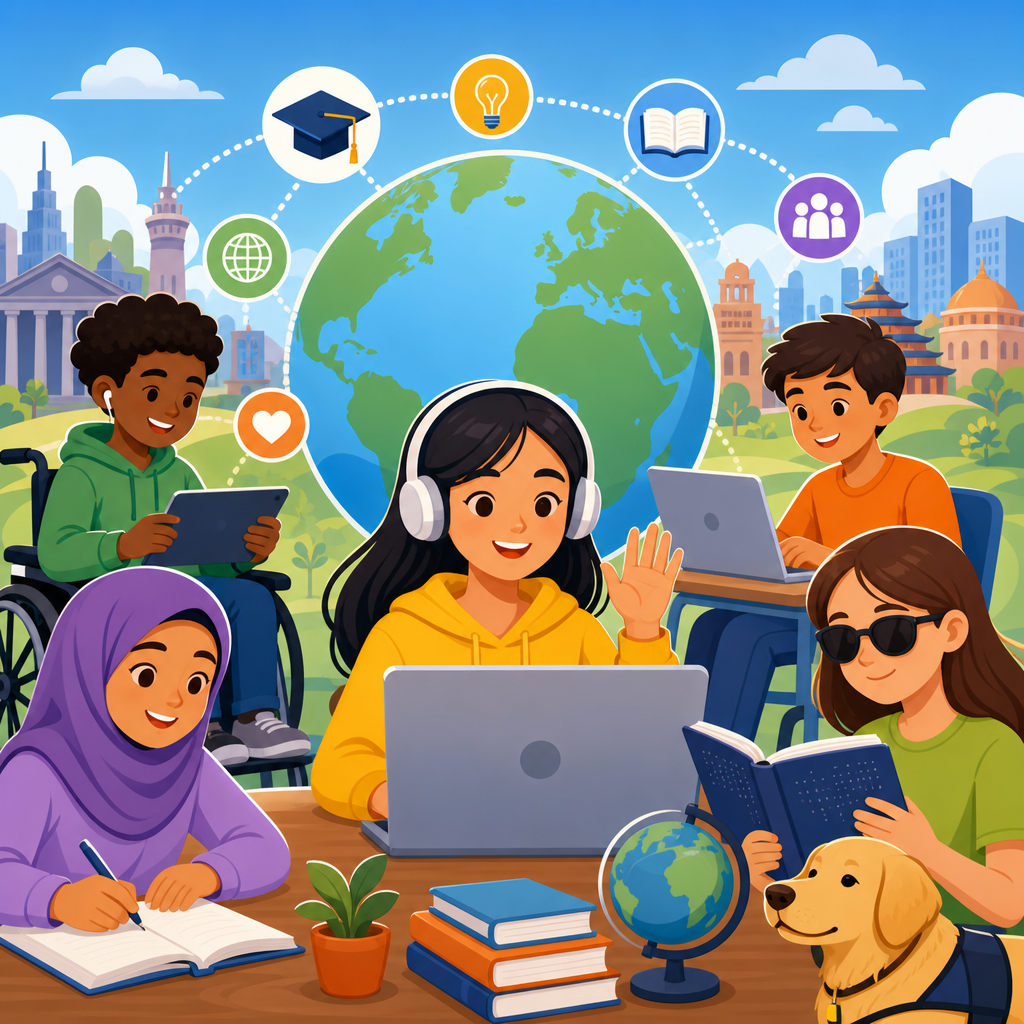
Accessible education platforms are becoming the backbone of inclusive learning worldwide, and their future will shape whether millions of students with disabilities can fully participate in school, training, and lifelong education. In this context, an accessible education platform is any digital learning environment, content system, assessment tool, or communication interface designed so learners with visual, hearing, mobility, cognitive, speech, or neurodivergent needs can use it effectively, independently, and with dignity. I have worked on international content and platform rollouts where a single unlabeled button blocked screen reader users from submitting coursework, and where poor captioning made a video lesson functionally useless for deaf students. Those experiences make one point unmistakable: accessibility is not a feature added at the end. It is infrastructure.
The issue matters globally because digital education is no longer optional. Schools, universities, ministries, employers, and nonprofits depend on learning management systems, virtual classrooms, mobile learning apps, and AI-supported tutoring tools. When these systems are inaccessible, exclusion scales fast. UNESCO has repeatedly highlighted that learners with disabilities face disproportionate barriers to quality education, and those barriers intensify in low-connectivity settings, during crises, and across language differences. Accessibility in education also sits at the intersection of disability rights, data protection, procurement policy, teacher training, and public investment. A platform may meet technical standards yet still fail if teachers upload image-only PDFs, videos without captions, or timed quizzes that cannot be extended. The future of accessible education platforms worldwide therefore involves technology, law, design practice, and institutional accountability working together.
For readers exploring the wider international perspective, this article serves as a hub for the future of global accessibility and disability rights by connecting the core themes that define the space: universal design, assistive technology compatibility, inclusive procurement, equitable broadband access, multilingual content, disability law harmonization, and the practical governance needed to turn rights into routine educational practice. The central question is simple: what will accessible education platforms need to look like over the next decade to support diverse learners across countries with different resources, regulations, and educational systems? The answer is equally direct. They must be interoperable, standards-based, mobile-friendly, multilingual, measurable, and built with disabled users from the start.
Why accessible education platforms are now a global rights issue
Accessible education platforms are no longer just product decisions for schools or software companies; they are increasingly part of how countries fulfill the right to education and the right to participate equally in public life. The UN Convention on the Rights of Persons with Disabilities established a clear international direction by requiring states to ensure inclusive education systems and access to information and communication technologies. In practical terms, that means students should be able to enroll, access lessons, complete assignments, collaborate, and demonstrate learning without facing preventable digital barriers. Across markets, I have seen the same pattern: when accessibility is treated as a compliance checkbox, students depend on ad hoc workarounds. When it is treated as a rights issue, institutions redesign systems before harm occurs.
Several forces are accelerating this shift. First, national rules are tightening. The Americans with Disabilities Act and Section 504 continue to influence educational access in the United States, the European Accessibility Act is raising expectations across Europe, and public sector web accessibility requirements in many countries increasingly reference WCAG 2.1 or 2.2. Second, digital learning is deeply embedded after the pandemic, so inaccessible platforms now affect attendance, progression, and credential attainment at scale. Third, disability advocacy is more organized and transnational than ever. Students and families compare experiences across borders, challenge inaccessible systems publicly, and push institutions to adopt stronger procurement requirements.
What makes this a global hub topic is that accessibility failures rarely occur in isolation. They are linked to broader disability rights questions: who is consulted, who pays for accommodations, whether standards are enforced, whether rural schools have sufficient bandwidth, and whether learning content is offered in local languages and sign languages. An accessible education platform in Nairobi, São Paulo, Delhi, London, or Manila may face different constraints, but the underlying principle is constant. Equal access must be designed into the platform, supported by policy, and verified through real user testing.
The technologies and design principles shaping the next decade
The future of accessible education platforms worldwide will be defined by universal design, compatibility with assistive technologies, and flexible content delivery across devices and bandwidth conditions. Universal design means building for the widest possible range of users from the beginning rather than creating separate experiences later. In education, that includes keyboard navigability, semantic headings, high-contrast interfaces, readable typography, resizable text, clear focus indicators, structured forms, logical reading order, and transcripts or captions for media. These are not minor interface preferences. They determine whether a learner can navigate a course independently.
Technical standards matter because they provide a shared baseline across institutions and vendors. WCAG remains the most widely referenced framework for web accessibility, while formats such as EPUB 3, DAISY, MathML, and properly tagged PDF improve access to digital books, STEM content, and long-form materials. In my experience, math and science remain major pain points globally because equations are often embedded as images and laboratory instructions are built around inaccessible visual assumptions. The next generation of platforms will need native support for accessible mathematics, screen reader-friendly diagrams where possible, tactile alternatives where necessary, and lab simulations that do not rely exclusively on drag-and-drop interaction.
Artificial intelligence will help, but only if used carefully. AI can generate captions, alt text drafts, text simplification, translation, reading supports, and personalized study prompts. It can flag inaccessible authoring choices before publication and suggest corrections to educators in real time. Yet AI also introduces risk. Auto-captioning can mislabel technical terms, speech engines can flatten accents, and image description tools often miss instructional context. A biology chart is not just “a graph with lines”; it may show a critical trend needed to answer an exam question. The future is therefore not fully automated accessibility. It is human-reviewed, workflow-integrated accessibility where AI reduces effort but does not replace responsibility.
| Area | What strong platforms do | Common global failure |
|---|---|---|
| Navigation | Support keyboard use, headings, landmarks, and consistent menus | Mouse-only interactions and confusing layouts |
| Video learning | Provide captions, transcripts, speaker labels, and audio description where needed | Auto-captions left unedited or no transcript at all |
| Assessments | Allow time adjustments, accessible question types, and screen reader support | Timed quizzes, drag-and-drop only tasks, inaccessible proctoring |
| Documents | Use tagged PDFs, accessible slides, EPUB, and alt text for images | Scanned image PDFs and poorly structured handouts |
| Mobile access | Work on low-cost phones, offline modes, and variable bandwidth | Desktop-first design that fails in low-connectivity regions |
Policy, procurement, and accountability will determine real progress
The biggest misconception in this field is that accessible education depends mainly on better software. In reality, procurement rules and governance models often matter more than interface polish. If ministries, school systems, universities, and donor-funded programs buy platforms without accessibility requirements, inaccessible products will continue to dominate. The institutions making the strongest progress usually do three things: they write accessibility criteria into tenders and contracts, require vendors to provide conformance documentation and remediation timelines, and test products with disabled users before full deployment. That is how accessibility moves from aspiration to enforceable expectation.
Public procurement is particularly powerful in the international accessibility landscape because governments are major education buyers. When a ministry specifies WCAG-based requirements, captioning standards, multilingual support, keyboard access, and compatibility with screen readers such as NVDA, JAWS, or VoiceOver, the vendor market responds. I have seen companies prioritize fixes in weeks when renewal revenue depended on it, after months of delay under informal requests. Procurement language should also cover authoring tools, not just learner interfaces. If teachers cannot create accessible quizzes, slides, and announcements within the platform, students still lose access even when the core product technically conforms.
Accountability also requires measurement. Strong institutions track caption coverage, document accessibility rates, unresolved user-reported barriers, accommodation turnaround times, and the percentage of courses passing accessibility checks before launch. They publish governance roles so educators know who owns standards, training, audits, and incident response. This is especially important for the future of global accessibility and disability rights because legal protections vary widely between countries. Where enforcement is weak, transparent institutional metrics can still drive progress. Where enforcement is strong, those same metrics become evidence of due diligence and continuous improvement.
Global equity challenges: infrastructure, language, affordability, and culture
The future of accessible education platforms worldwide cannot be separated from global inequality. A platform that performs well in a well-funded university with fiber internet may fail completely in a rural district where students share low-cost Android phones, recharge devices intermittently, and rely on prepaid data. Accessibility and digital inclusion overlap here. Large buttons and captions help, but so do lightweight pages, downloadable materials, offline access, low-data modes, and compatibility with older devices. In many regions, a highly polished but bandwidth-heavy platform is less accessible in practice than a simpler one that loads reliably.
Language is another decisive factor. Accessibility is often discussed as if English-first solutions can simply be translated later, but educational access depends on far more than interface localization. Students may need content in local languages, easy-to-read versions, national sign languages, and text-to-speech voices that correctly handle regional pronunciation. Speech recognition and reading support tools remain uneven across languages with smaller commercial markets, which creates a structural disadvantage for many learners. This is why open standards and public-interest investment matter. Without them, accessibility innovation clusters around profitable languages and leaves major gaps elsewhere.
Affordability affects institutions and learners alike. Assistive technologies can still be expensive, and licensing models sometimes exclude schools with constrained budgets. At the same time, free tools are not always robust enough for high-stakes learning. The practical path forward is mixed: better built-in operating system features, stronger compatibility with open tools like NVDA, subsidized access where specialized software is necessary, and procurement strategies that avoid locking institutions into inaccessible ecosystems. Cultural expectations also shape implementation. In some systems, disability disclosure carries stigma, so platforms should offer flexible access features without forcing students to formally identify themselves before receiving basic support.
What leading institutions should do next
Organizations planning the next generation of accessible education platforms should start with a simple rule: design the default experience so that fewer students need exceptions. That means choosing accessible core platforms, training teachers to create accessible content, funding disability support teams, and establishing routine audits. It also means involving disabled students, educators, and specialists throughout product selection and course design. The most useful feedback I have seen did not come from generic compliance reports alone. It came from students showing exactly where a workflow broke: a discussion board that trapped keyboard focus, a chemistry notation tool unreadable by screen readers, or a live class without caption controls.
Leaders should prioritize six actions. First, adopt a standards-based accessibility policy covering platforms, documents, media, and assessments. Second, embed accessibility requirements in procurement, renewal, and vendor management. Third, provide mandatory training for faculty and content teams, because inaccessible content is often the largest day-to-day barrier. Fourth, test with real users across disability groups, devices, and connectivity conditions. Fifth, build multilingual and mobile-first delivery into roadmaps from the start. Sixth, measure outcomes, not just intentions, using dashboards that show barrier reports, remediation time, and course readiness rates.
The long-term benefit is larger than compliance. Accessible education platforms improve clarity, usability, and resilience for everyone, including older learners, students using second languages, people studying on mobile devices, and anyone learning in noisy or low-bandwidth environments. They also create a stronger foundation for the broader future of global accessibility and disability rights by normalizing inclusive design across public services. If your institution is shaping an international education strategy, make accessibility a board-level priority now, audit your current learning stack, and fund the fixes that let every learner participate fully.
Frequently Asked Questions
1. What makes an education platform truly accessible for learners with disabilities?
A truly accessible education platform is designed so students with a wide range of disabilities can independently and effectively use it to learn, communicate, complete assignments, and demonstrate understanding. That means accessibility must go far beyond simply adding captions or making text larger. A strong platform supports screen readers for blind and low-vision learners, keyboard-only navigation for users who cannot rely on a mouse, captions and transcripts for deaf and hard-of-hearing students, and layouts that reduce confusion for learners with cognitive or neurodivergent needs. It should also work well with assistive technologies such as refreshable braille displays, voice recognition software, alternative input devices, switch controls, and text-to-speech tools.
Just as important, accessibility must be built into every layer of the learning experience. Course content, discussion boards, quizzes, documents, videos, live classes, notifications, and mobile apps should all be usable without unnecessary barriers. A platform may have an accessible homepage, for example, but still fail students if assignments are uploaded as unreadable PDFs, test timers cannot be adjusted, or navigation becomes inconsistent from one course module to the next. In practice, true accessibility means students do not have to constantly request workarounds in order to participate.
The most future-ready platforms also embrace inclusive design from the beginning instead of treating accessibility as an afterthought. They align with standards such as the Web Content Accessibility Guidelines, test with real users with disabilities, and update features as needs evolve. When platforms are built this way, accessibility becomes a foundation for better learning for everyone, not a special add-on for a limited group.
2. Why are accessible education platforms becoming so important worldwide?
Accessible education platforms are becoming essential worldwide because digital learning is now central to how education is delivered across schools, universities, workplace training, and lifelong learning programs. As more learning moves online or blends digital tools with in-person instruction, inaccessible systems can quickly exclude millions of students. For learners with disabilities, the platform itself often determines whether they can access lessons, interact with teachers, collaborate with peers, and complete assessments on equal terms. In that sense, accessibility is no longer a technical preference; it is a core issue of educational participation and equity.
This global importance is also growing because countries are expanding commitments to inclusion through disability rights laws, education policy reforms, and public expectations around equal access. Families, educators, and institutions increasingly recognize that a student should not be locked out of learning because videos lack captions, interfaces are too complex to navigate, or assignments are incompatible with assistive tools. In many regions, accessible platforms are now seen as part of the infrastructure required for quality education, much like reliable internet access, trained teachers, and safe learning environments.
There is also a broader social and economic reason these platforms matter. When students with disabilities can fully engage in education, they are better positioned to continue into higher education, vocational training, employment, entrepreneurship, and civic life. Accessible platforms therefore affect not just classroom success, but long-term independence and opportunity. Worldwide, the future of inclusive education will depend heavily on whether digital systems are designed to welcome every learner from the start.
3. How will the future of accessible education platforms likely evolve over the next decade?
Over the next decade, accessible education platforms will likely become more integrated, intelligent, and personalized. Instead of offering a few basic accessibility settings, leading systems will increasingly adapt to individual learners in real time. Students may be able to choose or automatically activate preferred formats such as simplified layouts, dyslexia-friendly text presentation, adjustable contrast, caption display options, audio support, alternative navigation methods, and flexible assessment formats. This shift will help platforms move from one-size-fits-all delivery toward more responsive and inclusive learning environments.
Artificial intelligence will probably play a major role, but its impact will depend on how responsibly it is implemented. AI may improve automatic captioning, translation, alt text generation, reading support, personalized pacing, and early identification of accessibility barriers within course design. However, the future will not simply be about using more AI. It will be about ensuring that automated tools are accurate, transparent, bias-aware, and easy for institutions to review and correct. If used well, these technologies could dramatically reduce the time it takes to create accessible content and support students across languages, regions, and disability profiles.
Another major change will be a stronger expectation that accessibility is standard across every feature, including virtual classrooms, simulations, mobile learning, digital assessments, collaboration tools, and credentialing systems. As immersive technologies, gamified learning, and global online programs expand, accessibility requirements will need to keep pace. The most successful platforms will be those that combine innovation with universal design, legal compliance, user testing, and ongoing improvement. In short, the future points toward platforms that are not only more advanced, but more inclusive by default.
4. What are the biggest challenges preventing accessible education platforms from reaching all learners?
One of the biggest challenges is that many education systems still treat accessibility as optional or secondary rather than essential. Platforms are often selected based on cost, speed, popularity, or feature lists without enough attention to whether students with disabilities can actually use them. As a result, schools and institutions may adopt tools that look modern but create serious barriers in practice. Common problems include inaccessible third-party plugins, poorly structured course materials, videos without captions, assessments that cannot be completed with assistive technology, and confusing interfaces that overwhelm some learners.
Another major barrier is the gap between technical compliance and real-world usability. A platform may claim alignment with accessibility standards, yet still frustrate students because features are inconsistent, updates introduce new obstacles, or important workflows were never tested by people with disabilities. Accessibility is not solved by checking a box once. It requires continuous auditing, thoughtful procurement, staff training, accessible content creation, and a willingness to respond when learners report problems. Without that ongoing commitment, even well-intentioned systems can remain difficult to use.
Global inequality also plays a significant role. In many parts of the world, learners face limited connectivity, outdated devices, language barriers, and insufficient access to assistive technology or disability support services. A platform cannot be considered truly inclusive if it assumes high-speed broadband, expensive hardware, or advanced digital literacy. Reaching all learners will require accessibility strategies that also account for affordability, localization, low-bandwidth performance, offline access, and teacher preparedness. The future of accessible education depends not only on better design, but on making inclusive technology practical and available across very different educational contexts.
5. What should schools, universities, and edtech companies do now to build more inclusive education platforms?
They should begin by making accessibility a non-negotiable design and purchasing requirement rather than a later fix. For schools and universities, this means evaluating platforms before adoption, asking detailed questions about compatibility with assistive technologies, reviewing accessibility documentation carefully, and testing core tasks such as enrollment, assignment submission, discussion participation, and exam completion. Institutions should also create internal policies that require accessible content creation, provide training for faculty and staff, and establish clear reporting channels so students can quickly flag barriers when they arise.
For edtech companies, the priority should be embedding accessibility into product development from the earliest stages. That includes designing with recognized standards in mind, involving people with disabilities in research and testing, and ensuring accessibility is considered across desktop, mobile, multimedia, live instruction, and assessment features. Companies should also document known limitations honestly and update products regularly as user needs, regulations, and technologies change. Accessibility teams should not be isolated from core engineering and design decisions; they should be central to how products are built and improved.
Most importantly, both institutions and technology providers should view accessibility as part of educational quality and innovation, not just compliance. The platforms that will shape the future most effectively are those that recognize inclusion as a driver of better outcomes for all learners. When organizations commit to accessible design, flexible learning options, multilingual support, affordability, and continuous user feedback, they help build a global education system where more students can participate fully and succeed on their own terms.