Sidewalks, curb ramps, and public right-of-way obligations shape whether residents can move through a city safely, independently, and lawfully. In municipal practice, the public right-of-way includes sidewalks, street crossings, curb ramps, pedestrian signals, on-street parking interfaces, and other transportation features owned or controlled by a city, county, or similar public entity. These elements are not optional amenities. They are core parts of a local government’s accessibility duties under the Americans with Disabilities Act, Section 504 of the Rehabilitation Act when federal funding is involved, and related design standards that govern how facilities must be built, altered, and maintained.
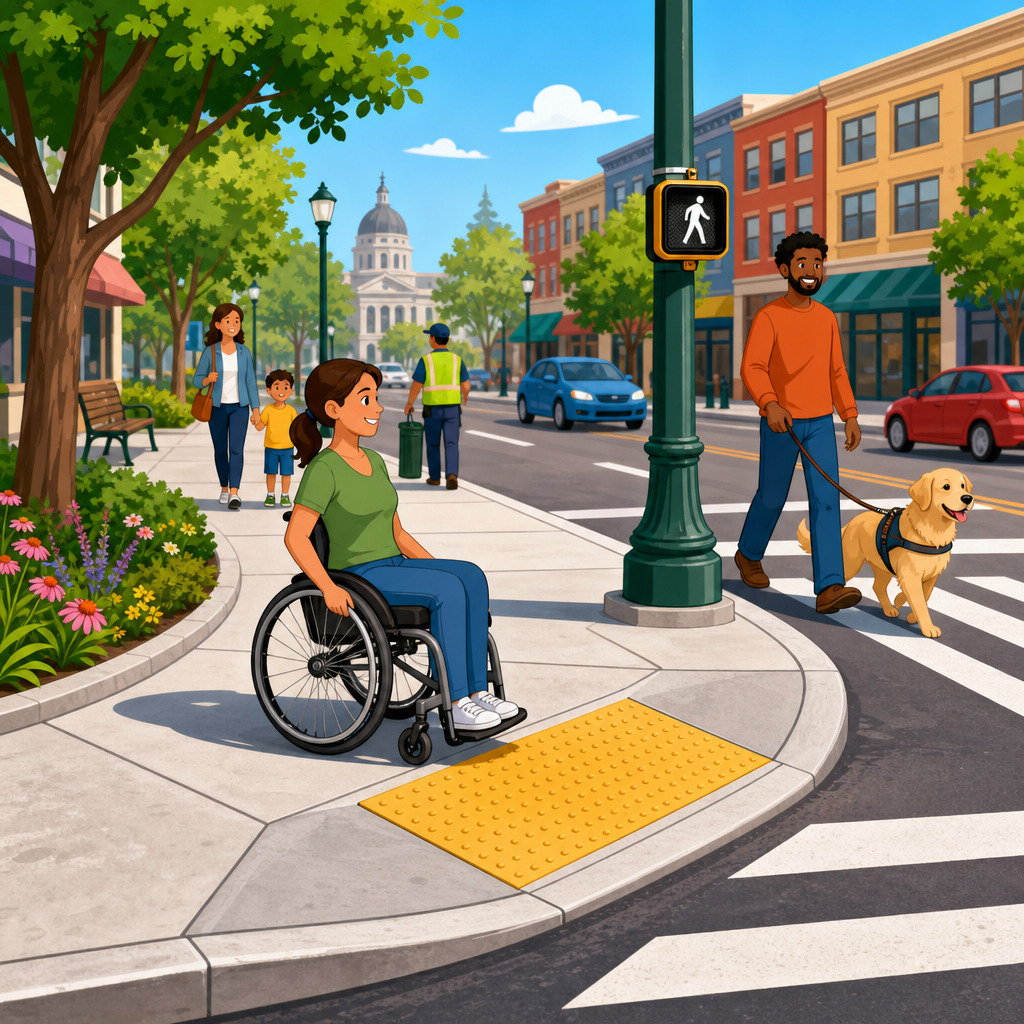
For cities, this topic matters because accessibility failures in public spaces create immediate barriers for people who use wheelchairs, scooters, walkers, canes, service animals, or who have low vision, blindness, hearing loss, cognitive disabilities, or limited stamina. A missing curb ramp can force a wheelchair user into traffic. Excessive cross slope can destabilize mobility devices. A protruding sign can become a head-level hazard for a blind pedestrian using a long cane. In my work reviewing municipal transition plans and field conditions, the most common problem is not a lack of intent. It is fragmented responsibility between engineering, public works, transportation, parks, facilities, and private developers working in the right-of-way without a single compliance framework.
This hub article covers the full public spaces and government landscape for sidewalks and curb ramps: what cities are required to do, what standards apply, how maintenance differs from alterations, how self-evaluations and transition plans fit in, where citizen complaints and litigation typically arise, and how municipalities can prioritize risk while improving access systemwide. It also serves as a launch point for more specialized guidance on pedestrian signals, on-street parking, temporary traffic control, snow and debris removal, work-zone accessibility, and procurement of accessible infrastructure. If a city treats right-of-way accessibility as a one-time construction issue, it will miss the larger operational obligation. Compliance is continuous, inventory-driven, and highly visible to the public every day.
What legal duties apply to sidewalks and curb ramps
The baseline rule is straightforward: when a city provides pedestrian routes in the public right-of-way, those routes must be accessible to people with disabilities unless doing so would fundamentally alter the service or impose an undue burden, and those defenses are narrow. Title II of the ADA applies to state and local governments. Department of Justice regulations require program accessibility in existing facilities and accessible design in new construction and alterations. The Department of Transportation’s regulations add specific obligations for transportation facilities and roadway projects, especially where federal aid is involved.
Curb ramps are one of the clearest triggers. If a city newly constructs or alters a street, road, or highway, it must provide curb ramps or other sloped areas at intersections and crossings where there are curbs or other barriers to entry from a pedestrian walkway. This requirement has been repeatedly enforced because resurfacing, intersection work, signal upgrades, and corridor reconstruction often qualify as alterations that affect usability. The legal question is usually not whether curb ramps matter. It is whether the scope of work changed the pedestrian environment enough to require them. In practice, many resurfacing projects do.
Program accessibility also matters beyond individual projects. A city cannot defend an inaccessible network by pointing to isolated compliant segments. Residents experience the system as a whole. If routes to city hall, libraries, transit stops, schools, parks, polling places, and business districts remain broken by missing ramps or impassable sidewalks, the public program may still be inaccessible even if recent capital projects met design requirements. That is why transition planning, grievance procedures, and complaint response systems are essential municipal functions rather than paperwork exercises.
Which standards cities use in design, construction, and review
Municipal staff often ask which technical standard governs a sidewalk project. The answer depends on the type of facility, date, funding source, and whether the work is new construction, alteration, or maintenance. For many buildings and site elements, the 2010 ADA Standards for Accessible Design are the familiar reference. In the public right-of-way, however, cities also rely heavily on guidance from the U.S. Access Board, Federal Highway Administration resources, Manual on Uniform Traffic Control Devices requirements for pedestrian features tied to traffic control, and state department of transportation standards.
The most widely used technical benchmark for right-of-way work is the Public Rights-of-Way Accessibility Guidelines, commonly called PROWAG. For years, cities used PROWAG as best practice even before formal adoption because it addressed features not covered well by building-oriented standards, such as blended transitions, pedestrian street crossings, detectable warning surfaces, pedestrian access routes within constrained corridors, and on-street parking. Today, leading municipalities treat PROWAG-based design as the safest path for consistency, especially in capital planning, standard details, and contractor specifications.
Technical compliance turns on dimensions and field conditions. Sidewalk width, passing space, running slope, cross slope, surface stability, vertical discontinuities, curb ramp slope, flare treatment, landing size, counter slope at street transitions, and detectable warning placement all matter. Small deviations can create real barriers. For example, a curb ramp that aligns diagonally into the middle of an intersection may technically fit a corner but can send a blind pedestrian into moving traffic. Good design is not only about meeting measurements. It is about preserving the intended travel path and making crossings understandable and safe.
Common barriers found in public spaces and government facilities
Across municipal inventories, the same defects appear repeatedly. Missing curb ramps remain the highest-risk issue because they create absolute barriers. Steep cross slopes on sidewalks are close behind, especially where older neighborhoods slope toward the gutter or where utility cuts and driveway crossings distort the pedestrian route. Broken pavement, uplift from tree roots, ponding water, narrow pinch points at poles or cabinets, and inaccessible push buttons at intersections are also common. In civic districts, decorative pavers and street furniture sometimes look attractive yet reduce maneuverability or create inconsistent surfaces for cane detection and wheel travel.
Government-owned public spaces add another layer. Parks, plazas, libraries, community centers, and civic campuses often connect directly to sidewalks but are designed under different departments and standards. I regularly see an accessible route reach the edge of a park and then disappear into loose gravel, steps, or gates with excessive opening force. Because users do not distinguish between transportation and facilities divisions, these breaks feel like one continuous failure. A city’s accessibility program has to connect the route from transit stop or parking space all the way to the program entrance and key site features.
Maintenance problems can be as serious as original design defects. Snow storage that blocks curb ramps, overgrown vegetation reducing clear width, temporary signs placed in the walkway, and poorly managed work zones all interrupt access. During election season, festivals, or emergency utility repairs, these temporary obstructions become frequent complaint drivers. Accessibility in public spaces is therefore both an engineering issue and an operations issue, requiring standards for daily field practices, permit conditions, and supervisor inspection routines.
How cities should inventory, prioritize, and phase compliance work
A defensible citywide approach starts with a self-evaluation and transition plan grounded in data. The self-evaluation identifies barriers in policies, facilities, and operational practices. The transition plan then prioritizes corrective action, assigns responsibility, estimates cost, and sets timelines. Cities that do this well use GIS-based sidewalk and curb ramp inventories, complaint logs, crash data, transit stop locations, school routes, and destination mapping to rank barriers by public impact rather than by political visibility alone.
Priority setting should be explicit. High-priority corridors usually include routes serving government buildings, public transportation, medical facilities, schools, downtown commercial streets, affordable housing, and areas with documented pedestrian demand. Complaint history matters, but it should not be the only driver, because underserved neighborhoods often generate fewer formal complaints despite higher barriers. Equity analysis is important here. If capital dollars consistently flow to already improved districts, the city can deepen access disparities while appearing active on paper.
| Priority factor | Why it matters | Example municipal response |
|---|---|---|
| Missing curb ramps at signalized intersections | Creates complete barriers and high crossing risk | Bundle retrofit with resurfacing and signal projects |
| Routes to government services | Directly affects access to civic programs | Upgrade paths to city hall, libraries, and polling sites first |
| Transit stop connectivity | Links pedestrian access to regional mobility | Coordinate with transit agency stop improvement plans |
| Complaint and settlement history | Shows recurring failure points and legal exposure | Track closure time and verify fixes in the field |
| High pedestrian injury corridors | Safety and accessibility risks overlap | Integrate ADA work into Vision Zero projects |
Phasing should combine stand-alone barrier removal with integration into routine capital programs. The fastest progress usually comes from embedding accessibility triggers into pavement management, utility coordination, permit review, subdivision approvals, and complete streets projects. Waiting for separate ADA funding alone is too slow. When cities attach curb ramp and sidewalk obligations to every relevant project, they move from reactive remediation to systematic compliance.
Alterations, maintenance, and private work in the right-of-way
One of the most misunderstood issues is the line between maintenance and alteration. Simple maintenance may preserve an existing facility without triggering full upgrades, while an alteration changes usability and can require accessible features within the project scope. Crack sealing is different from full-depth pavement rehabilitation. Spot sidewalk shaving is different from reconstructing a corridor. Because the consequences are legal as well as budgetary, cities need written decision rules reviewed by counsel, engineering leadership, and accessibility staff.
Private construction complicates matters further. Developers, utility companies, telecom providers, and adjacent property owners often cut into sidewalks or occupy portions of the right-of-way under permit. If permit conditions are weak, the city inherits inaccessible restorations and unsafe pedestrian detours. Strong right-of-way permitting requires accessible temporary routes, detectable barriers around work areas, maintained pedestrian access to transit stops and businesses, restoration to current standard details, and closeout inspections before bonds are released. The municipality remains responsible for the public right-of-way even when a private actor performed the work.
Maintenance response times also need structure. A city should define how quickly it addresses severe uplift, failed detectable warnings, blocked curb ramps, or inaccessible signal push buttons. Service-level targets help demonstrate good-faith administration and improve field accountability. They also create useful internal linking points across a government accessibility program, connecting streets maintenance, parks operations, emergency response, and constituent services into one trackable system.
Enforcement, complaints, and risk management for municipalities
Most city leaders focus on lawsuits, but complaints usually arrive first through resident calls, advocacy groups, ombuds offices, or federal and state agency inquiries. A strong grievance procedure is therefore a practical compliance tool. Residents should be able to report inaccessible sidewalks, missing curb ramps, blocked routes, inaccessible public meetings in outdoor spaces, or right-of-way construction barriers through multiple channels. The city then needs triage rules, documentation standards, and a verification process that confirms the fix actually restored access.
Litigation patterns are predictable. Claims often target systemic curb ramp deficiencies, inaccessible pedestrian routes to civic facilities, or failure to provide accessible paths during street work. Consent decrees and settlement agreements frequently require inventories, annual retrofit quotas, staff training, public reporting, and independent monitoring. These outcomes are expensive, but they also show what effective governance should have looked like from the start. The cheapest cure is early planning paired with consistent field execution.
Risk management should not be framed only as avoiding liability. Accessible sidewalks and curb ramps improve safety, increase transit usability, support aging in place, and expand participation in public life. They also reduce conflict at the permit counter because expectations are clear. For municipalities building a broader public spaces and government accessibility program, the right-of-way is the most visible proving ground. If the path to city services is inaccessible, the public will reasonably doubt every other accessibility commitment the city makes.
Building a durable citywide accessibility program
The cities that improve fastest treat right-of-way accessibility as an enterprise function, not a specialty issue assigned to one coordinator without authority. They adopt standard drawings aligned with current guidance, train inspectors and designers, maintain a living inventory, and require accessibility review at concept, design, bid, and closeout stages. They also align transportation, facilities, parks, procurement, and communications staff so that the public sees one coherent system. That coordination is what turns policy into an accessible street network.
As a hub for public spaces and government, this topic connects to every related article a municipality should study next: pedestrian signals, work-zone access, public parks routes, parking and passenger loading, snow and vegetation maintenance, citizen complaint workflows, and capital planning. The core lesson is simple. Sidewalks and curb ramps are not minor details at the edge of roadway projects. They are legal obligations and practical gateways to civic participation. Cities that inventory barriers, apply the right standards, prioritize high-impact routes, and embed accessibility into every project cycle make public services reachable in the way the law expects and residents deserve. Review your current right-of-way program, identify the biggest network gaps, and turn accessibility from a complaint response into a standing public works discipline.
Frequently Asked Questions
What is included in a city’s public right-of-way accessibility obligations?
A city’s public right-of-way accessibility obligations generally extend to the pedestrian network and related transportation features that residents and visitors use to travel through the community. This typically includes sidewalks, curb ramps, marked and unmarked crossings, pedestrian pushbuttons and signals, accessible routes around barriers, transit stop connections, detectable warnings, and interfaces with on-street parking. In practice, if a city owns, operates, or controls a feature within the public right-of-way, that feature may fall within the city’s accessibility responsibilities.
These duties are important because sidewalks and crossings are not treated as optional conveniences. They are part of the basic civic infrastructure that allows people with disabilities to move safely and independently. A route that is broken by missing curb ramps, excessive slopes, uplifted pavement, inaccessible pedestrian signals, or obstructions can effectively deny access even if the destination itself is technically open to the public. That is why accessibility analysis in the public right-of-way usually focuses on whether the full travel path is usable, not just whether isolated pieces appear compliant.
Municipal obligations often involve both maintaining existing facilities and ensuring that alterations, resurfacing work, signal upgrades, and other roadway projects do not leave accessibility gaps behind. A city may also need to evaluate barriers systematically, prioritize improvements, respond to complaints, and coordinate accessibility standards across public works, engineering, planning, and legal departments. In short, the obligation is broad: local governments must treat accessible pedestrian travel as a core part of how streets and public spaces are designed, built, and maintained.
When is a city required to install or upgrade curb ramps?
Curb ramps are commonly required where a pedestrian route crosses a curb at a street crossing, and cities are often obligated to install or upgrade them when streets, sidewalks, or intersections are newly built or altered. A common trigger is roadway resurfacing or other improvement work that affects the usability of the crossing. When a city alters an area in a way that affects pedestrian travel, accessibility requirements usually do not allow the city to ignore the curb ramps at that location. The work must be evaluated in light of the obligation to provide an accessible route.
This matters because a missing or noncompliant curb ramp can prevent a wheelchair user, walker user, or person with limited mobility from crossing safely at all. It can also create problems for people with vision disabilities if detectable warnings are missing or misaligned. The purpose of a curb ramp is not simply to slope pavement downward. It is to create a usable and predictable transition between sidewalk and street in a place where people are expected to cross.
Cities should not assume that curb ramp obligations arise only during major capital reconstruction projects. Accessibility duties may also be implicated by phased improvements, signal work, utility coordination, pedestrian safety projects, and corridor upgrades. The legal question often turns on whether the city has altered the facility and whether the altered area can be made accessible. Because this analysis can be fact-specific, municipalities should review projects early in the design process rather than waiting until construction is underway.
Do cities have to fix existing sidewalk barriers even if no new construction is planned?
Yes, cities may have responsibilities to address existing barriers in the public right-of-way even when a location is not part of a brand-new construction project. Accessibility law generally does not permit a public entity to leave known barriers unaddressed indefinitely simply because the infrastructure is old. If residents cannot travel along sidewalks or cross streets safely because of missing curb ramps, severe disrepair, obstructions, or inaccessible pedestrian features, the city may need to evaluate and remove those barriers through a programmatic approach.
In municipal practice, that often means conducting a self-evaluation, maintaining transition planning or comparable barrier-removal planning, setting priorities based on pedestrian need and risk, and budgeting for improvements over time. High-priority locations commonly include government buildings, schools, transit corridors, medical areas, commercial districts, and routes that connect neighborhoods to essential services. Complaint-driven repairs are important, but they are usually not enough by themselves. A city should also identify barriers proactively and create a rational, documented process for addressing them.
That said, the law typically recognizes that not every barrier in an entire city can be corrected at once. What matters is whether the municipality is moving in a meaningful, consistent way toward accessibility and whether it is avoiding policies or delays that effectively deny equal access. Cities that inventory barriers, document priorities, respond to requests, and integrate accessibility into routine maintenance and capital planning are generally in a stronger position than cities that treat sidewalk access issues as isolated or low-level maintenance concerns.
What makes a sidewalk or crossing inaccessible?
A sidewalk or crossing can become inaccessible for many reasons, and the problem is often cumulative rather than limited to one obvious defect. Common issues include missing curb ramps, curb ramps with excessive running slope or cross slope, broken or uplifted pavement, narrow clear width, utility poles or signs blocking passage, inaccessible pedestrian pushbuttons, ponding water, unstable surfaces, and crossings that do not align with the pedestrian path. Even if each condition seems minor in isolation, together they can make a route unusable for someone with mobility, vision, or balance limitations.
At crossings, accessibility depends heavily on continuity and predictability. A person should be able to approach the crossing on a usable sidewalk, locate and activate pedestrian controls where applicable, descend via a properly designed curb ramp, cross within a reasonably safe and accessible path, and reach the opposite side without encountering another barrier. If any one of those steps fails, the crossing experience may be effectively denied. For example, a new signalized crossing is not truly accessible if one corner still lacks a curb ramp or if pushbuttons are placed out of reach on a steep landing.
Maintenance also plays a major role. Sidewalk accessibility is not only a design issue; it is an operational issue. Debris, overgrown vegetation, temporary signs, sidewalk café encroachments, snow or ice accumulation, and construction detours can all block an otherwise compliant route. Cities should therefore think about accessibility as a year-round responsibility involving inspection, enforcement, maintenance standards, and coordination with adjacent property owners and contractors. A route is only accessible if people can actually use it in real-world conditions.
How should cities manage compliance and reduce legal risk for sidewalks and curb ramps?
The most effective approach is to treat public right-of-way accessibility as an ongoing municipal program rather than a series of isolated fixes. Cities should start with a reliable inventory of sidewalks, curb ramps, crossings, pedestrian signals, and known barriers. From there, they can establish standards for inspections, prioritize high-need corridors, integrate accessibility into resurfacing and capital project workflows, and create clear internal procedures so that public works, engineering, transportation, and risk management teams are applying the same expectations.
Documentation is especially important. A city should be able to show how it identifies barriers, how it responds to complaints and accommodation requests, how it prioritizes projects, and how accessibility considerations are built into design, procurement, and construction review. Training also matters. Staff and contractors need to understand that accessible routes, curb ramp geometry, detectable warnings, temporary pedestrian access during construction, and pedestrian signal placement are not secondary details. They are core compliance issues with direct consequences for public safety and equal access.
From a legal and practical standpoint, the goal is not simply to avoid disputes. It is to create a transportation network that people can use with dignity and confidence. Cities that plan ahead, maintain complete records, incorporate accessibility into routine operations, and address barriers before they become crisis points are better positioned to serve residents and reduce exposure to complaints, enforcement actions, and litigation. In this area, good compliance practice and good public service are usually the same thing.