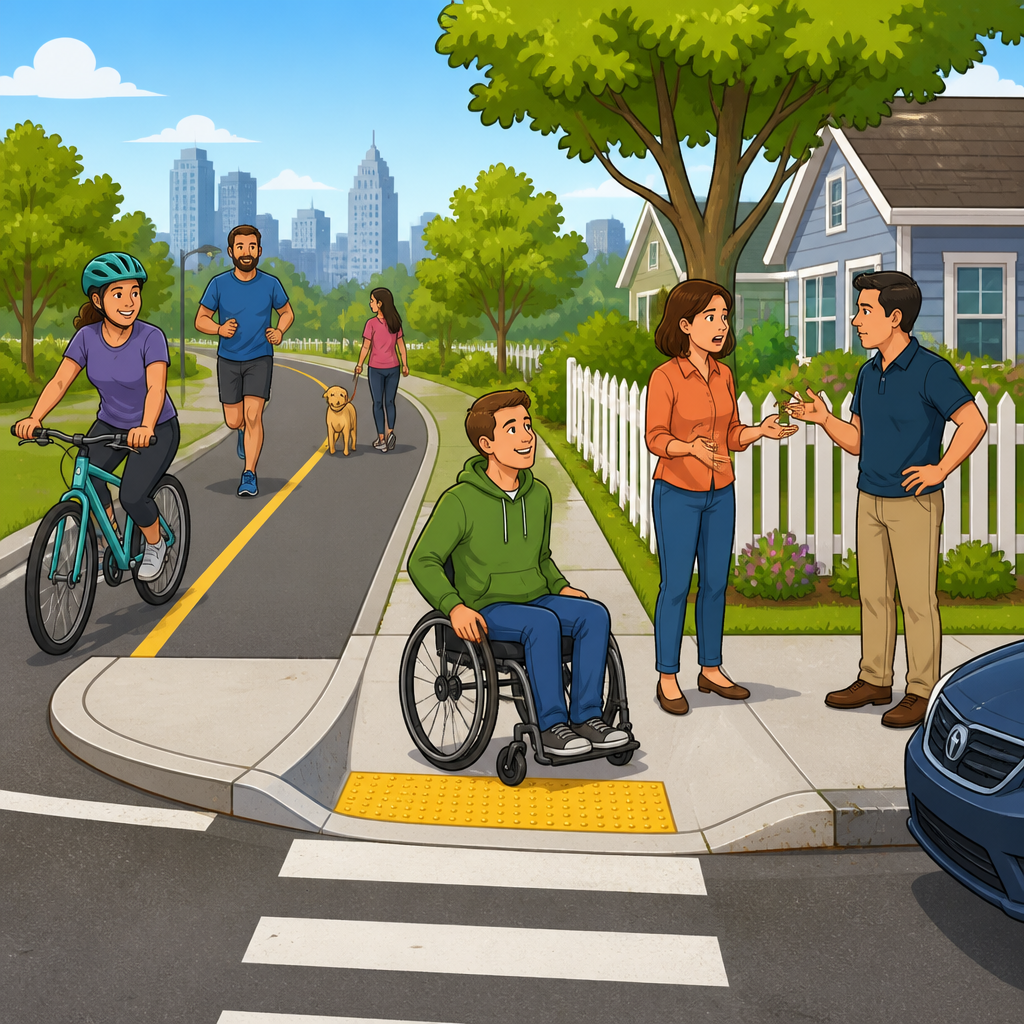
Shared use paths, curb ramps, and public right-of-way disputes sit at the center of a rapidly changing area of disability law because they determine whether people can move through a city safely, independently, and with equal access. In practice, these facilities connect homes to schools, transit stops, parks, business districts, government offices, and medical care. When they are built well, they expand mobility for wheelchair users, blind pedestrians, older adults, parents with strollers, cyclists, runners, and children. When they are built poorly, they become recurring sources of injury, exclusion, and litigation. For lawyers, planners, public works directors, and advocates, this is no longer a niche compliance topic. It is a core infrastructure issue with direct consequences under the Americans with Disabilities Act, Section 504 of the Rehabilitation Act, and related state and local accessibility standards.
A shared use path is an off-street route designed for multiple users, typically pedestrians, bicyclists, and people using mobility devices. A curb ramp is the sloped transition from sidewalk to street at a crossing point. Public right-of-way refers to land held or regulated for public travel, including sidewalks, street crossings, medians, signals, on-street parking interfaces, and pedestrian access routes. Disputes arise when these elements are missing, deteriorated, blocked, or designed in ways that fail to provide accessible travel. In my work reviewing accessibility claims and municipal transition plans, the same pattern appears repeatedly: a city upgrades a corridor for traffic flow, drainage, or bike mobility, yet leaves behind broken curb ramps, narrow pinch points, excessive cross slopes, or inaccessible detours during construction. Those gaps create legal exposure because accessibility is judged by real-world usability, not by design intent alone.
This hub article explains the emerging challenges and recent legal developments shaping these disputes. It covers why curb ramp cases remain active decades after the ADA, how shared use paths fit into accessibility duties, what technical issues most often trigger claims, and how courts evaluate notice, program access, maintenance, alterations, and remedies. It also maps the practical implications for agencies that need defensible policies, for plaintiffs documenting barriers, and for design professionals responsible for compliant plans. As a hub under legal cases and precedents, it is meant to orient readers to the key questions that connect more detailed articles on construction standards, municipal liability, sovereign immunity defenses, pedestrian signal disputes, maintenance obligations, and settlement trends. The central point is straightforward: public right-of-way accessibility law is becoming more specific, more data driven, and less forgiving of informal compliance approaches.
Why shared use paths and curb ramps remain active sources of ADA litigation
Curb ramps have been a consistent litigation focus because they are visible, measurable, and essential to travel. Federal regulations have long required curb ramps where a street level pedestrian walkway crosses a curb, and courts have repeatedly treated inaccessible curb ramps as barriers to equal access in municipal pedestrian systems. The legal theory is powerful because missing or noncompliant ramps can deny access to an entire route, not just a single corner. Plaintiffs often support claims with route-based documentation showing how one steep landing, a lip at the gutter, or a lack of detectable warnings forces a wheelchair user into traffic or leaves a blind pedestrian without a reliable cue at a crossing.
Shared use paths have generated newer disputes because many jurisdictions expanded trail and active transportation networks faster than they updated accessibility protocols. Agencies often viewed paths primarily as bicycle facilities, recreational amenities, or transportation alternatives, but disability law treats them through the lens of pedestrian access and program usability as well. If a path connects neighborhoods, schools, transit, or civic destinations, it can function as a critical part of the pedestrian network. In several reviews I have conducted, the compliance problem started at project scoping. Designers accounted for width, grade, and drainage for cyclists, yet overlooked passing space, resting intervals, accessible connections to sidewalks, and transitions at bollards, gates, or bridge approaches. Those oversights become legal issues once users demonstrate that the path is an expected public route.
Another reason disputes persist is that public entities often underestimate maintenance duties. Accessibility is not satisfied at ribbon cutting and then forgotten. Uplifted panels, ponding water, snow storage, vegetation encroachment, gravel washouts, and damaged tactile surfaces can turn a previously compliant route into an unusable one. Plaintiffs increasingly pair photographic evidence with geolocated surveys, slope measurements, and maintenance records requests. That combination makes it easier to show that a barrier was not isolated, that notice existed, and that the city lacked a reasonable inspection and repair program.
Recent legal developments reshaping public right-of-way disputes
The most important development is the shift from broad accessibility principles toward corridor-level scrutiny tied to specific technical features. Courts and settlement agreements increasingly focus on measurable conditions: running slope, cross slope, width, flare design, landing size, surface stability, detectable warnings, and accessible pedestrian signal integration. Even when the exact technical standard debated in a case varies by date of construction, alteration status, or adopted guideline, the litigation trend is clear. Agencies cannot rely on vague arguments that a route is generally usable if documented barriers materially impede travel for people with disabilities.
Another major development is the continued influence of transition planning and self-evaluation obligations. Municipalities that maintain current inventories, rank barriers by severity and connectivity impact, assign budgets, and track remediation are in a stronger position than agencies that address complaints piecemeal. Courts are more receptive when a city can show a functioning process rather than isolated promises. By contrast, a stale transition plan, no asset database, and no link between paving projects and curb ramp upgrades often undercut defenses.
Construction detours are receiving closer attention as well. Temporary routes must remain accessible to the maximum extent feasible, yet many projects still route pedestrians across uneven ground, through parking lots without marked accessible paths, or to crossings without curb ramps. These failures are especially risky because they arise during active public works projects, where notice and control are hard to dispute. I have seen claims grow from a single detour complaint into broader audits of an agency’s standard specifications and contractor oversight.
| Dispute area | Typical barrier | Why claims succeed | Common corrective action |
|---|---|---|---|
| Curb ramps | Excessive slope, missing detectable warnings, broken transitions | Barrier is measurable and directly affects crossing access | Full ramp reconstruction tied to paving and signal work |
| Shared use paths | Narrow pinch points, bollards, inaccessible path connections | Path functions as part of the pedestrian network | Redesign access controls and restore continuous route width |
| Maintenance | Heaving pavement, debris, ponding, vegetation | Records may show long-standing notice and inadequate response | Inspection cycles, work orders, prioritized repairs |
| Construction detours | Unmarked alternate routes, missing ramps, unstable surfaces | Entity or contractor had direct project control | Temporary accessible pedestrian access route standards |
Key technical issues that drive claims and settlements
Most public right-of-way disputes turn on a relatively small set of technical conditions. Cross slope is one of the most common. For wheelchair users, excessive cross slope can pull a chair sideways and require constant corrective force. At curb ramps and blended transitions, poor drainage design often leads to warped surfaces or localized steepness near the gutter line. Vertical discontinuities also matter. A small lip where the ramp meets the street may look minor on a plan sheet but can stop a front caster or create a trip hazard.
Detectable warnings remain heavily litigated because they serve a specific navigational function for blind and low-vision pedestrians at curb edges. Problems include missing panels, incorrect placement, poor contrast maintenance, detached domes, and installations interrupted by utility covers or seams. Agencies sometimes assume that adding a tactile panel alone resolves a crossing issue, but if alignment directs a user into a skewed crossing or toward a drainage depression, the route may still be unsafe.
On shared use paths, width and object hazards are frequent concerns. Bollards intended to control vehicle entry can obstruct mobility device users or create crash risks for cyclists, especially when placed on curves or without contrast markings. Gates, chicanes, and staggered barriers often reflect an outdated assumption that restrictive access control improves safety. In many modern retrofits, the better solution is to remove unnecessary barriers, improve sight lines, and rely on targeted enforcement rather than physical obstruction.
Accessible connections are equally important. A path may be smooth and wide for miles, yet still be inaccessible if its entrances are reachable only by stairs, steep side connections, gravel approaches, or curb returns without compliant transitions. This is why route continuity matters so much in litigation. Courts and experts tend to evaluate what a user can actually do from origin to destination, not whether isolated segments look compliant in photographs.
How courts analyze liability, defenses, and remedies
Although case outcomes depend on jurisdiction and facts, several recurring legal questions shape these disputes. First is whether the challenged facility is part of a public service, program, or activity that must be accessible when viewed in its entirety, or whether a specific alteration triggered a direct obligation to install compliant features such as curb ramps. Street resurfacing, signal modernization, sidewalk reconstruction, utility relocation, trail extensions, and drainage projects can all raise alteration questions. Agencies sometimes label work as maintenance to avoid upgrade duties, but courts examine the actual scope and effect of the project.
Second is notice. Plaintiffs may show actual notice through complaints, prior claims, staff emails, or inspection records. Constructive notice can be inferred when barriers are obvious, widespread, or long standing. Third is causation and standing. Successful plaintiffs usually document how specific barriers affected their travel, deterred use, or required dangerous workarounds. General frustration is less persuasive than route-specific evidence tied to repeated encounters.
Remedies often include injunctive relief rather than damages alone, especially in systemic cases against municipalities. Settlements may require updated transition plans, citywide inventories, annual spending commitments, web-based complaint portals, consultant audits, construction specification revisions, and periodic reporting. Those remedies matter because they reshape future capital planning. In effect, litigation often forces agencies to connect pavement management, sidewalk inventories, signal programs, and ADA compliance into a single accountable system.
Practical guidance for municipalities, advocates, and project teams
The strongest municipal strategy is to treat accessibility as an asset management issue, not just a legal review at the end of design. Maintain a current inventory of curb ramps, sidewalks, path segments, signals, and barriers. Link that inventory to paving schedules, crash data, school routes, transit stops, and equity indicators so upgrades follow connectivity and risk. Use recognized references such as the Manual on Uniform Traffic Control Devices for pedestrian traffic control, PROWAG as the leading technical benchmark for public right-of-way design, and current Department of Justice and Department of Transportation guidance when drafting standards.
For advocates and plaintiffs’ counsel, the most effective cases are built around documented travel chains. Show where the trip started, what barrier was encountered, why the barrier mattered, and what safe alternative, if any, was unavailable. Measurements, photos, weather conditions, construction status, and repeat observations all strengthen credibility. For designers and contractors, temporary pedestrian access deserves the same rigor as vehicle maintenance of traffic. If a project can preserve lanes with signs, barriers, and phasing, it can preserve accessible pedestrian travel with comparable discipline.
This area of law will keep evolving as cities build more multimodal networks and as users expect every public route to be navigable, continuous, and independently usable. The lesson from recent disputes is clear: accessible design, timely maintenance, and documented decision making reduce risk far more effectively than after-the-fact defenses. Review your network, update your standards, and fix the routes people rely on every day.
Frequently Asked Questions
What is the legal issue with shared use paths and curb ramps in the public right-of-way?
Shared use paths and curb ramps are not just design features; they are core access points that determine whether people with disabilities can travel safely and independently through a community. In the public right-of-way, these facilities often connect sidewalks, intersections, bus stops, schools, parks, downtown districts, medical offices, and government buildings. When they are missing, poorly maintained, or built with barriers such as steep slopes, abrupt level changes, unsafe crossings, or inaccessible transitions, they can exclude people with mobility, vision, and balance disabilities from ordinary civic life.
From a legal standpoint, disputes usually arise under disability access laws that require public entities to make pedestrian routes and related infrastructure accessible. The central question is often whether a city, county, transportation agency, or other public body has provided meaningful access to its pedestrian network. That analysis may involve curb ramp placement, detectable warnings, path width, cross slope, surface stability, obstruction removal, maintenance obligations, and whether alterations or new construction triggered specific accessibility duties. In many cases, the problem is not a single broken ramp or isolated defect, but a broader pattern of inaccessible design that limits equal participation across an entire neighborhood or corridor.
These disputes also matter because the public right-of-way is where access becomes practical. A person may have the legal right to enter a courthouse, clinic, or business, but that right means little if the route leading there is blocked by inaccessible crossings, missing curb ramps, or a shared use path that is too narrow or dangerous to use. That is why courts, agencies, advocates, and municipalities increasingly treat these features as essential parts of a city’s accessibility obligations rather than optional improvements.
Why are curb ramps so important in disability access cases?
Curb ramps are one of the most visible and litigated elements of pedestrian accessibility because they create the transition between sidewalks and streets. For wheelchair users, people using walkers, parents with strollers, delivery workers, and many older adults, a missing or defective curb ramp can make an intersection effectively unusable. For blind and low-vision pedestrians, curb ramp design also affects orientation and safety, especially when detectable warnings, alignment, and landing areas are not properly provided.
In legal disputes, curb ramps are often treated as a basic access feature, not a minor convenience. A city may face claims when ramps are absent at intersections, placed in the wrong location, built too steeply, directed into traffic instead of across the crosswalk, or allowed to deteriorate to the point that they become dangerous. The issue is especially significant when road resurfacing, street reconstruction, signal work, or sidewalk upgrades occur, because public agencies may have legal obligations to bring curb ramps into compliance when altering adjacent pedestrian routes.
What makes curb ramp cases so important is that they are systemic. If one neighborhood has dozens or hundreds of inaccessible corners, residents with disabilities may be cut off from bus stops, schools, grocery stores, parks, and public services on a daily basis. Courts and settlement agreements often look beyond isolated corners and focus on transition plans, inspection systems, repair timelines, and how a public entity prioritizes accessibility in capital projects. In that way, curb ramp disputes can reshape citywide policies, not just fix a single intersection.
How do shared use paths fit into public right-of-way accessibility disputes?
Shared use paths are increasingly central to accessibility disputes because many communities now rely on them as key transportation corridors rather than purely recreational trails. A shared use path may connect residential areas to schools, transit hubs, employment centers, parks, and shopping districts. When that happens, the path functions as part of the pedestrian circulation network and must be evaluated as a route people depend on for everyday travel.
Accessibility problems on shared use paths can include excessive slope, narrow passing space, poor surface conditions, lack of edge protection, inaccessible connections to sidewalks or transit stops, obstructed entry points, unsafe street crossings, and inadequate maintenance. For someone using a wheelchair or mobility device, a path with broken pavement or severe cross slope may be difficult or impossible to navigate. For blind pedestrians, unclear boundaries, poorly marked crossings, and inconsistent warnings can create serious hazards. Even where the path itself looks modern, the route may still be inaccessible if it ends at a staircase, lacks a usable curb ramp connection, or funnels users into traffic without a protected crossing.
In litigation or administrative complaints, a major issue is whether the path is part of the public right-of-way access system and whether the responsible public entity treated it as such. If a city promotes a route as a transportation connection but fails to make it usable by people with disabilities, that gap can support a broader claim of unequal access. These cases often require careful factual analysis, including how the route is used, what destinations it connects, what design standards apply, and whether the inaccessibility is isolated or systemic.
Who is typically responsible when inaccessible sidewalks, curb ramps, or shared use paths lead to a dispute?
Responsibility depends on ownership, control, and the nature of the work at issue, but in many public right-of-way cases, the primary defendant is a public entity such as a city, county, state transportation department, transit agency, or parks department. That is because these entities usually own, operate, maintain, or alter streets, sidewalks, intersections, and shared use paths. The legal analysis often focuses less on who caused the original condition decades ago and more on who currently has the duty and authority to provide accessible pedestrian infrastructure.
That said, responsibility can be split. A municipality may control sidewalks and curb ramps, while a transit authority controls bus boarding areas, or a state agency controls a highway crossing that interrupts a local pedestrian route. Developers and contractors may also become relevant where recent construction created inaccessible conditions or failed to comply with approved plans. In some jurisdictions, adjacent property owners have limited maintenance duties, but those duties do not usually eliminate a public entity’s obligations under disability access laws where the route is part of the public pedestrian system.
In practice, identifying the responsible party often requires reviewing maps, permits, maintenance agreements, capital improvement records, and project scopes. That is one reason public right-of-way disputes can become complex. A person encountering a barrier may not know whether the problem belongs to the city engineering department, public works, the transit agency, or a state transportation authority. Effective legal claims often begin by tracing who designed the facility, who altered it, who maintains it, and who has the power to correct the barrier now.
What remedies are available in a public right-of-way accessibility dispute?
The most important remedy is usually injunctive relief, meaning a court order or negotiated settlement requiring barriers to be fixed. In the context of shared use paths, curb ramps, and pedestrian routes, that can include installing missing curb ramps, replacing noncompliant ramps, correcting slopes and surfaces, removing obstructions, improving crossing signals and warnings, connecting isolated route segments, and adopting accessible design requirements for future construction. In larger cases, remedies may extend far beyond spot repairs and require a citywide remediation program.
Many disputes also result in policy changes. A public entity may be required to create or update a transition plan, conduct a self-evaluation, train staff, revise maintenance procedures, inventory barriers, prioritize high-need corridors, and integrate accessibility compliance into resurfacing, reconstruction, and permitting decisions. Those systemwide reforms can be just as important as physical construction because they reduce the chance that the same barriers will reappear in future projects.
Depending on the claims asserted and the governing law, plaintiffs may also seek attorneys’ fees and, in some cases, additional relief allowed by statute. But the practical goal in most public right-of-way cases is to secure safe, usable travel routes that allow people with disabilities to reach daily destinations with dignity and independence. The strongest outcomes are usually those that combine immediate corrections with enforceable timelines, transparent reporting, and long-term accountability measures so that accessibility becomes part of how the public entity plans, builds, and maintains the transportation network.


