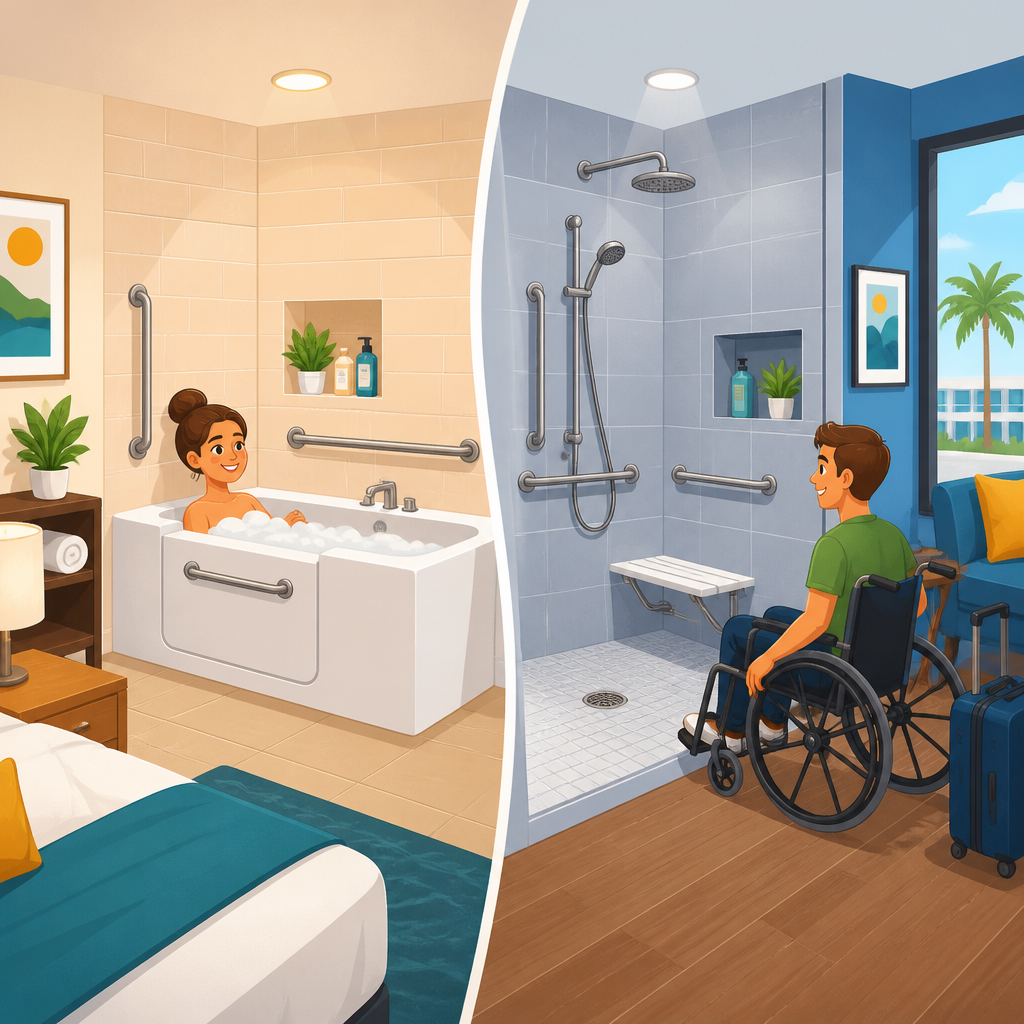
Accessible bathtubs and roll-in showers solve the same problem—making bathing possible for people with mobility limitations—but they do it in very different ways, and those differences affect compliance, safety, cost, maintenance, and guest experience in hotels and housing. In accessibility work, “accessible bathtub” usually means a tub with a permanent seat, grab bars, controls within reach, a hand shower, and clear floor space for transfer; “roll-in shower” means a shower compartment with no curb, enough interior size for wheelchair entry, required grab bars, a shower seat in many configurations, and controls placed for seated use. I have evaluated both in hotels, multifamily properties, and senior housing, and the choice is rarely cosmetic. It affects room layouts, plumbing rough-ins, waterproofing details, cleaning protocols, and whether a person can bathe independently or needs assistance. This matters because bathing is a daily activity tied directly to dignity, health, and legal compliance. Under the ADA Standards for accessible hotel guestrooms and common-use areas, and under Fair Housing Act design requirements for covered multifamily housing, fixture selection must align with technical criteria, user needs, and the type of occupancy. A hotel owner deciding between an accessible tub room and a roll-in shower room is not just picking amenities. They are deciding who can use the room comfortably, how many accessible rooms are required, and how reliably the bathroom will function over time.
How accessible bathtubs and roll-in showers differ in function and layout
The core difference is transfer method. An accessible bathtub is designed for a lateral or angled transfer onto a fixed seat at the tub head or side, followed by assisted or independent use of a hand shower. A roll-in shower is designed so a wheelchair user can enter the shower footprint directly, position beside or onto a folding seat, and use controls from a seated location. In practice, that distinction changes everything about the room. Tubs require a fixture length similar to a standard bathtub, but they need carefully placed grab bars, a seat, and unobstructed clear floor space along the open side. Roll-in showers trade the tub apron for a larger, open compartment and therefore need more planning for slope, drainage, and splash management.
Hotels often prefer roll-in showers in newer construction because they are easier for many wheelchair users, older adults with walkers, and guests using shower chairs. They also reduce the barrier created by a tub wall. However, accessible bathtubs still appear in lodging because some travelers prefer bathing, some reservation systems classify rooms separately, and certain room mixes require both transfer-type and roll-in options. In housing, the answer depends on program rules and resident profile. Senior living communities frequently specify curbless showers because fall risk and caregiver access are central concerns. Conventional multifamily developers may still install adaptable tubs in some units where local code, market preference, or space constraints push design decisions in that direction.
Compliance requirements in hotels, apartments, and other residential settings
Compliance starts with occupancy type. Hotels and motels fall under the ADA for transient lodging, which means the number and type of accessible bathing fixtures in guestrooms are tied to total room count and room features. The ADA Standards distinguish mobility-accessible rooms with transfer showers, roll-in showers, or accessible bathtubs, and dispersion rules can require accessible options across room classes. In my audits, one of the most common mistakes is assuming any larger bathroom qualifies. It does not. The bathing fixture, turning space, door maneuvering clearances, lavatory approach, toilet clearances, and accessory mounting heights all have to work together.
In multifamily housing, the Fair Housing Act design and construction requirements apply to covered dwellings, while Section 504 may apply in federally funded housing, and state accessibility codes can add further obligations. That means a housing provider may need adaptable bathrooms in many units and fully accessible bathrooms in some units, depending on funding, ownership, and jurisdiction. International Building Code provisions, ICC A117.1 technical criteria, and state amendments frequently shape the exact details designers follow. California, Texas, Florida, and New York each create compliance patterns that differ in plan review and inspection emphasis. The result is simple: there is no one-size-fits-all answer. The correct fixture choice depends on which law applies, how many units or rooms are required to be accessible, and whether the bathroom is for private use, public use, or common use.
Technical design details that determine whether each option actually works
The most important technical issue with accessible bathtubs is transfer usability. The seat height, seat depth, grab bar position, and faucet location must support safe movement from wheelchair or walker to seat. Controls must be reachable from the seat, and the hand shower must be mounted with a hose long enough for seated bathing. The clear floor area beside the tub must not be blocked by a toilet, door swing, vanity corner, or towel bar. I frequently see compliant-looking tub installations fail because decorative glass panels, deep vanity overhangs, or oversized toilet paper dispensers intrude into the transfer zone. A tub can meet product specifications and still fail as a usable assembly.
Roll-in showers depend on floor geometry. The absence of a curb requires precise sloping to the drain without creating cross-slope problems at the bathroom floor outside the shower. Inadequate recessing of the slab or poor mortar-bed planning can produce water migration into the dry area, especially in hotels with high turnover and aggressive housekeeping spray-down. The location of trench drains, center drains, or rear drains matters because wheelchair casters, seat legs, and user stability can all be affected by drainage layout. Fold-down seats must be mounted to reinforced blocking, not just tile and backer board, and grab bars need backing that aligns with exact dimensions rather than field guesswork. These details are invisible when done well, but they determine durability and safety.
| Feature | Accessible Bathtub | Roll-In Shower |
|---|---|---|
| Primary access method | Transfer over tub wall onto seat | Wheelchair entry into shower compartment |
| Best suited for | Users who can transfer with support and prefer bathing | Wheelchair users, users with shower chairs, caregiver assistance |
| Key construction challenge | Maintaining clear transfer space and reach ranges | Drainage, waterproofing, and floor slope control |
| Common failure point | Blocked transfer area or misplaced grab bars | Water escaping shower or seat/grab bar backing failure |
| Operational tradeoff | Familiar fixture but harder entry for many users | Easier entry but more demanding maintenance details |
Safety, independence, and user experience in real properties
From a user perspective, roll-in showers usually provide the highest level of independence for people who remain in their wheelchairs for bathing or who use rolling shower commodes. They also help travelers with limited hip flexion, knee issues, balance impairment, or post-surgical restrictions because there is no tub wall to step over. In hotels, that translates into fewer room-change requests and fewer improvised workarounds with portable chairs. In housing, it often means residents can age in place longer. Occupational therapists commonly recommend curbless showers because they support present needs and future decline better than tubs do.
That said, accessible bathtubs still serve legitimate users. Some people with partial mobility can transfer safely to a tub seat and strongly prefer soaking for pain relief, spasticity management, or routine comfort. Families traveling with small children may also find a tub more practical, though family convenience should never drive the accessible room inventory. Safety depends on fit between user and fixture, not on labels alone. A tub can be safe for a person who can pivot with grab-bar support, and unsafe for a full-time wheelchair user. A roll-in shower can be ideal for independent bathing, but problematic if the seat is too small, the controls are behind the user, or the floor becomes slippery because tile selection prioritized appearance over coefficient of friction and cleanability.
Cost, maintenance, and renovation implications for owners and operators
Developers often ask which option costs less. In new construction, the difference is usually smaller than expected once the full bathroom is considered. A basic accessible tub assembly may cost less in fixture price, but a compliant roll-in shower can avoid some future renovation costs because it aligns better with changing resident needs and reduces requests for retrofits. The true cost driver is not the tub or shower pan alone. It is framing, slab recessing, waterproofing, drain placement, wall reinforcement, tile labor, accessories, and how much square footage the room consumes. In hotels where every inch affects key count, the layout premium for a well-executed roll-in shower can influence revenue planning.
Maintenance also diverges. Tubs are simpler to contain from a water-management perspective, but the seat hardware, caulking joints, and handheld shower mounts still require inspection. Roll-in showers need disciplined housekeeping and engineering teams. Silicone joints, grout condition, drain performance, shower curtain placement, and seat hinge integrity all matter. I have seen otherwise excellent hotel rooms generate repeat complaints because curtains were too short, trench drains clogged with lint, or replacement grab bars were installed at the wrong height after tile repairs. Owners should create preventive maintenance checklists specifically for accessible bathrooms rather than treating them as standard wet areas. That is especially important in affordable housing and long-term ownership models where deferred maintenance can quickly become an accessibility barrier.
Planning the broader restrooms and plumbing strategy for an accessibility program
As a hub topic within restrooms and plumbing, accessible bathtubs versus roll-in showers should never be considered in isolation. The bathing fixture interacts with lavatory knee clearance, insulated pipes, toilet centerline, turning diameter, mirror height, accessory placement, hot-water delivery time, anti-scald protection, and door hardware. A well-designed bathroom is a coordinated system. For example, a roll-in shower may solve entry access but fail in practice if the lavatory blocks turning space or if the toilet transfer side is reduced by a vanity corner. Likewise, an accessible tub room can be technically compliant yet frustrating if the hand shower has a stiff hose, the diverter requires strong grip strength, or the water temperature fluctuates because pressure-balancing valves were omitted or poorly maintained.
Good planning starts with a room matrix. Identify which laws apply, the number of required mobility-accessible rooms or units, whether communication features are also required, what user groups are expected, and how reservation or leasing systems will describe each bathing option. Then review details against the governing standard, usually the ADA Standards, ICC A117.1, state code, and manufacturer installation instructions. Mockups are worth the cost. In several projects, I have caught seat placement errors, toilet-paper reach problems, and curtain-track conflicts only after standing in the full-scale room. If this page is your hub for restrooms and plumbing accessibility, the next logical topics to connect internally are toilet clearances, accessible lavatories, shower controls and grab bars, turning space, door maneuvering clearances, drinking fountains, and plumbing fixture mounting heights. Those subjects determine whether the bathing choice succeeds or fails in real use.
The key difference between accessible bathtubs and roll-in showers is not style; it is usability for different bodies in different settings. Accessible bathtubs support transfer bathing and can work well for users who can move onto a fixed seat with grab-bar assistance. Roll-in showers support direct wheelchair access, easier caregiver assistance, and stronger long-term adaptability, which is why they are often the better choice in modern hotels, senior housing, and inclusive residential design. Neither option is automatically compliant or automatically safe. Success depends on exact dimensions, control locations, clear floor space, waterproofing, reinforcement, and integration with the rest of the bathroom.
For owners, designers, and facility managers, the practical lesson is clear. Start with the governing accessibility standard, match the bathing fixture to the occupancy type and user profile, and then verify every related plumbing and restroom element in the room. That approach reduces complaints, avoids expensive corrections, and creates bathrooms people can actually use with dignity. If you are building or renovating under ADA accessibility standards, review your room types now and decide where an accessible bathtub is appropriate and where a roll-in shower is the better solution.
Frequently Asked Questions
What is the main difference between an accessible bathtub and a roll-in shower?
The biggest difference is how a person enters and uses the bathing fixture. An accessible bathtub is designed around a transfer approach. In most cases, the user moves from a wheelchair or mobility device onto a permanent seat at the tub, then swings or lifts their legs into the bathing area. To support that transfer, accessible tubs typically include a permanent seat, grab bars, a handheld shower spray, controls positioned within reach, and clear floor space next to the tub. A roll-in shower, by contrast, is designed for direct entry without a curb or raised threshold that blocks wheelchair access. The user can roll a shower chair or wheelchair into the shower area, which changes the bathing experience significantly.
That difference affects more than convenience. It influences who can use the space independently, how caregivers assist, how much maneuvering room is required, and how the bathroom functions day to day. Accessible tubs can work well for people who are able to transfer safely and want a bathing option that feels more familiar or residential. Roll-in showers are often a better fit for users who cannot safely step over a tub wall or complete a side transfer. In hotels and housing, this distinction matters because both options support accessibility, but they do not serve exactly the same physical needs or guest expectations.
Which option is usually safer for people with mobility limitations?
Safety depends on the user’s abilities, but in many situations, a roll-in shower is considered the lower-risk option because it eliminates the need to step over a tub wall or perform a difficult transfer into a deep bathing fixture. For people with limited balance, reduced lower-body strength, or wheelchair dependence, the ability to enter a shower on a level or nearly level surface can reduce fall risk and make assisted bathing more manageable. Roll-in showers also tend to provide more open floor area, which can help both users and caregivers move more safely.
Accessible bathtubs can still be safe when they are properly designed and installed, especially for users who can transfer with grab bars and a stable seat. However, the transfer itself is often the most challenging part. Moving onto the tub seat, repositioning the body, and bringing the legs over the tub edge may be difficult for some users, even with supportive features in place. In real-world hospitality and residential settings, the safest choice usually comes down to matching the fixture to the person’s functional needs. If independent or assisted rolling access is important, a roll-in shower often provides a clearer safety advantage. If the user can transfer reliably and prefers bathing in a tub, an accessible bathtub may still be appropriate.
How do accessible bathtubs and roll-in showers differ in hotel compliance and housing design?
From a compliance and design standpoint, the key issue is that accessible bathtubs and roll-in showers are not interchangeable in every setting, even though they both address bathing accessibility. In hotels, accessibility standards often require a certain distribution of room types and bathing fixture types based on the number of guest rooms and the applicable rules. That means a property may need some rooms with accessible tubs and others with roll-in showers, rather than choosing just one solution across the board. The reason is practical as well as regulatory: different guests have different access needs, and a compliant inventory should reflect that.
In housing, the analysis can be more nuanced because the answer depends on the type of housing, the governing code or standard, whether the project is new construction or renovation, and whether the unit is intended to be adaptable, accessible, or fully mobility-focused. Designers also have to think about long-term usability. A roll-in shower may better support aging in place and caregiver access, while an accessible bathtub may align more closely with family housing preferences or resident expectations. In both hotels and housing, successful compliance is not just about including grab bars or a handheld shower. It is about dimensions, clearances, control placement, thresholds, reinforcement, drainage, and usability as a whole. Small design decisions can determine whether a bathroom works in practice or only appears accessible on paper.
Which is more cost-effective to install and maintain: an accessible bathtub or a roll-in shower?
Cost-effectiveness depends on whether you are evaluating upfront construction, lifecycle maintenance, or operational flexibility. Accessible bathtubs can sometimes be simpler to incorporate in projects where a standard tub layout already exists, particularly in renovations where changing the entire wet-area floor assembly would be expensive. If the bathroom footprint is tight, keeping a tub format may avoid extensive structural changes. That said, the tub still needs the required seat, grab bars, handheld spray, reachable controls, and adequate clear floor space, so it is not just a standard bathtub with a few accessories added.
Roll-in showers often involve more careful planning and, in some cases, higher initial installation costs because they depend on proper floor slope, drainage, waterproofing, and enough maneuvering space. In renovations, creating a true curb-free or very low-threshold entry can be especially challenging if the floor structure does not easily allow recessing or reworking the drain. However, over time, many owners see value in roll-in showers because they can serve a wider range of users, may be easier for caregivers to assist in, and often align better with modern accessibility expectations.
Maintenance is also different. Roll-in showers require consistent attention to drainage performance, slip resistance, seals, and waterproofing details. Accessible tubs may present fewer floor drainage issues, but they still require durable seating, secure grab bar anchorage, and fixtures that hold up under repeated use. For hotels, operational cost is tied to room versatility and guest satisfaction as much as repair expense. For housing, long-term adaptability and resident turnover may be bigger factors. In short, the less expensive option upfront is not always the better value over the life of the property.
Which bathing option offers a better guest or resident experience?
There is no single universal winner because the better experience depends on the user’s mobility, bathing preferences, and need for independence or assistance. For many wheelchair users and people with significant mobility limitations, a roll-in shower offers a more dignified and practical experience. It can reduce physical strain, improve access for shower chairs, and make caregiver support far easier. In hotel settings especially, that can translate into a more predictable and comfortable stay, because the guest is less likely to encounter a fixture that technically meets requirements but is difficult to use in real life.
Accessible bathtubs, however, can provide a better experience for people who are comfortable with transfers and prefer the option of bathing rather than only showering. In some residential settings, a tub may feel more familiar, more family-friendly, or more desirable for multigenerational households. Some residents simply want the choice of soaking or using a tub seat rather than an open shower compartment. The best experience comes from thoughtful matching: understanding the likely user, the level of assistance required, and the context of the property.
For hotels, the strongest approach is usually to offer a mix where required and to describe rooms accurately so guests can book the bathing configuration that fits their needs. For housing, the best experience often comes from designing for present needs while allowing for future changes. In both cases, accessibility should not be treated as a checklist item. When the layout, reach ranges, surfaces, controls, and clearances all work together, the bathroom feels more usable, more comfortable, and far more respectful of the person using it.