Service animals in stores create a daily compliance challenge for retail and e-commerce brands because frontline staff must balance disability access, safety, customer service, and legal risk in real time. In this context, a service animal is generally a dog individually trained to perform tasks for a person with a disability, while a support animal that provides comfort without specific task training follows different rules in most public retail settings. I have trained store teams on this issue for years, and the same pattern repeats: one awkward interaction at the entrance can escalate into a complaint, a refund demand, a viral video, or an expensive discrimination claim. That is why every retailer needs clear staff scripts, documented procedures, and a practical understanding of what the law actually requires.
For stores, the stakes are higher than many managers assume. The Americans with Disabilities Act sets the baseline for customer access in most brick-and-mortar retail environments, but state laws, lease requirements, health codes, and company policies can add operational details. E-commerce teams also need alignment because buy online, pick up in store, curbside handoff, returns desks, and delivery partnerships blur the line between digital and physical service. A hub article on service animals in stores should therefore answer three questions directly: what staff may ask, what staff may not ask, and how a retailer should respond when behavior, hygiene, or safety concerns arise. Get those three areas right and most incidents become manageable instead of disruptive.
Compliance also matters because customers increasingly expect consistency across channels. If your website promises inclusive shopping but your greeter improvises at the door, trust disappears. If your call center tells a customer one thing and your store manager says another, the business looks careless. The goal is not to turn associates into lawyers. The goal is to give them simple, repeatable language supported by manager escalation paths, incident logs, and training that reflects actual store conditions such as fitting rooms, food areas, carts, checkout lines, and crowded seasonal events. Retailers that handle service animal access well protect revenue, reduce staff anxiety, and create a safer experience for everyone in the store.
What the law requires in retail settings
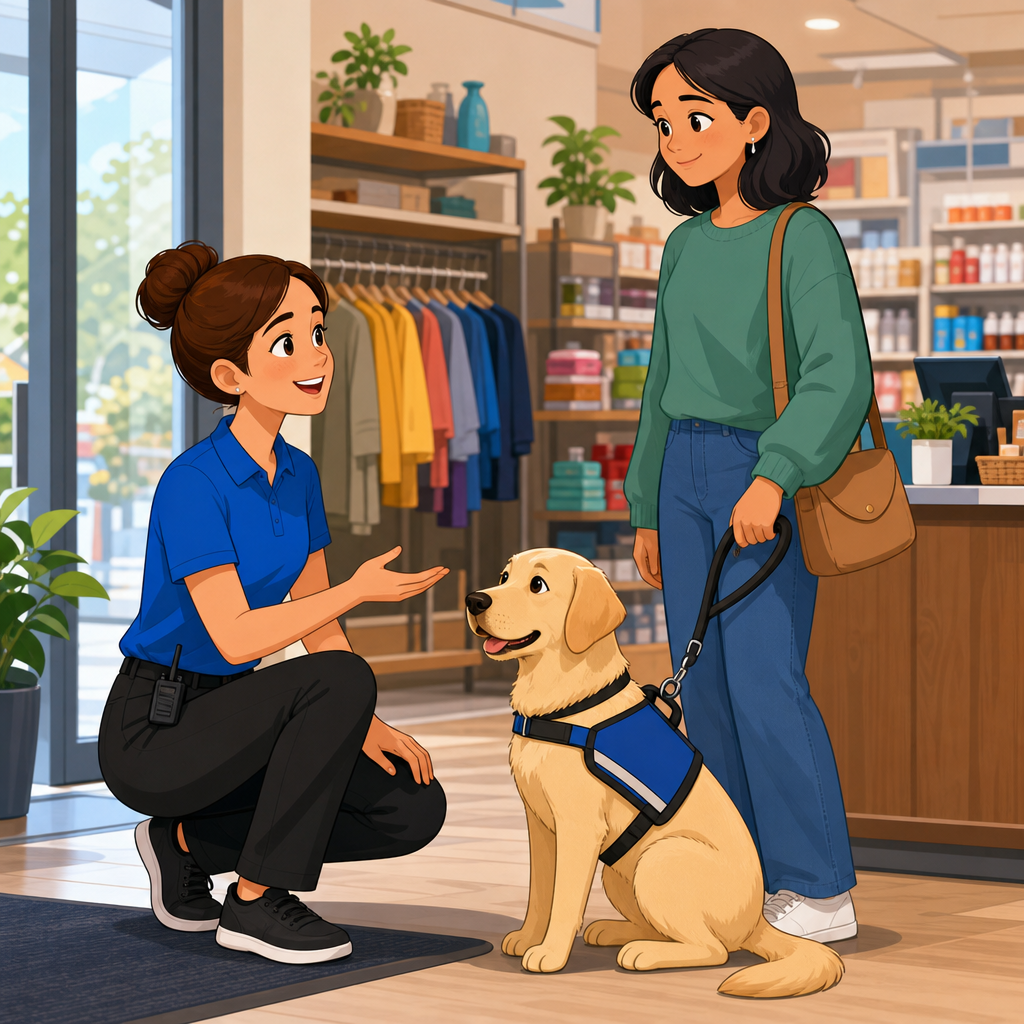
In most U.S. retail stores open to the public, a customer with a service animal must be allowed to enter anywhere customers are normally allowed to go. Under the ADA, businesses may ask only two limited questions when the need for the animal is not obvious: whether the dog is required because of a disability, and what work or task the dog has been trained to perform. Staff cannot demand medical documentation, require a special identification card, ask the dog to demonstrate its task, or question the nature of the person’s disability. Those limits are where most employee mistakes happen, especially when staff believe they are “just verifying policy.” Verification beyond those two questions often becomes the policy violation.
Retail leaders should also understand the exceptions. A store may ask that a service animal be removed if the dog is out of control and the handler does not take effective action to control it, or if the dog is not housebroken. Fear of dogs and allergies are not valid reasons to exclude a service animal, although staff can separate customers and use ordinary service recovery techniques. Miniature horses may qualify in some circumstances under federal rules, but they are rare in retail and require assessment of whether the facility can accommodate size, weight, and safety needs. The practical takeaway is simple: access is the default, exclusion is narrow, and any removal decision must be based on behavior, not assumptions.
State law may broaden rights or create additional notice obligations, so national chains should not rely on a single slide deck for every market. California, New York, Texas, Florida, and Illinois all have state-level disability access provisions that can affect training emphasis, enforcement, and penalties. Shopping centers, grocery operators, pharmacies, big-box retailers, boutiques, and mall kiosks all face the same core rule, but their risk profile differs because traffic patterns and merchandise environments differ. I advise retailers to anchor training to federal access standards, then add a short state addendum and a site-specific operations note. That structure keeps scripts consistent while preventing local compliance gaps that emerge when managers copy rules from unrelated industries.
Approved staff scripts for common store interactions
The fastest way to reduce mistakes is to script the first thirty seconds of the interaction. Frontline staff need language that sounds respectful, not robotic. A strong opening is: “Welcome. Service animals are allowed. If it is not obvious, I’m allowed to ask whether the dog is required because of a disability and what task it has been trained to perform.” If the customer answers appropriately, staff should stop there and continue normal service. The objective is not interrogation; it is lawful clarification. When stores skip scripting, associates tend to improvise with bad phrases like “papers, please,” “what’s your diagnosis,” or “pets aren’t allowed,” each of which increases complaint risk immediately.
Managers also need scripts for difficult moments. If a dog is barking repeatedly, lunging, jumping on merchandise, or blocking aisles, staff should address behavior, not status. A compliant script is: “Your dog is welcome if it remains under control. Right now the behavior is disrupting the store, so I need you to bring the dog under control. If that does not happen, I will ask that the dog be taken outside, but you may continue shopping without the animal or we can offer curbside assistance.” That wording matters because it preserves access while documenting a legitimate operational reason for intervention. It also signals that the store is offering an alternative service method rather than simply denying entry.
| Scenario | Say This | Avoid This |
|---|---|---|
| Need is not obvious | “Is the dog required because of a disability, and what task has it been trained to perform?” | “Show me certification.” |
| Customer mentions emotional support | “Thank you for explaining. In this store, trained service animals are permitted under access rules.” | “That animal is fake.” |
| Dog is disruptive | “Please bring the dog under control so you can continue shopping.” | “All animals must leave now.” |
| Another customer complains | “We accommodate service animals and can help create more space for you.” | “I’ll make them leave.” |
These service animal staff scripts work best when paired with role-play. In training sessions, I use checkout, fitting room, and returns-counter scenarios because those are the points where conflict peaks. Retail employees remember exact words when they have practiced them under time pressure. Written policy alone is not enough. Post a one-page quick reference at the service desk, include the scripts in new-hire onboarding, and require managers to coach to the script after any incident. Consistency is what makes a script legally useful and operationally credible.
Compliance tips for store operations, safety, and merchandising
Service animal compliance in retail is not limited to the front door. Merchandising layouts, queue design, sanitation routines, and safety plans all affect whether access works smoothly. Wide, uncluttered aisles help handlers navigate with less staff intervention. Endcap displays should not narrow major paths below accessible circulation standards. Fitting room attendants should know that a service animal may accompany a customer unless a specific safety issue exists. In food-selling environments such as grocery, convenience, and warehouse clubs, staff often assume local health rules prohibit animals everywhere. That is usually incorrect for trained service animals in customer areas, so operations manuals need plain-language clarification to prevent overenforcement.
Cart policies are another frequent issue. Many retailers prohibit animals from riding in shopping carts for hygiene and safety reasons, and that rule can usually be applied neutrally so long as the customer still has meaningful access to the store. A practical approach is to offer a basket, an associate runner, or pickup service rather than arguing at the aisle. Escalation should be manager-led because associates can accidentally frame the issue as disbelief about the dog’s status instead of concern about sanitation. The same principle applies to seating, café zones, and self-checkout corrals: focus on the operational rule, explain the alternative, and avoid personal commentary.
Incident documentation should be standardized. If a service animal is removed for being out of control or not housebroken, the report should note objective facts: time, location, observed behavior, staff instructions, customer response, witnesses, and accommodation offered. Avoid subjective labels such as “aggressive-looking” or “fake service dog.” Those phrases are inflammatory and weak if a complaint reaches corporate, a regulator, or outside counsel. Good retail compliance is built on observable behavior and contemporaneous notes. I also recommend periodic mystery shop reviews and camera audits of entry interactions to confirm that policy is being followed in live conditions, not just in annual training records.
How retail and e-commerce teams should work together
Although service animals in stores are primarily a brick-and-mortar issue, retail and e-commerce teams influence the customer experience together. Website accessibility pages, FAQ sections, live chat responses, curbside workflows, and marketplace seller policies should all use the same definitions and escalation language as in-store training. If a customer asks online whether a service dog is allowed during pickup, the answer should be direct and accurate. If a return initiated online ends in an in-store confrontation, the customer will not separate those channels in their mind. A hub page under Retail and E-commerce should therefore connect policy, training, and channel operations rather than treating them as separate departments.
There are also modern edge cases. Third-party delivery drivers may arrive with personal animals, which is different from a shopper entering with a service animal. Employees may request accommodation involving a service animal, which triggers an employment process under different legal standards than customer access. Marketplace pop-ups, in-store events, and holiday photo activations may involve temporary staff who have never been trained on access rules. Each of those situations should have a short decision tree owned by legal, HR, operations, and digital content leads together. In practice, the best retailers build one master policy and several audience-specific procedures so every team gets the guidance relevant to its role without mixing legal categories.
Internal linking strategy matters for this topic hub because store teams rarely need one giant policy page in the moment. Break supporting content into focused guides: service animal rules for grocery retail, handling disruptive animals at checkout, employee accommodation versus customer access, curbside pickup protocols, and documenting incidents after a removal. Then link those articles from this hub using descriptive anchor text. That structure improves findability for both human users and search systems, while giving managers a practical library they can use during onboarding and after incidents. A strong hub is not just comprehensive; it is operationally navigable.
Training mistakes that create complaints and how to prevent them
The most common retail training mistake is overconfidence. Leaders assume common sense will carry the day, but common sense is exactly what causes employees to ask for ID cards, challenge invisible disabilities, or rely on internet myths about service dog registries. Another mistake is teaching policy without context. Associates need examples: a calm dog lying under a rack, a barking dog in a checkout lane, a customer holding a small animal in a tote, a shopper citing anxiety, a child trying to pet a working dog. When teams train with realistic scenarios, they understand the difference between a protected access situation and a conduct issue that management can address.
Prevention depends on repetition, escalation, and accountability. Use microlearning refreshers every quarter, not just annual compliance modules. Require supervisors to sign off that each associate can state the two permitted questions correctly. Include service animal encounters in post-incident reviews the same way you review refunds, safety events, or shoplifting responses. If your stores use Zebra devices, Microsoft Teams, Slack, or another internal tool, pin a short reference card where staff can pull it up instantly. The best compliance tip is simple: make the right action easier than the wrong one. When policy is easy to find and easy to say, employees follow it under pressure.
Service animal compliance in retail becomes manageable when businesses replace guesswork with clear rules, practiced scripts, and coordinated operations across stores and digital channels. The essentials are consistent: allow access by default, ask only the two permitted questions when the need is not obvious, address behavior rather than assumptions, and document incidents with objective facts. Retailers that train to real scenarios at entrances, fitting rooms, checkout, curbside, and returns counters prevent most complaints before they start. They also protect staff confidence because employees know exactly what to say and when to escalate. That confidence is not cosmetic; it reduces legal exposure and improves the customer experience.
As the hub for Retail and E-commerce guidance, this topic should connect your teams to detailed playbooks on grocery environments, pickup workflows, employee accommodation issues, disruptive animal removals, and incident reporting. A single policy page is not enough for modern omnichannel operations. You need a practical content system that answers frontline questions quickly and aligns legal standards with store reality. Review your current scripts, compare them against actual ADA requirements, and test them in role-play this month. Then update your training materials, FAQ pages, and manager checklists so every customer interaction starts from a compliant, respectful foundation.
Frequently Asked Questions
1. What can store employees legally ask when a customer enters with a service animal?
In most public retail settings, staff should keep the conversation short, respectful, and tightly focused on the limited questions generally allowed under disability-access rules. If the need for the animal is not obvious, employees may usually ask two questions: whether the dog is required because of a disability and what work or task the dog has been trained to perform. Staff should not ask the customer to disclose or describe the disability, request medical documentation, demand a special ID card, or insist on proof of training or certification. They also should not ask the dog to demonstrate its task.
A practical script helps teams stay compliant under pressure. For example: “Hello, welcome in. If you don’t mind, because it’s not obvious to us, may I ask whether this dog is a service animal required because of a disability, and what task it has been trained to perform?” That wording is professional, consistent, and less likely to escalate the interaction. The goal is not to challenge the customer, but to gather only the information needed to decide whether the animal qualifies for access in that setting.
Training matters here because many frontline problems come from improvisation. Employees who go off-script often ask prohibited questions, sound accusatory, or create avoidable legal risk. A clear policy should explain when to ask, who can ask, and how to document concerns after the interaction. Managers should also coach staff to stay calm, avoid debating the law on the sales floor, and move quickly back to serving the customer once the limited inquiry is complete.
2. What is the difference between a service animal and an emotional support animal in a retail store?
The distinction is critical for store compliance. In general, a service animal in a public retail environment is a dog that has been individually trained to perform specific work or tasks for a person with a disability. Those tasks must be directly related to the person’s disability, such as guiding a person who is blind, alerting a person who is deaf, retrieving items, assisting with mobility, interrupting certain psychiatric symptoms, or responding to seizures. The legal access right is tied to the animal’s trained task work, not simply to the comfort its presence provides.
By contrast, an emotional support, comfort, or support animal typically provides companionship or a calming effect without individualized task training. That difference often changes the access analysis in stores. Many customers use the terms casually or interchangeably, so staff should not react harshly or assume bad intent. Instead, employees should rely on the approved two-question process when the need is not obvious. If the customer explains only that the animal provides comfort, emotional support, or anxiety relief without a trained task, the animal may not qualify for the same public-access treatment as a service animal in most retail settings.
This is where staff scripts and manager escalation procedures are essential. A team member should never say, “We don’t allow disabilities animals,” or “Prove it.” A better response is: “Thank you for explaining. Our store follows service-animal access rules for dogs trained to perform specific tasks related to a disability. Let me get a manager so we can handle this appropriately.” That protects customer dignity while reducing inconsistency and legal exposure. For brands operating both physical stores and e-commerce, consistency across training materials, customer service policies, and public-facing FAQs is especially important.
3. When can a store ask a service animal to leave?
Even when an animal qualifies as a service animal, a store does not have to tolerate behavior that creates a legitimate safety or operational problem. In general, a service animal may be excluded if it is out of control and the handler does not take effective action to control it, or if the animal is not housebroken. Examples may include repeated barking that is not task-related, lunging at customers, running freely through the store, jumping on merchandise, growling in a threatening manner, or relieving itself indoors. The key point is that exclusion should be based on the animal’s actual behavior, not on assumptions, fear of dogs, breed stereotypes, or a customer complaint alone.
Staff should use a calm, behavior-based script. For example: “We welcome service animals, but your dog is currently lunging at other customers. Please bring the dog under control. If that cannot happen, we may need to ask that the animal be removed, though you are welcome to continue shopping without the animal or with another person’s assistance if available.” This approach keeps the focus on conduct and offers continued service to the customer whenever possible. That distinction is important because the customer should not automatically be denied access to the store’s goods or services just because the animal must be removed.
Retailers should also prepare teams for edge cases involving sanitation, food areas, or customer allergies. Allergies and fear of dogs, standing alone, are generally not enough to exclude a service animal. Instead, staff should try to accommodate both parties, such as by increasing distance or redirecting traffic flow where feasible. Policies should require employees to involve a manager before removal whenever circumstances allow, and incident reports should document observable behavior, the script used, any warning given, and how the store continued serving the customer. Good documentation can be very helpful if the event later becomes a complaint or claim.
4. What are the best staff scripts and training tips for handling service animal situations without escalating conflict?
The best scripts are short, neutral, repeatable, and based on observable facts rather than personal opinions. Frontline staff need language for three moments: the initial inquiry, behavior correction, and manager escalation. For the initial inquiry, a strong script is: “Welcome. Because it isn’t obvious to us, may I ask whether this dog is a service animal required because of a disability, and what task it has been trained to perform?” For behavior correction: “We welcome service animals, but the dog needs to remain under control in the store.” For escalation: “I want to make sure we handle this correctly, so I’m bringing in a manager to assist.” Those scripts reduce improvisation and help employees avoid prohibited questions or emotionally loaded wording.
Training should also cover tone, body language, and what not to say. Employees should not crowd the customer, reach for the animal, pet the dog, or speak to the animal first. They should avoid phrases like “Show me papers,” “That’s not a real service dog,” or “You don’t look disabled.” Those statements can create immediate conflict and serious legal risk. Instead, stores should train teams to speak directly to the customer, keep their voice level, and avoid public embarrassment. Role-play scenarios are especially useful because service-animal interactions often happen during busy periods when employees are distracted and stressed.
From a compliance standpoint, the strongest programs pair scripts with decision trees. Employees should know when they may ask questions, when they should simply welcome the customer in, when behavior justifies intervention, and when to involve security or a manager. Short job aids at the register, service desk, and manager station can reinforce this. For multi-location brands, centralized training with periodic refreshers is important because inconsistent enforcement is a common source of complaints. If your store also supports online order pickup, curbside service, or returns desks, include those touchpoints in training so the customer experience remains compliant and consistent everywhere the brand meets the public.
5. How should retailers document and enforce a service animal policy to reduce legal risk and protect customer service?
A strong service animal policy should be simple enough for frontline staff to use in real time but specific enough to guide managers during difficult situations. At a minimum, the policy should define what the store recognizes as a service animal in its public-access operations, explain the limited questions staff may ask, identify behaviors that may justify removal, and state that employees must not request medical records, certification papers, or disability details. It should also make clear that the store will continue offering goods and services to the customer, even if the animal must be removed for legitimate reasons. This balance helps protect both access rights and operational safety.
Documentation practices are just as important as the written policy. If an incident occurs, the store should record the date, time, location, employees involved, observable animal behavior, the exact script or wording used, any customer statements volunteered, whether a warning was given, whether a manager participated, and what accommodation or alternative service was offered. Reports should stick to facts, not conclusions or sarcasm. For example, “dog barked continuously for three minutes and lunged toward passing shoppers” is useful; “fake service dog” is not. Clear, factual notes are more credible if the matter later reaches corporate customer care, legal counsel, or a regulator.
Retailers should also think beyond the single incident. Compliance is strongest when policies align across onboarding, annual training, manager playbooks, customer complaint handling, and any public website FAQs. If a brand operates both stores and e-commerce channels, customer care agents should understand the same core rules, especially for buy-online-pickup-in-store and returns. Periodic audits, mystery shopping, and post-incident reviews can reveal where employees are confused or where scripts need improvement. In practice, the lowest-risk approach is not over-policing customers, but equipping staff to respond consistently, respectfully, and lawfully when genuine questions or disruptions arise.