Accessible fitting rooms and checkout counters are not optional extras in modern retail; they are core customer service features that determine whether people can browse, try on products, and complete purchases with dignity and independence. In retail and e-commerce operations, accessibility means removing barriers that prevent customers with mobility, sensory, cognitive, or dexterity disabilities from using the same spaces and services as everyone else. Fitting rooms are the enclosed spaces where customers try on clothing, while checkout counters are the transaction points for payment, returns, pickup, and customer support. When these areas are designed poorly, the result is not a minor inconvenience but a direct exclusion from the shopping experience.
I have worked with store teams during remodels, compliance reviews, and complaint response projects, and the same pattern appears again and again: retailers often invest in visible sales floor aesthetics while overlooking the practical dimensions, clear floor space, hardware reach ranges, and service procedures that make a store usable. That mistake creates legal exposure, damages brand trust, and reduces revenue from customers who may leave without buying. It also affects family members, caregivers, and companions who choose where to shop based on ease and respect.
For a hub article covering retail and e-commerce, the subject matters beyond the physical store. Accessible fitting rooms influence buy-online-return-in-store workflows, omnichannel apparel strategies, and customer confidence in size-sensitive categories. Accessible checkout counters affect in-store payment, curbside confirmation, order pickup, gift card service, and returns processing. Retailers that handle these spaces well usually perform better across the entire service chain because the same operational discipline supports website accessibility, clear product information, and inclusive customer support.
The practical standard most US retailers use is the ADA Standards for Accessible Design, supported by state and local codes where applicable. Those standards guide dimensions, turning space, door maneuvering clearance, accessible routes, and sales and service counter requirements. Compliance, however, is only the baseline. The stronger goal is usability in real conditions: busy weekends, seasonal fixtures, stroller traffic, staffed and self-checkout lanes, and customers who need assistance without being singled out. Retail leaders should treat accessibility as a measurable operating requirement tied to design, merchandising, staffing, maintenance, and digital communication.
Accessible fitting rooms: design requirements and in-store realities
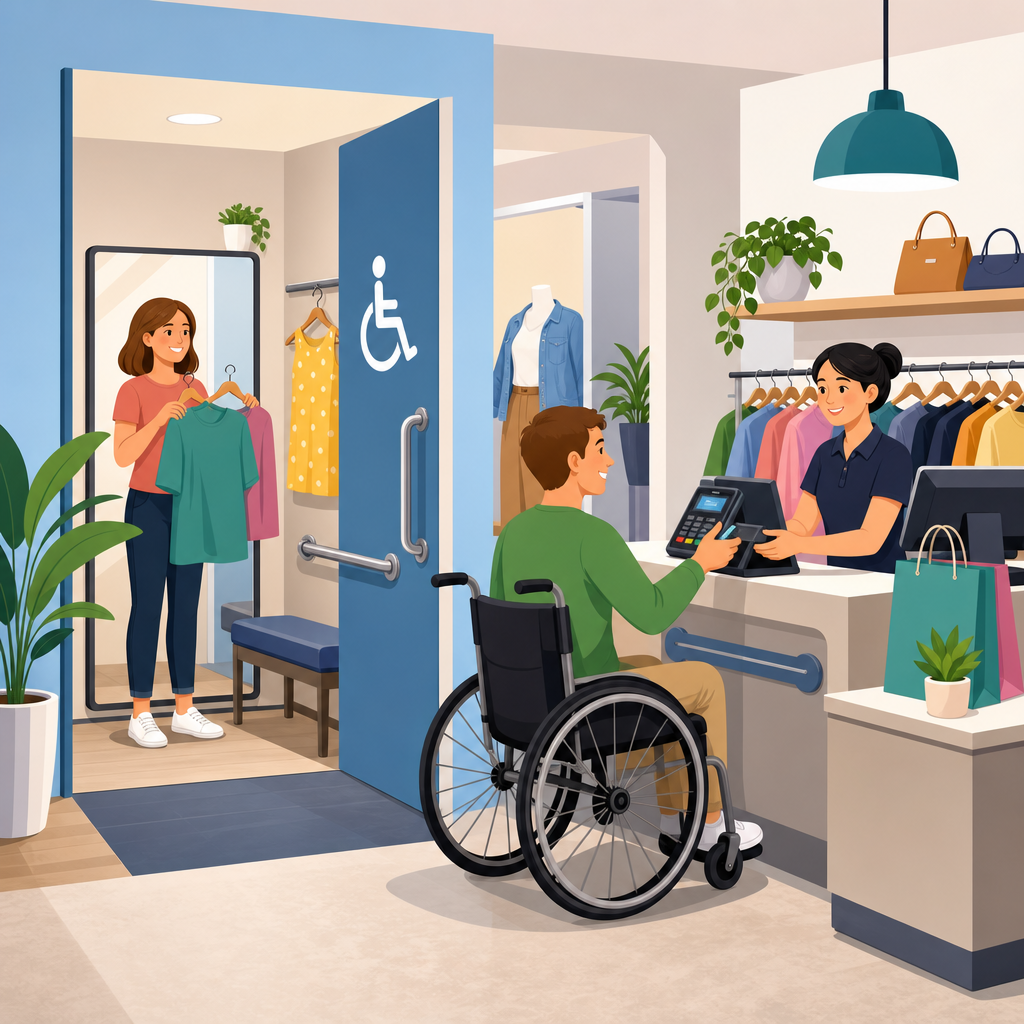
Accessible fitting rooms must be located on an accessible route, provide adequate maneuvering space, and include features a customer can actually use without staff improvisation. In practice, that means at least one fitting room, and often more depending on store size and jurisdiction, should accommodate wheelchair users and others who need additional space. A compliant room generally includes a wider clear entry, turning space for a mobility device, a bench, accessible door hardware, and coat hooks or shelves within reachable height ranges. If the room exists on paper but is packed with restock cartons, broken seating, or inward-swinging obstacles, it is functionally inaccessible.
Retailers frequently underestimate how operational choices break accessibility. I have seen fitting rooms pass plan review and then fail in use because associates stored returns racks inside, added decorative stools that blocked transfers, or allowed damaged latches to remain unrepaired. Apparel chains also create barriers by placing accessible rooms at the far end of narrow fixture runs, making the route difficult during peak traffic. Good design starts with dimensions, but good operations keep the room usable every hour the store is open. Daily opening checklists should include the accessible fitting room, not just general fitting room cleanliness.
Privacy and independence are central. A customer should not need to ask for a special key, wait for a manager, or explain a disability to gain access unless a locking policy applies uniformly to all fitting rooms. Benches should be stable, mounted properly, and positioned to support transfers. Mirrors should allow use from seated and standing positions whenever possible. Hooks and shelves should be easy to reach, because inaccessible storage forces customers to place personal items on the floor. Call buttons are not always legally required, but in large format stores they can improve safety and service if maintained and answered promptly.
Retailers in fashion, uniforms, lingerie, sportswear, and children’s apparel should connect fitting room accessibility to conversion rates. Customers often abandon apparel purchases when trying on clothes is difficult or humiliating. An accessible room that is easy to find, clean, and available can directly improve sell-through in categories with high fit variability. It also reduces return risk, including online orders tried on in store. For hub-level planning, related topics include accessible signage, aisle width management, adaptive apparel merchandising, and staff assistance protocols.
Accessible checkout counters: height, reach, payment, and service flow
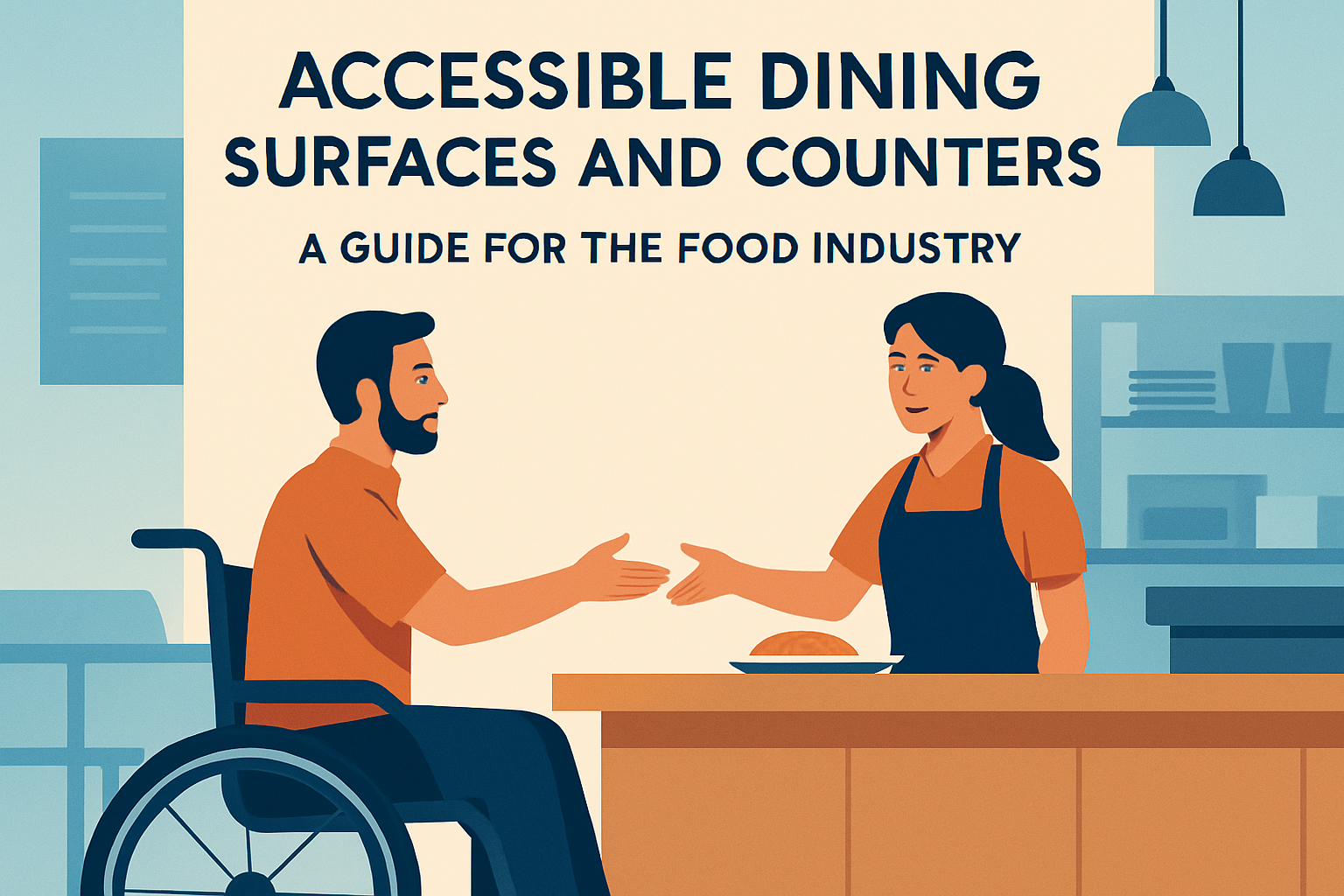
Checkout accessibility depends on more than counter height. The ADA framework generally requires that sales and service counters provide an accessible portion with an appropriate surface height and clear floor space for forward or parallel approach. In plain terms, a customer using a wheelchair should be able to approach, place items, review a receipt, sign if needed, and complete payment without stretching beyond reasonable reach or conducting the transaction awkwardly on their lap. The accessible portion must be integrated into normal service, not hidden at a separate desk that slows the process or signals that the customer is an exception.
Payment hardware introduces another layer. Card readers, PIN pads, signature screens, barcode scanners, loyalty keypads, and bagging shelves must be located so customers can use them with limited reach, grip strength, or vision. Too often, stores install a compliant counter and then mount the payment terminal on a tall stand beyond accessible reach. Wireless handoff terminals can solve this problem, but only if batteries are charged and staff are trained to present them naturally. For blind or low-vision customers, audible prompts, tactile keypads, and clear verbal guidance matter. For deaf or hard-of-hearing customers, written confirmation and screen visibility matter just as much.
Queue design affects accessibility at checkout. Narrow serpentine lines, promotional bins near lane entrances, and portable sign stands often constrict the accessible route. Self-checkout zones can be especially problematic when one nominally accessible station is blocked by baskets or has a software flow that times out before a customer can complete each step. Retailers should evaluate staffed lanes, self-checkout, service desks, and pickup counters as one system. If the only accessible counter is at customer service, but returns and pickups regularly create ten-minute waits, the shopping trip remains inequitable.
| Area | Common barrier | Better retail practice |
|---|---|---|
| Fitting room | Accessible room used for storage | Include room in opening audits and prohibit stock storage |
| Checkout counter | Card reader mounted too high or too far | Use movable terminals and verify reach during installation |
| Queue | Promotional displays narrow the route | Set fixture boundaries and inspect during floor walks |
| Self-checkout | Accessible station blocked or timed out | Keep clear floor space open and adjust software timing |
| Pickup desk | High counter only | Provide a lowered service surface within the main desk |
From an operations standpoint, checkout accessibility should be tested with real transactions. Run purchases involving coupons, age verification, returns, gift cards, split tender, and digital receipts. If an associate must leave the lane to fetch a clipboard or move merchandise every time an accessible counter is used, the process is not working. Strong retailers map each transaction type and remove friction before complaints arise.
Compliance, policy, and risk management for retail leaders
Retail accessibility sits at the intersection of civil rights law, building code, brand standards, and frontline behavior. In the United States, the ADA establishes core obligations for places of public accommodation, but retailers must also review state codes, lease obligations, and local permitting requirements. Existing stores face different technical questions than newly built locations, yet both can generate complaints if barriers are not addressed. The most costly mistakes usually come from assuming that a one-time construction review is enough. It is not. Accessibility must be managed continuously because movable merchandise, damaged hardware, staffing practices, and remodel decisions change conditions every week.
Risk management starts with an accurate inventory. Every store should know how many accessible fitting rooms it has, where they are located, whether routes remain clear, which counters provide accessible service, and what condition key features are in. Photographic audits help, but in-person verification is essential. I recommend pairing facilities teams with store operations and loss prevention because each group notices different issues. Facilities sees hardware failures, operations sees traffic flow, and loss prevention often controls queue stanchions, gates, and fixture placement that can create barriers.
Policies should answer basic questions clearly. Can associates reserve the accessible fitting room for any customer who requests extra space, provided it remains available when needed by disabled customers? How quickly must blocked routes be cleared? Who replaces broken benches, latches, and payment terminal mounts? What is the escalation path if a landlord-controlled area affects access? Without written ownership, problems linger. Retailers should also document temporary alternative service methods for outages, such as mobile checkout, but those alternatives should never become a substitute for repairing inaccessible permanent features.
Complaint handling deserves executive attention. When a customer reports an inaccessible fitting room or checkout lane, the first response should focus on fixing the barrier, not disputing the experience. Good records include the exact store location, date, photographs, dimensions if relevant, corrective action, and verification of completion. Trend analysis matters. Three minor complaints across a region may point to a prototype issue in millwork, payment terminal placement, or fixture planning. Hub topics that branch from this section include ADA retail audits, maintenance documentation, and accessibility governance across multi-site portfolios.
Training, maintenance, and omnichannel execution
Even well-designed stores fail customers when employees are unprepared. Training should show associates how to support shoppers without patronizing them, how to keep accessible spaces clear, and how to offer assistance only when needed. In fitting rooms, staff should know how to prioritize the accessible room, explain wait times neutrally, and avoid using disability as a public discussion point. At checkout, they should know how to reposition a card reader, read totals aloud when requested, and complete bagging or receipt handling respectfully. This training belongs in new-hire onboarding, manager refreshers, and seasonal ramp-up sessions, because temporary staff often work the busiest periods.
Maintenance is where accessibility programs either become credible or collapse. Benches loosen, automatic door hardware drifts out of adjustment, door closers become heavy, and payment terminals get replaced during technology upgrades. Retailers should include accessibility checkpoints in preventive maintenance systems such as CMMS platforms, not rely solely on customer complaints. Mystery shops can help, but store manager self-audits are faster and cheaper when backed by clear photographic standards. A strong cadence is monthly self-checks, quarterly district verification, and annual specialist review for higher-risk formats such as apparel flagships and high-volume big box locations.
Because this hub covers retail and e-commerce together, physical accessibility must connect to digital workflows. A customer may order multiple sizes online, visit the store to try them on, and return unwanted items immediately. If the fitting room is inaccessible, the omnichannel promise breaks. The same applies to pickup counters and return desks. Product pages should disclose fitting room availability where relevant for appointment-based stores, and store locator pages should provide accessibility details in plain language. Customer service teams should be able to answer whether a location has an accessible fitting room or lowered counter without guessing.
Retailers that lead in this area build accessibility into prototype design, procurement, digital product data, and field operations from the start. They test stores with disabled users, review complaints as operational intelligence, and treat inclusive service as a competitive advantage grounded in execution. If you manage retail facilities, store operations, design, or e-commerce, audit your fitting rooms and checkout counters now, fix the barriers customers encounter most often, and use this page as the foundation for a broader retail accessibility program.
Frequently Asked Questions
1. Why are accessible fitting rooms and checkout counters so important in retail settings?
Accessible fitting rooms and checkout counters are essential because they directly affect whether customers can shop independently, comfortably, and with dignity. For many people with mobility, dexterity, sensory, or cognitive disabilities, these areas are not minor convenience features; they are the points where a shopping trip either succeeds or fails. A customer may be able to enter a store and browse merchandise, but if they cannot get into a fitting room, maneuver a wheelchair inside, reach a call button, set down personal items, or complete a transaction at the counter, the store has not delivered equal access.
From a customer service perspective, accessibility improves the shopping experience for a wide range of people, including wheelchair users, customers who use walkers or canes, older adults, people recovering from injuries, parents with strollers, and individuals who need more space, seating, or clearer communication. These features also help staff serve customers more efficiently because the store environment is already designed to reduce barriers rather than requiring improvised assistance.
There is also a strong legal and operational reason to prioritize accessibility. In many jurisdictions, including under the Americans with Disabilities Act in the United States, retailers have responsibilities to provide accessible spaces and service features. Failing to address fitting rooms and checkout counters can create legal exposure, customer complaints, reputational damage, and lost sales. Most importantly, accessible design communicates that all customers are welcome and valued, which strengthens trust, loyalty, and brand credibility.
2. What features should an accessible fitting room include?
An accessible fitting room should be large enough for a customer using a wheelchair, scooter, walker, or other mobility device to enter, turn, and position themselves safely. The entrance should provide sufficient clear width, and the route to the fitting room should remain free of clutter, merchandise racks, and temporary displays. Inside the room, customers should have enough maneuvering space to use the room without struggling with tight corners, blocked paths, or awkward door swings.
Seating is another important element. A stable bench can help customers who need to sit while changing, resting, or organizing clothing. Hooks, shelves, and mirrors should be placed at usable heights so customers can hang garments, store belongings, and view clothing without overreaching. Flooring should be firm and slip-resistant, and lighting should be bright and even enough to support visibility without causing harsh glare.
Privacy and ease of use matter as well. Doors, curtains, latches, and handles should be easy to operate for people with limited dexterity. If a call system is used, it should be reachable and functional so a customer can request assistance without having to leave the room or struggle to get attention. Staff should also understand how to support customers respectfully, including asking before assisting and honoring privacy during the fitting process.
Retailers should think beyond minimum dimensions and consider the entire user experience. An accessible fitting room is not truly accessible if it is routinely used for storage, hidden in a difficult-to-reach area, or kept locked without a clear process for access. The best approach is to keep accessible rooms available, maintained, clean, and integrated into normal store operations so that customers can use them in the same straightforward way as everyone else.
3. How should retailers design and manage accessible checkout counters?
Accessible checkout counters should allow customers to approach, communicate with staff, place items, review purchases, and complete payment without unnecessary barriers. At least part of the counter should be positioned at a height usable by customers who are seated or who have limited reach. There should also be enough clear floor space in front of the counter for wheelchair access and turning, with pathways that remain open and free from impulse displays, carts, bins, or stacked merchandise.
Payment equipment deserves special attention. Card readers, signature devices, and touchscreens should be within reach and positioned so customers can use them without stretching, twisting, or depending entirely on staff. If a device cannot be moved or adjusted, it may create a real barrier during checkout. Visual displays should be readable, and staff should be prepared to communicate totals, prompts, and receipts clearly for customers with vision, hearing, cognitive, or speech-related disabilities.
Good accessible checkout design also includes operational practices. Retailers should avoid treating the accessible counter as a back-up station that is closed most of the time or blocked by signage and displays. If only one accessible point of sale exists, it should be staffed or readily available whenever checkout service is being offered. Customers should not have to wait significantly longer or be sent to a separate area just to complete a purchase.
In addition, staff training is critical. Employees should know how to offer assistance appropriately, how to handle communication needs respectfully, and how to make basic adjustments such as turning a payment terminal, reading out options when requested, or providing extra time. A truly accessible checkout counter combines compliant physical design with consistent, customer-centered service.
4. What are the most common mistakes retailers make with accessible fitting rooms and checkout counters?
One of the most common mistakes is assuming that having an accessible feature on paper is the same as providing real access in practice. For example, a fitting room may technically meet size requirements but be used for storage, filled with boxes, or placed at the end of a narrow aisle crowded with merchandise. Similarly, an accessible checkout counter may exist, but if it is constantly blocked by product displays, turned into a returns station with no room to approach, or equipped with an unreachable payment terminal, customers still face barriers.
Another frequent problem is poor maintenance. Broken door hardware, loose curtains, nonfunctional call buttons, damaged benches, burnt-out lighting, or cluttered floor space can quickly make accessible features unusable. Retailers sometimes invest in the initial buildout but fail to create inspection routines that keep these spaces functional day to day. Accessibility should be monitored the same way retailers monitor safety, cleanliness, and point-of-sale performance.
Staff behavior can also create avoidable issues. Employees may not know where the accessible fitting room is, may not understand that it must remain available, or may respond to disability-related requests inconsistently. Some staff members may help too quickly without asking, while others may avoid helping at all because they are unsure what is appropriate. Both responses can damage the customer experience.
A final mistake is treating accessibility as a one-time compliance project instead of an ongoing service standard. Store layouts change, seasonal fixtures come and go, checkout technology evolves, and staffing turns over. Retailers should regularly audit how fitting rooms and counters function in real conditions, gather customer feedback, and update procedures as needed. The goal is not just to pass an inspection, but to make sure every customer can shop, try products on, and pay with confidence and independence.
5. How can retailers improve accessibility in existing stores without a full remodel?
Many retailers can make meaningful improvements without undertaking a complete renovation. A strong first step is conducting an accessibility walkthrough focused specifically on the customer journey: entering the store, moving through aisles, reaching the fitting room, using it comfortably, approaching checkout, and paying independently. This kind of review often reveals operational barriers that can be fixed quickly, such as blocked routes, misplaced fixtures, hard-to-reach payment devices, or accessible rooms being used for storage.
Low-cost improvements can have a major impact. Retailers can widen pathways by repositioning racks, ensure at least one fitting room remains clear and available, install easy-to-grip hardware, add a stable bench, lower or relocate hooks and shelves where feasible, improve lighting, and place mirrors for better usability. At checkout, stores can move displays away from access routes, adjust queue layouts, provide a lower transaction surface where possible, and use movable or flexible payment terminals that are easier for customers to reach.
Training is one of the most effective upgrades because it improves service immediately. Staff should know how to keep accessible features usable, how to communicate respectfully with customers with different disabilities, and how to provide assistance without being intrusive. They should also understand that accessibility is part of everyday operations, not a special exception. Regular reminders, checklists, and manager oversight can help maintain standards.
Retailers should also invite feedback and treat it as valuable operational insight. Customer comments, mystery shopping, internal audits, and accessibility consultations can help identify gaps that are easy to miss. Even when structural changes are limited by budget or building constraints, stores can still remove many barriers through better layout choices, maintenance, policy changes, and employee readiness. In practice, accessibility improvements often lead to smoother traffic flow, better service, and a more inclusive brand experience for everyone.