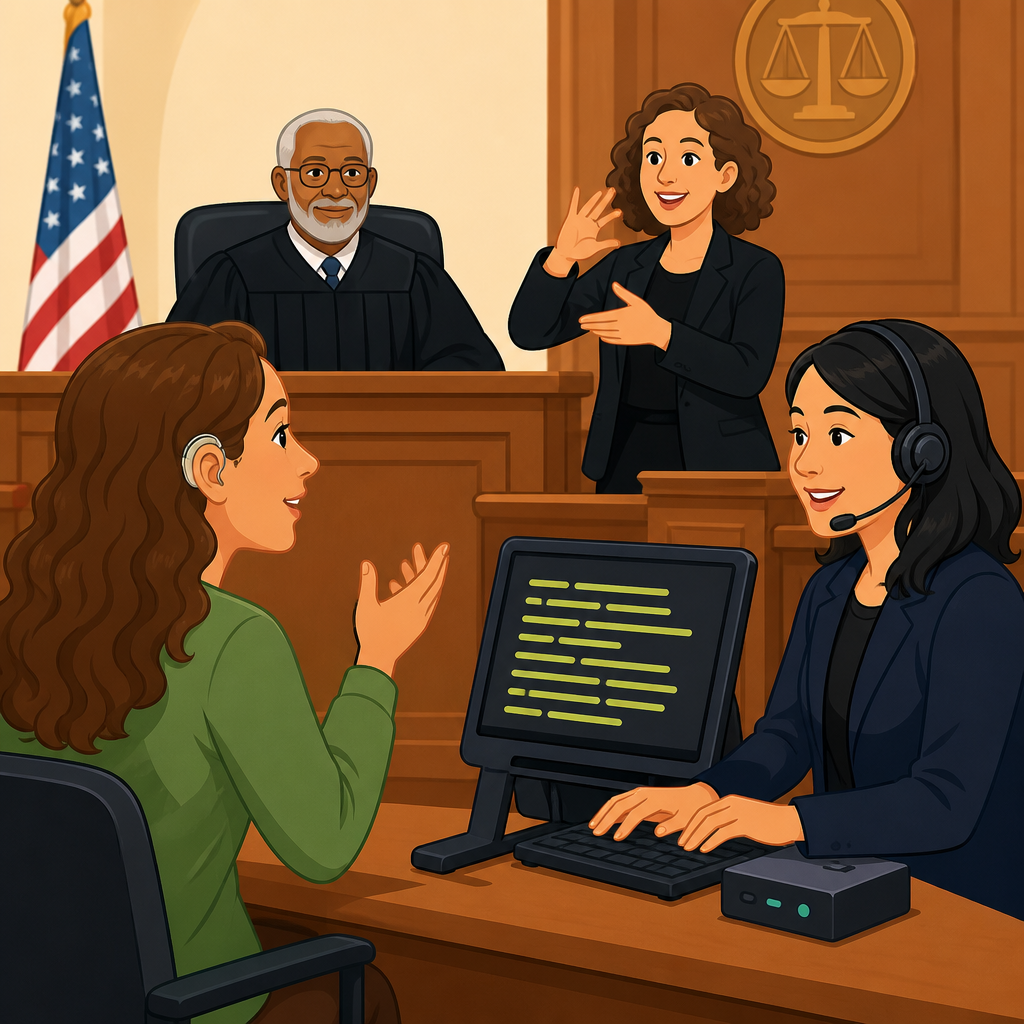
When a court user needs CART instead of a sign language interpreter, the issue is not preference or convenience; it is whether the court is providing communication access that is actually effective. In legal settings, “effective communication” means a person with a communication disability can understand and participate with accuracy, timeliness, and independence comparable to other court users. CART, or Communication Access Realtime Translation, converts spoken words into text as they are spoken, usually displayed on a screen, laptop, or tablet. A sign language interpreter conveys spoken language into a signed language such as American Sign Language. These services overlap in purpose, but they are not interchangeable. I have worked on accessibility planning where agencies assumed that booking an interpreter solved every hearing-related access request, and that assumption repeatedly caused preventable barriers.
This distinction matters because court proceedings are dense, fast, technical, and high stakes. A missed word can affect testimony, plea decisions, protective orders, custody outcomes, or compliance with a sentence. Many deaf and hard of hearing people do not use sign language as their primary language. Some lost hearing later in life, some are not fluent in ASL, some have additional disabilities affecting language processing, and some simply understand written English more reliably than interpreted signing in a courtroom context. Others may need both CART and an interpreter, depending on the event. Rights and protections in action therefore begin with an individualized assessment, not a one-size-fits-all accommodation list. This hub explains how that principle works in practice, where courts get it wrong, what standards apply, and how real-world case patterns can guide better decisions across filings, hearings, jury service, family court, criminal court, and court-connected services.
Why CART may be the legally appropriate accommodation
CART is often the right accommodation when the court user needs a verbatim or near-verbatim text display of proceedings rather than language translation into signing. In practice, that includes late-deafened adults, hard of hearing people who do not sign, people with auditory processing disabilities, and deaf users who prefer text for precision. A qualified CART provider listens to the proceeding and produces realtime text with speaker identification and punctuation conventions that support comprehension. In contrast, an interpreter is making language choices, condensing where necessary, and conveying meaning in a different modality. That is a skilled and valuable service, but it serves a different access need.
The governing legal concept is that public courts must provide auxiliary aids and services that result in effective communication, absent a fundamental alteration or undue burden. In the United States, that obligation is rooted principally in Title II of the Americans with Disabilities Act and reinforced by Section 504 for covered entities receiving federal funds. The Department of Justice has long emphasized that the public entity must give primary consideration to the person’s requested aid or service. Primary consideration does not mean the request is automatically granted in every circumstance, but it does mean the court needs a strong, fact-based reason to choose something else. “We always provide interpreters” is not enough. Neither is “CART costs more,” without a real undue burden analysis at the agency level.
In courtroom use, the practical advantages of CART are straightforward. Realtime text captures legal terminology, proper names, numbers, dates, case citations, and rapid colloquy more precisely for many readers than signed interpretation alone. A litigant can review the line just displayed, reducing the cognitive load of remembering a long oral statement. During voir dire, sidebar-adjacent discussions that are audible in open court, or multi-speaker exchanges, text can preserve sequence in a way that helps the user follow who said what. For some people, especially those with residual hearing, combining CART with hearing technology such as an assistive listening system produces the best access.
Common court scenarios where CART is needed instead of interpretation
Real-world applications show why the analysis must be individualized. In a protection order hearing, a petitioner who became deaf as an adult may read English fluently but know little or no ASL. If the court assigns an interpreter anyway, the petitioner is forced to receive information in a language they do not use. In a criminal arraignment, a hard of hearing defendant may catch fragments of speech but miss conditions of release, fines, and future court dates unless CART is provided. In a child custody trial, a parent with hearing loss may need to track expert testimony loaded with clinical terminology; realtime text can be the only practical way to do that accurately.
Jury service creates another recurring case study. Courts often think only about parties and witnesses, but prospective jurors and seated jurors are also court users. A deaf juror who does not use sign language may need CART for voir dire, instructions, and open-court proceedings. Deliberation presents a separate challenge because confidentiality, room setup, and equipment logistics must be handled without compromising access. Courts that plan ahead can provide secure CART or onsite captioning support while maintaining the secrecy of jury discussions. Courts that do not plan often exclude qualified jurors unnecessarily, creating both legal risk and a loss of civic participation.
Clerk’s offices, self-help centers, mediation programs, probation intake, and court-ordered classes also belong in this discussion. Access failures often happen before the judge enters the courtroom. I have seen agencies correctly arrange an accommodation for the hearing itself but leave the person without access during check-in, settlement conferences, or orientation sessions. Effective communication must cover the full court process. If a person needs CART to understand a mediation session or to communicate with staff about filing deadlines, providing only an interpreter at the final hearing does not cure the earlier barrier.
How courts should evaluate accommodation requests
The strongest accessibility systems use a simple sequence: ask, assess, confirm, implement, and review. First, the court should ask what accommodation the person needs for each event, because needs can vary by task. A litigant may use CART for hearings, an assistive listening device for short clerk interactions, and captioned remote platforms for status conferences. Second, staff should assess operational details without second-guessing the disability itself. Relevant questions include whether the event is in person or remote, estimated duration, number of speakers, confidentiality constraints, and whether the user needs a display visible only to them or to counsel as well.
Third, the court should confirm the accommodation in writing with enough specificity to prevent day-of confusion. “Interpreter requested” is too vague; “onsite CART with personal display, arrival thirty minutes early, covering clerk intake and hearing” is usable. Fourth, implementation requires qualified providers and tested technology. Remote CART can work well, but only with clean audio, reliable internet, microphones for all speakers, and a judge willing to manage turn-taking. Fifth, review what happened. If the caption feed lagged, if side comments were inaudible, or if the user still missed bench directions, that information should improve the next event.
| Scenario | Why interpreter alone may fail | Why CART may be effective |
|---|---|---|
| Late-deafened litigant in family court | User does not know ASL well enough for legal discussion | Realtime text matches user’s strongest receptive language |
| Hard of hearing defendant at arraignment | Fast exchanges and legal terms are easily missed | Text preserves names, dates, release conditions, and fines |
| Deaf juror during voir dire | Multiple speakers make signed tracking difficult for some users | Captioning identifies speakers and supports review of questions |
| Remote mediation session | Platform audio and overlap reduce interpretation clarity | Remote CART provides a synchronized text stream on screen |
Frequent mistakes and what real cases teach
The most common mistake is substituting staff assumptions for the court user’s stated communication method. Staff may think CART is only for public events, only for remote meetings, or only for people who are not deaf. All of those assumptions are wrong. Another mistake is treating cost as a routine basis for denial. Accessibility law does allow consideration of undue financial and administrative burdens, but that is a high-level determination, not an offhand response from a scheduling clerk. Courts also stumble when they rely on family members, opposing counsel, or note writing during complex proceedings. Those substitutes rarely provide effective communication in legal matters.
Case patterns from enforcement actions and settlement agreements consistently point in the same direction: courts must have a process, train staff, and avoid blanket rules. When agencies lose these disputes, it is often because the record shows they ignored the individual request, failed to explore alternatives, or waited until the hearing date to improvise. In my experience, the day-of scramble is where rights fail in practice. The provider cannot hear the witness from the back row, the laptop has no power outlet, the remote feed is muted during side discussions, or the user is told to sit where they cannot see both the judge and the text. None of this is inevitable. It reflects planning failures, not legal ambiguity.
Real-world applications also show that hybrid solutions can be necessary. A deaf witness might need an interpreter to give testimony in ASL, while a hard of hearing parent in the gallery needs CART to follow the same hearing. A lawyer with hearing loss may use CART for trial but prefer captioned telephones for scheduling calls. Courts do better when they stop asking which service is “better” in the abstract and start asking which service is effective for this person, in this setting, for this task.
Building a rights-centered court access system
As a hub for rights in action, this topic connects case studies to operational practice. The best courts create written accommodation policies, centralized request channels, vendor protocols, bench cards for judges, and post-event feedback loops. They also map the full user journey: website notice, request form, confirmation message, security screening, clerk interaction, waiting areas, hearing rooms, remote links, and follow-up orders. Every handoff is a potential access point or access failure. A rights-centered system anticipates both.
Training should be role-specific. Clerks need scripts for receiving requests without demanding unnecessary medical proof. judges need guidance on pace, microphone use, speaker identification, and handling objections or sealed matters with accommodation providers present. IT staff need standards for audio routing, platform captions, and backup connections. Procurement teams should understand qualifications, confidentiality expectations, and scheduling lead times for CART vendors. These details sound administrative, but they determine whether the legal right becomes a lived reality.
This sub-pillar also supports related articles on remote hearings, jury service, witness testimony, family court access, criminal procedure, and complaints when accommodations are denied. Together, those pages should help readers move from rule statements to application. The central lesson remains simple: if a court user needs CART instead of a sign language interpreter, the court must evaluate that request seriously and provide the aid that delivers effective communication. Start by reviewing your court’s accommodation process, updating request forms to name CART clearly, and checking whether every stage of the court experience is truly accessible.
Frequently Asked Questions
When does a court user need CART instead of a sign language interpreter?
A court user may need CART instead of a sign language interpreter when real-time written text is the only accommodation that provides effective communication in court. This often applies to people who are deaf or hard of hearing but do not use American Sign Language, people who lost hearing later in life, individuals who rely on English text for accuracy, and court users with communication disabilities who process spoken language better through live captions than through signing. In court, the standard is not whether an accommodation is commonly offered or easier to schedule. The question is whether the person can follow what is happening, review exact wording as it is spoken, and participate with a level of accuracy, timeliness, and independence comparable to everyone else in the courtroom. Because legal proceedings involve fast speech, specialized terminology, names, objections, instructions, and testimony that can affect rights and outcomes, a sign language interpreter may not be effective for someone who does not understand sign language well enough or who needs a verbatim text display to keep up. In those situations, CART is not a convenience. It is the auxiliary aid that may be necessary to make communication truly accessible.
What is CART, and why can it be especially important in legal proceedings?
CART stands for Communication Access Realtime Translation. A trained provider listens to spoken communication and converts it into live text that appears on a screen, laptop, tablet, or other display in real time. In a court setting, CART can be especially important because it gives the court user immediate visual access to what is being said by judges, attorneys, witnesses, clerks, and other participants. Legal proceedings are often dense, fast-moving, and highly precise. Missing a single date, name, instruction, or objection can create confusion or affect a person’s ability to make decisions, respond appropriately, or understand what happened in their own case. CART helps address that problem by presenting spoken language in text as it is spoken, allowing the court user to read along, track details, and participate more independently. It can also reduce misunderstandings where sign language is not the person’s primary language or where the person’s communication needs are better met by written English. In practical terms, CART can improve accuracy, support note-taking and comprehension, and provide a more direct path to equal participation in hearings, conferences, trials, and other court events.
Is it enough for the court to offer a sign language interpreter if the person specifically requests CART?
No. If the person specifically requests CART and explains that a sign language interpreter will not provide effective communication, the court should not assume that offering any hearing-related accommodation is automatically sufficient. Courts generally must provide an auxiliary aid or service that is effective for the individual’s actual communication needs. That means the analysis is individualized, not generic. A sign language interpreter may be fully effective for one court user and completely ineffective for another. If the person does not use sign language, uses it only in a limited way, or needs real-time text to understand legal language accurately and independently, then substituting an interpreter for CART may fail to provide equal access. Courts can consider logistics and available options, but they should give primary consideration to the accommodation that will actually work for the person, especially when the stakes involve due process, comprehension of legal rights, and meaningful participation. In short, the issue is not whether the court offered something. The issue is whether the court offered communication access that is timely, accurate, and genuinely usable for that individual in that specific legal context.
How does CART support effective communication, accuracy, and independence in court?
CART supports effective communication by turning spoken information into readable text in real time, which can be critical in a courtroom where every word may matter. Accuracy is important because court users need to understand names, legal terms, procedural instructions, dates, conditions, and testimony without guessing or relying on partial information. CART can help a person catch details that might otherwise be missed in a rapid or complex exchange. Timeliness matters too, because communication in court cannot be meaningfully accessible if the person receives information too late to respond, consult with counsel, object, or make informed choices. Independence is another key part of effective communication. With CART, the individual can often follow the proceeding directly from the text display instead of depending on another person to summarize or clarify after the fact. That direct access can improve privacy, reduce reliance on third parties, and allow more confident participation in the moment. In many legal situations, especially those involving extensive dialogue or technical language, CART offers a level of immediacy and precision that is essential to equal access, not merely helpful.
What should a court user do if they need CART for a hearing, conference, or trial?
A court user who needs CART should make the request as early as possible and be clear that CART is necessary for effective communication, not just preferred. The request should identify the proceeding, the date if known, and explain that the person needs Communication Access Realtime Translation because a sign language interpreter or another accommodation would not allow them to understand and participate accurately, timely, and independently. It can also help to describe the person’s communication needs in practical terms, such as not using sign language, relying on live text to process spoken English, needing to follow exact wording, or requiring captioning to keep up with legal discussions. If the court has an accommodation form or ADA request process, the person should use it, but a request should still be evaluated based on effectiveness even if made informally. If the court proposes a different accommodation, the court user should explain specifically why that alternative will not work in the courtroom setting. Keeping copies of emails, forms, and responses is also a good idea. If problems continue, the person may ask to speak with the court’s ADA coordinator or access coordinator and restate that the legal standard is effective communication. The goal is to ensure the accommodation provided actually allows full and equal participation in the proceeding.