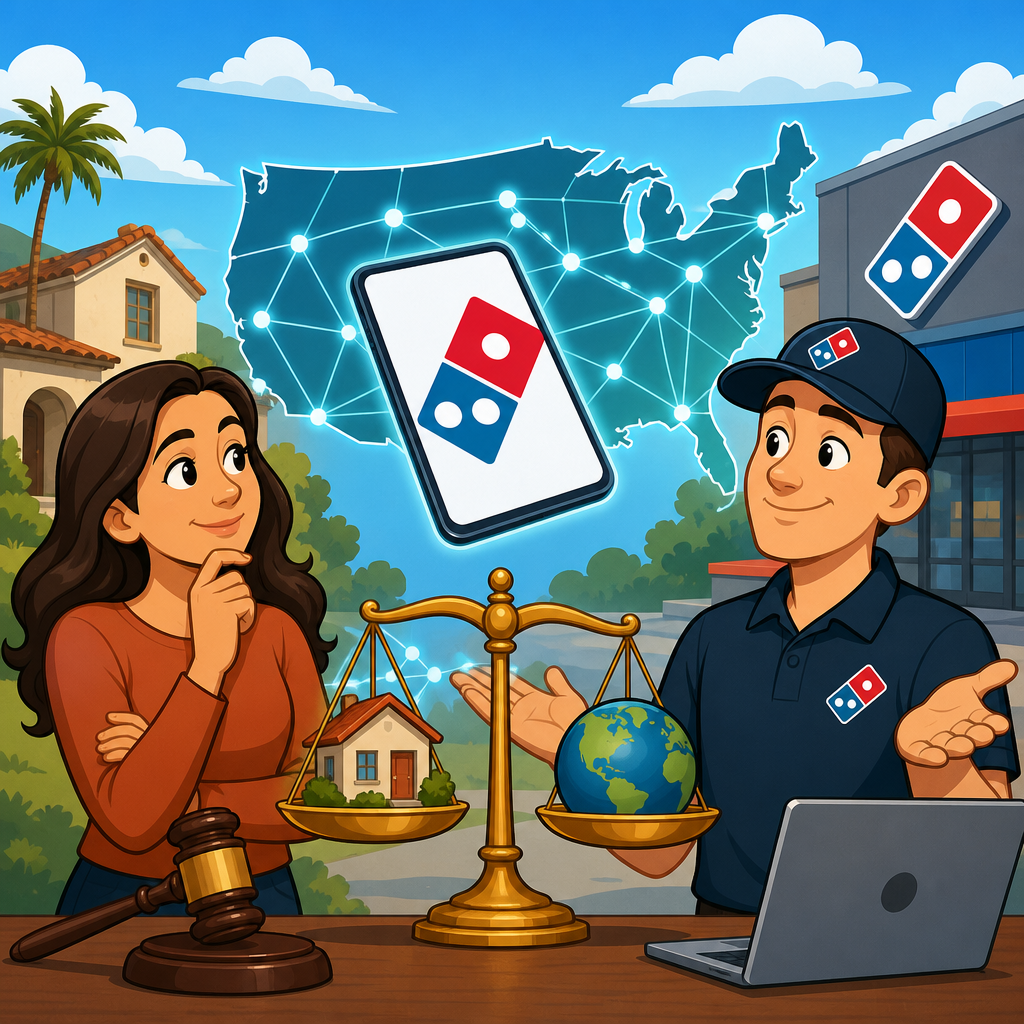
Robles v Domino’s and the digital nexus debate sit at the center of modern disability law because they ask a practical question every business now faces: when a customer uses a website or mobile app to reach a physical store, do accessibility rules apply online? The case became a landmark in discussions about the Americans with Disabilities Act, especially Title III, which governs places of public accommodation such as restaurants, hotels, retailers, theaters, banks, and service establishments. For lawyers, compliance teams, designers, and business owners, the case matters far beyond pizza ordering. It helped define how courts analyze the connection between digital tools and brick-and-mortar locations, a concept often called the digital nexus. In plain terms, nexus means a link. In ADA litigation, it refers to whether an inaccessible website or app is sufficiently tied to a physical place that is already covered by disability access law. I have worked with organizations auditing digital customer journeys after demand letters, and Robles is one of the first cases everyone reads because it explains why online barriers can block equal access to goods and services in the real world.
This article serves as a hub for influential ADA cases in employment and public access, with Robles as the anchor for the public access side and with related employment decisions providing contrast. The ADA has several titles, and that distinction is essential. Title I regulates employment and applies to covered employers. Title III regulates private businesses open to the public. Different titles create different duties, defenses, remedies, and litigation patterns, yet the cases often intersect around a shared principle: disability discrimination includes barriers that prevent equal participation. Over the last three decades, courts have debated what counts as a barrier, whether technology falls within older statutory language, and how far businesses must go to provide effective access. The result is a patchwork of precedent shaped by the text of the ADA, Department of Justice enforcement positions, technical standards such as WCAG, and the realities of how people shop, work, apply, schedule, and communicate today. Understanding Robles means understanding that larger map of precedent.
The reason this subject matters is simple: accessibility disputes are no longer confined to wheelchair ramps and parking spaces. They now include online job applications, employee software, websites, mobile apps, self-service kiosks, video content, and digital documents. Plaintiffs have used the ADA and related state laws to challenge inaccessible systems in both employment and consumer settings, while defendants have argued due process, standing, mootness, and the limits of statutory text. Courts have responded in different ways, but several influential decisions now guide compliance strategy. Some cases broadened protection, some narrowed it, and some clarified procedural rules. Together they shape how organizations evaluate risk and how disabled people secure access. For any reader tracking legal cases and precedents, the key is to see Robles not as an isolated ruling but as one node in an evolving framework for public access and employment accessibility.
Robles v Domino’s: what the Ninth Circuit actually decided
Robles v Domino’s Pizza, LLC arose after Guillermo Robles, a blind plaintiff, alleged that Domino’s website and mobile app were incompatible with his screen reader and therefore prevented him from ordering customized pizzas and accessing promotions available to other customers. Domino’s argued that applying Title III to its digital platforms without formal Department of Justice regulations would violate due process. The Ninth Circuit rejected that argument in 2019. Its core holding was straightforward: Title III applies when the alleged inaccessibility of a website or app impedes access to the goods and services of a place of public accommodation. Domino’s physical restaurants were unquestionably public accommodations, and the digital tools connected customers to those restaurants. That connection was enough for the court. The Supreme Court later declined review, which left the Ninth Circuit decision in place and amplified its practical influence nationwide.
The decision did not hold that every website everywhere is automatically covered by Title III. That nuance is where the digital nexus debate comes from. The Ninth Circuit focused on the website and app as gateways to the goods and services of physical restaurants. Customers used them to locate stores, build orders, redeem coupons, and complete purchases for pickup or delivery. Inaccessibility therefore had a real-world exclusionary effect. The court also said Domino’s had fair notice of its general obligation to provide effective communication and auxiliary aids under the ADA, even without detailed technical regulations specifying code-level requirements. In practice, that meant a business could not avoid accessibility duties simply because the government had not prescribed one exact engineering checklist. For compliance teams, this was critical: the absence of a regulation is not the absence of an obligation.
From my experience reviewing digital remediation plans, Robles changed boardroom conversations because it made litigation risk concrete. Before Robles, many companies treated web accessibility as a niche issue or as something pending future rulemaking. After Robles, they began asking operational questions: Does the app support VoiceOver and TalkBack? Can a screen reader user complete payment without encountering unlabeled buttons? Are online-only discounts also available through an accessible channel? Those are the practical questions the case forces. The lesson is not merely legal. Accessibility failures in a digital ordering path can exclude users at the exact point of transaction, which is why courts view these barriers as discrimination rather than a minor usability defect.
The digital nexus debate and the split over online-only coverage
The phrase digital nexus describes a judicial approach, not a statutory term. Courts using this approach ask whether the challenged website, app, or digital service has a sufficient connection to a covered physical location. If yes, Title III likely applies. If no, some courts are less willing to extend coverage. This framework developed because the ADA was enacted in 1990, before e-commerce and smartphones became routine. Judges therefore had to interpret text referring to places of public accommodation in a world where many customer interactions happen through code and interfaces rather than storefronts alone.
Not every court has adopted the same view. The First Circuit’s decision in Carparts Distribution Center v Automotive Wholesaler’s Association, though older and not a website case in the modern sense, suggested that public accommodation is not limited strictly to physical structures. That reasoning has supported broader arguments that online-only businesses can also be covered. By contrast, some circuits have required a tangible link to a physical place. The Eleventh Circuit’s panel decision in Gil v Winn-Dixie initially embraced a narrower approach before later procedural developments limited its precedential force. The overall landscape remains uneven, which is why businesses operating nationally often choose a higher accessibility standard rather than betting on the most restrictive interpretation available in one jurisdiction.
A useful way to understand the debate is to compare three scenarios. A restaurant app used to order from local stores has a strong nexus. An airline kiosk interface inside an airport raises physical-and-digital overlap plus separate federal transportation rules. A purely digital subscription service with no customer-facing physical location presents the hardest question under a strict nexus model. Courts may divide on that third case, but Robles strongly supports coverage in the first. For most retailers, restaurants, banks, healthcare providers, and hospitality brands, that is enough to make digital accessibility a direct public access issue, not a future theoretical one.
| Case | Area | Main issue | Practical impact |
|---|---|---|---|
| Robles v Domino’s | Public access | Website and app tied to stores | Confirms digital barriers can violate Title III when linked to physical locations |
| Gil v Winn-Dixie | Public access | Retail website usability | Showed circuit disagreement and litigation volatility |
| Carparts v AWADA | Public access | Meaning of public accommodation | Supports broader nonphysical interpretation in some jurisdictions |
| US Airways v Barnett | Employment | Reasonable accommodation and seniority systems | Defines limits and presumptions under Title I |
| Toyota v Williams | Employment | Definition of disability | Narrow reading later superseded by the ADA Amendments Act |
| Chevron v Echazabal | Employment | Direct threat to self | Confirms employers may consider significant self-harm risks under EEOC rules |
Influential ADA public access cases beyond Robles
Robles is pivotal, but it sits within a longer line of public access decisions. National Federation of the Blind v Target was an early and highly watched case because it challenged the accessibility of a major retailer’s website. The court allowed claims to proceed where the website’s barriers impeded access to goods and services in physical stores, reinforcing the nexus concept years before Robles. The eventual settlement pushed many large retailers toward structured accessibility programs, including audits, policy adoption, training, and testing by disabled users. In practical compliance work, Target remains important because it demonstrated that litigation can produce durable operational changes rather than one-time code fixes.
Another significant decision is Spector v Norwegian Cruise Line Ltd., in which the Supreme Court held that Title III could apply to foreign-flag cruise ships serving U.S. customers, subject to some limitations. The case was not about websites, yet it matters because it showed the Court reading the ADA functionally where businesses operate in American commerce and offer public services. That functional reasoning echoes in later digital disputes. Cases involving hotel reservation systems similarly expanded the concept of equal access by recognizing that the booking process itself can be discriminatory when critical accessibility information is missing or when online systems are unusable.
Gil v Winn-Dixie deserves attention because many executives misread it as a permanent defense. The district court had found the grocery chain’s website inaccessible and ordered conformance measures, but later appellate proceedings complicated that outcome. The case illustrated two lessons. First, web accessibility law can shift quickly on standing, mootness, or interpretation. Second, relying on a favorable procedural turn in one circuit is a weak enterprise strategy when customer expectations, settlement pressure, and overlapping state statutes continue to drive claims. In other words, a temporary litigation win does not create accessible commerce.
Influential ADA employment cases and why they belong in this hub
A complete hub on influential ADA cases must include employment precedent because Title I shapes how organizations think about accommodation, undue hardship, essential functions, and disability definitions. US Airways, Inc. v Barnett is one of the most cited Supreme Court employment cases under the ADA. The Court held that a requested accommodation that conflicts with a bona fide seniority system is ordinarily not reasonable, although an employee may still show special circumstances. Barnett matters because it rejects simplistic rules. Employers must assess accommodation requests individually, but established workplace systems can carry significant weight.
Chevron U.S.A. Inc. v Echazabal addressed the direct threat defense. The Court upheld an EEOC regulation allowing an employer to refuse a job placement when the work would pose a direct threat to the employee’s own health due to disability. This is a narrow defense, not a license for paternalism. Employers need objective medical evidence and individualized assessment. I regularly see confusion here: managers assume any elevated risk justifies exclusion. Echazabal says otherwise. The analysis must be evidence-based, current, and tailored to the actual job duties and available accommodations.
Toyota Motor Manufacturing, Kentucky, Inc. v Williams once interpreted disability narrowly, requiring severe restrictions on activities central to daily life. Congress responded with the ADA Amendments Act of 2008, explicitly broadening coverage and directing courts to construe disability in favor of expansive protection. That legislative override is itself one of the most important ADA precedents because it changed how employment and public entities analyze threshold coverage. For employers, the modern lesson is clear: spend less time fighting over whether someone is disabled and more time evaluating accommodation, process, and performance evidence. Cases such as EEOC v Ford Motor Co., involving telework and essential functions, further show that workplace technology can be both an accommodation tool and a source of dispute when employers define attendance, collaboration, and job structure.
Compliance lessons for businesses, lawyers, and accessibility teams
The strongest takeaway from Robles and related ADA cases is that accessibility must be built into operations, not treated as a one-off legal patch. For public-facing digital systems, the most defensible baseline is WCAG 2.1 AA, increasingly supplemented by WCAG 2.2 criteria where feasible. Although courts do not always mandate a specific version in every order or settlement, WCAG remains the dominant technical benchmark in private settlements, consent decrees, and procurement standards. Businesses should pair automated scanning tools such as axe, WAVE, or Siteimprove with manual keyboard testing, screen reader testing, mobile assistive technology testing, and usability reviews by disabled participants. Automation alone cannot reliably catch focus order failures, ambiguous link text, broken form labels, or confusing error handling.
For employment systems, accessibility must cover the full lifecycle: recruiting pages, online applications, pre-employment assessments, onboarding portals, benefits platforms, training modules, internal communication tools, PDFs, and software used to perform essential duties. The legal analysis differs between applicants, employees, and customers, but the operational answer is similar. Map the user journey, identify points where disability-related barriers can block participation, assign ownership, and document remediation. Procurement language is especially important. Many organizations inherit risk through third-party software contracts that lack accessibility warranties, VPAT review, testing rights, and remediation timelines. In practice, inaccessible vendor products create the same discrimination exposure as internally built tools.
One final lesson is strategic humility. Not every accessibility dispute should be litigated to the limit. Courts remain split on some questions, especially for online-only businesses, but disabled users do not experience barriers as abstract doctrine. They experience them as failed purchases, lost job opportunities, and denied independence. The most effective response is a mature accessibility program with executive sponsorship, policy controls, training, testing, and prompt correction paths. If you are using this hub to explore influential ADA cases in employment and public access, start with Robles, then trace how Barnett, Echazabal, Target, Carparts, and the ADA Amendments Act shape the broader compliance picture. Use those precedents to audit your own systems, close obvious barriers, and make access part of ordinary governance.
Frequently Asked Questions
What was Robles v Domino’s really about, and why did it become so important?
Robles v Domino’s centered on whether a blind customer could use Domino’s website and mobile app with screen-reader technology to order pizza and access the same services available to other customers. The legal issue was not simply about technology in the abstract. It focused on whether digital tools that help customers interact with a physical business must be accessible under Title III of the Americans with Disabilities Act. Because Domino’s operates places of public accommodation such as restaurants, the case raised a major question: if a website or app functions as a gateway to those physical locations, does the ADA require digital accessibility as well?
The case became highly influential because it addressed a problem affecting nearly every modern business. Companies increasingly use websites and apps for ordering, scheduling, payments, coupons, loyalty programs, and customer service. In that environment, digital barriers can prevent people with disabilities from accessing goods and services tied to brick-and-mortar locations. Robles v Domino’s helped move the conversation beyond physical ramps and doorways to the digital pathways customers now rely on every day. That is why the case is often described as a landmark in the debate over how far ADA obligations extend online.
What does the term “digital nexus” mean in the ADA context?
In ADA discussions, “digital nexus” refers to the connection between an online platform, such as a website or mobile app, and a physical place of public accommodation. The idea is that when a digital service is closely tied to a business’s physical operations, the online experience may fall within the reach of Title III. For example, if a restaurant’s app allows customers to order food for pickup, redeem in-store promotions, or locate nearby locations, that app may be seen as part of the way the public accesses the restaurant’s services.
This concept matters because Title III was written before the modern internet became central to commerce. Courts have therefore had to interpret older statutory language in a new technological setting. Some courts have been more willing to apply the ADA when there is a clear link between the website or app and a physical store, hotel, bank, or other covered location. That connection is what people mean by a digital nexus. The phrase captures the legal argument that inaccessible digital tools can interfere with equal access to the goods and services of a business that already has ADA responsibilities offline.
How did the court approach the relationship between Domino’s digital platforms and its physical restaurants?
The court treated the website and mobile app as tools that facilitated access to Domino’s physical restaurants rather than as isolated digital products with no connection to brick-and-mortar operations. That distinction was important. Customers used the platforms to do things directly related to the restaurants, including building orders, arranging pickup or delivery, and taking advantage of offers tied to the store experience. Because of that close relationship, the digital barriers alleged in the case were not viewed as separate from the services provided by a place of public accommodation.
This approach reinforced a practical point that has shaped later accessibility discussions: businesses cannot always separate their online and offline customer experience for legal purposes. If the website or app acts as an extension of the store, barriers in that digital channel may effectively block access to the business itself. The case therefore strengthened the argument that Title III can apply when online tools are integral to how customers obtain goods and services from a covered physical location.
Why is Robles v Domino’s often discussed in connection with Title III of the ADA?
Robles v Domino’s is closely associated with Title III because that section of the ADA governs private businesses that are considered places of public accommodation. These include restaurants, hotels, retail stores, theaters, banks, and many service establishments open to the public. The case tested how those long-established obligations apply when customer interaction takes place through digital channels rather than only in person. In other words, it asked whether equal access under Title III stops at the front door or extends to the website and app customers use before they ever arrive.
The case is especially significant because it highlighted how discrimination can occur through design choices, not just physical architecture. If an inaccessible website or app prevents a person with a disability from placing an order, using a coupon, or navigating store services, the result may be similar to encountering a physical barrier at the location itself. That framing has made Robles v Domino’s a key reference point for lawyers, judges, compliance teams, and business owners trying to understand how ADA principles translate into the digital economy.
What lessons should businesses take from the digital nexus debate after Robles v Domino’s?
The biggest lesson is that businesses with physical locations should not assume their ADA obligations end with their buildings. If a website or app helps customers access products, services, reservations, promotions, or support connected to a physical place of public accommodation, digital accessibility deserves serious attention. The digital nexus debate shows that online platforms may be legally important when they function as part of the customer journey to a store, restaurant, hotel, or similar establishment.
A second lesson is that accessibility should be treated as an ongoing business responsibility rather than a one-time legal reaction. Companies benefit from building accessibility into design, development, testing, and content updates from the start. That includes considering screen-reader compatibility, keyboard navigation, readable form labels, color contrast, alternative text, and mobile usability. Even beyond legal risk, accessible digital systems improve customer experience, expand audience reach, and demonstrate a genuine commitment to equal access. Robles v Domino’s remains a powerful reminder that in modern commerce, digital access can be just as important as physical access.


