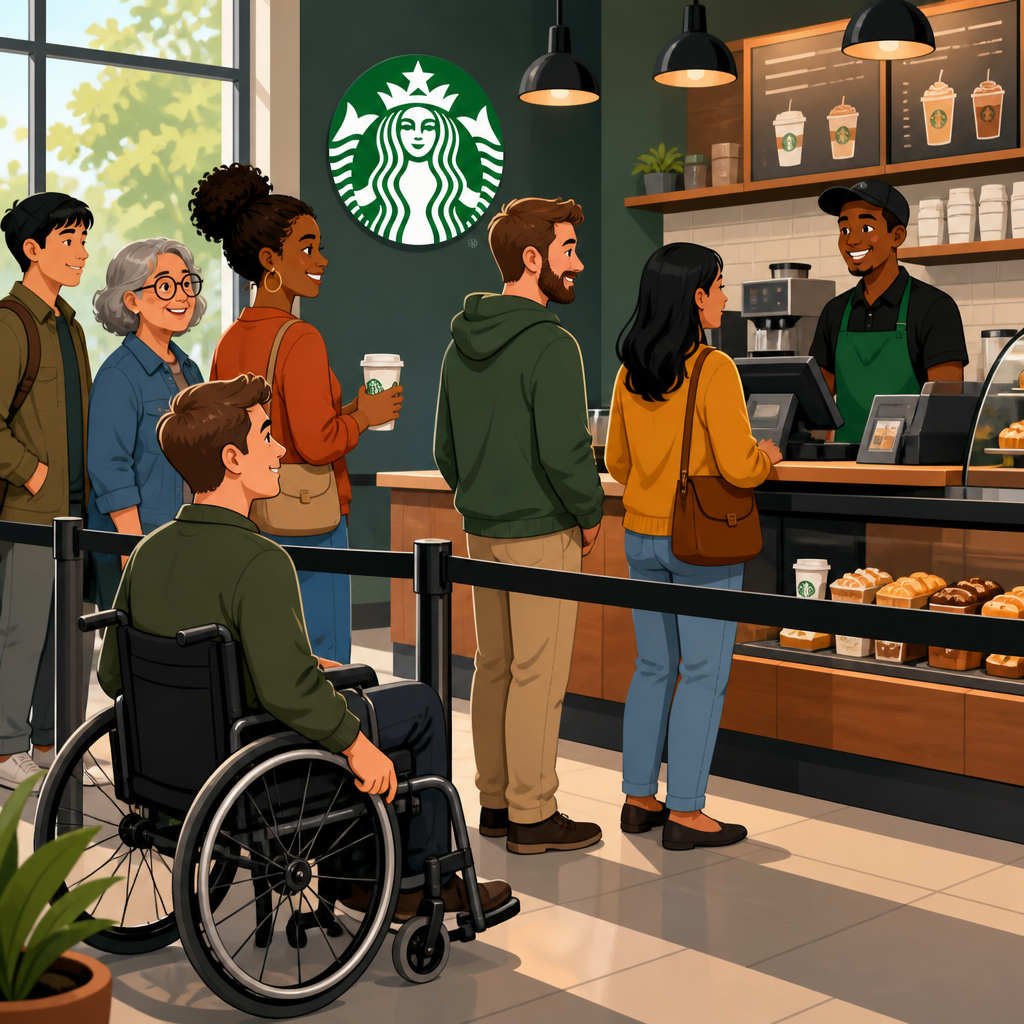
Crandall v Starbucks shows how a routine coffee line can become a serious accessibility issue, and it remains a useful entry point for understanding influential ADA cases in employment and public access. The case is often discussed because it translates abstract compliance duties into a physical experience most people recognize: entering a store, waiting in line, ordering, paying, and moving safely through a crowded layout. In disability law, that ordinary sequence matters. The Americans with Disabilities Act, or ADA, is the federal statute that prohibits discrimination against people with disabilities in settings such as workplaces, stores, restaurants, hotels, transportation systems, and government services. When lawyers, business owners, architects, and compliance teams talk about public access, they mean whether a person with a disability can use a space, service, or process with substantially equal convenience, safety, and dignity.
As a hub within legal cases and precedents, this article connects Crandall v Starbucks to the larger body of influential ADA cases in employment and public access. Those two branches of ADA litigation are related but legally distinct. Employment claims usually arise under Title I and focus on reasonable accommodation, the interactive process, medical inquiries, qualification standards, and retaliation. Public access claims usually arise under Title III for private businesses open to the public, or Title II when public entities are involved, and they focus on barriers, effective communication, auxiliary aids, policies, and equal enjoyment. In practice, I have seen organizations misunderstand this split. A company may have strong human resources accommodation procedures yet fail basic customer circulation standards in a retail buildout. Another business may invest in ramps and restroom retrofits but mishandle employee leave, reassignment, or communication accommodations.
That is why Crandall v Starbucks matters beyond one queue line. It illustrates how accessibility disputes often center on details that operations teams think are minor: movable merchandise, stanchion spacing, queuing patterns, point of sale placement, and peak-hour congestion. Those details can determine whether a route remains usable under the 2010 ADA Standards for Accessible Design. They also affect litigation risk, settlement costs, brand reputation, and customer trust. More broadly, the most important ADA precedents teach a consistent lesson: compliance is not a checklist completed at opening. It is an ongoing duty shaped by layout, staffing, policies, technology, and day-to-day decisions. Businesses that understand that principle are better positioned to reduce legal exposure and serve customers and employees effectively.
For readers researching influential ADA cases in employment and public access, the key questions are straightforward. What did the case actually show about accessibility obligations? How do courts evaluate barriers and accommodations? Which facts tend to decide outcomes? And what practical steps can businesses take now? This article answers those questions by using Crandall v Starbucks as the organizing example, then placing it alongside major employment and public accommodation rulings that continue to shape compliance strategy today.
What Crandall v Starbucks teaches about queue-line accessibility
Crandall v Starbucks is important because queue lines are not legally trivial. In a retail or food-service environment, the line is part of the customer’s path of travel and therefore part of the accessibility analysis. If a wheelchair user, scooter user, blind customer with a cane, or customer with another mobility limitation cannot navigate the route to ordering and pickup in a reasonably equivalent manner, the problem may constitute a barrier under the ADA. In practical compliance work, queue lines fail most often for three reasons: insufficient clear width, temporary obstructions, and poor management of movable elements such as merchandise displays or ropes.
The core lesson is that accessibility is measured in actual use, not only in drawings. A store may have been designed with a compliant route on paper, yet become inaccessible once freestanding displays, promotional bins, seasonal merchandise, or line-control devices are added. I have audited retail spaces where the architectural set showed a clear accessible route, but holiday inventory reduced circulation by several inches at the exact choke point where customers had to turn toward the register. During a site visit, that difference was enough to make independent passage difficult. Cases like Crandall bring those operational failures into focus because plaintiffs experience the layout as customers do, not as architects intended months earlier.
Another reason the case resonates is that queue-line accessibility is closely tied to equal enjoyment, not merely entry. A customer who can technically enter a café but cannot comfortably reach the ordering point, maneuver while others are queued, or wait without being forced into a conflicting circulation path does not receive the same practical access as other patrons. Courts and settlement agreements often reflect this reality by focusing on the entire transaction sequence. The legal issue is not solved if an employee is willing to take an order from outside the line when the normal process remains inaccessible, unless the alternative provides equivalent service and is implemented reliably.
How ADA public access cases are evaluated in the real world
Public access cases generally turn on a combination of statutory duties, design standards, and factual proof from the site. Under Title III, places of public accommodation must remove architectural barriers where removal is readily achievable in existing facilities, and newly constructed or altered spaces must comply with applicable accessibility standards. The 2010 ADA Standards for Accessible Design provide technical requirements for routes, clear floor space, counters, doors, restrooms, and many other features. For queue lines and circulation, measurements, turning space, protruding objects, and sales counter conditions may all matter. Photographs, measurements, plans, maintenance records, and witness testimony usually drive the case.
One repeated misconception is that accessibility liability only concerns permanent construction defects. In reality, temporary conditions can be just as significant. A compliant aisle that is routinely narrowed by stock carts, café furniture, or impulse displays can become a barrier through operation rather than original design. The Department of Justice has long emphasized that accessible features must be maintained in operable working condition. That principle reaches beyond elevators and automatic doors. It also applies to the practical maintenance of accessible routes. Businesses that treat accessibility as a facilities issue only, without involving store managers and district operations leaders, usually miss this point.
| Issue | Common Failure | Why It Matters | Better Practice |
|---|---|---|---|
| Queue layout | Movable stanchions narrow the route | Customers cannot maneuver to the register independently | Set fixed spacing rules and audit during peak hours |
| Merchandise placement | Impulse displays intrude into circulation | Design intent is defeated by operations | Use floor plans that preserve clear width at all times |
| Service counters | No accessible transaction point | Ordering and payment become unequal experiences | Provide compliant counter height and reachable payment devices |
| Staff response | Ad hoc assistance replaces accessible design | Service becomes inconsistent and dignity is reduced | Train staff on equivalent service and escalation procedures |
Crandall v Starbucks fits this framework because the queue is both a spatial feature and an operational system. That combination is common in modern retail, where customer flow changes throughout the day. If a business wants to avoid similar claims, it should document accessibility reviews after remodels, merchandise resets, seasonal rollouts, and point-of-sale changes. It should also conduct site walks at real operating times, not only before opening or after cleanup, because congestion often reveals barriers hidden in static inspections.
Influential ADA employment cases and the rules they established
Employment cases under the ADA answer a different set of questions: who is a qualified individual with a disability, what accommodation is reasonable, when does an employer have to modify policies, and when does a requested change create undue hardship? Several major cases remain central. US Airways, Inc. v. Barnett addressed reassignment and seniority systems. The Supreme Court held that reassignment conflicting with a bona fide seniority system is ordinarily not reasonable, though employees may still show special circumstances. That decision matters because it rejects the simplistic view that any vacant job must always be awarded as an accommodation regardless of established workplace rules.
Toyota Motor Manufacturing, Kentucky, Inc. v. Williams once narrowed the definition of disability by requiring a demanding showing that an impairment substantially limited major life activities. Congress responded through the ADA Amendments Act of 2008, which broadened coverage and instructed courts to interpret disability more expansively. For today’s compliance teams, the lasting lesson is practical: employers should spend less energy contesting whether someone meets the threshold definition and more energy addressing accommodation promptly and in good faith.
EEOC v. Ford Motor Co. is frequently cited in remote work discussions. The Sixth Circuit recognized that regular attendance at the workplace may be an essential function for some jobs, especially where teamwork and in-person problem solving are integral, but it also showed why employers must analyze actual job duties rather than relying on outdated assumptions. After the pandemic, that lesson became even more concrete. I have seen employers lose credibility by claiming physical presence is essential for roles already performed successfully in hybrid form. Courts look closely at evidence, not slogans.
Another foundational precedent is Chevron U.S.A. Inc. v. Echazabal, which allowed employers to refuse placement where the job would pose a direct threat to the employee’s own health. Yet the defense is narrow. It requires individualized assessment based on medical or other objective evidence, not paternalism or broad fears. Similarly, equal treatment is not enough if the employer ignores the interactive process. Across enforcement actions, breakdowns usually happen when supervisors dismiss requests informally, fail to involve human resources, or treat accommodation as a favor rather than a legal obligation.
Influential public accommodation cases beyond Starbucks
To understand why Crandall matters, it helps to place it next to other public access cases that changed compliance expectations. PGA Tour, Inc. v. Martin is one of the clearest examples. The Supreme Court held that allowing golfer Casey Martin to use a cart was a reasonable modification under Title III and did not fundamentally alter the nature of the tournament. The significance extends far beyond sports. The case shows that businesses must modify policies when necessary for access unless doing so would fundamentally alter the service, program, or activity. Policy barriers can be just as discriminatory as physical ones.
Spector v. Norwegian Cruise Line Ltd. confirmed that ADA obligations can reach businesses serving the U.S. market even in complex operational contexts. Robles v. Domino’s Pizza, LLC became the leading digital accessibility case, holding that alleged inaccessibility of a website and app could impede access to the goods and services of physical pizza franchises. For companies managing omnichannel customer journeys, Robles is essential. Accessibility now includes digital ordering, account management, loyalty programs, and pickup workflows, not just doors and aisles.
Paralyzed Veterans of America v. Ellerbe Becket Architects & Engineers, involving the design of the MCI Center, remains influential on sight lines and wheelchair seating distribution in assembly spaces. Although factually different from a coffee shop line, the principle is shared with Crandall: accessibility is about functional equivalence during actual use. A technically designated wheelchair space is not enough if the patron cannot see over standing spectators. Likewise, a nominal route through a café is not enough if the line configuration makes routine ordering unworkable.
Together, these cases show the breadth of public access doctrine. Physical barriers, policy barriers, and digital barriers all matter. Businesses that silo these issues create risk. The strongest compliance programs treat the customer journey as one system, from parking and entrance to queuing, ordering, payment, seating, pickup, and mobile interfaces.
Practical compliance lessons for employers and customer-facing businesses
The most effective lesson from influential ADA cases in employment and public access is that compliance succeeds when legal standards are translated into workflows. For employers, that means documented accommodation intake, supervisor training, job-description review, medical documentation protocols, and consistent follow-up. For customer-facing businesses, it means design review, operational auditing, accessibility maintenance, digital testing, and complaint resolution. In both settings, the legal risk usually increases where decisions are decentralized but standards are vague.
For queue-line accessibility specifically, businesses should test routes with actual mobility devices, not assume plans are enough. Measure clear widths after merchandising is installed. Check whether customers can approach the register, payment terminal, condiment area, and pickup zone without conflict. Review peak-hour conditions, because a route that works at 2 p.m. may fail at 8 a.m. Train employees to recognize when temporary objects create barriers and empower them to correct the issue immediately. Large chains should also build accessibility checkpoints into store prototype updates and remodel sign-off processes.
For employment matters, maintain a disciplined interactive process. Clarify essential functions using real operational evidence. Consider schedule changes, equipment, leave, reassignment, communication supports, and remote-work options where appropriate. Document why an accommodation is effective or why it would create undue hardship, and revisit decisions when circumstances change. Many disputes that become lawsuits begin as communication failures, not hard legal questions. A manager says no too quickly, an employee stops responding, or medical paperwork sits unresolved.
Crandall v Starbucks remains valuable because it makes ADA compliance tangible. A queue line seems ordinary until it excludes someone, and then the legal duty becomes unmistakable. As a hub for influential ADA cases in employment and public access, the broader lesson is clear: accessibility law governs real experiences, not abstract intentions. In workplaces, that means thoughtful accommodations, individualized assessment, and consistent interactive processes. In public-facing businesses, it means routes, counters, policies, websites, and service models that work for disabled people in ordinary conditions, including rush periods and changing layouts.
The strongest precedents all point in the same direction. Barnett explains that accommodations must be balanced against legitimate workplace systems. Martin shows that policy modifications may be required even when an organization believes its rules are neutral. Robles confirms that digital tools can block access as surely as a step at the door. Cases like Crandall underscore that temporary and operational barriers are still barriers. The common theme is functional equality: can a person with a disability work, order, purchase, communicate, and participate with meaningful independence and dignity?
If you manage legal risk, facilities, human resources, or store operations, use these cases as a working checklist rather than history. Audit customer routes during real service hours. Review accommodation procedures with supervisors. Test digital and physical touchpoints together. When in doubt, measure conditions, document decisions, and correct problems before a complaint forces the issue. That is the practical value of studying ADA precedents: they show where organizations fail, but they also show exactly how to build access into everyday operations.
Frequently Asked Questions
What is Crandall v Starbucks, and why is it important for accessibility discussions?
Crandall v Starbucks is frequently used as a practical example of how accessibility law applies to everyday customer experiences, not just dramatic or obvious barriers. The case is often discussed in the context of queue-line design and interior circulation because it highlights how a person with a disability may encounter problems during a routine visit: entering a store, joining a line, moving toward the register, paying, and exiting safely. That sequence matters under the Americans with Disabilities Act because access is not limited to simply getting through the front door. A business must also consider whether customers can actually use the goods, services, and pathways the business offers.
Its importance comes from the way it turns abstract ADA concepts into something concrete. Most people understand what it is like to stand in a coffee line during a busy rush, navigate around other customers, and move near counters, displays, and furniture. When that space is too tight, poorly organized, or unpredictable, the experience can become more than inconvenient for someone using a wheelchair, scooter, cane, walker, or other mobility aid. The case therefore serves as a useful teaching tool for property owners, employers, architects, compliance teams, and advocates because it underscores that accessibility failures often arise from ordinary design decisions.
It also remains relevant because it connects public accommodation issues with broader ADA awareness. Starbucks stores are familiar environments, so the case helps readers understand that compliance duties are not theoretical. They affect line management, fixture placement, aisle width, customer flow, and safety in high-traffic areas. In short, Crandall v Starbucks matters because it shows that accessibility law reaches the lived experience of moving through a business, not just the checklist item of whether a ramp or door exists.
What accessibility lesson does the case teach about queue lines and store layouts?
The central lesson is that a queue line is part of the customer experience and must be usable by people with disabilities in a real-world sense. A store may appear accessible on paper, but if customers cannot safely navigate the line or reach the ordering and payment area without obstruction, the business may still be creating a barrier to access. Queue lines are especially important because they are dynamic spaces. Chairs shift, promotional displays are added, stanchions move, and crowds compress the available clearance. Accessibility depends not only on static floor plans but also on how the space functions during normal operations.
This means businesses should think beyond entrance access and examine the entire travel path. Can a customer using a wheelchair approach the line without being forced into an awkward or unsafe detour? Is there enough width to maneuver near other patrons? Are turns too tight near counters or merchandise displays? Can the customer reach the point of sale and then leave without backtracking through congestion? Those questions reflect the practical, operational side of ADA compliance. A technically compliant element can still fail in practice if the overall route is blocked or the layout funnels customers into inaccessible bottlenecks.
The case also teaches that crowding does not excuse poor planning. Retail and food-service spaces are expected to become busy, and a business should anticipate that normal customer volume can expose accessibility weaknesses. Good design and good operations work together. Clear routes, consistent line organization, well-placed fixtures, and staff awareness all reduce the risk that a queue becomes exclusionary. For that reason, Crandall v Starbucks is often cited as a reminder that accessibility is about usability in context, not just dimensions measured in an empty room.
How does the ADA apply to a coffee shop or similar public-facing business in situations like this?
Under the ADA, a coffee shop is generally considered a place of public accommodation, which means it has legal obligations to provide individuals with disabilities equal access to its goods and services. In practical terms, that includes the ability to enter the store, move through it, participate in the ordering process, pay for items, and use the space in a manner comparable to other customers. The law is concerned with barriers that interfere with that access, whether those barriers are architectural, operational, or sometimes both.
For a business like a coffee shop, compliance is not limited to major structural features. Interior routes, counters, waiting areas, seating zones, merchandise placements, and queue systems can all be relevant. If the line configuration narrows circulation to the point that a person with a mobility disability cannot reasonably proceed, the issue may raise ADA concerns. Likewise, if movable objects such as signs, display racks, or furniture repeatedly obstruct the accessible route, the fact that they are not permanent does not automatically eliminate the problem. Day-to-day operations matter because the ADA looks at whether people with disabilities can actually use the services being offered.
The case also helps illustrate an important distinction: equal access does not always require identical experiences, but it does require meaningful access. A business may use different methods to achieve accessibility, yet those methods must be effective. If the only workable option requires a disabled customer to wait outside the normal line, depend on special assistance every time, or face avoidable safety risks, that may indicate the layout or process needs improvement. In this way, Crandall v Starbucks supports a broader understanding of the ADA: businesses must evaluate how customers move through ordinary service environments and remove barriers where required and feasible.
What practical steps can businesses take to avoid queue-line accessibility problems?
Businesses should start by evaluating the full customer path rather than isolated features. That means looking at the route from the entrance to the line, from the line to the register, and from the register to pickup or exit areas. Management should assess whether customers using wheelchairs or other mobility aids can travel that route smoothly during both slow and busy periods. A layout that works at opening time may become inaccessible once customers gather, displays are rolled out, and employees stage products near the counter. Accessibility reviews should therefore be based on actual operations, not idealized conditions.
One key step is maintaining clear width and maneuvering space. Queue barriers, menu stands, retail shelves, seasonal displays, and trash receptacles should never be placed in ways that pinch travel routes. Businesses should train staff to recognize that movable items can create legal and safety issues if they drift into access paths. Operators should also develop simple floor-management rules, such as keeping merchandise outside designated circulation zones, checking line areas during rush periods, and ensuring that pickup stations do not spill into the route needed by customers approaching the register.
Another important step is conducting routine accessibility audits with real-world testing. It is useful to measure routes, but it is even more useful to observe how people actually move through the space. Businesses may benefit from mock walkthroughs using mobility devices, outside consultants, or feedback from disabled customers and employees. If a store has frequent congestion, management should consider redesigning line patterns, relocating fixtures, or changing where customers wait for orders. The strongest lesson from cases like Crandall v Starbucks is that accessibility should be built into operations, not treated as a one-time construction issue. Consistent attention to layout, training, and customer flow is what prevents ordinary lines from becoming exclusionary barriers.
Why does this case continue to matter for ADA compliance, employment awareness, and public access policy?
This case continues to matter because it sits at the intersection of legal doctrine and lived experience. Many ADA disputes involve technical standards that can seem remote to nonlawyers, but a crowded coffee line is immediately understandable. That makes Crandall v Starbucks a useful reference point in compliance training, policy discussions, and educational materials. It helps explain why accessibility law is not only about major building features, but also about the routine interactions that define whether a business is genuinely open to everyone.
It also has continuing value because it reinforces a broader compliance mindset. Employers and public-facing businesses alike can learn from the underlying principle: barriers often arise from assumptions about how people move, wait, turn, reach, and respond to crowded environments. In employment settings, those same assumptions can affect workspace layout, common-area access, break rooms, service counters, and emergency egress planning. In customer-facing environments, they affect whether patrons can participate independently and safely. The case therefore supports a more integrated understanding of disability access across physical design, workplace practices, and customer service operations.
Finally, the case remains relevant because accessibility disputes are rarely just about inconvenience. They implicate dignity, independence, safety, and equal participation. A line that is too narrow or poorly organized can force a person with a disability to ask for special help, abandon a purchase, or risk physical harm in a congested space. That is why this case still resonates in conversations about ADA obligations and best practices. It reminds decision-makers that ordinary environments deserve close attention, and that thoughtful design and management are essential to meaningful public access.


