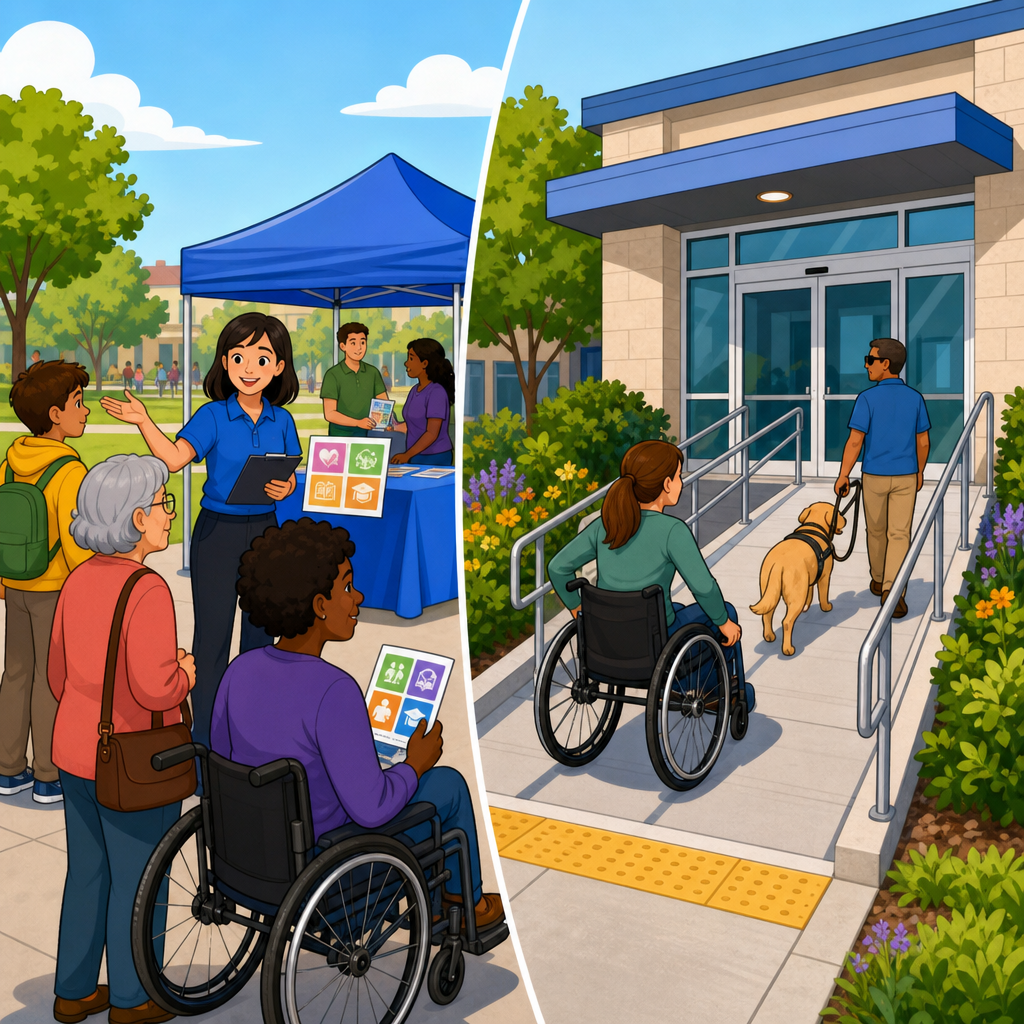
Public entity ADA litigation often turns on a crucial distinction: whether the law requires every facility to be physically altered for access, or whether a government may satisfy its duties by ensuring people with disabilities can use the program as a whole. In practice, that distinction separates program accessibility from structural access, and it shapes outcomes in cases involving city halls, sidewalks, parks, courthouses, schools, prisons, transit systems, and digital public services. For lawyers, compliance officers, risk managers, and advocates, understanding how courts draw that line is essential because the answer affects budgeting, capital planning, policy design, remediation timelines, and litigation strategy.
Under Title II of the Americans with Disabilities Act, state and local governments must provide qualified individuals with disabilities an equal opportunity to participate in and benefit from public services, programs, and activities. The Rehabilitation Act, especially Section 504, often overlaps when federal funding is involved. Structural access usually refers to the physical accessibility of facilities, routes, entrances, restrooms, counters, parking, and other built elements, measured against standards such as the 1991 ADA Standards, the 2010 ADA Standards for Accessible Design, and, in public rights-of-way disputes, transportation and curb-ramp requirements shaped by regulations and case law. Program accessibility is broader. For existing facilities, it asks whether the public entity, viewed in its entirety, makes its programs accessible through a combination of physical changes, relocation, policy modification, auxiliary aids, or other methods.
I have worked through Title II audits where officials assumed that one compliant entrance settled the issue, only to discover that inaccessible paths, hearing access failures, and online forms still excluded residents from the actual service. That is why the leading public entity cases matter. They show when courts accept a flexible program-level approach, when they require barrier removal at specific locations, and when they reject defenses based on cost, administrative burden, or legacy infrastructure. This hub article explains the core doctrines, analyzes influential ADA legal cases, and provides a framework for reading related decisions across transportation, civic buildings, sidewalks, corrections, education, and emergency services.
What Program Accessibility Means in Public Entity Cases
Program accessibility is the governing concept for existing facilities under Title II. The regulation at 28 C.F.R. 35.150 does not demand that every older building become fully accessible immediately. Instead, a public entity must operate each service, program, or activity so that, when viewed in its entirety, it is readily accessible to and usable by individuals with disabilities. That flexibility matters in large public systems. A county with multiple service centers may relocate a benefit interview to an accessible branch, install remote participation technology, provide home visits in limited contexts, or alter policies, so long as the person with a disability receives meaningful access and not a second-class substitute.
Courts repeatedly stress two limits. First, program accessibility is not a license to leave barriers untouched where they deny effective participation. If a voter can technically request assistance but cannot independently enter the polling place, secrecy and dignity concerns can make the program inaccessible. Second, the “viewed in its entirety” language does not permit governments to concentrate access in a few token sites while large portions of the public system remain closed. In enforcement work, the Department of Justice has often examined routes, communication access, dispersed neighborhood services, and the practical experience of the user, not just the existence of an alternative location on paper.
The defenses are also specific. A public entity may avoid a particular structural change if it can prove fundamental alteration or undue financial and administrative burdens, but that decision must be made by the head of the entity or a designee after considering all resources available for the program, and it must be documented in writing. Even then, the entity must take other steps to provide access to the maximum extent possible. Courts tend to scrutinize unsupported burden claims closely, especially where barriers are longstanding, the program is central, or the requested fix is routine, such as curb ramps, captioning, or accessible route maintenance.
What Structural Access Requires and Why It Still Drives Litigation
Structural access focuses on the physical environment and often becomes outcome determinative because many public programs are inseparable from place. A courtroom on an upper floor without an elevator is not made accessible merely because another county building has a meeting room. A park program may fail if accessible parking exists but paths, play elements, and restrooms do not connect into a usable experience. Structural claims are especially strong in new construction and alterations, where compliance with design standards is mandatory and the “viewed in its entirety” flexibility largely disappears. Once a public entity alters a primary function area, path-of-travel obligations can also be triggered.
This is why plaintiffs often plead both theories. Program accessibility captures exclusion from the service; structural access identifies the concrete barriers causing it. In my experience, the best case analyses map the user journey from arrival to participation to departure. Courts respond well to that method because it translates abstract doctrine into facts: the inaccessible bus stop that prevents reaching city hall, the missing curb ramp that blocks the route to a library, the witness stand without wheelchair access, the website PDF that prevents permit submission before an in-person visit. Structural barriers are often the proof of program denial.
Public entities sometimes argue that because Title II allows flexibility for existing facilities, plaintiffs cannot demand changes at a specific site. That argument overreaches. While Title II does not universally require retrofitting every building, courts may order site-specific relief where a barrier prevents meaningful access to the relevant program, where alternatives are inadequate, or where the claim involves altered facilities, sidewalks, transportation stops, or rights-of-way that function as programs themselves. The case law below shows how this principle developed.
Influential ADA Cases That Define the Line
The most cited starting point is Tennessee v. Lane, 541 U.S. 509 (2004). George Lane, who used a wheelchair, had to crawl up stairs to reach a second-floor courtroom and later faced criminal consequences after refusing to do so again. The Supreme Court held that Congress validly abrogated state sovereign immunity in Title II cases implicating the fundamental right of access to courts. Lane matters not only for immunity. It illustrates that some public programs, especially court access, demand more than abstract availability elsewhere. Physical access to the proceeding itself can be constitutionally significant, making structural barriers legally decisive.
Barden v. City of Sacramento, 292 F.3d 1073 (9th Cir. 2002), is foundational for sidewalks. The Ninth Circuit held that maintaining public sidewalks is a program, service, or activity under Title II. That conclusion expanded municipal exposure because inaccessible sidewalks, missing curb ramps, and obstructed pedestrian routes are not just construction defects; they can deny access to the public right-of-way system. Cities often preferred to characterize sidewalks as incidental infrastructure, but Barden rejected that narrow view. Since then, sidewalk transition plans, curb-ramp inventories, and complaint-driven remediation have become central municipal compliance tools.
Frame v. City of Arlington, 657 F.3d 215 (5th Cir. 2011) (en banc), reinforced that disabled pedestrians may challenge newly built or altered sidewalks without tying each barrier to a separate municipal program housed elsewhere. The Fifth Circuit recognized the sidewalk itself as the service used for pedestrian travel. That reasoning is powerful because it narrows the space for a city to argue that access exists “in the aggregate” while specific routes remain impassable. Where travel along the route is the service, structural access and program access converge.
Transit litigation shows the same dynamic. In Kirola v. City and County of San Francisco, although the plaintiff ultimately did not prevail after trial on her broad systemic claims, the case remains instructive because it examined parks, libraries, pools, and curb ramps program by program and site by site. Courts asked whether the plaintiff personally encountered barriers, whether those barriers denied meaningful access, and whether the city’s evidence showed overall accessibility. The lesson is practical: a plaintiff needs a tightly documented record, and a public entity needs accurate inventories rather than general assurances that accessibility exists somewhere in the system.
| Case | Core Issue | Key Holding | Practical Impact |
|---|---|---|---|
| Tennessee v. Lane | Courthouse access | Access to courts can require enforceable Title II relief against states | High-risk area for structural barriers |
| Barden v. City of Sacramento | Sidewalk accessibility | Sidewalks are covered services, programs, or activities | Curb ramps and route maintenance became central compliance issues |
| Frame v. City of Arlington | Pedestrian rights-of-way | Disabled pedestrians may sue over inaccessible sidewalks as a direct service denial | Route-specific fixes often required |
| TOKIO Marine v. ADA transit line cases | Transit access patterns | Operational alternatives do not erase fixed-route access duties | Agencies must align stops, vehicles, and communications access |
Another major line of authority comes from correctional settings. In United States v. Georgia, 546 U.S. 151 (2006), the Supreme Court allowed a prisoner’s Title II claim to proceed where alleged conduct also violated the Fourteenth Amendment. While the case centered on immunity and prison conditions, its practical significance is broader. Jails and prisons are public entity programs, and courts increasingly examine whether accessible housing, showers, toilets, medical units, visitation areas, and grievance procedures exist in fact, not merely by policy. Program accessibility arguments fail quickly when the person cannot physically reach toilets, medications, or hearings.
Education cases also reveal the distinction. Public schools may argue that a student can receive a service elsewhere on campus, yet courts and settlement agreements often require access integrated with peers unless separate placement is necessary and appropriate. An accessible rear entrance used only by staff, or a nurse’s office visit replacing participation in science lab, usually does not satisfy equal opportunity principles. In this way, structural access supports integration, which remains a central value in disability law.
How Courts Evaluate Specific Public Entity Contexts
Courthouses are judged strictly because participation is personal, time-sensitive, and often constitutionally protected. Election sites receive similar scrutiny. If a polling place has steep temporary ramps, inaccessible parking, or no accessible voting equipment, a county may face claims even if absentee voting exists. Courts ask whether the alternative preserves independence, privacy, and equal dignity. Those factors make structural access highly important in democracy-related services.
Municipal buildings present mixed outcomes. A city may lawfully centralize some services in an accessible building rather than retrofit every older annex. But if zoning hearings, utility payment, permitting, police reporting, and council participation are spread across inaccessible facilities, the “viewed in its entirety” defense weakens. I have seen plaintiffs succeed by showing they had to make repeated inaccessible trips for one matter, turning what looked like isolated barriers into a systemwide denial.
Parks and recreation cases depend heavily on usable routes and connected features. An accessible parking space alone is meaningless if the path to the playground is soft gravel, the picnic pad lacks clearance, or the restroom hardware requires tight grasping. Courts increasingly evaluate recreation as an end-to-end experience. The same is true for libraries and community centers, where circulation desks, meeting rooms, computer stations, and assistive listening systems all affect meaningful access.
Digital public services add a modern dimension. Although this article focuses on physical access cases, public entity litigation now regularly combines inaccessible websites, online forms, and virtual meetings with structural barriers. When permit applications, tax appeals, public comment, transit updates, or emergency alerts are delivered online, inaccessible digital design can independently violate Title II. Program accessibility today therefore spans buildings, routes, communications, and software interfaces. Public entities that fix ramps but ignore screen-reader compatibility are missing how courts increasingly understand access.
Compliance Lessons, Litigation Patterns, and Hub Topics for Further Analysis
The recurring litigation pattern is simple. Plaintiffs win strongest cases when they identify a specific public program, document personal encounters with concrete barriers, show why alternatives are ineffective, and connect requested relief to recognized standards. Public entities defend best when they maintain current transition plans, barrier-removal schedules, alteration records, grievance procedures, and written analyses for any claimed burden. Generic testimony that access exists “somewhere” is weak evidence.
For readers using this page as a hub within legal cases and precedents, the next issues to examine are predictable. First are sidewalk and curb-ramp cases, where route continuity, maintenance, and alteration triggers dominate. Second are courthouse and civic participation cases, including meetings, voting, and jury service, where equality, privacy, and constitutional interests increase the pressure for structural fixes. Third are transit disputes covering bus stops, rail stations, paratransit interactions, and wayfinding communications. Fourth are correctional and detention cases, where inaccessible cells and hygiene facilities create immediate harms. Fifth are education and campus access disputes, where integration and equal participation shape the remedy.
The main takeaway from influential ADA legal cases is that program accessibility and structural access are not competing doctrines so much as complementary lenses. Title II gives public entities flexibility for existing facilities, but courts require meaningful, equal, and practical access to the actual service. Where physical barriers block that result, site-specific structural relief is often the answer. If you manage risk, litigate cases, or plan public infrastructure, review your programs the way a disabled resident experiences them from curb to counter to digital form, then prioritize the barriers that stop participation. That is the most reliable path to compliance and the strongest foundation for the deeper case analyses linked from this hub.
Frequently Asked Questions
What is the difference between program accessibility and structural access in public entity ADA cases?
Program accessibility and structural access are related concepts, but they are not the same legal requirement. Program accessibility focuses on whether a person with a disability can meaningfully participate in, benefit from, or use a public entity’s services, programs, or activities when viewed in their entirety. Structural access, by contrast, focuses on whether a particular building element, route, entrance, restroom, counter, courtroom, sidewalk segment, or other physical feature complies with accessibility design standards. That distinction matters because many Title II cases do not turn on whether every single public facility is fully modernized, but on whether the government has made the program itself accessible in practice.
In older facilities, public entities are often not automatically required to retrofit every structure in every respect. Instead, the core question is often whether the service can be accessed through relocation, redesign of procedures, use of alternate accessible sites, curb ramps, auxiliary aids, policy changes, or other reasonable methods. However, that does not mean physical barriers are irrelevant. If barriers effectively exclude people with disabilities from participating in the program, then structural changes may become necessary. Courts often examine whether the public entity is relying on a genuine, workable access strategy or simply pointing to theoretical alternatives that do not provide equal or meaningful access.
In newer construction or altered facilities, structural compliance becomes much more direct and demanding because specific accessibility standards usually apply. In those cases, the issue may not be whether the program is accessible overall, but whether the altered or newly built feature itself must comply with design requirements. So in litigation, the distinction often shapes the entire case: one side argues that access to the program as a whole is sufficient, while the other argues that the inaccessible structure itself is the barrier preventing equal participation. Courts then evaluate the age of the facility, the nature of the service, the availability of alternatives, and whether the public entity’s solution offers real, timely, integrated access.
Does the ADA require every public building or facility to be physically accessible?
No, not always, and that is one of the most commonly misunderstood points in public entity accessibility disputes. Under Title II of the ADA, public entities must ensure that their services, programs, and activities are accessible to individuals with disabilities. For existing facilities, that does not necessarily mean every building, room, entrance, restroom, or service counter must be physically reconstructed. The law generally allows flexibility in how accessibility is achieved, especially for facilities built before current accessibility standards applied. A city, county, school district, transit authority, or state agency may in some circumstances meet its obligation by providing access through other effective methods.
That said, the answer changes depending on the context. If a public entity builds a new facility or alters an existing one, the altered or new portions usually must comply with applicable architectural accessibility standards. Also, when a public entity cannot provide meaningful access to a program without removing a physical barrier, structural changes may be required even in an older facility. For example, if court services are routinely held only on an inaccessible upper floor and no practical alternative exists, the government may not be able to defend the barrier simply by saying the courthouse as a whole serves the public. The legal analysis is highly fact-specific and turns on actual access, not labels.
Courts also look closely at whether alternatives are equivalent, timely, and integrated. An inaccessible front entrance paired with a distant side entrance that requires advance notice, staff assistance, or special treatment may raise concerns. Likewise, a city cannot always rely on ad hoc accommodations if they are unreliable or stigmatizing. So while the ADA does not automatically require every existing public building to be completely retrofitted, it does require public entities to eliminate exclusion from public programs, and in many cases that practical obligation leads directly to physical accessibility improvements.
How do courts decide whether a public entity has provided meaningful program access?
Courts generally begin by identifying the specific service, program, or activity at issue and then asking whether people with disabilities can access it in a real and usable way. That sounds simple, but it is often the central battle in these cases. A public entity may argue that access exists because the service is offered somewhere in the system, by appointment, online, by phone, or at another site. A plaintiff may respond that those alternatives are inferior, delayed, segregated, geographically unrealistic, or unavailable when needed. The court then evaluates the program in practical terms rather than in abstract policy language.
Several recurring factors influence that analysis. One is location: if the only accessible option is far away or unavailable in the community where the service is ordinarily provided, access may not be meaningful. Another is timeliness: delayed access can amount to denied access, especially in contexts like court proceedings, voting services, emergency response, public meetings, transportation, education, or detention. Courts also consider independence and dignity. If a person with a disability must repeatedly request special treatment, rely on staff to bypass barriers, or accept a substantially different experience than nondisabled users, that can weigh against the public entity.
Judges also distinguish between occasional accommodations and systemic accessibility. A government that fixes problems only after complaints may have trouble proving that its program is accessible as a whole. In contrast, a public entity with a documented transition plan, consistent accessible routes, trained staff, functioning auxiliary aids, accessible digital platforms, and effective relocation procedures is in a stronger position. Ultimately, meaningful access is about whether the program works for disabled users in ordinary operation, not whether the government can imagine a workaround after litigation begins. That is why evidence about everyday conditions, repeated barriers, and the reliability of alternatives is so important in these cases.
Why is this distinction so important in cases involving sidewalks, parks, courthouses, schools, prisons, transit, and digital public services?
The distinction matters because different public services function in different ways, and courts often analyze access differently depending on the setting. In a courthouse, the inability to reach a courtroom, clerk’s office, jury assembly room, or witness stand may directly interfere with participation in the justice system, making the barrier difficult to defend through general program-access arguments. In a school setting, inaccessible classrooms, cafeterias, athletic facilities, or parent meeting spaces may undermine equal participation for students, families, and staff. In prisons and jails, the question can become especially urgent because incarcerated people cannot simply choose another location or provider.
Sidewalk and curb ramp cases often illustrate the overlap between structural barriers and program access. Public entities may argue that transportation or pedestrian mobility should be viewed at a systems level, while plaintiffs often point to specific missing curb ramps, broken paths, excessive slopes, or dangerous crossings that make community access impossible. Parks and recreation disputes raise similar issues: a city may say the park system offers recreational opportunities overall, but inaccessible routes, restrooms, seating areas, play spaces, or waterfront features may still exclude disabled residents from actual use. Transit cases likewise involve both systemwide access and the compliance of specific stops, stations, vehicles, platforms, and communication tools.
Digital public services add a modern layer to the same legal framework. If a government moves essential functions online, such as permit applications, court payments, benefit enrollment, school information, or public meeting participation, the accessibility of those digital platforms can become central to program access. A public entity may claim the program is still accessible by phone or in person, but if the digital channel is the primary or most efficient method used by the public, inaccessible websites, PDFs, portals, kiosks, or mobile apps may effectively block equal participation. Across all these settings, the basic legal question remains consistent: is the public entity providing genuine, equal access to the program, or are structural or design barriers preventing meaningful use?
What should public entities and plaintiffs pay attention to when litigating or evaluating these cases?
Both sides need to focus on facts, not just legal slogans. For public entities, it is not enough to say “the program is accessible in its entirety” without evidence showing how disabled individuals actually obtain access. Governments should be prepared to identify accessible sites, routes, communication methods, policies, staff practices, timelines, and backup procedures. Documentation matters. Transition plans, self-evaluations, maintenance records, grievance procedures, digital accessibility audits, architectural surveys, and examples of consistent accommodation can all affect the outcome. Courts are often skeptical of unsupported claims that an inaccessible feature does not matter because another option supposedly exists.
Plaintiffs, on the other hand, should define the program clearly and show how the specific barrier causes exclusion, delay, unequal treatment, or loss of independence. Strong cases usually connect physical or digital barriers to practical consequences: missed hearings, inability to attend meetings, blocked pedestrian travel, inaccessible educational participation, reduced park use, delayed benefits, or exclusion from civic life. Repeated incidents, photographs, measurements, expert reports, testimony about failed accommodation requests, and evidence that alternatives are inferior or unreliable can be especially persuasive. Plaintiffs also often strengthen their claims by showing that the barrier is not isolated, but part of a broader pattern of inaccessible operations.
From a strategic standpoint, everyone involved should pay close attention to the age of the facility, whether alterations occurred, what standards apply, whether the issue concerns physical access, communication access, or digital access, and whether the public entity’s alternative provides equal and integrated participation. The most important point is that program accessibility is not a loophole that excuses exclusion, and structural compliance is not always the


