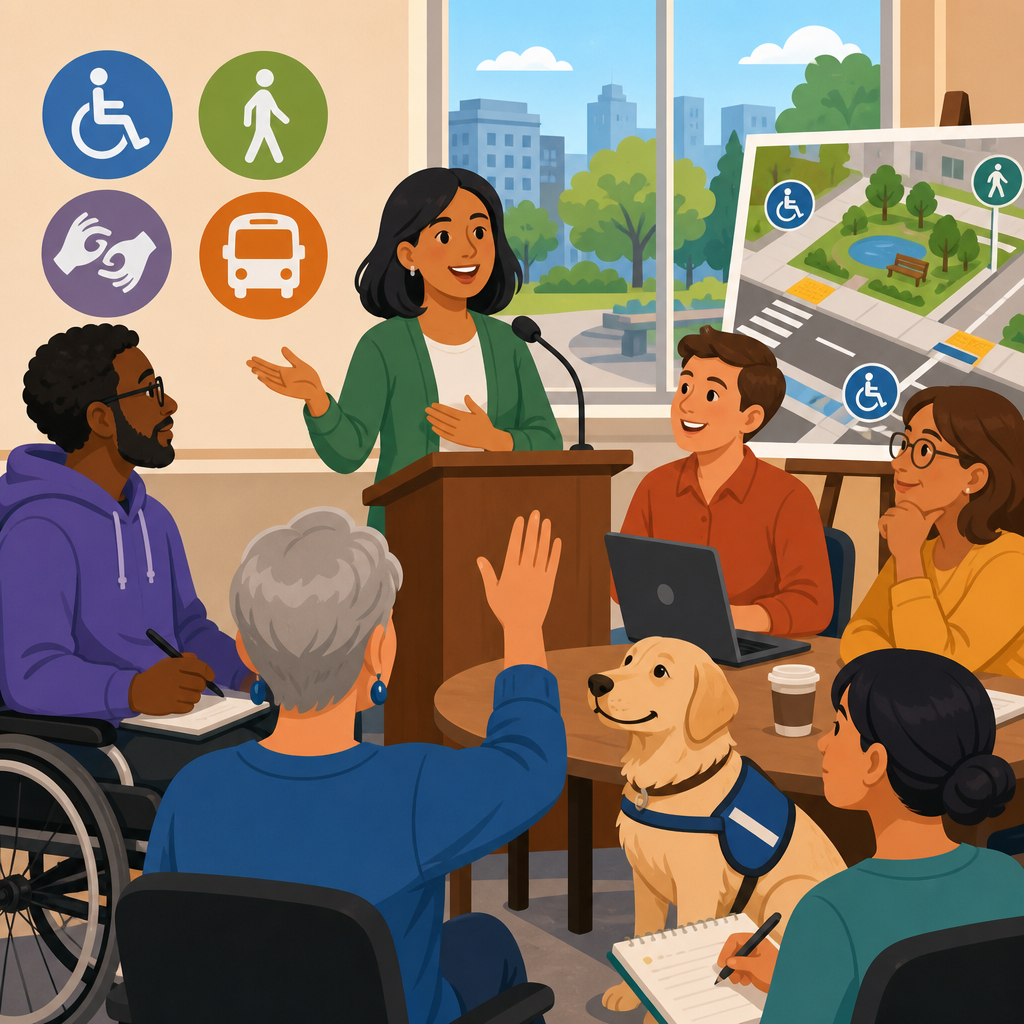
Public comment strategies for ADA transition planning determine whether an accessibility program reflects real barriers, legal priorities, and the daily experience of people with disabilities. In ADA transition planning, a public entity documents physical obstacles, sets removal priorities, assigns responsibility, and schedules improvements so programs, services, and activities become accessible under Title II of the Americans with Disabilities Act. Public comment is the structured process used to gather, review, and respond to feedback from residents, employees, advocates, businesses, and disability organizations before and during implementation. I have worked with cities, school districts, and transportation agencies on these plans, and the pattern is consistent: when outreach is broad, accessible, and disciplined, the final plan is more defensible, better scoped, and easier to fund. This matters because transition plans are not simply engineering lists. They are public commitments that affect curb ramps, sidewalks, parks, websites, restrooms, recreation programs, emergency communications, and procurement standards. Poor engagement misses barriers and creates distrust. Strong engagement produces a clearer barrier inventory, a stronger record of decision-making, and better alignment between legal obligations, capital planning, and lived experience across the community.
Effective engagement starts by defining the terms that often get blurred together. An ADA self-evaluation reviews policies, practices, communications, and facilities to identify barriers. A transition plan translates facility-related findings into a schedule for structural changes, budget phasing, and implementation accountability. Public comment is not the same as a general survey, and it is not a single hearing held at city hall on a weekday afternoon. It is a multi-channel consultation process designed to reach people with mobility, vision, hearing, cognitive, sensory, and mental health disabilities, as well as caregivers and older adults who interact with the same barriers. The central question is simple: what prevents equal access, where is it happening, and which fixes should come first? The strongest hub approach under Resources and Support connects this question to related workstreams, including complaint intake, digital accessibility, accessible meetings, language access, transportation coordination, and technical assistance for departments managing design standards and capital projects.
Build the engagement framework before requesting comments
The most effective public comment strategies are designed before the first notice is issued. Start with a written engagement plan that names the ADA coordinator, project manager, consultant support if used, records custodian, and departmental reviewers for public works, parks, facilities, information technology, transit, and communications. Define what input you need: barrier locations, program access concerns, priority destinations, policy obstacles, and implementation preferences. Then define how each type of input will be used. Residents are more likely to participate when they understand whether comments will affect project ranking, scope refinement, maintenance fixes, or future capital requests. In practice, I recommend publishing a plain-language process map showing intake, acknowledgment, review, verification, scoring, response, and plan update timelines. That single step reduces frustration because people can see that comments are logged, not lost.
Accessibility has to be designed into the process itself. Notices should be available in accessible PDF and HTML, compatible with screen readers, written in plain language, translated into prevalent local languages, and distributed in formats that support Braille, large print, and audio on request. Public meetings should include captioning, sign language interpreters when requested or appropriate, accessible seating, clear wayfinding, quiet space options, and remote participation. Phone hotlines remain important because not every resident uses web forms. A dedicated voicemail line with relay-compatible access often surfaces detailed location-based complaints that online surveys miss. Agencies should also coordinate with independent living centers, protection and advocacy organizations, veterans groups, senior centers, paratransit providers, parent advisory councils, and local disability commissions. Those partners do not replace direct input from individuals, but they expand reach and improve trust.
Use outreach methods that produce representative input
One of the biggest mistakes in ADA transition planning is relying on a single outreach channel and then treating the results as community consensus. Representative input requires layered outreach. Post the draft inventory map online, but also hold neighborhood sessions, attend existing community meetings, visit senior housing, and partner with disability-serving organizations for targeted listening sessions. Schools and universities can help identify pedestrian barriers affecting students with disabilities. Transit agencies can point to inaccessible bus stop pads, missing warnings, or dangerous crossing routes. Parks departments often hear first about inaccessible play areas, trails, and restrooms. Each source reveals different barriers because users experience the built environment differently.
Timing also affects who responds. Midday hearings may exclude workers, caregivers, and transit users. Evening events can exclude people who do not travel after dark. The best practice is to offer multiple windows: one daytime virtual session, one evening in-person session, one small-group listening session, and an open comment period long enough for organizations to consult their members. I have seen response rates improve substantially when agencies offer location-specific tools, such as an interactive map that lets users drop pins at broken curb ramps or inaccessible entrances. Compared with open-ended email inboxes, map-based tools produce cleaner data because each comment is tied to an asset, direction of travel, and barrier type. Even so, always provide a non-digital alternative. Paper comment cards at libraries, utility payment counters, and community centers still matter.
| Outreach method | Best use | Main limitation | How to strengthen it |
|---|---|---|---|
| Interactive map | Pinpointing sidewalk, curb ramp, crossing, and facility barriers | Excludes some users without reliable internet or mapping confidence | Pair with phone intake and staffed kiosks at public buildings |
| Public hearing | Formal record and leadership visibility | Often attracts only confident speakers and organized groups | Accept written, remote, and recorded comments before and after |
| Targeted listening session | Detailed discussion with disability communities | Smaller sample size | Use skilled facilitation and publish themes transparently |
| Intercept outreach | Capturing comments at transit hubs, parks, and events | Short interactions limit depth | Use brief prompts and provide follow-up channels |
Ask questions that reveal actionable barriers and priorities
Good public comment design depends on better questions. Vague prompts like “share your thoughts on accessibility” produce vague answers. Ask users where they travel, what service they were trying to use, what barrier blocked access, how often it occurs, whether an alternative route exists, and what consequence followed. For example: “Which building entrance do you use, what feature is inaccessible, and does staff provide an alternative?” or “Which street crossing lacks a curb ramp, and does that barrier block access to transit, school, work, or medical care?” These questions convert lived experience into usable planning data. They also help distinguish isolated maintenance issues from systemic program access failures.
Prioritization questions are equally important. Title II does not allow agencies to avoid access, but it does require reasoned sequencing when barriers are numerous and budgets are finite. Ask participants to identify high-value destinations such as government service counters, polling places, emergency shelters, transit connections, schools, libraries, and parks with citywide draw. Ask whether a barrier affects daily necessity, occasional use, or discretionary recreation. Ask whether temporary workarounds exist and whether those workarounds are dignified and equivalent. A side entrance reached by calling staff from a parking lot is not equivalent access. A meeting relocated on request may solve one event but does not fix a pattern of inaccessibility. Comments should be coded to reflect these distinctions because they shape ranking and corrective action.
Turn comments into decisions the public can understand
Collecting comments is only half the job. The real test is whether the agency can show how feedback changed the plan. Create a comment matrix that assigns each submission a tracking number, location, barrier category, verification status, responsible department, interim measure if any, and disposition. Group recurring issues into themes such as pedestrian network gaps, inaccessible restrooms, counters without lowered service areas, noncompliant parking, inaccessible playground surfacing, or wayfinding failures for blind and low-vision users. Then publish a summary that explains what was heard and what will happen next. This is where many plans become credible or collapse into boilerplate.
Decision rules should be explicit. If sidewalks are ranked, say whether the factors include proximity to public facilities, connection to transit, complaint volume, crash history, population density, social vulnerability, and feasibility of construction. If facilities are sequenced, say whether priority goes to buildings delivering essential services, high-use sites, or locations where temporary accommodations are ineffective. The Department of Justice has long emphasized that transition planning must identify physical obstacles, describe methods, specify a schedule, and indicate the official responsible for implementation. Public comment should map directly onto those elements. When residents can see that a complaint about a missing curb ramp fed a corridor priority score and then entered the capital improvement program, the process earns legitimacy.
Manage conflict, legal risk, and expectation setting
Public comment on accessibility often surfaces conflict. Some residents prioritize downtown sidewalks, others want neighborhood routes to schools, and advocacy groups may challenge rankings that appear to favor visible projects over daily access. Agencies should acknowledge these tensions directly. The answer is not to promise every fix immediately. The answer is to explain legal obligations, constraints, and sequencing criteria while preserving room to revise priorities when evidence changes. I advise teams to separate three categories in public materials: immediate maintenance corrections, short-term programmatic accommodations, and long-term capital projects. That framework prevents every issue from being treated as a ten-year project and helps the public see where rapid action is possible.
Documentation is your strongest protection. Keep records of notices, accommodation requests, meeting attendance, transcripts, written comments, map entries, staff analyses, field verification, and final responses. If a comment identifies a barrier already covered by another initiative, such as a pavement management program or parks renovation, link it in the record. If a requested solution is not feasible as proposed, explain why and identify the alternative path. Avoid defensive language. The objective is not to debate disability experience; it is to evaluate barriers under recognized standards such as the 2010 ADA Standards for Accessible Design, Public Rights-of-Way Accessibility Guidelines where adopted or used as best practice, Manual on Uniform Traffic Control Devices requirements affecting pedestrian access, and applicable state accessibility codes. Clear records reduce legal exposure and improve continuity when staff changes.
Use the transition plan as a living hub for advanced ADA support
A strong hub page on Community Engagement and Advanced ADA Support should position public comment as an ongoing management function, not a one-time compliance event. The transition plan should link to complaint procedures, accommodation request forms, accessible meeting guidance, digital accessibility standards, procurement clauses, design review checklists, and annual progress reports. That structure helps users move from identifying a barrier to understanding how the agency resolves it. It also helps departments connect public input to routine workflows. For example, an inaccessible web form belongs in digital remediation, while a dangerous missing curb ramp belongs in transportation and capital planning. Both still belong in the broader accessibility program because users experience them as one system.
Advanced support means using public comments to improve governance. Review submissions quarterly for trend analysis. Compare complaint hotspots with 311 data, work orders, crash records, transit stop accessibility audits, and demographic mapping. Use recurring comments to refine design standards, maintenance protocols, and staff training. If many residents report inaccessible temporary pedestrian routes during construction, update traffic control requirements and contractor oversight. If event participants repeatedly request captioning too late, revise event registration and procurement language. The agencies that improve fastest are the ones that treat each comment as both a site-specific issue and a signal about system performance. Public comment strategies for ADA transition planning work best when they feed budgeting, design, operations, and accountability all year, not only during plan adoption.
Public comment strategies for ADA transition planning succeed when they are accessible, structured, and tied to visible decisions. The essentials are clear: define the engagement framework early, use multiple outreach channels, ask questions that produce actionable data, publish a transparent response process, and document how comments shape priorities, schedules, and responsible parties. Done well, community engagement improves more than optics. It sharpens the barrier inventory, reveals program access problems that inspections alone miss, supports defensible prioritization, and builds trust with people who depend on accessible routes, facilities, communications, and services every day. It also strengthens the broader Resources and Support hub by connecting transition planning to complaint systems, digital access, procurement, training, and annual reporting.
The practical benefit is a plan that agencies can implement and communities can believe. Residents want to know that reporting a broken curb ramp, inaccessible entrance, or ineffective accommodation will lead to review and action, not disappear into a generic inbox. Staff need a repeatable method for turning lived experience into budgets, work orders, and capital projects. Leaders need a record that shows thoughtful compliance and responsible stewardship. If you are building or updating an ADA transition plan, start by auditing your public comment process with the same rigor you apply to facilities. Then strengthen the channels, publish the rules, and invite the community to help shape an accessibility program that works in the real world.
Frequently Asked Questions
Why is public comment so important in ADA transition planning?
Public comment is one of the most important parts of ADA transition planning because it helps a public entity move beyond a paper review of facilities and policies and understand how accessibility barriers affect real people in daily life. A transition plan under Title II of the ADA is meant to identify physical obstacles, describe the methods that will be used to make programs, services, and activities accessible, assign responsibility for corrective action, and establish a schedule for improvements. Public comment strengthens every one of those elements by bringing in firsthand experience from people with disabilities, caregivers, advocates, staff, and community members who use public buildings, sidewalks, parking, transit connections, parks, and digital services in different ways.
Without meaningful input, a plan may technically list barriers yet still miss the obstacles that create the greatest practical harm. For example, a facility survey may note inaccessible entrances, but residents may explain that the larger problem is the inaccessible route from public parking, the lack of curb ramps nearby, or the fact that the only accessible entrance is locked after certain hours. Those details often determine whether a program is truly usable. Public comment also helps public entities identify patterns, such as recurring issues across multiple sites, inconsistent maintenance, or policies that unintentionally exclude people with disabilities even where physical access has been improved.
Just as importantly, a well-designed comment process demonstrates good-faith compliance and builds public trust. It shows that the entity is not simply checking a legal box, but actively inviting participation from the people most affected by accessibility decisions. When comments are documented, reviewed, and reflected in prioritization decisions, the resulting transition plan is more defensible, more accurate, and more likely to produce improvements that matter in practice.
What are the most effective ways to collect public comment for an ADA transition plan?
The most effective public comment strategies use multiple accessible channels rather than relying on a single hearing or online form. A strong process usually combines written comments, online surveys, in-person meetings, virtual listening sessions, one-on-one interviews, focus groups, and direct outreach to disability organizations and community stakeholders. This approach recognizes that people communicate differently, have different access needs, and may face barriers related to transportation, technology, language, hearing, vision, cognition, or scheduling.
Accessibility must be built into the process from the start. Public notices should be written in plain language and distributed in formats that are easy to access, including website postings, email lists, social media, printed notices, and direct contact with local advocacy groups. Meetings should be held in accessible locations and should offer reasonable modifications and auxiliary aids when requested, such as captioning, sign language interpreters, accessible presentation materials, and options for remote participation. Online surveys and comment portals should work with assistive technology and avoid unnecessary complexity. It is also wise to provide more than one way to respond, such as by phone, email, mail, and web form, so participation does not depend on a single platform.
Targeted outreach is especially valuable. General public notices may not reach the people most affected by mobility barriers, inaccessible pedestrian routes, or facility design limitations. Public entities should consider partnering with independent living centers, disability rights groups, senior organizations, veterans’ groups, paratransit users, and local advisory boards. They should also ask specific questions that produce useful planning data, such as where barriers are located, how often they interfere with participation, whether temporary workarounds exist, and which improvements should be treated as the highest priority. The best comment process is broad enough to invite community-wide participation and structured enough to generate actionable information for the transition plan.
How should a public entity prioritize the comments it receives during ADA transition planning?
Comments should be prioritized using a clear, consistent framework that connects public input to ADA compliance obligations, program access needs, safety concerns, and the practical impact of barriers on daily use. Public entities should not treat every comment as carrying the same legal or operational weight, but they should evaluate each one carefully and transparently. A useful starting point is to identify whether the comment relates to access to a core government program, service, or activity; whether the barrier prevents or significantly limits participation; whether there is a history of complaints or known recurring issues; and whether the barrier poses safety risks or isolates people with disabilities from the general public.
High-priority items often include barriers affecting essential government functions such as voting sites, courts, public meetings, permitting offices, emergency services, public rights-of-way, transportation connections, and major community facilities. A comment about an inaccessible route to city hall, for instance, may warrant faster action than a lower-use site because it affects broad civic participation. Similarly, if several commenters identify the same obstacle at different locations, that pattern may indicate a systemic issue that should move up on the schedule. Frequency of use, severity of exclusion, cost and feasibility of removal, and the availability of temporary alternatives should all be part of the analysis.
It is also important to document how prioritization decisions were made. Public entities should summarize themes in the comments, explain which issues were incorporated into the transition plan, and identify why certain items were scheduled sooner than others. That record helps demonstrate reasoned decision-making and can reduce confusion or mistrust if some requested improvements cannot happen immediately. Prioritization does not mean disregarding lower-ranked barriers; it means sequencing improvements in a way that advances meaningful access while aligning public input with legal responsibilities and available resources.
What mistakes should public entities avoid when using public comment in ADA transition planning?
One of the biggest mistakes is treating public comment as a formality instead of as a substantive planning tool. If an entity asks for input but does not make the process accessible, does not actively seek participation from people with disabilities, or does not show how the comments influenced the final plan, community members may reasonably conclude that the process was symbolic rather than meaningful. This weakens trust and can undermine the credibility of the transition plan.
Another common mistake is relying too heavily on broad announcements without targeted outreach. Many people who encounter ADA barriers do not regularly monitor government notices, attend public meetings, or have the time and energy to navigate a complicated feedback system. If outreach is not intentional, the entity may hear mainly from the most engaged residents while missing people who face the most serious access barriers. Related problems include inaccessible surveys, meetings without communication access supports, overly technical materials, short comment windows, and failure to offer alternative submission methods.
Public entities should also avoid gathering comments that are too vague to support implementation. Questions like “Do you have any accessibility concerns?” may produce less useful data than prompts that ask about specific locations, routes, entrances, restrooms, service counters, parking, sidewalks, websites, or program participation experiences. Finally, a major mistake is failing to close the loop. Commenters should not be left wondering what happened after they participated. Even if every suggestion cannot be adopted immediately, the entity should summarize feedback themes, explain next steps, and show how the information will be used in barrier identification, prioritization, and scheduling. A comment process becomes far more effective when it is visible, responsive, and tied directly to planning decisions.
How can public entities show that public comment actually influenced the ADA transition plan?
The clearest way to show impact is to create a visible connection between the comments received and the actions included in the transition plan. That means documenting the outreach methods used, the number and types of participants engaged, the accessibility measures provided during the comment process, and the major themes identified from the feedback. A good plan does not merely state that comments were collected; it explains what was learned and how that information shaped barrier removal priorities, project scopes, timelines, and responsibility assignments.
For example, if community members repeatedly identify inaccessible curb ramps near government buildings, missing accessible parking at heavily used facilities, or a lack of accessible routes to parks and meeting spaces, the plan should note those themes and reflect them in the recommended improvements and schedule. If commenters explain that certain facilities are technically accessible but operationally unusable because doors are locked, wayfinding is poor, or service counters are too high, the plan can incorporate both physical and policy-level corrections. This demonstrates that the entity listened not only to structural concerns but also to program access realities.
Public entities can reinforce transparency by publishing a summary of comments, preparing a response matrix, or including an appendix that categorizes input and notes whether each issue was incorporated, deferred, referred for further study, or addressed through another process. They can also report on how input influenced short-term versus long-term priorities. When the public can see that their experiences changed what was surveyed, what was prioritized, and how implementation will proceed, the transition plan becomes more than a compliance document. It becomes a practical roadmap shaped by the people who will rely on it every day.


