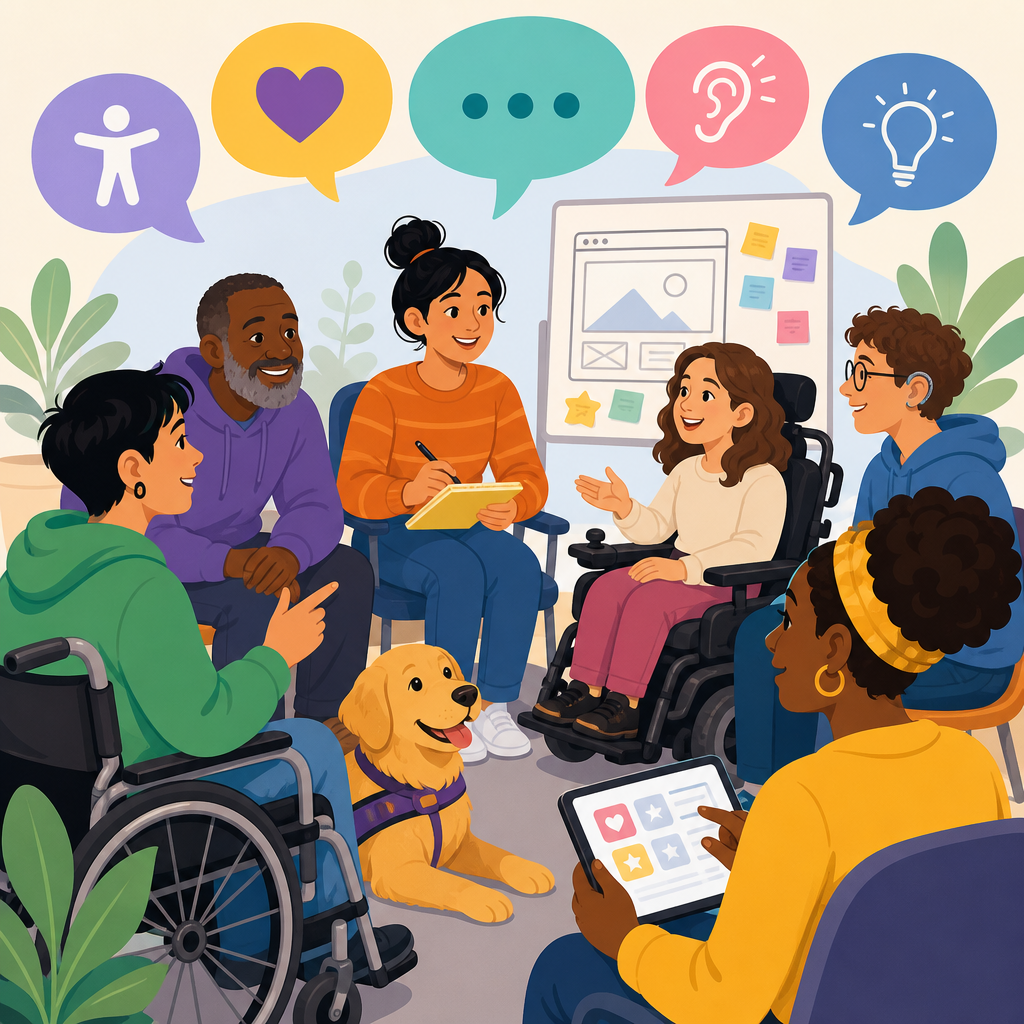
Gathering disability community feedback before you build is the fastest way to avoid expensive redesigns, prevent accessibility failures, and create services people can actually use. In practice, this means involving disabled people early, before requirements are locked, prototypes are approved, or code is shipped. “Community feedback” is broader than usability testing. It includes listening sessions, paid advisory input, co-design workshops, interviews, surveys, pilot programs, and long-term relationship building with disability organizations and individual advocates. “Before you build” also matters. Once a team has already chosen layouts, workflows, procurement vendors, or physical fixtures, accessibility gaps become harder to correct and more costly to fix.
I have seen projects that looked compliant on paper still fail in the real world because teams asked for feedback too late. A clinic kiosk technically met contrast requirements, yet blind users could not complete a check-in independently because the audio jack was poorly placed and the on-screen timeout was too short. A city program launched an application portal with captions and keyboard access, but people with cognitive disabilities found the instructions confusing and the error messages overwhelming. These problems were not caused by bad intent. They came from building around assumptions instead of lived experience.
This topic matters because accessibility is not only a legal or technical issue. It is an operational, financial, and trust issue. The Americans with Disabilities Act, Section 504, Section 508, and the Web Content Accessibility Guidelines provide essential standards, but standards do not replace community insight. Rules can tell you minimum requirements. Disabled users can tell you whether a process is understandable, dignified, efficient, and safe. That difference is critical for schools, healthcare systems, employers, retailers, software teams, nonprofits, and public agencies that want support services to work across digital, physical, and service environments.
As a hub page under Resources and Support, this guide covers the full discipline of community engagement and advanced ADA support. It explains when to seek disability community feedback, who to involve, how to compensate participants, which methods work best, what questions to ask, and how to turn feedback into action. It also frames accessibility as an ongoing partnership rather than a single checkpoint. If your team is planning a website, mobile app, office renovation, transportation service, intake form, event, procurement process, or customer support workflow, this is where to start.
Why disability community feedback must happen before design decisions harden
The simplest answer is that early feedback changes the right things. Late feedback usually only changes surface details. If you talk with disabled users while defining the problem, you can rethink whether a task should exist, whether a step can be removed, whether a service needs both digital and human pathways, or whether a product should support multiple interaction modes from the beginning. If you wait until prelaunch review, you may only have budget or political room to adjust labels, colors, and small interface issues.
Early engagement also exposes hidden dependencies. For example, a transportation booking flow may appear accessible in a prototype, yet fail because confirmation calls are placed through an automated phone system that does not work well with relay users. A workplace accommodation portal may pass automated scans and manual keyboard checks, yet break down when medical documentation deadlines are too short for people navigating chronic illness. By speaking with people who live these realities, teams discover process barriers that technical audits alone rarely surface.
Another reason is risk management. Remediation after launch costs more than inclusive planning. In software, rebuilding information architecture, replacing inaccessible components, and rewriting transactional emails can consume an entire sprint cycle or more. In physical spaces, moving counters, replacing signage, changing hardware clearances, or reworking circulation paths can require permits and contractor time. In service design, retraining staff and rewriting policy after complaints or legal review carries reputational cost. Front-loading feedback reduces all three forms of risk: technical, operational, and legal.
Who to involve and how to recruit representative participants
A strong engagement plan includes people with different disability experiences, not a single spokesperson. Depending on the project, that may include blind people, Deaf and hard of hearing people, wheelchair users, people with limited dexterity, speech disabilities, cognitive disabilities, intellectual disabilities, neurodivergent people, people with mental health disabilities, people with chronic illness, and people with multiple disabilities. Intersectionality matters too. Age, language, race, income, broadband access, housing status, and rural geography often shape access barriers as much as the primary disability category.
Recruitment should combine organizational outreach and direct participant sourcing. Local Centers for Independent Living, disability rights groups, parent advocacy organizations, vocational rehabilitation networks, Deaf service agencies, senior organizations, and university disability resource centers can help identify participants and advise on outreach language. For digital products, I also recommend using established research recruitment tools while screening for assistive technology use, task familiarity, and environmental factors such as mobile-only access. Do not rely entirely on your employees, friends, or one advisory board member. Convenience samples miss too much.
Representation does not mean statistical perfection. It means recruiting enough variety to uncover different failure modes. A website that works with screen readers may still frustrate magnifier users because of reflow issues. An event registration process that works for blind attendees may still fail for people with fatigue if it requires long uninterrupted completion. A virtual support service that serves English-speaking adults may still exclude Deaf users who prefer interpreters over captions. Your goal is to gather input that reflects how disability is experienced across contexts, tools, and identities.
How to choose the right engagement method for the decision in front of you
Different methods answer different questions. Listening sessions are useful when you need broad input on pain points, trust, stigma, and service barriers. One-to-one interviews work well when experiences are sensitive, individualized, or tied to health, employment, or benefits systems. Co-design workshops help when you need participants to react to concepts, workflows, and tradeoffs. Usability testing is best for observing task completion on prototypes or live systems. Advisory councils support long-term governance, especially for institutions that repeatedly launch programs and need continuity beyond a single project.
In my work, the most effective sequence is often discovery interviews, then concept testing, then prototype usability sessions, then a limited pilot with structured follow-up. That progression mirrors how decisions actually mature. Early conversations reveal unmet needs. Mid-stage sessions test whether the proposed solution fits those needs. Pilot feedback catches implementation gaps such as staff training, support response times, login recovery problems, or inaccessible documents sent after the main transaction. Each step produces a different kind of evidence, and skipping one usually leaves blind spots.
| Method | Best use | What it reveals | Main limitation |
|---|---|---|---|
| Listening session | Early discovery | Shared barriers, trust issues, unmet needs | Less detail on task performance |
| Interview | Sensitive or complex topics | Personal workflows, context, tradeoffs | Smaller sample size |
| Co-design workshop | Shaping concepts | Preferences, priorities, alternative ideas | Requires skilled facilitation |
| Usability test | Evaluating prototypes or products | Observed errors, friction, completion barriers | Focused on a specific flow |
| Pilot program | Prelaunch validation | Operational problems in real conditions | Takes more time and coordination |
How to make participation accessible, respectful, and worth people’s time
If you want high-quality disability community feedback, remove participation barriers first. Offer multiple formats: video, phone, email, text, in-person, and asynchronous options. Provide plain-language invitations, accessible PDFs only when necessary, and web forms that work with screen readers and keyboard navigation. Ask participants what accommodations they need instead of guessing. That may include interpreters, CART, captions, flexible scheduling, extended breaks, fragrance-free spaces, wheelchair-accessible meeting rooms, transportation support, support persons, or materials in advance for processing time.
Compensation is not optional if you are asking for expertise. Pay participants, and pay promptly. Gift cards can work for some audiences, but cash or direct payment is often better because it is flexible and more respectful of professional contribution. Be transparent about rates, timing, tax forms, and any impact on public benefits if relevant. Some participants may prefer payment to an organization; others will not. The key principle is that lived experience has value. Unpaid “feedback” frequently results in extractive relationships and narrow participation from those who can afford to volunteer.
Respect also means handling privacy carefully. Tell people how notes will be used, whether sessions are recorded, who will see recordings, and whether quotes will be attributed. Avoid asking participants to educate your team on every aspect of disability if it is unrelated to the project. Keep sessions focused, accessible, and purposeful. When people share barriers, believe them. Your job is not to debate whether the problem is real. Your job is to understand the conditions that produced it and determine what change is required.
What questions to ask before building websites, spaces, services, or programs
Good questions uncover barriers, workarounds, and decision criteria. Start with lived process questions: How do you do this today? Where does it break? What makes the task slower, stressful, or dependent on another person? Which tools do you use, such as JAWS, NVDA, VoiceOver, TalkBack, switch access, magnification, captions, or relay services? What alternatives do you choose when the standard route fails? These questions reveal the ecosystem around the task rather than just opinions about a design.
Then ask future-state questions tied to scenarios. If you needed to book this service outside business hours, what would help? If you arrived at this building alone, what would you need before you enter? If your screen froze during checkout, how would you recover? If the only instructions were in a dense PDF, what would happen next? Scenario-based prompts generate clearer answers than abstract questions like “Do you like this design?” because they force teams to understand moments of friction and failure.
For advanced ADA support, ask policy and staffing questions too. What happens when the standard workflow does not work for you? How easy is it to reach a human who can solve the issue? Are staff trained to offer alternatives without making people disclose more than necessary? Many accessibility failures come from service breakdowns rather than interface defects. A technically accessible form still fails if support lines are unresponsive, accommodation requests disappear into shared inboxes, or front-desk staff do not know the escalation path.
How to analyze feedback and turn it into build decisions
Collecting feedback is only useful if it changes requirements, backlog priorities, and operating procedures. After sessions, tag findings by severity, frequency, affected user groups, and root cause. Separate preference from barrier. If one participant prefers dark mode, that may be a feature request. If several screen reader users cannot identify form errors, that is a functional barrier. I recommend mapping findings to specific artifacts: product requirements, design system components, content standards, procurement criteria, training scripts, facility plans, and service policies.
Root cause analysis matters because symptoms can be misleading. Participants may say a site feels confusing, but the underlying issue could be heading structure, inconsistent button labels, time-limited sessions, poor plain language, or a combination of all four. A receptionist may report that accommodation requests are hard to process, while the real problem is that the intake system lacks structured fields and sends inaccessible confirmations. Fixes should target the system condition that creates repeated failure, not only the most visible complaint.
Close the loop with participants whenever possible. Share what you learned, what you changed, what you could not change yet, and why. That step builds trust and improves future participation. It also disciplines internal teams. When leaders know they must report back to the community, they are more likely to assign owners, timelines, and budgets. Community engagement without accountability quickly becomes performative. The strongest programs treat disability feedback as governance input, not as a one-time consultation to validate a predetermined plan.
Building a lasting community engagement program under Resources and Support
The biggest payoff comes when feedback practices become repeatable. Create an accessibility research panel with consented participants, compensation guidelines, accommodation workflows, and documented recruitment criteria. Maintain templates for accessible outreach, moderation guides, and post-session summaries. Train product managers, service owners, facilities teams, and communications staff on when to trigger community engagement. Pair this hub with deeper articles on inclusive research methods, accessible events, digital accessibility testing, reasonable accommodation workflows, and procurement review so teams know where to go next.
Long-term programs also need executive sponsorship and measurement. Track which projects engaged the disability community before launch, which barriers were found, how many were fixed before release, and how long remediation took. Monitor complaint trends, support tickets, abandonment rates, and accommodation response times. These are practical indicators of whether your support ecosystem is improving. When organizations institutionalize this work, accessibility stops being a scramble after a problem surfaces and becomes part of how planning happens.
Gather disability community feedback before you build, and you will make better decisions at every stage. You will define problems more accurately, avoid preventable barriers, spend less on rework, and earn more trust from the people you serve. Most importantly, you will create resources and support systems that reflect real human use instead of internal assumptions. Start small if needed: identify one upcoming project, recruit a diverse set of disabled participants, compensate them fairly, and use their input to shape requirements before design begins. That first step changes the quality of everything that follows.
Frequently Asked Questions
Why is it important to gather disability community feedback before building a product or service?
Gathering disability community feedback early helps teams make better decisions before those decisions become expensive to change. When disabled people are included before requirements are finalized, prototypes are approved, or development begins, accessibility stops being a last-minute fix and becomes part of the foundation of the product. This approach reduces the risk of launching experiences that unintentionally exclude users, create barriers, or fail basic usability expectations in real-world situations.
It also improves the quality of what you build. Accessibility compliance alone does not guarantee that a service is understandable, efficient, or trustworthy for disabled users. Community feedback reveals practical issues that internal teams often miss, such as confusing workflows, inaccessible support channels, assumptions about vision, hearing, dexterity, cognition, stamina, or assistive technology use, and mismatches between how a team imagines a task will be completed and how people actually complete it. By hearing directly from disabled participants early, organizations can spot hidden friction before it spreads through design systems, content, engineering, and policy decisions.
Just as important, early feedback builds credibility. Inviting disabled people in only after something is nearly complete sends the message that their input is optional. Involving them from the start demonstrates respect, improves trust, and leads to services that are more usable for a much wider audience. In most cases, it is the fastest way to avoid redesigns, reduce accessibility failures, and create something people can actually use with confidence.
What kinds of disability community feedback should teams collect before they build?
Teams should think beyond traditional usability testing and gather multiple forms of input depending on the stage of the work. Early discovery may benefit from listening sessions, one-on-one interviews, and paid advisory conversations that help define user needs, risks, and priorities before solutions are proposed. Co-design workshops can be especially valuable when teams want to shape workflows, features, language, or service models alongside disabled participants rather than presenting a nearly finished idea for approval.
Surveys can help identify broader patterns, especially when teams want to understand unmet needs across a larger or more geographically dispersed group. Pilot programs and low-fidelity prototype reviews are useful for testing assumptions before significant time and money are invested. If the product or service is ongoing, long-term relationships such as advisory panels, recurring check-ins, or community partnerships can provide continuity and help teams avoid one-time consultation that does not influence future decisions.
The best feedback mix usually includes both open-ended and structured methods. Open conversations reveal lived experience, workarounds, and unmet needs that may never appear in a checklist. Structured methods make it easier to compare themes, prioritize issues, and feed findings into product planning. A strong research plan also reflects disability diversity, including people with mobility, vision, hearing, speech, cognitive, neurodivergent, mental health, and chronic illness experiences, along with people who use a wide range of assistive technologies. The goal is not to collect feedback from a single representative voice, but to understand a range of perspectives before key decisions are locked in.
How do you recruit disabled participants ethically and effectively for early feedback?
Ethical recruitment starts with recognizing disabled people as experts in their own experience, not as volunteers expected to donate free labor. Participants should be paid fairly for their time, insight, preparation, and any follow-up involved. Compensation should be straightforward, timely, and available in formats that do not create new barriers. Recruitment materials should clearly explain the purpose of the session, what will be discussed, how the feedback will be used, how long participation will take, and what accessibility supports are available.
Effective recruitment also means avoiding narrow outreach methods. If teams rely only on existing professional networks or a single advocacy contact, they are likely to hear from the same few people and miss important perspectives. Strong recruitment often combines partnerships with disability organizations, community groups, independent advocates, researchers, service providers, and direct outreach through accessible channels. Materials should be available in plain language and, where needed, alternative formats. Scheduling should be flexible, and teams should be prepared to offer accommodations such as captioning, sign language interpretation, extended time, breaks, multiple communication options, and accessible digital or physical environments.
It is equally important to recruit for the decisions you need to make. If you are designing account setup, payment flows, transportation interactions, medical forms, classroom tools, or customer support systems, seek participants whose lived experiences align with those contexts. A good process respects privacy, avoids intrusive gatekeeping, and does not force people to disclose more personal information than necessary. Done well, recruitment creates the conditions for honest input, broader representation, and stronger decision-making from the beginning.
When in the product or service development process should disability community feedback happen?
The short answer is as early as possible, and then repeatedly. The most valuable time to gather feedback is before requirements are fixed and before the team becomes attached to a specific solution. Early discovery feedback helps organizations understand what problems actually matter, what barriers already exist in current services, and what assumptions may be flawed. This is where teams can prevent major missteps by validating the problem space before they start designing screens, drafting policies, or writing code.
Feedback should continue through concept development, prototyping, piloting, and launch preparation. At the concept stage, teams can test whether ideas are understandable and relevant. During prototyping, they can identify interaction, navigation, communication, and workflow issues before implementation costs rise. Pilot programs can reveal operational barriers such as inaccessible onboarding, unclear support processes, or dependencies on third-party tools that create exclusion. Even after launch, ongoing feedback helps teams monitor whether real users are succeeding over time and whether updates introduce new barriers.
What teams should avoid is treating disability feedback as a single approval checkpoint at the end. That approach limits participants to reacting to decisions that are already difficult to change. A better model is continuous involvement, where disabled people influence priorities, not just polish. The earlier the feedback happens, the more strategic it becomes. Instead of fixing isolated accessibility defects later, teams can shape the entire service around real use from the start.
How should teams turn disability community feedback into better decisions instead of letting it sit in a report?
The key is to build a process that connects feedback directly to decisions, owners, and timelines. After gathering input, teams should synthesize findings into clear themes, document the barriers and unmet needs identified, and map each issue to a specific product, content, operational, or policy decision. Insights should not remain as vague observations such as “users found this difficult.” They should be translated into actionable statements that explain what is failing, who is affected, why it matters, and what needs to change before moving forward.
It also helps to separate quick fixes from structural changes. Some feedback may point to immediate improvements in wording, navigation, forms, or support materials. Other feedback may expose deeper issues in assumptions, service models, procurement choices, or success metrics. Leadership, design, engineering, research, compliance, and customer-facing teams should all be involved where relevant so that responsibility does not fall entirely on one accessibility specialist or researcher. If tradeoffs are necessary, teams should document them transparently and avoid dismissing accessibility concerns as edge cases.
Closing the loop with participants matters too. When possible, let people know what changed, what is still being evaluated, and how their feedback influenced the work. This builds trust and supports stronger long-term relationships with the disability community. The most effective organizations treat feedback as an ongoing governance input, not a one-time research artifact. When insights are tied to roadmap decisions, design criteria, acceptance standards, and post-launch measurement, community feedback becomes a practical driver of better products and services rather than a report that gets archived and forgotten.


