Passenger loading zones under the ADA are designated curbside or pull-up areas where people enter and exit vehicles, and they are governed by technical rules that make boarding safer for wheelchair users, people with walkers, and travelers who need extra space or level access. In practice, these spaces seem simple, but I have seen many projects fail inspections because teams treated them like a striped curb instead of a carefully dimensioned accessible element tied to route, slope, vertical clearance, and site circulation. This matters because Chapter 5 of the ADA Accessibility Standards covers the site and building features people encounter before they ever reach a lobby, classroom, clinic, or store entrance. Passenger loading zones sit alongside accessible parking, curb ramps, outdoor developed paths, stair handrails, drinking fountains, and other common elements that determine whether a site works for real people in real weather, traffic, and time pressure.
Within this chapter, passenger loading zones are especially important at hospitals, hotels, schools, airports, multifamily housing, senior living campuses, government buildings, and event venues where drop-off activity is constant. A compliant design includes a vehicle pull-up space, an adjacent access aisle, required vertical clearance, and a connection to an accessible route. The rules come from ADA Standards section 503, with related requirements in sections addressing routes, slopes, curb ramps, protruding objects, and site arrival points. If a project provides passenger loading zones, at least one must be accessible. That single sentence drives many design decisions, yet it is only the starting point. True compliance depends on dimensions, layout, drainage, cross slope, and how pedestrians move from curb to entrance without being forced into traffic lanes. As a hub article for Chapter 5, this guide explains the loading-zone rules in depth and shows how they connect to the broader family of general site and building elements.
What an ADA Passenger Loading Zone Must Include
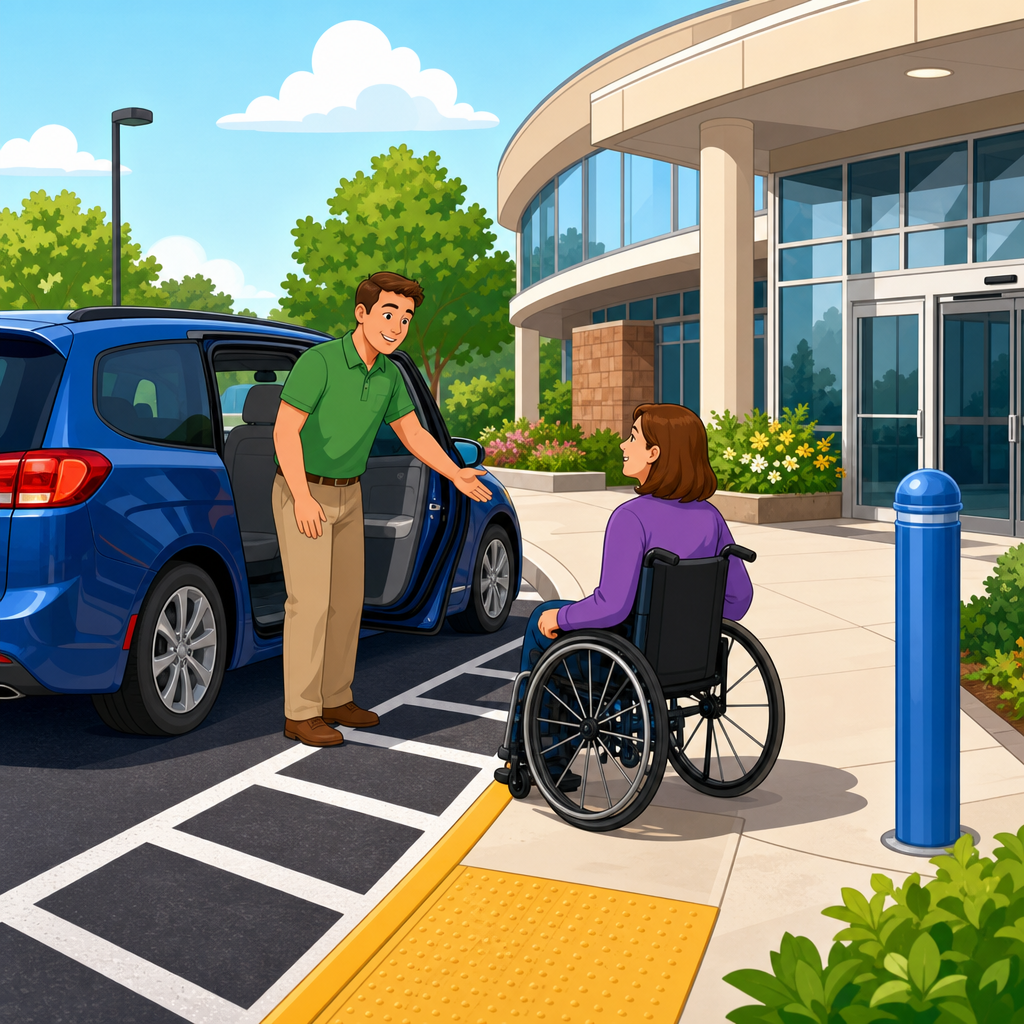
An accessible passenger loading zone has four core features. First, it needs a vehicle pull-up space that is at least 96 inches wide and 20 feet long minimum. Second, it needs an access aisle that is at least 60 inches wide and the same 20-foot minimum length. Third, both the pull-up space and access aisle must have slopes not steeper than 1:48 in all directions. Fourth, the vehicle space, access aisle, and vehicular route serving them must provide a vertical clearance of at least 114 inches. The access aisle must adjoin the vehicle pull-up space and connect to an accessible route. Those dimensions are not optional details. They are the basis for safe deployment of lifts or ramps and for side transfers from vans, paratransit vehicles, taxis, and private cars.
In the field, the most common mistake is assuming an accessible parking stall can substitute for a loading zone. It cannot. Parking serves parked vehicles; loading zones support active boarding and unloading. The geometry is different, the use pattern is different, and the clearance requirement is different. Another frequent error is placing the access aisle between the curb and vehicle lane without checking whether users can move directly onto an accessible route. If the aisle empties into landscaping, a steep curb ramp flare, or a crosswalk with excessive running slope, the zone may be striped correctly but still unusable. Designers should think of the loading zone as a complete boarding sequence: vehicle arrival, door opening, lift deployment, passenger maneuvering, and path of travel to the entrance.
How Passenger Loading Zones Fit Within Chapter 5
Chapter 5 addresses general site and building elements that shape arrival, circulation, and everyday use. Passenger loading zones work only when the surrounding elements are also compliant. For example, the accessible route requirements in Chapter 4 affect whether a person can get from the access aisle to the building entrance without steps or steep grades. Curb ramps become relevant when the route crosses a curb line. Changes in level, walking-surface stability, and protruding object limits also influence usability. In transportation-heavy sites, the loading zone may intersect with bus boarding areas, crosswalks, or passenger queuing space, which means the design team has to coordinate multiple standards rather than reviewing section 503 in isolation.
This interconnected reading of Chapter 5 is how successful projects avoid late redesigns. On healthcare campuses, I often review loading zones at emergency departments, outpatient clinics, and main lobbies where rain can pond near the curb. If drainage pushes slope beyond 1:48 in the access aisle, the issue is not just a loading-zone failure; it is a grading and civil coordination failure. On school sites, the loading zone may sit near security bollards, signposts, or canopies. If those elements reduce clear width, create protruding hazards, or conflict with the accessible route, the loading area becomes functionally compromised. The chapter is best understood as a set of linked obligations covering how people arrive, orient themselves, and move through exterior and interior site elements.
Technical Dimensions, Clearance, and Surface Conditions
The dimensional requirements are straightforward, but applying them on built sites requires precision. The vehicle pull-up space must be 96 inches wide minimum, and the access aisle must be 60 inches wide minimum. Both must extend the full 20-foot length minimum. Vertical clearance must be 114 inches minimum at the loading zone, the aisle, and the vehicular route to and from the area. This often affects canopy design, tree placement, signage arms, and low decorative lighting. A hotel porte cochere may look generous, yet if a hanging fixture drops below 114 inches, van access can be blocked. Likewise, ambulance-adjacent loading zones at medical facilities need overhead review early because equipment booms, soffits, and wayfinding signs can interfere.
Surface condition is where many accessible loading zones quietly fail. The 1:48 maximum slope in all directions applies to the pull-up space and access aisle, so cross slope and running slope both matter. Contractors sometimes create a smooth-looking curb lane that still exceeds tolerance after settlement or paving transitions. Loose unit pavers, broken asphalt, and utility covers in the aisle can also undermine maneuvering. Although the ADA Standards do not prescribe every material choice, best practice is a stable, firm, slip-resistant surface with drainage designed away from the user standing area. Snow storage is another operational issue. In northern climates, plowed snow often gets pushed into the aisle because staff see it as extra pavement. That turns a technically compliant design into a seasonal barrier unless maintenance plans specifically protect the access aisle.
Common Design Scenarios and Practical Solutions
Different building types use passenger loading zones differently, and the design should match the use case. At a hospital, patients may arrive in wheelchair vans, nonemergency medical transport, or family vehicles. They may need wide door swing clearances, weather protection, and direct access to automatic doors. At a hotel, luggage, valets, and queuing can encroach on the access aisle, so pavement markings and staff training matter as much as layout. At a school performing arts center, peak-event traffic can create temporary drop-off patterns that conflict with the designated accessible zone. In each setting, the legal minimum remains the same, but the operational demands change how much space, signage, and supervision are prudent.
A reliable solution is to place the access aisle on the passenger side nearest the accessible route and protect it from standing traffic. If bollards are used, they should be located outside required clear widths and outside lift deployment areas. If a canopy is provided, verify clearance at every low point, including decorative trim. Where a curb ramp connects the loading zone route to a sidewalk, align it with travel rather than forcing diagonal movement across flares. In renovations, if site constraints make a conventional curbside layout difficult, re-striping, relocating a crosswalk, or adjusting island geometry can often create compliance without major demolition. The key is to test the design with the actual movement of a wheelchair user, not just with lines on a civil plan.
| Requirement | ADA Minimum | Why It Matters | Common Failure |
|---|---|---|---|
| Vehicle pull-up width | 96 inches | Allows passenger vehicle positioning | Striped too narrow near curb returns |
| Access aisle width | 60 inches | Supports lift deployment and maneuvering | Encroached on by posts, planters, or valet stands |
| Length of both spaces | 20 feet | Provides usable boarding area along vehicle | Shortened by crosswalks or landscaped noses |
| Slope | 1:48 maximum in all directions | Reduces tipping and rolling risk | Drainage grading exceeds tolerance |
| Vertical clearance | 114 inches | Accommodates accessible vans | Canopies, signs, or branches hang too low |
| Accessible route connection | Required | Completes travel from vehicle to entrance | Aisle leads to curb without compliant route |
Relationship to Accessible Routes, Curb Ramps, and Entrances
The access aisle is only half the story; the route beyond it determines whether the site is actually usable. An accessible route from the loading zone should connect to an accessible entrance without stairs, abrupt level changes, or narrowed clear width. If the route crosses a curb, the curb ramp must meet its own technical criteria for width, slope, landings, and detectable warnings where applicable under other standards. Designers often create a loading zone at a side entrance because curb geometry is convenient, then forget that the side entrance has heavier door pressure, no automatic opener, or a steep sidewalk segment. From the user’s perspective, the failed route matters more than the compliant stripe pattern.
Entrances also need coordination with site planning. Revolving doors cannot be the only accessible entrance. Vestibules need enough maneuvering clearance for mobility devices. Door thresholds, hardware, and opening force affect whether a person arriving from the loading zone can enter independently. This is why Chapter 5 should be reviewed as part of the larger accessibility chain that continues into doors, rooms, controls, and restrooms. If you are building a hub page for ADA Accessibility Standards, internal topic planning should connect passenger loading zones to related guidance on accessible routes, curb ramps, doors and doorways, site arrival points, and parking. Users rarely search these items in isolation; they need the full path from curb to destination explained in one coherent framework.
Operations, Maintenance, and Compliance Reviews
Compliance does not end at design approval. Property operators must keep the passenger loading zone clear, striped, and connected to a usable route. I have seen compliant hospital drop-offs become inaccessible because valet podiums migrated into the aisle, seasonal planters narrowed the route, or shuttle queues covered the curb ramp. Maintenance teams should inspect pavement markings, drainage performance, canopy clearance, lighting, and snow removal practices regularly. If repaving occurs, recheck slopes with a digital smart level or similar tool rather than assuming the original dimensions survived the work. For larger portfolios, create a site-accessibility checklist and photograph each loading zone after maintenance projects, because small changes often create outsized barriers.
Formal reviews should include both plan review and field verification. During design, confirm dimensions on civil, landscape, architectural, and structural drawings, not just one sheet. During construction, measure clearance after signage, lighting, and canopy finishes are installed. During turnover, walk the route from street approach to entrance using the same path a passenger would take. Ask direct questions: Can a van stop here without blocking traffic? Can a side lift deploy fully? Is the aisle free from drain grates and utility lids? Does a wheelchair user reach the entrance without entering the drive lane? These are practical, answerable questions, and they reveal more than a code summary alone. Strong ADA compliance comes from combining technical standards with real-world observation.
Passenger loading zones under the ADA are a small part of Chapter 5 on paper, but they carry outsized importance because they shape first arrival, safe boarding, and independent access for people with disabilities. The essential rules are clear: if passenger loading zones are provided, at least one must be accessible, with a 96-inch vehicle pull-up space, a 60-inch access aisle, 20-foot minimum lengths, slopes no steeper than 1:48, 114 inches of vertical clearance, and a direct connection to an accessible route. Those requirements must then be coordinated with curb ramps, entrances, circulation paths, site grading, overhead elements, and daily operations. When any one of those pieces fails, the loading zone stops functioning even if the striping appears correct.
As a hub within ADA Accessibility Standards, Chapter 5 should be approached as an integrated system of general site and building elements rather than a checklist of unrelated details. Passenger loading zones connect directly to accessible parking, routes, doors, exterior paths, and maintenance practices, so the best results come from reviewing them together. For designers, owners, and facility managers, the benefit is practical: fewer barriers, fewer complaints, smoother inspections, and a site that works for actual users every day. If you are auditing or planning a property, start by tracing the full passenger journey from drop-off to entrance and correct every break in that chain. That is the fastest way to turn technical compliance into genuine accessibility.
Frequently Asked Questions
What is an ADA-compliant passenger loading zone, and how is it different from a typical curbside drop-off area?
An ADA-compliant passenger loading zone is a specifically designed area where passengers can safely enter and exit a vehicle, with features that support accessibility for people who use wheelchairs, walkers, canes, crutches, or other mobility devices. It is not just a painted curb or a convenient place to stop. Under the ADA standards, a compliant passenger loading zone must include a vehicle pull-up space and an adjacent access aisle so there is enough room for deploying ramps, lifts, and mobility equipment. The area must connect to an accessible route and be built with careful attention to slope, dimensions, and vertical clearance.
The major difference between a standard drop-off area and an ADA-compliant passenger loading zone is that accessibility is built into the geometry and layout from the start. A regular curbside area may let vehicles stop, but it often lacks the space needed for side or rear lift deployment, may force passengers into traffic, may have excessive cross slope, or may not connect to the entrance by an accessible path. In contrast, an ADA passenger loading zone is intended to support safe, usable boarding and alighting without creating barriers. That is why these spaces are frequently scrutinized during plan review and field inspection. If the access aisle is too narrow, the route is interrupted, or the slopes exceed allowed tolerances, the space may fail even if it looks acceptable at a glance.
What are the main ADA design requirements for passenger loading zones?
The core ADA requirements focus on dimensions, surface conditions, and connectivity. A compliant passenger loading zone includes a vehicle pull-up space that is at least 96 inches wide and an access aisle that is at least 60 inches wide. The access aisle must run the full length of the vehicle pull-up space. This matters because accessible vans and paratransit vehicles often need a long clear area to deploy lifts or ramps safely. The access aisle and pull-up space must also have a surface slope that does not exceed 1:48 in all directions, which is one of the most common points of failure in construction. Small grading errors that seem minor in the field can make the space noncompliant.
Vertical clearance is another critical requirement that teams sometimes overlook. At passenger loading zones serving vans or similar accessible vehicles, the zone and the vehicular route to and from it must generally provide at least 114 inches of vertical clearance. This is especially important at canopies, porte-cochères, parking structures, and covered drop-off areas where beams, signs, lighting, or decorative elements may intrude into the required height. The loading zone must also connect to an accessible route leading to the accessible entrance, and that route must remain usable without requiring people to travel behind parked vehicles, negotiate abrupt level changes, or enter unsafe traffic conditions. In short, compliance depends on how the entire element works together, not just whether one measurement appears close enough.
Why do passenger loading zones so often fail ADA inspections?
Passenger loading zones often fail because they are treated as a simple traffic feature instead of a technical accessibility element. Design teams may focus on curb line, vehicle circulation, or striping while missing the ADA requirements that make the area actually usable for disabled passengers. One common issue is improper slope. Even a well-marked loading area can be unusable if the pavement pitches too steeply toward the gutter or drains in multiple directions. Wheelchair users need a stable platform for transfers, and ramp and lift deployment can become dangerous on uneven surfaces. Inspectors pay close attention to these conditions because they affect real-world safety, not just paperwork compliance.
Another common reason for failure is poor coordination between civil, architectural, and site elements. For example, a compliant-looking pull-up space may be installed, but the access aisle might end at a curb with no curb ramp, or the route to the entrance may pass through doors, mats, grates, or changes in level that are not accessible. In covered loading areas, vertical clearance is frequently missed because designers coordinate the pavement but forget overhead signs, soffits, fire sprinklers, or decorative structures. There are also failures caused by field modifications: a bollard placed in the aisle, a drain added where a clear surface was required, or striping shifted during construction. These are the kinds of issues that make passenger loading zones deceptively complex and explain why they need precise planning and final verification in the field.
How should a passenger loading zone connect to the accessible route and building entrance?
The passenger loading zone should connect directly and safely to an accessible route that leads to the accessible building entrance without unnecessary obstacles, detours, or exposure to moving traffic. The access aisle is not an isolated space; it is part of the overall accessible path of travel. Once a passenger exits the vehicle, they should be able to continue toward the entrance on a stable, firm, slip-resistant route that meets ADA requirements for width, slope, changes in level, and clearances. If the route crosses a curb, a compliant curb ramp or blended transition is typically needed. If it crosses a drive aisle or roadway, the design should minimize conflict and maintain a clear, understandable path.
This connection is where many designs break down in practice. A loading zone may meet dimensional requirements, but if the accessible route begins with a step, narrows at a gate, or runs behind idling vehicles, the user experience is compromised and the installation may not meet ADA expectations. The route also needs to be usable under everyday conditions, not just in theory. That means avoiding drainage patterns that pond water in the aisle, placing signage and bollards outside the clear travel path, and ensuring door hardware, thresholds, and entry features do not create the next barrier after a successful drop-off. A well-designed passenger loading zone works as part of a continuous accessible journey from vehicle to entrance.
Who needs to provide passenger loading zones, and what should property owners, designers, and contractors watch most closely?
Passenger loading zones are typically required where passenger drop-off and pick-up areas are provided as part of a facility, especially at places such as hospitals, hotels, schools, airports, transportation centers, medical offices, government buildings, and large commercial or multifamily developments. If a site includes a designated loading or valet area for passengers, the ADA may require that the feature be accessible. The exact scoping can depend on the type of facility, applicable standards, and whether state or local accessibility codes impose additional obligations. Property owners should not assume that general parking accessibility alone covers this issue. A site can have compliant accessible parking and still fail because its passenger loading zone does not meet ADA criteria.
For owners, designers, and contractors, the most important things to watch are dimensions, slopes, vertical clearance, and route continuity. Those four items cause the majority of field problems. It is wise to verify grading early, coordinate overhead conditions before construction, and measure finished surfaces rather than relying only on plan intent. Contractors should also protect these spaces from last-minute encroachments such as signs, planters, wheel stops, drains, or utility covers that can compromise the access aisle. Owners should understand that maintenance matters too. Even a compliant installation can become unusable if the route is obstructed, repaved incorrectly, or altered by future site work. The safest approach is to treat the passenger loading zone as a high-priority accessibility feature from design through final inspection and ongoing operation.