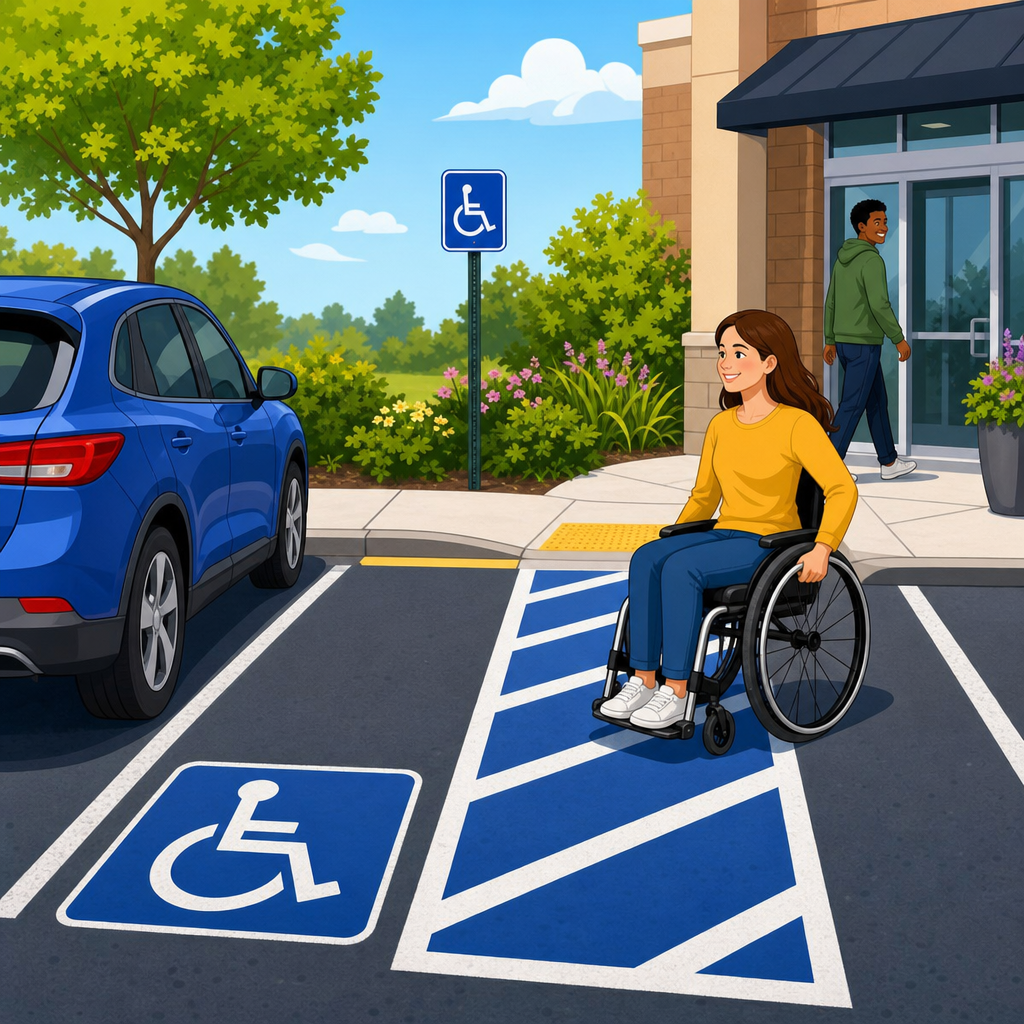
ADA parking access aisles are the striped spaces beside accessible parking spaces that give people room to deploy ramps, transfer to mobility devices, and enter or exit vehicles safely, and their width, slope, and placement are governed primarily by the 2010 ADA Standards for Accessible Design within Chapter 5: General Site and Building Elements. Chapter 5 matters because parking is often the first point of contact on a site, and if the aisle is too narrow, too steep, or placed where users must travel behind cars, the rest of an accessible route may be functionally useless. In plan reviews and field inspections, I have seen otherwise well-designed projects fail compliance because contractors treated the access aisle as paint instead of a required circulation space with exact dimensions and performance limits. For property owners, designers, and facility managers, understanding these rules reduces legal risk, supports safe use, and creates parking that works in real conditions, including rain, snow, van ramp deployment, and busy drop-off periods.
This article explains the core requirements for ADA parking access aisles and places them in the wider context of Chapter 5, which also covers parking spaces, passenger loading zones, stairs, handrails, drinking fountains, toilet and bathing rooms, dressing and fitting rooms, and other commonly used site and building elements. Key terms are important at the outset. An accessible parking space is a designated vehicle space that meets required dimensions and signage rules. An access aisle is the adjacent clear area that must connect to an accessible route. A van-accessible space includes wider maneuvering needs for lifts or side-entry ramps. Slope refers to the rate of rise in any direction across the parking space and access aisle, and placement refers to where the aisle sits in relation to the parking space, route to the entrance, and other parking spaces. Those definitions sound straightforward, but practical compliance depends on small details such as whether the route crosses a curb, whether a wheel stop projects into the aisle, and whether drainage creates cross slope beyond the allowed maximum.
What Chapter 5 Requires for Accessible Parking and Access Aisles
Chapter 5 establishes the technical framework for parking in Section 502, with scoping for the number of required spaces found in Section 208. The basic requirement is simple: every accessible parking space must have an access aisle, and the aisle must adjoin the full length of the parking space. Standard car-accessible spaces need an access aisle at least 60 inches wide. Van-accessible spaces can comply in one of two ways commonly used in practice: either provide a 132-inch-wide parking space with a 60-inch-wide aisle, or a 96-inch-wide parking space with a 96-inch-wide aisle. Those dimensions are not interchangeable after striping; they determine whether a van user can lower a lift or deploy a ramp with enough clear width.
Placement rules are just as important as width. Access aisles must be on the passenger side of van spaces where possible, and van spaces may share an aisle. The aisle has to connect directly to an accessible route serving the building entrance or other destination. In real layouts, the best-performing configuration is usually a cluster of accessible spaces on the shortest accessible route to the accessible entrance, with aisles leading toward the sidewalk rather than forcing users behind parked vehicles. The Standards also require aisles to be marked to discourage parking in them. That means the striping is not merely decorative; it is a functional no-parking zone that keeps the maneuvering area available at all times.
The most misunderstood rule is slope. Parking spaces and access aisles serving them must comply with surface slope requirements so they are nearly level. Under the 2010 ADA Standards, accessible parking spaces and access aisles must be at the same level, and changes in level are not permitted. The commonly applied best practice is to hold both running slope and cross slope to no more than 1:48, which is about 2.08 percent. This matters because even modest slope can cause wheelchair drift, unstable transfers, or a van lift platform landing unevenly. During field checks, I use a digital level because drainage design frequently pushes one corner of an aisle out of tolerance.
Width Requirements and Why Inches Matter in Real Use
The width rules exist because people do not use parking spaces the way site plans imply. A wheelchair user may need room to open the door fully, align a transfer board, swing a leg out, or deploy a side-entry ramp. Someone using a power chair may need turning clearance before moving toward the curb ramp. A parent assisting an adult family member may need to stand beside the vehicle while operating a lift. In each of these cases, an aisle that is even a few inches short can turn a compliant-looking space into one that cannot be used independently.
For car spaces, a 60-inch access aisle is the minimum technical threshold, not a comfort margin. For van spaces, the 96-inch aisle option is often more practical because it better accommodates side-entry vans, though both standard configurations are permitted when laid out correctly. Designers should also account for striping width, curb overhang, bollard placement, and wheel stop location. I have seen installations where the measured aisle width was technically correct between paint lines, but a wheel stop reduced usable maneuvering space and created a trip hazard. The Standards evaluate clear space, not just striping intent.
One reliable way to avoid dimensional conflicts is to coordinate civil, architectural, and striping documents early. If the accessible route rises at a curb ramp immediately beside the aisle, the ramp flare or detectable warning area cannot intrude into the required parking maneuvering area. If the route passes through a narrow sidewalk throat, users may clear the vehicle only to encounter another bottleneck. Chapter 5 works as a system: parking dimensions, route continuity, surface stability, and entrance access all have to align for the space to function.
Slope Limits, Drainage, and Surface Quality
Slope is where many parking projects succeed on paper and fail on asphalt. The access aisle and parking space must be as level as possible, with the accepted compliance benchmark of 1:48 maximum in all directions. Designers sometimes place accessible spaces on the same gradient used to drain the overall parking field, assuming the difference is negligible. It is not. A 3 percent cross slope may look flat to an able-bodied inspector, yet it can create dangerous wheelchair roll, complicate transfers, and cause van lifts to bottom out or feel unstable.
Drainage should be routed around accessible parking rather than through it whenever feasible. The best layouts place accessible stalls on a relatively flat pad, then pick up site drainage outside the required area with valley pans, trench drains located beyond the route, or carefully coordinated grading. Surface quality matters too. The Standards require stable, firm, and slip-resistant surfaces. That means potholes, rutting, loose gravel, cracked pavement lips, or patched trenches can all undermine usability. In maintenance audits, surface deterioration is one of the fastest ways a compliant installation slips into noncompliance.
Snow and resurfacing add another layer. In colder climates, snow storage must not block aisles, curb ramps, or signs. After sealcoating or mill-and-overlay work, restriping often drifts a few inches, and accessible parking can end up farther from the route or with altered dimensions. Every resurfacing project should include re-verification of aisle width, slope, signage height, and route connection. Parking compliance is not a one-time design issue; it is an ongoing facility management duty.
Placement: Closest Route, Entrance Relationship, and Site Planning
Accessible spaces and access aisles must be located on the shortest accessible route to an accessible entrance, but shortest does not simply mean geographically closest. The route must actually be accessible, without stairs, steep curb ramps, missing landings, or travel behind active loading operations. On many sites, the right location is near a side entrance that has level access and automatic doors rather than near the front facade where decorative steps dominate. Chapter 5 rewards practical route planning over superficial proximity.
Placement also affects user safety. An access aisle should not empty into traffic without a protected pedestrian path. It should not require someone using a mobility device to move behind reversing vehicles to reach the sidewalk. For medical offices, schools, apartment complexes, and retail centers, I generally recommend locating accessible parking where the pedestrian route is obvious from the moment the vehicle door opens. That often means aligning the aisle with a sidewalk connection, curb ramp, or flush transition directly ahead, not offset several spaces away.
Sites with multiple accessible entrances need distributed parking, not just a single compliant cluster at one doorway. Hospitals may need spaces near emergency, outpatient, and rehabilitation entries. Large campuses often need accessible parking near each major function. The scoping rules determine how many spaces are required overall, but thoughtful placement determines whether people can use the site with dignity and efficiency.
| Element | Minimum requirement | Common field issue | Best-practice response |
|---|---|---|---|
| Car access aisle | 60 inches wide | Striping correct but wheel stop reduces usable width | Keep all obstructions outside required clear area |
| Van access aisle | 60 inches with 132-inch space, or 96 inches with 96-inch space | Ramp deployment blocked by curb or sign post | Use wider aisle layout where van use is likely |
| Slope | Maximum 1:48 in practice for space and aisle | Drainage cross slope exceeds limit after paving | Grade a flat pad and verify with digital level |
| Placement | Shortest accessible route to accessible entrance | Users must travel behind parked cars | Align aisle directly to sidewalk or curb ramp |
| Marking | Clearly marked no-parking aisle | Faded striping leads to vehicle encroachment | Include restriping in routine maintenance plan |
How Access Aisles Connect to Other Chapter 5 Elements
This page serves as a hub because parking access aisles are only one part of Chapter 5. The moment a user leaves the aisle, the route interacts with other technical requirements. If a curb ramp connects the aisle to a sidewalk, its slope, width, flares, and detectable warnings must work with the parking layout. If the route leads to toilet rooms, drinking fountains, or dressing rooms, those elements have their own clear floor space, reach range, and turning space rules. In audits, I often find that owners focus on counting spaces while missing the chain of access beyond the car door.
Passenger loading zones in Section 503 are closely related. They require a vehicle pull-up space, a wide access aisle, and vertical clearance suitable for vans. For hotels, hospitals, and senior living facilities, a compliant loading zone can be as important as parking because many users arrive through drop-off rather than self-parking. Stairs and handrails, covered in other parts of Chapter 5, also matter because an accessible route from parking cannot rely on stair-only access. If the accessible entrance is around the building, wayfinding signs should direct users clearly from parking to that entrance.
As a sub-pillar under ADA Accessibility Standards, this hub should guide readers to deeper topics such as the required number of accessible parking spaces, van signage, curb ramps, passenger loading zones, surface maintenance, and enforcement against misuse. The central principle remains consistent across Chapter 5: accessibility is a continuous sequence, not a checklist of isolated details. A perfect access aisle that leads to an inaccessible entrance still fails the user.
Common Compliance Mistakes and How to Prevent Them
The most common mistake is assuming local code alone governs the layout. In reality, projects often need to satisfy the ADA Standards along with state accessibility codes and local amendments, and the stricter provision may control. Another frequent error is measuring slope only parallel to the stall striping instead of in both directions across the actual surface. Contractors also misplace signs, omit the “van accessible” designation where required, or center sign posts in a way that blocks door swing and ramp use.
Repairs create hidden problems. A utility cut through an access aisle may be patched with a rough lip. A curb ramp replacement may shift the route so users now cross the aisle at an awkward angle. Landscaping crews sometimes let shrubs grow into route width, and snow contractors may pile snow exactly where a ramp needs to deploy. Prevention depends on routine inspections using a repeatable checklist: confirm dimensions, check slope with calibrated tools, inspect markings and signage, verify route continuity, and review maintenance conditions seasonally.
For new construction, mock up one accessible bay early and field-measure it before paving the entire lot. For existing facilities, prioritize corrections that restore independent use: slope fixes, route connections, surface repairs, and clear markings usually deliver the biggest usability gains. If you manage multiple properties, standardize details and inspection protocols across sites so compliance does not depend on individual memory.
ADA parking access aisles succeed when three things are true at the same time: they are wide enough for real maneuvering, level enough for safe transfers, and placed where the accessible route begins immediately and intuitively. Chapter 5 provides the technical backbone for those decisions, but good outcomes depend on how designers, contractors, and owners apply the rules in the field. Width without placement still creates dangerous travel paths. Placement without slope control still leaves users on unstable pavement. Compliance requires all three.
As the hub for Chapter 5: General Site and Building Elements, this page should anchor your understanding of accessible parking while pointing you toward related topics such as parking counts, passenger loading zones, curb ramps, signage, and route continuity. If you are planning a new site, resurfacing a lot, or auditing an existing property, start by measuring your access aisles, checking slope in both directions, and tracing the actual path a user takes from vehicle to entrance. Then update the full chain of site elements so the parking space works as part of a complete accessible experience.
Frequently Asked Questions
What is an ADA parking access aisle, and why is it so important?
An ADA parking access aisle is the striped area located next to an accessible parking space that provides the extra room needed for people with disabilities to safely enter and exit a vehicle. It is not just painted buffer space. It is a required part of an accessible parking space because many drivers and passengers need additional clearance to open doors fully, transfer to a wheelchair, deploy a lift or ramp, or maneuver a mobility device beside the vehicle. Without an access aisle, the parking space may technically exist, but it may not function as an accessible space in any meaningful way.
The importance of the access aisle becomes clear in real-world use. For someone using a wheelchair van, a side-mounted ramp may extend several feet into the striped area. For a person transferring from a car seat into a wheelchair, there must be enough level, stable space to position mobility equipment and move safely. If the aisle is too narrow, obstructed, or poorly located, the person may be forced into a vehicular travel lane, behind parked cars, or into an unsafe route just to get from the vehicle to the accessible entrance. That defeats the purpose of accessible parking.
Under the 2010 ADA Standards for Accessible Design, parking and access aisles fall within Chapter 5 because they are foundational site features. Parking is often the first place a visitor encounters on a property, and if accessibility breaks down there, the rest of the site may effectively be unusable. In practice, compliant access aisles help reduce injury risk, improve independence, and support equal access from the moment a person arrives.
How wide does an ADA parking access aisle have to be?
The required width of an ADA parking access aisle depends on the type of accessible parking space it serves. For standard accessible car spaces, the access aisle must be at least 60 inches wide. For van-accessible spaces, the standards allow a couple of compliant configurations, but one common arrangement is a 96-inch-wide parking space with a 96-inch-wide access aisle. Another compliant van layout uses a 132-inch-wide parking space with a 60-inch-wide access aisle. The key point is that van-accessible parking requires more room because larger vehicles and ramp systems need additional deployment space.
These dimensions are minimums, not targets to undercut. In the field, striping errors, wheel stop placement, curb overhang, bollards, and adjacent obstructions can all reduce the usable aisle width even if the original design appeared compliant on paper. That is why it is important to think in terms of clear, usable width rather than simply measuring paint line to paint line. If a post, sign base, or curb feature intrudes into the aisle, the practical function of the aisle may be compromised.
It is also important to remember that access aisles can be shared by two accessible parking spaces in certain compliant layouts. Shared aisles are common and efficient, but they still must meet the applicable dimensional requirements and remain fully accessible for both spaces. Designers, contractors, and property owners should be cautious during restriping projects because accessible dimensions are often lost when parking lots are reconfigured for efficiency rather than usability. A few inches taken from the aisle can make the space unusable for the people it is intended to serve.
What slope is allowed for an ADA parking access aisle?
ADA parking access aisles must be relatively level so that people can safely stand, transfer, and operate ramps or lifts. Under the 2010 ADA Standards, the running slope and cross slope of parking spaces and access aisles generally cannot exceed 1:48. That standard is critical because even a modest slope can create serious problems for wheelchair users, people with walkers, and anyone trying to transfer from a vehicle while maintaining balance. A steep or uneven aisle can cause mobility devices to roll unexpectedly, make ramp deployment unsafe, and increase the likelihood of falls.
Slope compliance is one of the most commonly misunderstood parts of accessible parking. A parking lot may look flat to the eye and still exceed the maximum allowable slope. In addition, some sites are designed so that water drainage runs directly across the access aisle, creating excessive cross slope exactly where level conditions are needed most. This is why proper field measurement matters. Contractors and inspectors typically use digital levels or similar tools to verify that the finished surface stays within allowable limits in the actual parking stall and aisle area, not just in surrounding pavement.
Another important point is that resurfacing can create noncompliance even when an aisle was originally built correctly. Seal coating, overlays, patching, and improper regrading can alter drainage patterns and change slope over time. Property owners should treat slope as an ongoing maintenance issue, not a one-time design concern. If an access aisle has ponding water, noticeable pitch, or visible settlement, it may no longer provide the level, stable surface required for safe accessibility.
Where should ADA parking access aisles be placed?
Access aisles must be placed on an accessible route that connects the parking space to the accessible building entrance or other accessible destination. In practical terms, that means the aisle should allow a person to exit a vehicle and move directly into a safe pedestrian path without having to travel behind parked cars or out into traffic lanes whenever possible. Placement is just as important as size. A properly sized aisle in the wrong location can still create a dangerous or unusable condition.
The 2010 ADA Standards require accessible parking spaces to be located on the shortest accessible route to the accessible entrance, and the access aisle must be part of that functional path of travel. For van-accessible spaces especially, placement should account for ramp deployment and maneuvering space so that users are not discharged into traffic. Designers must think through how a person actually arrives, opens the vehicle, deploys equipment, and moves toward the entrance. If the aisle leads into a curb without a compliant curb ramp, empties into a drive lane, or forces a user to pass behind other vehicles, the layout may fail in practice even if certain dimensions appear correct.
Good placement also considers site features such as curb ramps, sidewalks, building entrances, loading zones, and pedestrian crossings. The safest and most functional layouts minimize conflicts between pedestrians and moving vehicles. They also keep the access aisle free from encroachments like planters, sign posts, cart corrals, and utility equipment. In short, the aisle should not simply fit beside the parking space; it should support a continuous, accessible, and safe journey from vehicle to destination.
What are the most common ADA access aisle mistakes property owners should avoid?
Some of the most common mistakes involve width, slope, and placement, but there are several recurring problems that cause access aisles to fail compliance and usability. One frequent issue is restriping a parking lot without preserving the required accessible dimensions. Standard stalls get widened or shifted, and the access aisle ends up too narrow. Another common problem is excessive slope caused by drainage design, pavement settlement, or resurfacing work. Even if the stripes are correct, an aisle that is too steep may not be usable.
Obstructions are another major issue. Property owners sometimes place signs, wheel stops, bollards, landscaping features, or snow piles within the striped aisle, forgetting that the entire area must remain clear for ramp deployment and side transfer. Misplacement is also common, especially when the aisle routes users into vehicular lanes instead of onto an accessible pedestrian route. In colder climates, maintenance practices can also create barriers if snow, ice, or debris accumulate in the aisle and reduce the available clear space.
Perhaps the biggest mistake is treating ADA compliance as a striping exercise instead of a functional access issue. A compliant access aisle must be correctly sized, properly sloped, well located, clearly connected to an accessible route, and kept usable over time. Property owners should periodically inspect accessible parking areas, especially after paving, seal coating, drainage repairs, or site modifications. Catching problems early is much easier than responding to user complaints, safety incidents, or accessibility claims later.