International models for accessible public transportation show how disability rights move from principle to daily reality. An accessible transport system lets people with physical, sensory, cognitive, and psychosocial disabilities travel safely, independently, affordably, and with dignity across buses, rail, ferries, taxis, sidewalks, stations, and digital trip-planning tools. In practice, that means step-free boarding, reliable audio and visual announcements, barrier-free ticketing, trained staff, predictable wayfinding, and complaint systems that actually resolve failures. I have worked with transport accessibility audits and policy reviews, and the pattern is consistent: mobility is the hinge that connects education, employment, healthcare, housing, and civic participation.
This topic matters because transport is where disability rights become measurable. A country can adopt strong anti-discrimination language, but if a wheelchair user cannot board a bus, a blind passenger cannot navigate a station, or an autistic traveler cannot tolerate chaotic ticketing procedures, equal rights remain abstract. Public transportation also shapes broader urban outcomes. Accessible design supports older adults, parents with strollers, travelers carrying luggage, and people with temporary injuries. That is why universal design, reasonable accommodation, and inclusive mobility planning appear repeatedly in international law, national standards, and city transport strategies.
As a hub for global views on disability rights, this article examines accessible public transportation as a comparative field. It connects legal frameworks, infrastructure standards, operations, technology, and enforcement across regions. The key question is not whether accessibility is desirable; it is how different countries structure it, fund it, monitor it, and improve it over time. The strongest international models treat accessibility as a system requirement rather than a special service. They build it into vehicle procurement, station retrofits, digital platforms, emergency planning, driver training, and performance reporting.
Several terms guide the discussion. Accessibility means a transport environment can be used by disabled people on an equal basis with others. Usability goes further, asking whether the service works consistently in real conditions, not just on paper. Interoperability matters when a journey crosses agencies, regions, or modes. Independent travel means a passenger can complete a trip without relying on ad hoc assistance. These distinctions are important, because many systems meet minimum technical rules yet still fail passengers through poor maintenance, unclear information, or fragmented responsibility.
Disability Rights Frameworks That Shape Transport
The global baseline is the United Nations Convention on the Rights of Persons with Disabilities, especially Article 9 on accessibility and Article 20 on personal mobility. Countries that ratify the convention commit to identifying and eliminating barriers, setting standards, and ensuring access to transportation, information, and services open to the public. The convention changed the conversation from welfare to rights. In transport policy, that shift matters because accessibility stops being discretionary and becomes a legal and administrative obligation.
Regional and national laws translate that obligation into specific duties. In the United States, the Americans with Disabilities Act and Department of Transportation regulations require accessible buses, complementary paratransit, key rail station access, and service policies covering announcements, securement, and stop accessibility. In the European Union, accessibility emerges through passenger rights regulations, the European Accessibility Act, procurement rules, and technical specifications for interoperability in rail. The United Kingdom applies the Equality Act alongside Public Service Vehicle Accessibility Regulations and rail accessibility requirements. Canada uses the Accessible Canada Act and enforceable regulations through the Canadian Transportation Agency.
These frameworks differ in style. Some rely on detailed technical rules. Others emphasize outcomes, anti-discrimination duties, or progressive realization. The best systems combine all three: clear standards, enforceable rights, and realistic implementation schedules. They also recognize that accessibility failures are cumulative. A low-floor bus is not enough if the curb is broken, the stop lacks tactile paving, and the payment app is unreadable by screen readers.
What Strong International Models Have in Common
Across cities that perform well, five features recur. First, accessibility is mainstreamed into network planning, not isolated in a disability office. Second, standards cover the whole journey from home to destination. Third, agencies collect operational data such as elevator uptime, boarding failures, and complaint resolution times. Fourth, disabled people and representative organizations are involved early in design and testing. Fifth, funding is tied to measurable compliance rather than symbolic commitments.
I have seen agencies improve quickly when they stop treating access as a retrofit problem alone. Procurement language is one of the strongest levers. When vehicle contracts specify boarding gap tolerances, contrasting handrails, induction loops, space for mobility devices, and multilingual passenger information systems, suppliers respond. The same is true for digital procurement. If trip planners, kiosks, and fare systems must meet WCAG standards and support assistive technology, accessibility becomes a normal deliverable rather than an exception.
| Model | Representative places | What works | Main limitation |
|---|---|---|---|
| Rights-based regulation | United States, Canada | Clear legal remedies, detailed service duties, enforceable complaints | Litigation can be slow and uneven by region |
| Standards-led integration | Germany, Netherlands, Japan | Strong engineering standards, reliable multimodal coordination, high-quality stations | Legacy infrastructure retrofits remain expensive |
| Universal design urbanism | Sweden, Denmark, Singapore | Accessibility built into streets, interchanges, digital services, and wayfinding | High performance depends on sustained maintenance budgets |
| Rapid modernization | Brazil, Colombia, India | New corridors can embed access quickly at scale | Informal transport and older fleets may stay inaccessible |
Regional Examples and Lessons
Japan offers one of the clearest examples of disciplined accessibility implementation. Major rail operators use platform edge warnings, tactile guidance blocks, visual information displays, priority spaces, and highly standardized station navigation. The Barrier-Free Law accelerated station upgrades and step-free routes. What stands out operationally is consistency. A passenger may still need staff support in some locations, but signage, boarding procedures, and platform management are usually predictable.
London demonstrates how a legacy network can improve through transparent data and phased investment. Transport for London publishes step-free access information, station status, and journey-planning filters that matter to real users. Buses are widely accessible, and the city has invested in audio-visual announcements, raised boarding areas, and staff guidance protocols. The Underground remains constrained by historic infrastructure, but London’s value as a model lies in honest disclosure. Accessibility information is useful only when it reflects actual conditions.
Singapore shows the strength of integrated planning. Rail stations, buses, sidewalks, and public housing environments are coordinated more tightly than in many cities. Elevators, barrier-free routes, clear signage, and sheltered connections reduce friction across the travel chain. Because land use and transport policy are planned together, accessibility is less likely to break at agency boundaries.
In Latin America, Bogotá and Curitiba influenced bus rapid transit worldwide, but accessibility results have been mixed. Enclosed stations and level boarding can work well when maintained, yet overcrowding, feeder gaps, and uneven sidewalk quality can limit independence. The lesson is important for fast-growing cities: high-capacity transit can support disability rights, but only if access extends beyond the trunk corridor to neighborhood streets and local services.
Design Standards That Determine Real Access
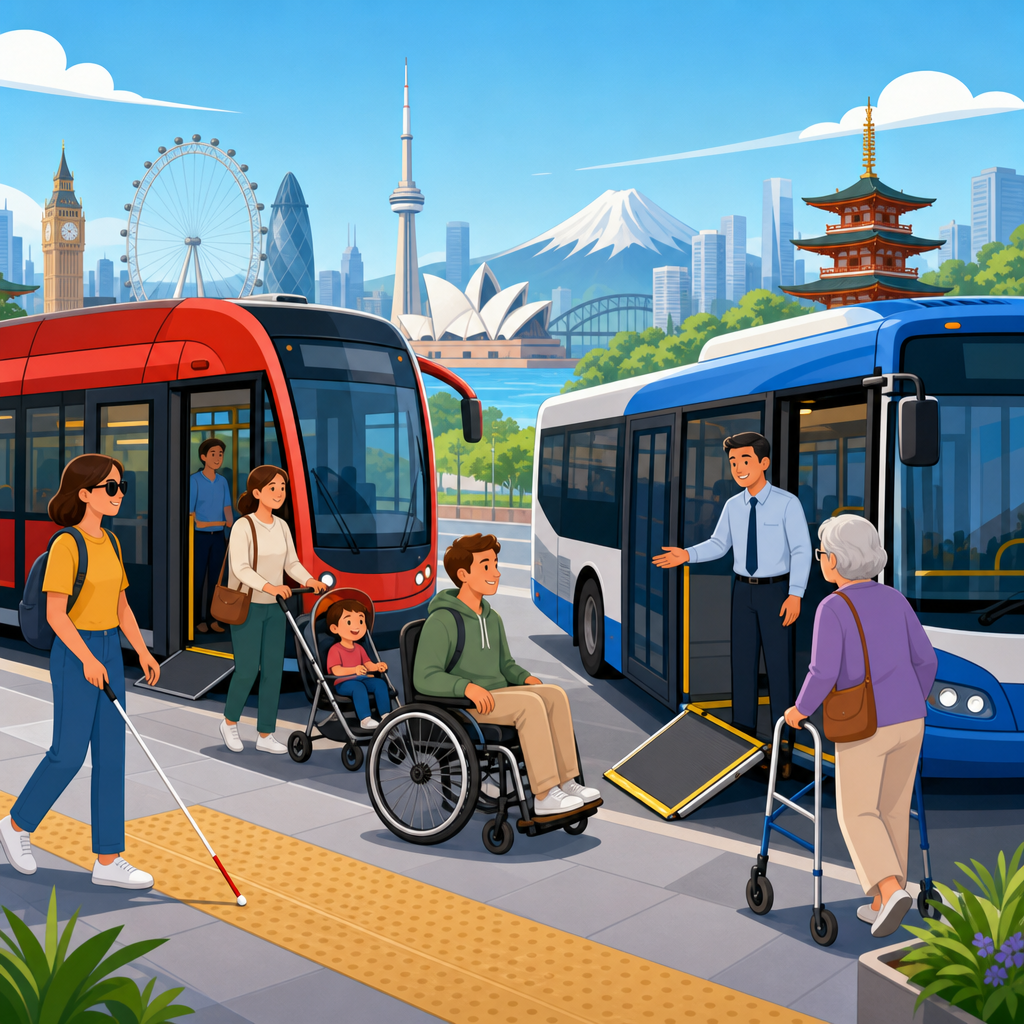
The most decisive technical choices are often simple. Level boarding reduces dwell times and improves safety for wheelchair users, older passengers, and anyone with limited balance. Tactile paving and detectable warning surfaces support blind and low-vision travelers, but only when layouts are consistent and unobstructed. Audio announcements must be synchronized with visual displays because each channel covers failures in the other. Handrails need strong contrast, reachable heights, and continuity through stairs and ramps. Ticket machines require tactile controls, readable screens, speech output, and enough clear floor space for mobility devices.
Station design deserves special attention because interchanges generate the highest cognitive and physical load. Good wayfinding uses plain language, consistent icons, line-of-sight decision points, and route confirmation at key moments. Poor wayfinding is a hidden access barrier, especially for people with intellectual disabilities, dementia, brain injury, or limited literacy. In recent audits, I found that adding one more sign rarely fixes the problem. The real solution is to simplify the decision path.
Maintenance is as important as design. An elevator that fails repeatedly erases the value of an accessible station. Snow clearance, platform gap management, broken curb ramps, and out-of-service announcement systems are everyday rights issues, not minor defects. Agencies with the best reputations publish maintenance targets and redundancy plans, such as nearby accessible alternatives and rapid-response repair contracts.
Operations, Staff Training, and the Human Factor
Even excellent infrastructure fails without competent operations. Drivers and station staff need practical training on ramp deployment, securement areas, communication with deaf and blind passengers, de-escalation, and respectful assistance. Training should include disabled trainers and scenario-based practice rather than one-time compliance modules. Frontline staff shape trust more than policy documents do.
Assistance models also matter. Some rail systems require advance booking for boarding assistance, which can help manage staffing but limits spontaneity and equality. Better systems minimize pre-booking and design for independent boarding wherever possible. When assistance is necessary, requests should transfer across operators automatically, with real-time confirmation and accountability if a handoff fails.
Complaint systems are another operational test. Effective agencies allow multiple formats, set response deadlines, track repeat failures, and publish trends. If ten passengers report the same inaccessible stop, that is asset intelligence. Systems that bury complaints lose the data needed to fix recurring barriers.
Digital Accessibility and the Future of Inclusive Mobility
Modern public transportation depends on apps, account-based ticketing, real-time disruption alerts, and demand-responsive services. Digital accessibility is therefore inseparable from transport accessibility. A screen-reader compatible app, captions on service videos, accessible PDFs, high-contrast maps, and simple language alerts are now baseline expectations. When agencies ignore this, they create a new exclusion layer even if vehicles are technically accessible.
Emerging tools can help if governed carefully. Indoor navigation using Bluetooth beacons, computer-vision wayfinding, and open data feeds can support independent travel. On-demand accessible shuttles may fill gaps in low-density areas. But technology is not a substitute for fixed-route accessibility. Paratransit and microtransit are essential complements, not excuses to postpone mainstream access.
For the broader international perspective on disability rights, accessible public transportation is the clearest systems test. It reveals whether governments can turn equality principles into coordinated design, operations, and accountability. The strongest global models share a practical truth: accessibility works when it is planned across the whole journey, funded as core infrastructure, and checked against lived experience. Laws set direction, but performance comes from standards, maintenance, training, and transparent data.
The main takeaway is simple. Inclusive mobility is not achieved by one ramp, one app, or one policy. It requires legal rights, engineering discipline, user participation, and operational follow-through. Countries and cities do not need identical systems, but they do need the same commitment to independence, predictability, and dignity. Use this hub as a starting point to compare regional laws, design practices, and enforcement models across the international disability rights landscape. Then review your own transport network with a full-journey lens and identify the barriers that still keep equal access out of reach.
Frequently Asked Questions
What does accessible public transportation actually include in an international context?
Accessible public transportation includes far more than ramps or priority seating. In international practice, it refers to a complete mobility system designed so people with physical, sensory, cognitive, and psychosocial disabilities can travel safely, independently, affordably, and with dignity. That system spans buses, rail, ferries, taxis, paratransit, sidewalks, stations, stops, pedestrian crossings, ticketing machines, websites, mobile apps, and customer service channels. A truly accessible model treats every part of the journey as important, from planning a trip at home to reaching the final destination.
In practical terms, accessible systems usually include step-free boarding, elevators or lifts that are reliably maintained, tactile paving, clear wayfinding, wheelchair spaces, priority seating, audible and visual stop announcements, barrier-free ticketing, readable signage, induction loops, and staff trained to assist respectfully. International leaders also recognize that accessibility is not only about infrastructure. It also requires consistent operations, published service standards, accessible real-time information, inclusive emergency procedures, and complaint systems that actually lead to improvements.
The strongest international models are based on universal design, meaning services are built to work for as many people as possible from the start rather than adapted later. That benefits not only disabled passengers, but also older adults, parents with strollers, travelers with luggage, and people with temporary injuries. In this sense, accessible transport is both a disability rights issue and a core measure of public service quality.
Which countries or cities are often seen as strong international models for accessible public transportation?
Several countries and cities are frequently cited as useful models, although no system is perfect. London is often recognized for combining low-floor buses, consistent audio and visual announcements, step-free improvements across parts of the Underground and rail network, and strong accessibility information for trip planning. Cities in Japan are widely noted for detailed wayfinding, platform safety measures, station staff support, and a long-term commitment to barrier-free transit design, especially in major urban rail systems. Stockholm, Copenhagen, and other Nordic examples are often praised for integrating accessibility into broader social welfare and transport planning frameworks.
In North America, systems in places such as New York, Toronto, and parts of California are often discussed because of legal enforcement, accessibility standards, and active advocacy by disabled communities. These examples show how civil rights law, public investment, and user pressure can combine to expand accessible stations, improve bus fleets, and strengthen paratransit. Meanwhile, some Latin American cities have drawn attention for bus rapid transit systems that improve physical access through level boarding, platform design, and network planning, though implementation quality can vary widely.
What makes these places valuable as models is not that they have solved every issue, but that they show different pathways to progress. Some lead through strong legal mandates, others through design innovation, integrated planning, or long-term funding commitments. The most useful lesson is that accessibility advances fastest when governments set measurable standards, operators publish transparent data, and disabled people are involved in every stage of planning, testing, and oversight.
Why is accessible transportation considered a disability rights issue rather than just a service upgrade?
Accessible transportation is a disability rights issue because mobility determines whether people can participate equally in education, work, healthcare, housing, culture, and civic life. If a person cannot reliably reach a school, job interview, medical appointment, polling place, or community event because buses are inaccessible, stations lack elevators, announcements are not usable, or trip-planning tools exclude screen-reader users, that person is effectively denied equal opportunity. Access to transportation is therefore closely linked to non-discrimination, inclusion, and independent living.
International disability rights frameworks, including the principles reflected in the Convention on the Rights of Persons with Disabilities, reinforce the idea that governments should remove barriers that isolate disabled people from public life. Transportation is central to that obligation because it connects people to almost every other right. A system that works only for some users is not neutral; it actively creates exclusion. That is why accessible transport should not be viewed as a courtesy or special add-on, but as a necessary condition of equal citizenship.
This rights-based perspective also changes how success is measured. Instead of asking whether a system offers occasional accommodations, policymakers ask whether disabled passengers can use mainstream transport safely, spontaneously, and with dignity. The goal is not merely to provide a backup service, but to ensure equal access to the same public network others rely on every day. That distinction is what turns accessibility from a technical feature into a matter of justice.
What features make an accessible transportation system work well on a daily basis?
The most effective accessible systems work because they combine infrastructure, operations, information, and human support. Physical access is the foundation: low-floor buses, level boarding, ramps or bridge plates, elevators, accessible toilets, non-slip surfaces, wide gates, seating areas, tactile guidance paths, and safe platform-train interfaces all matter. But these elements must be reliable. An elevator that is frequently out of service or a ramp that requires lengthy staff intervention can make a technically accessible route unusable in real life.
Information access is equally important. Passengers need route maps, digital trip planners, ticketing systems, service alerts, and emergency announcements in formats they can use. That means high-contrast visual displays, audio announcements, plain language, captioned video content, compatibility with screen readers, and predictable signage throughout the network. Real-time updates are especially valuable because they let riders avoid disruptions before they become barriers. International best practice increasingly treats accessible information as essential, not optional.
Staff training is another critical factor. Drivers, station attendants, security staff, and call-center teams need practical instruction on disability awareness, communication, equipment use, and respectful assistance. The best systems train staff not only to respond in emergencies, but to support everyday independence without being patronizing. They also create feedback loops so riders can report issues and see results. In daily operations, accessible transportation succeeds when every link in the chain works consistently enough that disabled passengers can travel with confidence instead of uncertainty.
How can cities improve public transportation accessibility by learning from international models?
Cities can make meaningful progress by starting with a whole-journey approach. Rather than focusing on one visible feature, such as adding a few ramps, planners should examine every stage of travel: sidewalks to stops, station entrances, fare payment, boarding, transfers, onboard communication, and arrival at the destination. International models show that fragmented improvements often fail because one inaccessible link can break the entire trip. A city that wants results should map barriers across the network and prioritize changes that improve everyday usability at scale.
Another key lesson is to involve disabled people directly in design, testing, policy development, and monitoring. The strongest systems are rarely built through top-down assumptions alone. They improve because people with lived experience identify problems that technical teams may overlook, such as poor platform gaps, confusing signage, stressful lighting, inaccessible mobile apps, or inconsistent staff practices. Formal advisory bodies, user audits, pilot testing, and paid consultation can all help make accessibility planning more accurate and accountable.
Cities also need clear standards, long-term funding, and public reporting. International examples show that accessibility improves faster when requirements are written into procurement contracts, infrastructure codes, fleet replacement plans, digital service rules, and maintenance targets. Measurable goals such as elevator uptime, percentage of step-free stations, coverage of audio-visual announcements, and response times for repairs help turn promises into operational reality. Most importantly, accessibility should be treated as a permanent part of transport governance, not a one-time project. That is how international models move disability rights from principle to daily reality.