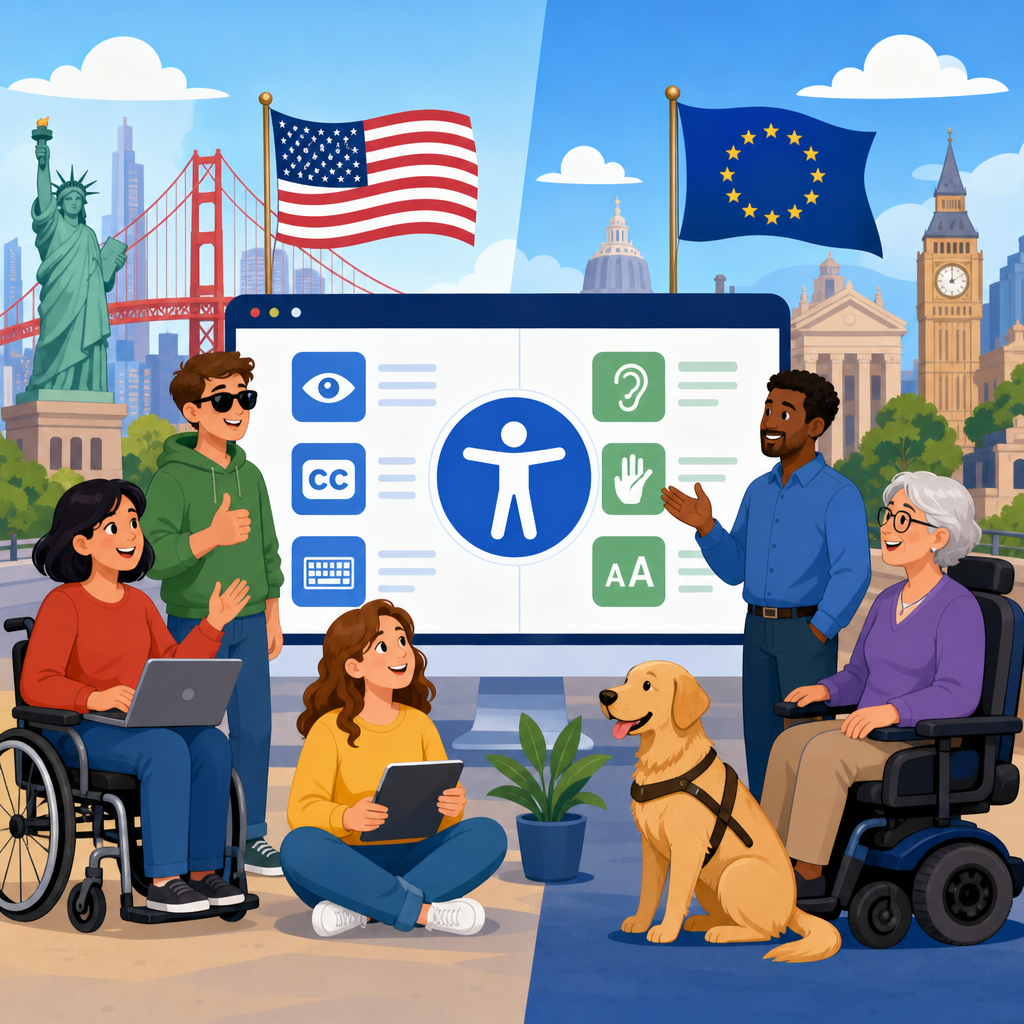
Web accessibility standards shape whether people with disabilities can use websites, mobile apps, digital documents, kiosks, and online services with independence and dignity. Comparing U.S. and EU approaches to web accessibility standards is essential because both systems influence global product design, procurement rules, litigation risk, and disability rights policy far beyond their borders. In practice, I have seen multinational teams discover that a checkout flow acceptable in one market can still fail legal, technical, or usability expectations in another. That gap usually comes from misunderstanding how laws, standards, enforcement, and rights frameworks interact.
At its core, web accessibility means designing digital experiences so people with visual, auditory, motor, cognitive, neurological, and speech disabilities can perceive, understand, navigate, and interact with content. Standards are the technical benchmarks used to measure whether that goal has been met. The best known benchmark is the Web Content Accessibility Guidelines, usually called WCAG, published by the World Wide Web Consortium. Yet accessibility compliance is never just about WCAG checklists. It also involves statutory obligations, public-sector procurement requirements, complaint mechanisms, remedies, timelines, and local interpretations by regulators and courts.
This article serves as a hub for global views on disability rights by explaining how the United States and the European Union approach digital accessibility from different legal traditions while converging around many of the same technical expectations. The U.S. tends to rely on a civil rights model driven by anti-discrimination law, agency rulemaking, procurement standards, and litigation. The EU combines fundamental rights principles, market harmonization, public-sector directives, product legislation, and member-state enforcement. Understanding those distinctions helps organizations build governance that works internationally instead of retrofitting region by region after complaints or lawsuits appear.
For readers exploring international perspective issues, this comparison also provides a foundation for related topics such as disability rights history, accessible public procurement, global conformance testing, and localization challenges. The main question is simple: if both regions often point to WCAG, why do implementation and risk look so different? The answer lies in scope, legal architecture, and enforcement.
Shared foundation: disability rights values and the role of WCAG
The United States and the European Union start from the same practical reality: inaccessible digital services exclude people from education, employment, commerce, healthcare, banking, transportation, and civic participation. Both regions also operate in the shadow of the U.N. Convention on the Rights of Persons with Disabilities, which strengthened the global expectation that accessibility is a rights issue, not merely a usability enhancement. Even where domestic law differs, the convention helped normalize accessible information and communication technology as part of equal participation.
Technically, both systems heavily depend on WCAG. Teams usually target WCAG 2.1 Level AA today because it is embedded in many policies, contracts, audits, and settlement agreements. WCAG organizes requirements under four principles: content must be perceivable, operable, understandable, and robust. That means images need text alternatives, keyboard navigation must work, focus order must make sense, error messages must be clear, color contrast must be sufficient, and code should expose names, roles, and values to assistive technologies. These are not abstract ideals. They directly affect whether a screen reader user can complete a form, whether a keyboard-only user can operate a menu, and whether a user with low vision can read text on a mobile screen.
Still, standards alone do not guarantee access. In audits I have run, sites that “passed WCAG” through automated scans still failed badly for real users because PDFs were untagged, support chat timed out, or account verification depended on inaccessible CAPTCHAs. That is why serious accessibility programs in both regions combine technical testing, manual review, user feedback, and governance.
How the United States regulates web accessibility
The U.S. approach is decentralized and often sector specific. The Americans with Disabilities Act is the core civil rights law. Title II covers state and local governments, while Title III covers places of public accommodation operated by private entities. For years, web accessibility obligations under the ADA developed through enforcement actions, settlement agreements, and court decisions rather than one comprehensive web regulation for every business. That created uncertainty, but it also made accessibility impossible to ignore. Plaintiffs, advocacy groups, and the Department of Justice pushed the issue forward.
In 2024, the Department of Justice issued a final rule under Title II requiring state and local government web content and mobile apps to meet technical requirements based on WCAG 2.1 Level AA, with limited exceptions. That rule matters because it gives public entities a clear baseline and influences vendor contracts. Another major U.S. pillar is Section 508 of the Rehabilitation Act, which applies to federal agencies and aligns with revised standards incorporating WCAG-based requirements. Section 508 has had an outsized market effect because federal procurement pressures vendors to build accessible products from the start.
For private companies, ADA web obligations remain heavily shaped by litigation and judicial interpretation. Courts have differed on whether a website must have a nexus to a physical place, although the trend has favored broader coverage. Retail, hospitality, banking, healthcare, higher education, and food service have all faced claims. Real-world patterns are consistent: inaccessible online reservations, unlabeled form fields, keyboard traps, low-contrast menus, and screen-reader barriers in account management generate legal exposure quickly because they block core transactions. The U.S. model therefore creates compliance through a mix of explicit rules, procurement pressure, negotiated settlements, and active private enforcement.
How the European Union regulates web accessibility
The EU approach is more harmonized but layered across directives, national implementation, and product legislation. A central instrument is the Web Accessibility Directive, which requires public sector websites and mobile applications across member states to meet accessibility standards, publish accessibility statements, and offer feedback mechanisms. Monitoring and reporting obligations are built in, which gives the directive a stronger administrative structure than many U.S. regimes. Public bodies are not only expected to conform; they must also document and explain their accessibility status.
The European Accessibility Act extends accessibility requirements into parts of the private sector by covering specified products and services, including e-commerce in many cases, as implemented through national law. Its purpose is both rights based and market oriented: improve access for persons with disabilities while reducing fragmentation across the internal market. The technical route often runs through harmonized European standards, especially EN 301 549, which incorporates WCAG and addresses broader ICT accessibility requirements beyond traditional web pages, including software, documents, and some hardware interfaces.
Because EU law is implemented by member states, enforcement details vary. However, the overall framework is clearer than many private-sector U.S. scenarios because legislation defines categories, timelines, and institutional responsibilities more directly. In practice, EU organizations often encounter accessibility through public procurement, conformity assessment, consumer protection expectations, and regulator oversight before they encounter courtroom pressure. That does not make enforcement weaker; it makes it differently structured.
Key differences in scope, enforcement, and business impact
The easiest way to compare U.S. and EU approaches is to separate three questions: who is covered, what standard applies, and how noncompliance is enforced. Both regions often lead organizations toward WCAG 2.1 AA, but they arrive there by different legal roads.
| Issue | United States | European Union |
|---|---|---|
| Primary legal logic | Anti-discrimination, civil rights, procurement, litigation | Fundamental rights, harmonization, directives, market regulation |
| Public sector | ADA Title II, Section 508, state rules | Web Accessibility Directive, national implementation |
| Private sector | ADA Title III, case law, settlements, sector rules | European Accessibility Act for covered services and products |
| Technical baseline | Usually WCAG 2.1 AA in rules and settlements | WCAG via EN 301 549 and related standards |
| Enforcement style | Agency action plus high litigation exposure | Regulator oversight, monitoring, national authorities |
| Documentation | Useful, often strategic, sometimes contract driven | Accessibility statements and formal processes more explicit |
These differences change business behavior. In the U.S., companies often invest after receiving a demand letter, lawsuit, or settlement requirement. In the EU, organizations are more likely to face structured compliance planning linked to regulatory deadlines, procurement eligibility, and public reporting. I have seen U.S. teams ask first, “Will we be sued?” while EU teams ask, “What does the directive or national transposition require us to publish, test, and remediate?” Both questions matter, but they produce different governance habits.
Another difference is the treatment of exceptions and disproportionate burden. EU frameworks often articulate those concepts more formally, especially for public-sector bodies, though they do not excuse inaction lightly. U.S. law also recognizes limits, but the discussion is frequently embedded in reasonableness, undue burden, effective communication, or case-specific defenses rather than standardized public statements. As a result, the EU often demands clearer documentary accountability, while the U.S. often creates sharper adversarial risk.
What multinational organizations should do
The most effective strategy is to build one accessibility program that satisfies the stricter practical requirement wherever possible. Start with WCAG 2.1 Level AA as the minimum engineering baseline, then map legal scope across public websites, authenticated areas, mobile apps, PDFs, video, customer support flows, and third-party components. Use EN 301 549 when selling into Europe or public procurement channels, and verify U.S. obligations under ADA, Section 508, state law, and sector-specific rules.
Testing must combine automated tools such as axe, WAVE, or Lighthouse with manual keyboard review, screen reader testing in NVDA, JAWS, and VoiceOver, zoom and reflow checks, caption audits, and document accessibility review. Mature teams assign issue severity based on user impact, not just code frequency. For example, one missing alt attribute on a decorative icon may be minor, while an unlabeled payment form field can stop a transaction entirely. Governance should include design system standards, procurement language, release gates, training, and an accessibility statement that reflects actual performance rather than generic legal wording.
Finally, remember that accessibility is not a one-time remediation project. It is a product quality discipline and a disability rights obligation. Organizations that understand the U.S. and EU approaches gain more than compliance. They reduce legal risk, improve usability, strengthen procurement readiness, and create digital services that more people can use successfully. If you manage international digital products, audit your current experience against both regimes, close the highest-impact barriers first, and build accessibility into every release cycle.
Frequently Asked Questions
1. What is the main difference between U.S. and EU approaches to web accessibility standards?
The biggest difference is that the United States and the European Union often arrive at accessibility requirements through different legal and regulatory pathways, even when they rely on many of the same technical concepts. In the U.S., web accessibility obligations are shaped by a combination of civil rights law, sector-specific rules, procurement requirements, agency guidance, and litigation under laws such as the Americans with Disabilities Act and Section 508 of the Rehabilitation Act. That means organizations often face a legal environment driven by broad nondiscrimination principles, enforcement actions, and court interpretations about whether digital experiences must be accessible.
In the EU, the approach is generally more structured through directives, harmonized standards, and market-wide rules that member states implement into national law. Accessibility is treated not only as a disability rights issue but also as part of internal market regulation, public procurement, and product compliance. Measures such as the Web Accessibility Directive and the European Accessibility Act create a more explicit framework for when public sector websites, mobile apps, and certain digital products and services must meet accessibility expectations.
In practice, both regions frequently point organizations toward WCAG-based conformance, but the compliance landscape feels different. The U.S. can seem more litigation-centered and interpretation-driven, while the EU often appears more standard-centered and implementation-driven across member states. For multinational teams, this matters because a feature that seems legally acceptable in one environment may still fall short in another due to different enforcement models, documentation expectations, procurement rules, or covered services.
2. Do the U.S. and EU use the same technical accessibility standard, such as WCAG?
They overlap heavily, but the answer is not as simple as “yes, they use the same standard in exactly the same way.” In both the U.S. and EU, the Web Content Accessibility Guidelines, or WCAG, play a central role in defining what accessible digital content should look like. WCAG addresses issues such as keyboard access, color contrast, screen reader compatibility, captions, form labeling, error identification, and predictable navigation. Because it is internationally recognized and technically detailed, WCAG has become the common language for designers, developers, testers, and legal teams.
That said, the legal mechanism for adopting or referencing WCAG differs. In the U.S., WCAG is often used as the practical benchmark for compliance, especially in settlements, consent decrees, procurement standards, and accessibility programs, even when the underlying law does not always name a specific WCAG version in every context. Section 508, for example, ties federal ICT accessibility requirements to incorporated technical standards, while ADA-related website cases have often relied on WCAG as the de facto measure of accessibility even when the statute itself is broader and less technically specific.
In the EU, WCAG is commonly operationalized through European standards such as EN 301 549, which incorporates accessibility requirements for ICT products and services, including web and mobile content. This creates a more formal bridge between legal obligations and technical requirements. So while teams in both jurisdictions may end up working toward WCAG 2.1 AA or a similar target, the compliance evidence, procurement language, and conformity process may differ. The practical takeaway is that organizations should not stop at saying “we follow WCAG.” They need to confirm which version applies, how it is referenced in law or contracts, and whether additional documentation, monitoring, or product-level obligations also apply.
3. How do enforcement and litigation risks differ between the United States and the European Union?
The U.S. is widely known for having a more visible private litigation environment, especially around digital accessibility claims involving commercial websites, apps, and online customer journeys. Businesses operating in the U.S. often worry about lawsuits alleging that barriers in navigation, checkout, account management, reservation systems, PDFs, or mobile experiences deny equal access to people with disabilities. Even when the legal standards are sometimes debated in court, the cost of defending claims, remediating systems under time pressure, and managing reputational harm can be significant. This has made litigation risk a major driver of accessibility investment in the U.S.
In the EU, enforcement tends to be more regulatory and administrative, though the picture varies by member state because directives must be implemented nationally. Public sector monitoring, reporting obligations, conformity expectations, market surveillance, consumer protection mechanisms, and disability rights enforcement all play a role. Rather than focusing only on courtroom disputes, organizations may face oversight tied to whether a website, app, kiosk, e-commerce service, or digital document aligns with legal and technical obligations under member state law implementing EU rules.
That does not mean the EU is low risk. It means the risk often shows up differently. A company may encounter procurement exclusion, compliance notices, enforcement by national authorities, consumer complaints, or barriers to selling covered products and services across European markets. For multinational organizations, the smart approach is to treat U.S. and EU risks as complementary rather than interchangeable: in the U.S., be prepared for claims and settlement expectations; in the EU, be prepared for demonstrable conformity, governance, and consistent implementation across jurisdictions.
4. Which organizations and digital products are covered under U.S. and EU accessibility rules?
Coverage is one of the most important areas to compare because it determines whether accessibility is treated as optional good practice or a binding legal requirement. In the U.S., accessibility obligations can apply differently depending on whether the organization is a federal agency, federal contractor, state or local government entity, public accommodation, educational institution, healthcare provider, or business offering services to the public. Section 508 directly affects federal agencies and procurement, while the ADA can reach many private-sector digital experiences where websites and apps are tied to goods, services, programs, or public-facing operations.
In the EU, the coverage framework is often more clearly mapped through legislation that identifies specific sectors, products, and services. The Web Accessibility Directive focuses on public sector websites and mobile applications, while the European Accessibility Act extends accessibility obligations into parts of the private sector, including certain digital services and consumer-facing technologies. Depending on how member states implement and enforce those requirements, accessibility can apply to e-commerce, banking interfaces, ticketing systems, self-service terminals, e-readers, telecom-related services, and more.
This difference matters operationally. A company might assume that if one website passes review for one country, the same accessibility posture is sufficient everywhere else. In reality, coverage may expand once mobile apps, downloadable documents, kiosks, SaaS platforms, customer portals, or embedded transaction flows are considered. The safest strategy is to inventory all digital touchpoints, map them against the relevant U.S. and EU legal categories, and then prioritize remediation based on both user impact and jurisdiction-specific exposure. Accessibility compliance is rarely just about the homepage; it extends across the full ecosystem people use to access information, buy products, complete tasks, and participate independently.
5. What should multinational companies do to align with both U.S. and EU web accessibility expectations?
Multinational companies should start by adopting a unified accessibility program rather than trying to patch issues market by market after complaints arise. The most effective approach is to build around a strong technical baseline, typically WCAG 2.1 AA or the most current applicable benchmark required by contracts, regulations, or procurement rules, and then layer on jurisdiction-specific legal review. This reduces the risk that one team designs for minimum compliance in one region while another team later discovers that the same component, checkout flow, authentication step, or PDF process fails in another.
From an operational standpoint, organizations should create a governance model that includes legal, design, engineering, QA, procurement, content, and product leadership. Accessibility needs to be embedded into design systems, coding standards, third-party purchasing, user research, testing workflows, and release management. Teams should audit websites, mobile apps, documents, and self-service interfaces using both automated tools and manual testing, including assistive technology testing with screen readers, keyboard-only navigation, zoom, reflow, and captioning review. Just as importantly, they should involve disabled users in evaluation because formal conformance and real-world usability are related but not identical.
Documentation also matters. In the EU, companies may need more structured conformity evidence, accessibility statements, or procurement-ready records. In the U.S., organizations should be ready to show good-faith efforts, remediation roadmaps, policy commitments, training, and ongoing monitoring if challenged. Ultimately, the best strategy is not to ask, “What is the least we can do in each region?” but rather, “How do we create digital experiences that work reliably for people with disabilities across markets?” When accessibility is treated as a design quality, risk management priority, and rights issue all at once, companies are much better positioned to satisfy both U.S. and EU expectations.