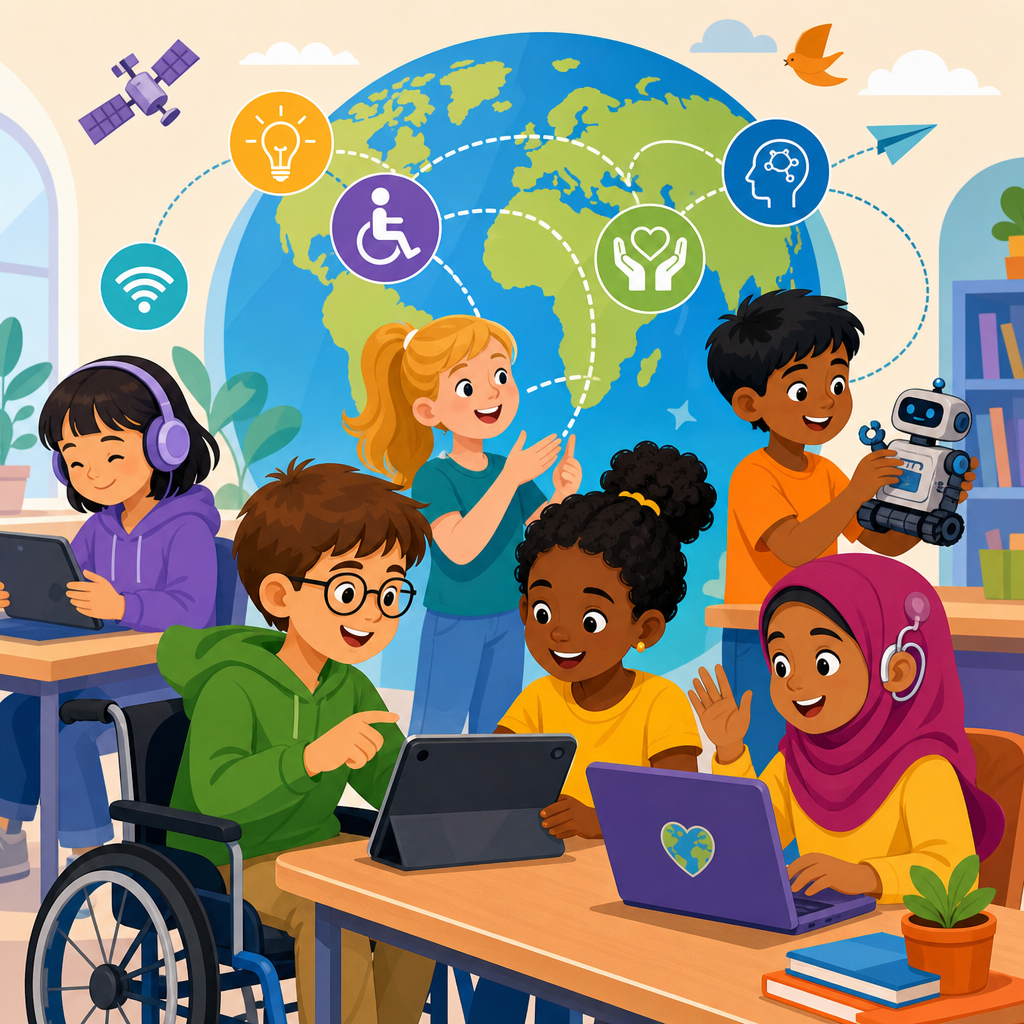
Global innovations in inclusive education technology are reshaping how schools, universities, and training systems remove barriers for learners with disabilities, language differences, and varied cognitive needs. Inclusive education technology refers to digital tools, platforms, devices, and design practices that help every learner participate meaningfully in teaching, assessment, communication, and school life. In practice, that includes screen readers, captioning, augmentative and alternative communication systems, adaptive hardware, accessible learning management systems, multilingual supports, and data tools that help educators personalize instruction. I have worked with institutions adopting these systems across multiple regions, and the pattern is consistent: when accessibility is built into procurement, curriculum design, and teacher training, outcomes improve for far more students than the original target group.
This topic matters globally because inclusive technology sits at the intersection of educational quality, human rights, and economic participation. UNESCO, UNICEF, and the World Bank have repeatedly shown that disability, poverty, displacement, and language exclusion often overlap, making inaccessible education systems a driver of long-term inequality. The United Nations Convention on the Rights of Persons with Disabilities established access to education as a legal obligation, while frameworks such as Universal Design for Learning and the Web Content Accessibility Guidelines give practical direction for implementation. Yet the global challenge remains uneven. Wealthier systems may have sophisticated assistive tools but fragmented adoption, while lower-resource systems often innovate through mobile-first delivery, open-source software, and community-based support. A serious international perspective must account for both realities.
As a hub for international innovations and strategies in accessibility, this article maps the major approaches shaping inclusive education technology worldwide. It explains how countries and institutions are improving digital accessibility, what technologies are delivering measurable value, where implementation commonly fails, and how leaders can build sustainable systems rather than isolated pilots. The central lesson is clear: effective inclusion is not created by a single app or device. It comes from aligning standards, infrastructure, pedagogy, procurement, and continuous support so that accessibility becomes a normal feature of learning instead of a special accommodation requested too late.
Global policy frameworks are pushing accessibility from aspiration to requirement
Inclusive education technology scales fastest when policy moves accessibility from optional good practice to enforceable expectation. Across Europe, public sector accessibility rules shaped by the EN 301 549 standard have influenced how ministries and universities buy software, hardware, and digital content. In the United States, long-standing disability law has been reinforced by clearer expectations around digital access in education, prompting schools to audit learning platforms, video libraries, and assessment systems. In Canada, Accessible Canada Act obligations and provincial standards have created similar pressure. These legal signals matter because procurement language changes vendor behavior faster than awareness campaigns alone.
Internationally, ministries are also tying inclusion goals to broader education modernization programs. India’s digital education initiatives increasingly emphasize accessible e-content and multilingual delivery. Rwanda and Kenya have used national ICT-in-education strategies to support device access and teacher digital skills, creating a foundation on which accessible content can be layered. In Latin America, countries such as Chile and Colombia have supported digital inclusion through public programs that combine connectivity, teacher development, and targeted disability services. The strongest systems avoid treating accessibility as a niche compliance item. They embed it in curriculum reform, platform selection, public examinations, and school accountability.
The most effective policy frameworks share four traits. They define accessibility using recognized standards, assign operational responsibility, fund implementation, and require monitoring. Without all four, schools are left with vague mandates and no practical pathway. I have seen institutions publish admirable inclusion statements while still purchasing classroom tools that fail keyboard navigation, captioning, or color contrast checks. By contrast, organizations that require accessibility conformance reports, conduct user testing with disabled learners, and budget for remediation make faster progress because they address barriers before deployment rather than after complaints.
Universal design and accessible platforms create the foundation for participation
The most important innovation in inclusive education is not a single device. It is the shift from retrofit accommodation to universal design. Universal Design for Learning encourages educators to provide multiple means of engagement, representation, and expression so learners can access content in different ways from the start. In digital environments, that means course materials compatible with screen readers, videos with captions and transcripts, interfaces usable by keyboard alone, readable typography, structured headings, alt text for images, and assessments that do not rely on one sensory or motor pathway. These are foundational design choices, not premium add-ons.
Accessible learning management systems and productivity suites now make this work more achievable. Platforms such as Canvas, Moodle, Blackboard, Google Workspace for Education, and Microsoft 365 have steadily improved accessibility features, though quality still depends heavily on local configuration and content authoring. Microsoft’s Immersive Reader, for example, supports text spacing, read-aloud, translation, and parts-of-speech highlighting, which helps students with dyslexia, emerging language proficiency, or attention difficulties. Google’s captioning, voice typing, and collaborative tools support multimodal participation. Open-source ecosystems are especially important internationally because they allow localization, lower cost, and adaptation for low-bandwidth settings.
However, platform accessibility is only as strong as the materials uploaded into it. A perfectly accessible LMS can still deliver inaccessible scanned PDFs, unlabeled diagrams, or videos without captions. This is why leading institutions pair platform selection with content governance: templates, accessibility checkers, faculty training, and remediation workflows. In my work, the fastest gains often came from simple process changes, such as requiring structured documents and captioned lecture capture by default. Those steps improved usability for disabled students, mobile users, and multilingual learners at the same time.
Assistive technologies are becoming smarter, cheaper, and more mainstream
Assistive technology remains essential because universal design reduces barriers but does not eliminate individual needs. Screen readers such as JAWS, NVDA, and VoiceOver continue to be central for blind and low-vision learners. Refreshable braille displays provide direct tactile access to digital text, especially valuable in advanced literacy, mathematics, and coding. Speech recognition tools, switch access systems, eye-tracking interfaces, and alternative keyboards support learners with motor disabilities. Augmentative and alternative communication applications, including Proloquo2Go and TD Snap, help nonspeaking students participate in lessons and social interaction. These tools are no longer confined to specialist settings; they are increasingly integrated into mainstream classrooms.
Artificial intelligence has accelerated this trend. Real-time captioning and transcription now support deaf and hard-of-hearing learners in lectures, meetings, and recorded lessons. Optical character recognition turns printed pages into machine-readable text for text-to-speech software. Computer vision can describe images, though accuracy still varies. Predictive text and grammar support can reduce writing barriers for students with dyslexia or language impairments. Translation tools can also improve access for multilingual learners and refugee students when used carefully. The practical advantage is speed: tasks that once required manual conversion by disability services can now happen at scale, often inside commonly used software.
Still, mainstreaming does not remove the need for specialist evaluation. I have seen schools adopt AI captioning and assume the problem is solved, only to discover discipline-specific terminology, accents, or noisy classrooms severely reduced accuracy. Braille users still need properly coded math through MathML or Nemeth-compatible workflows. AAC implementation still depends on communication partner training, vocabulary planning, and consistent classroom use. The lesson is straightforward: smart tools extend capacity, but inclusion depends on matching tools to learner context and validating performance in real learning conditions.
International strategies differ by context, but common patterns emerge
Countries with strong infrastructure often focus on systems integration, while lower-resource settings prioritize reach, affordability, and mobile access. In Finland and Estonia, digital education strategies have benefited from high connectivity and strong public digital services, making accessible platforms easier to scale nationwide. In the United Kingdom, universities have expanded lecture capture, digital note access, and inclusive assessment design, partly in response to legal expectations and student advocacy. In Australia, institutions commonly align disability support with accessible procurement and campus-wide digital standards. These environments show what becomes possible when policy, infrastructure, and institutional capacity move together.
Elsewhere, innovation frequently comes from constraint. In parts of sub-Saharan Africa and South Asia, smartphones are the primary learning device, so inclusive design must work on small screens, intermittent connections, and shared hardware. Offline content packages, compressed media, WhatsApp-based communication, and SMS alerts can be more impactful than complex desktop platforms. Organizations have used radio, accessible digital textbooks, and community resource centers to extend access where broadband remains unreliable. In humanitarian settings, portable solar charging, multilingual audio learning, and lightweight assistive devices can determine whether displaced learners stay connected to education at all.
| Region or context | Common accessibility strategy | Practical example | Main implementation challenge |
|---|---|---|---|
| High-income national systems | Accessible procurement and integrated platforms | Universities requiring vendor conformance reports before purchase | Inconsistent content created by staff |
| Mobile-first emerging markets | Low-bandwidth, multilingual, smartphone-friendly delivery | Audio lessons and captioned microlearning through messaging apps | Device sharing and unstable connectivity |
| Humanitarian and displacement settings | Portable, offline, resilient learning tools | Solar-charged tablets with accessible local content | Funding continuity and teacher support |
| Vocational and workforce programs | Assistive technology tied to job skills | Screen-reader-compatible digital certification courses | Accessible assessment and employer alignment |
Across these settings, four common patterns stand out. First, mobile accessibility is no longer secondary; it is the main route to inclusion in many countries. Second, teacher capability matters more than hardware quantity. Third, open educational resources and open-source tools can dramatically reduce cost barriers when localized well. Fourth, accessibility succeeds when disabled people are involved in design, testing, and governance. International strategies look different on the surface, but these operating principles appear repeatedly in programs that last.
Teacher training, procurement, and measurement determine long-term success
The biggest gap in inclusive education technology is often not innovation but implementation discipline. Teachers need practical training that goes beyond awareness sessions. They should know how to create accessible documents, structure online courses, choose readable color combinations, caption media, provide flexible assessment options, and use built-in accessibility features on common devices. They also need confidence in when to refer for specialist support. Short workshops help, but sustained coaching, exemplar libraries, and peer review produce stronger results. In institutions I have supported, accessibility improved fastest when course design teams, librarians, disability staff, and IT worked together instead of in separate silos.
Procurement is equally decisive. Every request for proposal should ask vendors about keyboard access, screen-reader compatibility, captioning workflows, language support, interoperability, privacy, and evidence of user testing. A vendor accessibility statement is useful, but it is not enough. Institutions should request a current Voluntary Product Accessibility Template or equivalent conformance documentation, validate claims through hands-on testing, and include remediation obligations in contracts. This protects learners and saves money. Retrofitting an inaccessible assessment tool after campus-wide deployment is far more expensive than screening it early.
Measurement must also move beyond counting devices distributed. Useful indicators include the percentage of course materials meeting accessibility checks, caption coverage rates, time required to provide alternate formats, learner satisfaction, withdrawal gaps between disabled and non-disabled students, and completion outcomes across language groups. Qualitative evidence matters too. Student feedback often reveals friction that dashboards miss, such as inaccessible group work practices or panic caused by timed tests that ignore assistive technology lag. Institutions that combine compliance audits with learner experience data build more accurate improvement plans.
The next phase is inclusive by default, multilingual, and evidence driven
The future of inclusive education technology will be defined less by isolated specialist tools and more by accessible ecosystems that work across languages, devices, and learning contexts. Three developments are especially important. First, accessibility features are moving deeper into mainstream products, reducing stigma and speeding uptake. Second, multilingual support is becoming central as migration, international education, and cross-border online learning expand. Third, analytics are improving the ability to detect where learners are struggling, although institutions must use that data carefully and ethically. Predictive systems should inform support, not label students unfairly or automate exclusion.
There are also important cautions. Generative AI can simplify text, draft alt text, and create transcripts, but it can also introduce factual errors, biased language, or misleading image descriptions. Automated accessibility checkers catch only part of the problem; human review remains necessary, especially for pedagogy, cultural context, and complex media. Privacy and security rules differ internationally, so schools must evaluate whether disability-related data is handled lawfully and sensitively. Affordability remains a structural issue as well. Subscription pricing can make excellent tools unreachable for public systems unless governments negotiate at scale or support open alternatives.
The strongest path forward is clear. Build accessibility into standards, budgets, teacher development, content workflows, and platform selection. Design for mobile and low bandwidth from the beginning. Involve disabled learners and educators in testing and decision-making. Use global standards, but adapt implementation to local language, infrastructure, and culture. As this international perspective hub shows, the best innovations in inclusive education technology are not merely technical advances. They are strategies that make access routine, measurable, and sustainable. Review your current digital learning environment, identify the barriers students face most often, and start with the changes that make inclusion the default for everyone.
Frequently Asked Questions
What is inclusive education technology, and why is it becoming such an important global priority?
Inclusive education technology refers to digital tools, assistive devices, software platforms, and design approaches that make learning more accessible and meaningful for all students, especially those who may face barriers related to disability, language, communication, mobility, sensory processing, or different cognitive needs. It includes well-known supports such as screen readers, live captioning, text-to-speech and speech-to-text tools, augmentative and alternative communication systems, multilingual learning platforms, adaptive assessments, and classroom applications built according to universal design principles. The goal is not simply to add accommodations after a problem appears, but to build learning environments that are usable by a wider range of learners from the start.
This is becoming a global priority because education systems are under growing pressure to serve increasingly diverse student populations more equitably. Schools and universities are expected to support learners with disabilities, students from multilingual backgrounds, rural populations, displaced learners, and individuals who learn best through different formats or pacing. Technology can help reduce long-standing barriers by offering multiple ways to access information, participate in class, demonstrate understanding, and communicate with teachers and peers. In many countries, innovations in inclusive education technology are also being driven by stronger disability rights frameworks, accessibility laws, and broader recognition that education quality cannot be separated from education access. When implemented well, inclusive technology benefits not only a specific subgroup, but the entire learning community by making instruction more flexible, responsive, and learner-centered.
What are some of the most important global innovations shaping inclusive education technology today?
Several major innovations are changing how inclusive education is delivered around the world. One of the most significant is the improvement of built-in accessibility features across mainstream devices and learning platforms. Tablets, laptops, and smartphones now often include screen magnification, voice control, text-to-speech, closed captioning, reading support, and customizable display settings as standard features rather than expensive add-ons. This matters because it lowers cost barriers and normalizes accessibility in everyday learning. Cloud-based collaboration tools are also evolving to support translation, transcription, captioning, and shared visual communication, making it easier for students with hearing differences, language differences, or literacy challenges to participate more fully.
Another key area of innovation is adaptive and personalized learning technology. These systems can adjust reading level, pacing, task complexity, interface layout, and feedback style based on learner needs. Artificial intelligence is also being used to generate live captions, automate alt text suggestions, support language translation, identify content accessibility gaps, and provide tutoring assistance in multiple formats. In parallel, AAC tools are becoming more portable and sophisticated, helping non-speaking or minimally speaking learners communicate more independently. There is also meaningful progress in low-bandwidth and offline-first educational tools designed for regions with limited internet access, which is essential for global inclusion. Importantly, the strongest innovations are not always the most advanced technically; many of the most impactful solutions combine affordability, local language support, teacher usability, and accessible design in ways that make them practical across very different educational settings.
How does inclusive education technology support learners with different disabilities, language backgrounds, and cognitive profiles?
Inclusive education technology supports learners by offering multiple pathways into the same learning experience. For students who are blind or have low vision, screen readers, braille displays, audio navigation, scalable text, and high-contrast interfaces make digital materials usable. For deaf and hard-of-hearing learners, captioning, transcripts, visual alerts, and sign language-enabled resources improve access to instruction and discussion. Students with physical disabilities may benefit from alternative input tools such as eye-tracking systems, switch access, voice commands, and customizable keyboards. For learners with speech-related communication needs, AAC devices and communication apps can make classroom participation, social interaction, and assessment more accessible and independent.
The benefits extend well beyond traditional disability categories. Multilingual learners can use translation tools, bilingual glossaries, speech supports, and visual scaffolds to understand content while developing academic language. Students with dyslexia or other literacy-related differences may benefit from text-to-speech, dyslexia-friendly fonts, annotation tools, read-aloud features, and structured writing supports. Learners with attention, executive functioning, or processing differences often do better with technologies that break tasks into smaller steps, reduce visual clutter, allow flexible timing, and provide multimodal instructions. The broader value of inclusive technology is that it reduces the pressure for all students to learn in one fixed way. Instead, it creates options for reading, listening, speaking, viewing, organizing, and responding, which leads to better engagement, greater confidence, and a more equitable classroom experience overall.
What challenges do schools and universities face when adopting inclusive education technology at scale?
Although the promise of inclusive education technology is substantial, implementation can be difficult if institutions focus only on tools and not on systems. One of the most common challenges is unequal access to infrastructure. Reliable internet, updated devices, assistive hardware, electricity, and technical support are still not consistently available across regions, particularly in low-resource settings. Cost is another issue, especially when institutions depend on proprietary software, recurring licenses, or imported devices that are difficult to maintain locally. Even when technology is purchased, it may remain underused if teachers are not trained to integrate it into teaching, assessment, and communication in practical ways.
There are also design and policy barriers. Some platforms still fail to meet accessibility standards, and digital content may be uploaded in formats that cannot be read by assistive technologies. In other cases, schools rely on a medical or compliance-based model of support, where technology is treated as a niche accommodation for a small group rather than as part of inclusive teaching for everyone. Privacy, data protection, and algorithmic bias also require attention, especially when AI tools are involved in assessment or learner monitoring. Another challenge is sustainability: successful adoption depends on ongoing procurement, updates, maintenance, teacher support, and user feedback, not one-time implementation. The institutions making the most progress tend to take a whole-system approach that combines accessible procurement policies, professional development, student participation, universal design practices, and continuous evaluation of what is actually improving inclusion in everyday learning.
What should educators and policymakers look for when choosing effective inclusive education technology?
Educators and policymakers should begin by asking whether a technology truly removes barriers or simply adds another layer of complexity. The most effective solutions are grounded in accessibility, usability, and flexibility from the start. That means platforms should work with screen readers, support keyboard navigation, offer captions and transcripts, allow text resizing and color adjustments, and provide multiple ways for students to engage with materials and show what they know. Products should also be tested with real users, including learners with disabilities and diverse language backgrounds, rather than evaluated only through technical specifications. If a tool is difficult for teachers to learn or difficult for students to use independently, its impact will likely be limited no matter how innovative it seems.
Decision-makers should also consider affordability, local relevance, data privacy, interoperability, and long-term support. A strong inclusive technology solution should work across different devices, function in low-bandwidth environments when possible, and support local languages and contexts. It should align with inclusive pedagogy, not just digitize traditional exclusionary practices. Training matters as much as the tool itself, so schools should look for providers that offer practical onboarding, accessible documentation, and ongoing support. Policymakers should further prioritize standards-based procurement, universal design for learning principles, and measurable outcomes related to participation, retention, learner independence, and achievement. In short, the best inclusive education technology is not defined only by advanced features, but by whether it helps more learners participate fully, consistently, and with dignity in real educational environments.