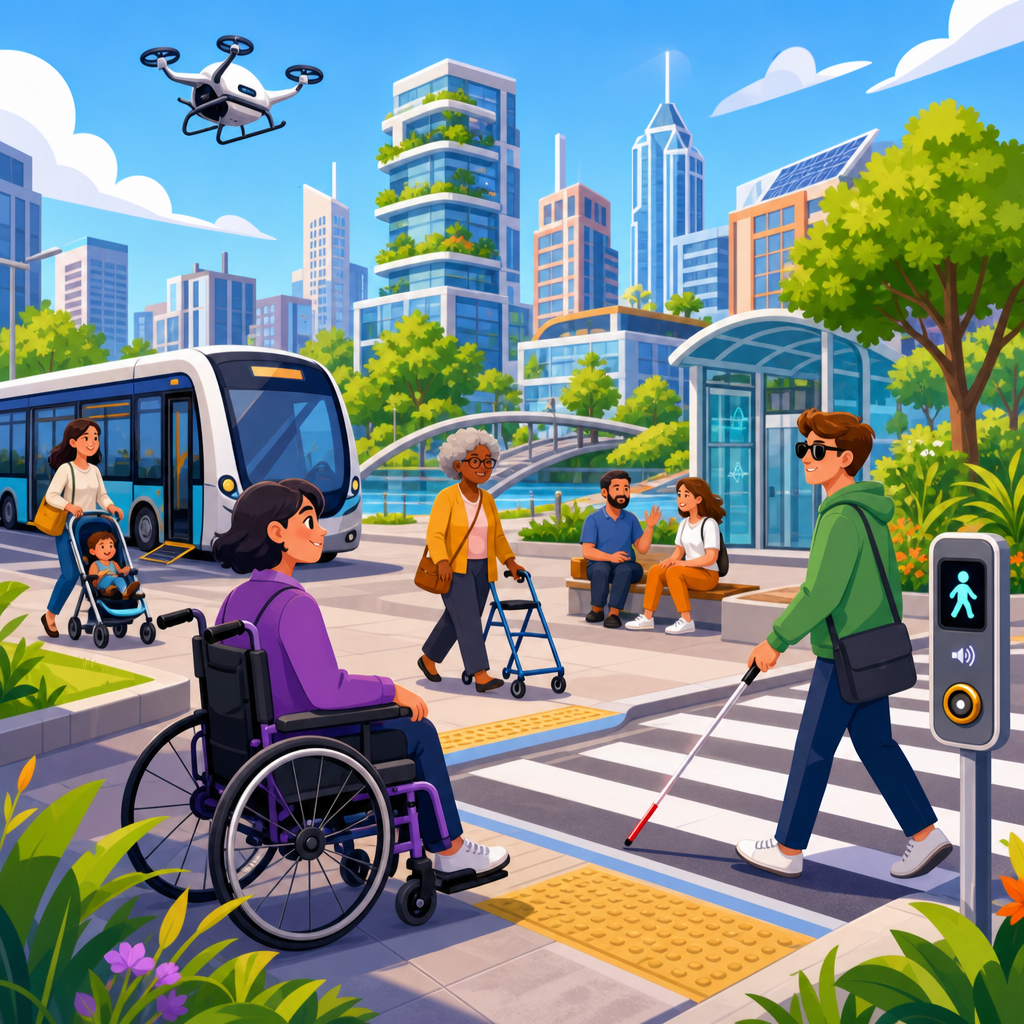
Smart city accessibility strategies are reshaping how people move, communicate, work, and participate in civic life, and the most important lesson from international projects is simple: accessibility works best when it is designed into urban systems from the start rather than added later. In this context, a smart city uses digital infrastructure, connected devices, data platforms, and coordinated public services to improve urban life. Accessibility means those systems can be used safely, independently, and with dignity by people with disabilities, older adults, temporary injury populations, neurodivergent residents, low-literacy users, and visitors who do not speak the local language. When cities combine these ideas well, they reduce barriers across transport, housing, public space, emergency communication, and digital services at the same time.
This matters because urban populations are aging, disability prevalence rises with age, and more public services now depend on apps, kiosks, sensors, and automated decision systems. The World Health Organization has long linked healthy aging to supportive environments, while the United Nations Convention on the Rights of Persons with Disabilities established accessibility as a rights issue, not a convenience feature. I have seen projects succeed when accessibility teams sit beside transport planners, procurement officers, and software architects from day one. I have also seen expensive failures: ticket machines placed beyond wheelchair reach, city apps that ignore screen readers, and “smart” crossings that assume every pedestrian can see and hear perfectly. The strongest international accessibility strategies avoid those errors by tying innovation to standards, testing, procurement rules, and measurable service outcomes for real users.
As a hub for international innovations and strategies in accessibility, this article maps the practices worth watching across governance, mobility, public realm design, digital service delivery, inclusive data, and emergency resilience. It also points to the strategic questions decision-makers should ask before copying a model from another country. Climate adaptation, migration, tourism, and fiscal pressure all affect accessibility planning, so there is no one universal template. Still, clear patterns are emerging. The best smart city accessibility strategies share common traits: they use universal design principles, follow recognized technical standards such as WCAG for digital content and ISO-guided design processes, involve disabled residents in co-design, and measure outcomes beyond compliance. Cities that do this well are not merely more convenient. They are more equitable, more economically productive, and more prepared for demographic and technological change.
Policy, governance, and procurement set the pace
The first strategy worth watching is boring on the surface and decisive in practice: governance. Cities make faster progress when accessibility is written into procurement language, capital planning, service-level agreements, and performance dashboards. In Toronto, London, Singapore, Barcelona, and Seoul, accessibility gains have generally been stronger where public agencies can require vendors to meet specific standards for websites, mobile applications, kiosks, audio-visual announcements, and built environments. Procurement matters because many urban systems are bought from outside vendors. If a city orders inaccessible fare gates, curbside sensors, or citizen portals, retrofitting later costs more and usually delivers less.
A strong governance model usually includes four elements. First, an accessibility policy aligned with disability rights law and technical standards. Second, a review process that checks accessibility before deployment, not after complaints accumulate. Third, user testing with people who have different disabilities and language needs. Fourth, public accountability through reporting. I have worked with teams where a single procurement clause changed an entire product roadmap because suppliers knew they would be scored on conformance, testing evidence, and maintenance commitments. That leverage is one of the highest-return interventions available to cities.
Another international pattern is the creation of cross-department accessibility leads. Transport agencies, parks departments, emergency management offices, libraries, and digital service teams often collect separate data and buy separate systems. Without coordination, residents face fragmented experiences. A city may have accessible buses but inaccessible wayfinding in stations, or compliant websites linked to PDF forms that screen readers cannot parse. Cross-department leadership reduces these gaps by setting common criteria and escalation paths. The strategy is especially effective when paired with an accessibility advisory council that includes disabled residents, advocacy groups, and technical specialists with authority to review major projects.
Accessible mobility is the clearest smart city test
Transport reveals whether a smart city is genuinely inclusive because mobility chains fail at their weakest link. A rider needs accessible trip planning, curb design, station entry, ticketing, boarding, announcements, and last-mile connections. Cities such as Vienna, Tokyo, Helsinki, and Singapore have shown that digital mobility tools can improve independence when they provide real-time elevator status, step-free routing, platform information, and multimodal alternatives in one place. The best journey planners do not treat accessibility as a filter hidden in settings. They make it a core routing parameter.
Real-time status data is particularly valuable. When an elevator is out of service, the barrier is not theoretical; it can completely block a journey. Publishing that outage through open APIs lets city apps, third-party navigation tools, and station displays reroute passengers immediately. This approach supports wheelchair users, travelers with strollers, people carrying luggage, and older adults who avoid stairs. London’s transport network has demonstrated the value of detailed accessibility mapping, while cities in the Netherlands and Nordic region have invested heavily in integrated cycling and pedestrian infrastructure that benefits users of mobility devices as well as conventional cyclists.
Smart intersections are another area worth watching. Accessible pedestrian signals with tactile indicators, locator tones, countdowns, and adjustable timing improve safety, but only when calibrated to local conditions. Some cities are also testing smartphone-based crossing requests and beacon systems that provide orientation cues to blind and low-vision pedestrians. These pilots can help, yet they should never replace physical buttons, tactile paving, and audible signals. Requiring a personal device to cross a street creates a new barrier for visitors, low-income residents, and anyone with battery or connectivity issues. Redundancy is not waste in accessibility design; it is resilience.
| Strategy area | What leading cities do | Why it matters |
|---|---|---|
| Journey planning | Offer step-free routing, elevator status, and multimodal alternatives in one app or API | Prevents failed trips and supports independent travel |
| Ticketing | Design kiosks with tactile controls, audio output, reachable screens, and contactless options | Reduces queues and enables use by people with varied mobility and sensory needs |
| Streets and crossings | Combine tactile paving, audible signals, countdowns, and safe curb geometry | Improves navigation and crossing safety for many user groups |
| Operations data | Publish outages and service alerts through open data feeds | Lets riders and developers act on real conditions, not assumptions |
Digital public services must work beyond compliance checklists
Many smart city services now live inside websites, apps, portals, kiosks, and automated messaging systems. Accessibility strategy fails if these tools only meet minimum checklist requirements while remaining confusing in practice. The cities making real progress treat accessibility and usability as connected disciplines. That means plain language, consistent navigation, high-contrast interfaces, captions, transcripts, keyboard access, error prevention, and compatibility with assistive technologies. WCAG remains the baseline for digital content, but mature teams also test complete service journeys, including registration, payment, identity verification, appointment booking, and document upload.
Barcelona’s digital inclusion work, Estonia’s public digital infrastructure, and Singapore’s e-government services all show a useful principle: a service is only as accessible as its hardest step. Identity checks are a frequent failure point. Face recognition can exclude people with certain disabilities, low vision, facial differences, or limited device control. Time-limited forms can also block users with cognitive disabilities or those using screen readers and voice input. The practical response is to offer multiple secure pathways, save progress automatically, and provide human support channels when automation fails. That is not a retreat from innovation; it is good service design.
Kiosks deserve special attention because cities increasingly use them for payments, permits, visitor information, and public Wi-Fi access. I have audited kiosks that technically included accessibility settings but buried them behind touch-only menus impossible for some users to reach. Better deployments place controls within reach range, support tactile input, include headphone jacks or wireless audio pairing where appropriate, offer clear speech output, and maintain readable glare-resistant screens. They also avoid placing kiosks in cluttered or noisy environments where navigation and listening become difficult. Physical placement is part of digital accessibility, and cities often overlook it.
Inclusive public spaces depend on sensors, mapping, and maintenance
Accessibility in parks, sidewalks, plazas, and civic buildings is increasingly shaped by location data, sensors, and digital twins. The opportunity is significant. Cities can map curb ramps, sidewalk gradients, benches, shade, restroom access, and surface quality, then use that information for route planning and maintenance prioritization. In practice, this helps people choose routes based on stamina, mobility device type, heat sensitivity, or rest needs. It also helps maintenance teams focus on barriers with the highest impact, such as broken lifts, uneven paving, snow blockage, or malfunctioning wayfinding systems.
However, data quality is the hard part. Crowdsourced maps can surface local knowledge quickly, but they may be incomplete or inconsistent. Sensor networks can detect usage patterns and equipment faults, yet they rarely capture lived experience on their own. The best international models combine municipal asset inventories, open data standards, and community reporting. Sidewalk accessibility is a strong example. A route that looks compliant on paper may be blocked by café furniture, parked scooters, temporary construction fencing, or poor drainage. Continuous maintenance and enforcement matter as much as capital upgrades.
Wayfinding is another area where smart city tools can add real value. Beacon-based indoor navigation, tactile maps, audio landmarks, and accessible QR-linked information can improve orientation in complex stations, hospitals, museums, and civic campuses. Still, digital overlays should complement, not substitute for, legible physical environments. Clear sightlines, intuitive layouts, contrast on signage, consistent symbols, and multilingual information remain essential. Cities that rely too heavily on apps risk excluding people who prefer non-digital navigation or cannot use smartphones easily. The most effective public-space strategies preserve choice.
Data, participation, and emergency planning separate leaders from laggards
The most advanced smart city accessibility strategies treat disabled residents as experts, not end users invited at the end. Co-design workshops, paid advisory roles, participatory audits, and community-led testing consistently produce better outcomes than consultant-only reviews. This is especially visible in cities that have built disability innovation labs or formal accessibility panels. Paid participation matters because unpaid consultation often narrows input to people with time and resources, missing exactly the populations most affected by barriers.
Good data practices are equally important. Many cities still measure accessibility through asset counts alone: number of ramps installed, elevators added, or pages remediated. Those metrics are useful but incomplete. Leaders also track successful trip completion, service abandonment rates, emergency alert reach, response times for repairs, complaint resolution, and satisfaction across disability groups. Disaggregated data helps identify uneven outcomes. For example, a city may perform well for wheelchair access while failing Deaf users during emergency broadcasts or autistic residents in noisy customer-service environments.
Emergency communication is where accessibility strategy becomes a public safety requirement. Wildfires, floods, heat waves, and power outages expose the weaknesses of digital-first systems quickly. Alerts should be available in multiple formats: SMS, voice, captioned video, sign language where feasible, plain language, multilingual text, and accessible maps. Backup power for elevators, shelters designed for medical equipment charging, and registries that support voluntary assistance planning can all improve outcomes, though registries must be governed carefully to protect privacy and avoid false assumptions about who needs help. The broad lesson from recent disasters is clear: if accessibility is not embedded in resilience planning, the people already facing barriers face the highest risk.
For cities building an international accessibility roadmap, the practical path is straightforward. Start with rights-based policy, procurement rules, and cross-agency ownership. Audit transport, digital services, and public spaces as connected journeys rather than separate assets. Publish accessible operational data, test with real users repeatedly, and budget for maintenance as seriously as initial deployment. Borrow ideas internationally, but adapt them to local law, language, climate, and street conditions. A dense rail city, a rapidly growing coastal city, and a tourism-heavy historic center will need different tactics even when they share the same principles.
The strategies worth watching are not the flashiest pilots. They are the systems that make everyday urban life usable for more people, more of the time. Accessible journey planning, inclusive kiosks, readable alerts, maintainable sidewalks, and accountable procurement do not just serve disabled residents. They help parents, visitors, older adults, shift workers, and anyone navigating stress, fatigue, or unfamiliar environments. That wider benefit is why accessibility should sit at the center of smart city planning, not at the edges.
As this hub for international innovations and strategies in accessibility, this page should guide your next steps across the broader topic. Use it to evaluate case studies, compare policy models, and identify which subtopics deserve deeper research in your city or organization. The core message is simple: smart city accessibility succeeds when technology, design, and governance work together around real human needs. If you are shaping urban policy, commissioning digital tools, or redesigning public services, make accessibility a first requirement and a measurable outcome from the beginning.
Frequently Asked Questions
1. What makes a smart city accessibility strategy effective from the beginning?
An effective smart city accessibility strategy starts with inclusive design rather than retrofitting barriers after systems are already in place. In practice, that means accessibility is built into transportation planning, digital services, public information systems, civic technology, street design, and emergency communications from day one. Cities that do this well treat accessibility as a core performance standard, not a special feature for a small group of users. They plan for people with mobility, vision, hearing, cognitive, sensory, and communication differences at every stage of development.
This approach usually includes accessible wayfinding, step-free transit planning, readable and multilingual digital interfaces, captioned and screen-reader-friendly public information, and physical infrastructure that works alongside connected technology. For example, a smart bus network is far more useful when real-time arrival tools are compatible with assistive devices, stops include audio and visual announcements, sidewalks are navigable, and payment systems are simple and accessible. The strongest strategies also involve disabled residents, advocacy groups, service providers, and accessibility specialists early in procurement, testing, and policy design. That feedback helps cities avoid expensive redesigns and create systems people can actually use independently, safely, and with dignity.
2. Why is accessibility more valuable when it is integrated into smart city systems instead of added later?
Accessibility delivers better results when it is integrated from the start because city systems are interconnected. Transportation apps connect to payment systems, public kiosks connect to city data platforms, traffic signals interact with pedestrian infrastructure, and emergency alerts depend on communication channels that reach everyone. If accessibility is treated as an afterthought, gaps quickly appear between those systems. A city may launch a sophisticated digital service, for example, but if the interface is not keyboard navigable, lacks image descriptions, or fails to support clear language, many residents are excluded even though the technology is technically advanced.
Designing access in from the beginning improves usability, lowers long-term costs, and increases public trust. Retrofitting often requires rebuilding hardware, rewriting software, retraining staff, and correcting procurement mistakes. By contrast, early integration lets cities set accessibility standards before vendors are selected and before systems are scaled. It also improves resilience. A communication platform that already supports text, voice, captioning, translation, and plain-language alerts is more reliable in daily life and during emergencies. Perhaps most importantly, integrated accessibility benefits far more people than many policymakers first assume. Parents pushing strollers, older adults, tourists, temporary injury patients, and people navigating unfamiliar systems all gain from cleaner design, clearer information, and more predictable urban services.
3. Which smart city accessibility strategies are most important to watch internationally?
Several strategies are standing out globally because they combine digital innovation with practical urban usability. One major area is accessible mobility. Cities are investing in real-time transit data, audio-enabled crosswalks, intelligent traffic signals, platform guidance tools, and multimodal trip planning that accounts for elevators, curb cuts, route disruptions, and step-free options. These tools matter because accessibility is not just about whether a destination exists on a map, but whether someone can realistically and independently reach it.
Another important strategy is inclusive digital public service design. This includes city apps and portals built to recognized accessibility standards, public kiosks with tactile, audio, and visual support, and service systems designed for people with different literacy, language, and communication needs. A third area worth watching is the use of data to identify barriers. Cities are increasingly mapping sidewalk conditions, transit reliability, lighting, obstacle reports, and service access patterns to improve decision-making. When used responsibly, this can help prioritize repairs and investments in places where barriers are most severe.
Also important are smart emergency communication systems that deliver alerts in multiple formats, and connected public spaces that support independence through better signage, environmental sensing, and assistive navigation tools. The most promising international examples do not rely on technology alone. They combine standards, policy, budgeting, public engagement, and cross-agency coordination so that accessibility becomes part of how the whole city operates, not just a pilot project or isolated innovation.
4. How do smart city technologies improve everyday participation in work, communication, and civic life for people with disabilities?
When designed well, smart city technologies expand independence and remove friction from ordinary daily tasks. In transportation, real-time updates, accessible routing, and integrated fare systems can make commuting more predictable and less stressful. In communication, accessible city websites, public service apps, digital forms, and multilingual alert systems allow residents to get information, request services, pay bills, report problems, and receive updates without unnecessary gatekeeping. In public spaces, connected infrastructure such as smart signals, responsive lighting, and digital wayfinding can make navigation safer and more intuitive.
These improvements have direct effects on employment and civic participation. If people can reliably travel to workplaces, access training resources, use digital government platforms, and communicate with city services independently, they are more able to engage in economic and public life. Accessibility also strengthens inclusion in community meetings, emergency preparedness, education, healthcare access, and local decision-making. Features such as live captioning, remote participation tools, accessible online consultations, and clearly structured public information help residents contribute their perspectives rather than being passively informed after decisions are made.
The key point is that accessibility in a smart city is not limited to compliance. It shapes whether residents can fully participate in urban life on equal terms. A city that removes communication barriers, improves mobility, and simplifies access to services creates more opportunity across work, culture, education, and civic engagement. That is why accessibility is increasingly being viewed as both a social priority and a practical foundation for smarter urban development.
5. What should city leaders measure if they want to know whether their accessibility strategy is actually working?
City leaders should look beyond broad claims about innovation and measure whether residents can use systems effectively in the real world. Good metrics include the percentage of transit stations that are step-free, the reliability of elevators and accessible routes, the accessibility of mobile apps and websites, the usability of digital payment systems, response times for barrier repairs, and the availability of public information in multiple formats such as text, audio, captioning, and plain language. It is also useful to measure how well different systems work together, because accessibility often breaks down at transition points between street, station, platform, app, and destination.
User experience data is equally important. Cities should gather feedback from disabled residents through testing, advisory groups, satisfaction surveys, and participatory planning sessions. They should ask whether people can complete key tasks independently, such as planning a trip, crossing an intersection, attending a public meeting, reporting a service issue, or receiving emergency information. Complaint patterns, abandonment rates in digital services, and disparities in service access can reveal hidden barriers that technical compliance alone may miss.
Strong evaluation also includes governance and accountability measures. City leaders should track whether accessibility requirements are included in procurement, whether staff are trained, whether vendors meet performance targets, and whether accessibility improvements are funded over time rather than only during launch periods. The best indicator of success is simple: more people can move through the city, use its digital tools, and participate in public life safely, independently, and consistently. If those outcomes are improving, the strategy is working.