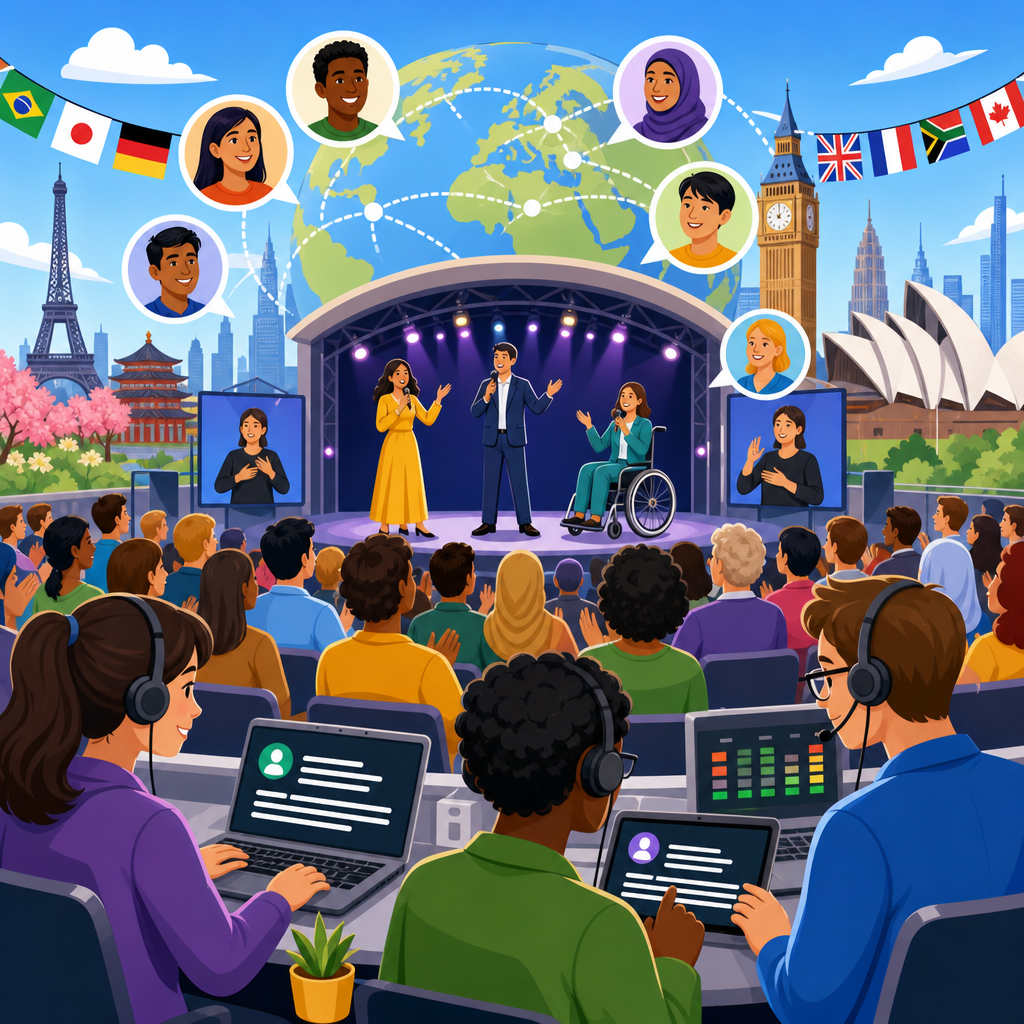
International strategies for captioning live public events have moved from a niche accessibility practice to a core requirement for inclusive communication, regulatory compliance, and audience growth. Live public events include conferences, festivals, civic meetings, sports broadcasts, worship services, university lectures, and emergency announcements delivered in real time to in-person, broadcast, or streaming audiences. Captioning is the process of converting spoken audio and relevant sound cues into on-screen text, while accessibility covers the broader design of experiences that people with hearing loss, language barriers, cognitive differences, or noisy environments can use effectively. As organizations expand across borders, captioning can no longer be treated as a single-language technical add-on; it must be planned as an international service with editorial, legal, operational, and cultural dimensions.
I have worked on multilingual event workflows where a caption feed that looked accurate in rehearsal failed in production because speaker turnover, accent diversity, venue acoustics, and streaming latency were not addressed early. That pattern is common. Good captioning at live public events depends on synchronized planning between event producers, caption vendors, interpreters, AV teams, streaming platforms, and accessibility leads. The strongest international programs define quality standards before the event, assign responsibilities for every handoff, and build contingency plans for network failure, platform outages, and unplanned speakers.
This topic matters because demand is rising from several directions at once. Laws and procurement rules increasingly require accessible communications. Global audiences expect text support on mobile devices. Event owners want discoverable recordings and reusable transcripts. Public institutions need equitable access for multilingual communities. At the same time, captioning quality is under scrutiny. Viewers notice delays, dropped terminology, incorrect names, and poor readability immediately, especially during crisis communications or political events where every word matters.
International innovation in accessibility is shaped by both technology and policy. Automatic speech recognition has improved quickly, but it still performs unevenly across accents, code-switching, domain-specific terminology, and high-noise environments. Human captioners remain essential for accuracy, speaker identification, and judgment. Many successful organizations now use hybrid models: AI for speed and scale, humans for correction, quality assurance, and difficult segments. This hub article explains the main strategies, compares operating models, and outlines how to build a reliable international captioning program for live public events.
Regulatory frameworks and global accessibility expectations
Any international captioning strategy should begin with the rules that apply in the countries where the event is hosted, streamed, or funded. In the United States, the Americans with Disabilities Act influences access expectations for public accommodations and government entities, while the FCC sets captioning rules for many broadcast contexts. In the European Union, the European Accessibility Act, the Audiovisual Media Services Directive, and national implementations shape obligations differently by sector. The United Kingdom relies on the Equality Act and Ofcom guidance. Canada uses the Accessible Canada Act and CRTC requirements. Australia’s Disability Discrimination Act and ACMA standards are also relevant. The exact duty varies, but the direction is consistent: organizers are expected to provide reasonable, effective access.
Standards matter because they turn general legal obligations into practical production targets. The Web Content Accessibility Guidelines are frequently used as a baseline for digital delivery, especially for live streams embedded on websites. WCAG does not prescribe every caption workflow detail, but it establishes outcomes such as synchronized, equivalent alternatives for time-based media. Broadcasters and major platforms often supplement this with internal metrics for latency, accuracy, completeness, and placement. In my experience, the organizations that perform best write these expectations directly into vendor statements of work rather than relying on informal assumptions.
International audiences also bring cultural expectations beyond formal law. In multilingual regions, users may expect same-language captions, translated subtitles, sign language interpretation, or all three. Public agencies in countries with strong plain-language traditions often demand simplified terminology for civic meetings and emergency updates. Global event planners should therefore define accessibility as an audience commitment, not just a compliance box. That approach changes procurement, rehearsal planning, and post-event reporting in productive ways.
Choosing the right live captioning model
There is no single best method for every event. The right model depends on risk, audience size, languages, venue conditions, and budget. The main options are stenographic captioning by trained human professionals, respeaking in which a captioner repeats speech into a speech recognition engine with commands and punctuation, fully automatic speech recognition, and hybrid workflows that combine automation with live human editing. For high-stakes events such as government briefings, shareholder meetings, medical congresses, and major ceremonies, human-led or hybrid models are the standard because they manage terminology and speaker changes more reliably.
Latency and accuracy create the central tradeoff. Fully automatic systems can be fast and inexpensive, but error rates increase sharply with crosstalk, applause, music beds, poor microphone discipline, and nonnative pronunciation. Stenographers usually deliver stronger accuracy for dense or technical speech, though coverage may be limited by staffing availability and language markets. Respeaking is effective in languages where stenography talent is scarce, but quality depends heavily on the operator’s preparation and software training. Hybrid models increasingly offer the best balance, especially when paired with glossaries and dedicated quality monitoring.
| Model | Best use case | Main strength | Main limitation |
|---|---|---|---|
| Human stenography | High-stakes single-language events | High accuracy and strong speaker handling | Higher cost and limited supply in some markets |
| Respeaking | Languages with fewer stenographers | Flexible and effective with preparation | Operator skill varies widely |
| Automatic speech recognition | Low-risk or very large-scale events | Speed, cost efficiency, easy deployment | Lower reliability with noise, accents, jargon |
| Hybrid human plus AI | International conferences and streams | Balances scale, speed, and quality control | Requires careful workflow design |
When I scope a live event, I usually ask four questions first: How harmful would an error be, how many languages are needed, will there be remote speakers, and what happens if the internet drops for thirty seconds? The answers determine the captioning model faster than any product demo. International strategy begins with risk classification, not software selection.
Multilingual workflows for global audiences
Captioning a live public event internationally often means supporting more than one audience at the same time: people who need same-language captions, viewers who need translation, and participants switching between languages on stage. Those are different services. Same-language captions prioritize verbatim access and speed. Live translated subtitles prioritize meaning transfer and readability. If organizers merge them without planning, both suffer. A speaker talking rapidly in Spanish may need Spanish captions produced by respeaking while a separate linguist creates English live subtitles from an interpretation feed rather than from the original floor audio.
The most reliable multilingual workflow starts with source discipline. Each speaker should use an isolated microphone, remote guests should join with clean audio paths, and interpreters should receive direct program sound. Captioners need run-of-show documents, speaker lists, acronyms, product names, and place names in advance. For large summits, I prepare multilingual glossaries covering executive names, institution titles, technical terminology, and likely policy references. This sounds basic, but glossary quality is one of the biggest predictors of live captioning success, especially when events involve code-switching between English and regional languages.
There is also an important editorial choice between verbatim and edited captions. In legal or parliamentary settings, verbatim is often preferred because wording matters. In public festivals or community livestreams, lightly edited captions may improve readability on small screens. Translation adds another layer, since literal rendering can exceed the reading speed of viewers. Strong international teams therefore define maximum characters per line, line breaks, speaker labels, and punctuation conventions before the event. These micro-decisions create macro-level comprehension.
Technical infrastructure, platform integration, and failover
Even the best captioners cannot rescue a weak signal chain. International live events succeed when captioning is designed into the AV architecture. That means identifying where captions originate, how they are transported, where they are encoded, and how they appear across venue screens, webcast players, social platforms, and recording archives. Common transport methods include NDI-adjacent production workflows, SRT and RTMP streaming pipelines, and caption carriage standards such as CEA-608 or CEA-708 in broadcast-related environments. Streaming platforms may instead rely on WebVTT, TTML, or proprietary APIs. Compatibility should be tested early because platform support varies by player, device, and language.
Latency budgeting is critical. Every step adds delay: audio capture, interpretation, caption creation, encoder processing, CDN distribution, and player rendering. International events with multiple language layers can easily drift into frustrating delay if no one owns timing. I recommend establishing an acceptable end-to-end latency target and measuring against it in rehearsal with real speakers, not sample clips. Teams should also test edge cases such as speaker walk-on music, audience Q&A from floor microphones, remote presenters on unstable Wi-Fi, and emergency script overrides.
Redundancy separates professional accessibility programs from improvised ones. A resilient design includes backup internet paths, mirrored caption connections, local display alternatives for venue audiences, and a recovery protocol if the primary caption feed fails. For mission-critical public events, I prefer a secondary operator or at least a shadow monitoring role that can escalate issues immediately. A simple failover runbook listing who switches what, where, and when can prevent long outages during a keynote or public safety announcement.
Quality assurance, staffing, and measurement
Quality in live captioning is measurable, but only if organizers define metrics clearly. Accuracy matters, yet raw word error rate alone is too narrow for public events. A complete evaluation should include latency, completeness, correct speaker attribution, punctuation, handling of non-speech information, terminology accuracy, and readability on the final display. Broadcast environments often use structured scoring models such as NER-based approaches, while internal event teams may create simplified dashboards. The point is consistency. Without a scoring method, feedback becomes subjective and recurring problems stay unresolved.
Staffing strategy is equally important. International programs need not only captioners, but also accessibility producers, technical coordinators, interpreter managers, and support staff who understand player behavior across devices. For long events, rotation planning is essential because fatigue degrades performance quickly. I have seen excellent captioners struggle after extended unscripted panels simply because breaks were not scheduled. Staffing plans should account for time zones, handover procedures, escalation paths, and the reality that multilingual events often require separate specialists rather than one generalist wearing every hat.
Post-event review is where innovation compounds. Save transcripts, annotate failures, compare rehearsal assumptions with production realities, and update glossaries for the next event. If a summit repeatedly hosts speakers with similar subject matter, each iteration should become easier and more accurate. Mature organizations treat every live event as training data for the next one, while still protecting privacy and contractual obligations. That discipline is how international accessibility programs improve year over year.
Emerging innovations and strategic trends
The most significant innovations in accessibility for live public events are not purely algorithmic; they are operational. AI-based speech recognition is better than it was even two years ago, particularly for clean English audio, but international excellence comes from combining engines, humans, glossaries, and platform logic intelligently. Some providers now adapt language models with event-specific vocabularies, improving names and technical terms substantially. Others route the best possible source audio to separate services for captions, translation, and archive transcripts, rather than forcing one output to serve every purpose.
Another major trend is personalization. Audiences increasingly expect selectable caption size, position, contrast, and language on their own devices. Venue-based QR access to personal caption streams is becoming more common at museums, festivals, and hybrid conferences because it reduces reliance on a single large screen. There is also growth in multilingual caption-to-archive workflows, where the live output is rapidly cleaned for replay, search indexing, and knowledge management. That creates value beyond compliance by making event content more reusable internally and more discoverable externally.
Looking ahead, the strongest international strategies will combine accessibility by design, vendor accountability, and continuous measurement. Organizations should map audience needs country by country, choose captioning models based on event risk, prepare multilingual terminology, test platform integrations under real conditions, and insist on post-event reporting. Captioning live public events is not just about displaying words on a screen. It is about preserving meaning at speed for people in different languages, devices, and environments. If you manage international events, audit your current workflow, identify the weakest handoff, and improve that point first. Accessibility scales when process, technology, and editorial judgment work together consistently.
Frequently Asked Questions
1. Why has live captioning become such an important part of international public events?
Live captioning has evolved from a specialized accessibility service into a core communication standard because public events now reach broader, more diverse, and more global audiences than ever before. Conferences, government briefings, sports broadcasts, university lectures, worship services, festivals, and emergency announcements are no longer experienced only by people physically present in the room. They are often streamed across borders, rebroadcast on social platforms, translated for multilingual viewers, and archived for on-demand access. In that environment, captioning supports not just accessibility for people who are deaf or hard of hearing, but also comprehension for non-native speakers, viewers in noisy settings, people watching with the sound off, and audiences processing technical or fast-paced information in real time.
Internationally, live captioning is also tied closely to legal and regulatory expectations. Many countries have strengthened accessibility rules covering broadcasters, public institutions, educational settings, and digital services. As a result, organizations that host public events increasingly view captioning as a risk-management necessity as well as a public-service obligation. Failing to provide accurate, timely captions can create compliance exposure, damage public trust, and limit participation from key audiences. In civic and emergency contexts, it can also prevent people from receiving critical information when they need it most.
There is also a strong audience-growth argument. Captioned events tend to be more usable and more shareable. Viewers stay engaged longer, recorded content becomes easier to search and repurpose, and event organizers can serve international and multilingual markets more effectively. In short, live captioning matters because it improves inclusion, supports clarity, helps meet legal standards, expands audience reach, and strengthens the overall quality and professionalism of public communication.
2. What are the main international strategies organizations use to caption live public events effectively?
The most effective international strategies combine planning, technology, language support, and operational consistency. A strong live-captioning approach usually begins well before the event itself. Organizers first identify the audience profile, event format, subject matter, languages involved, and delivery channels. A local town hall meeting may need highly accurate same-language real-time captions for an in-person screen and livestream, while a global conference may require English captions, multilingual translation workflows, remote captioners, and platform integrations for webcast and archive distribution. The strategy should match the event’s actual communication demands rather than relying on a one-size-fits-all model.
Many organizations use a blended captioning model that combines human expertise with automated speech recognition. Human captioners, including stenographers or respeakers, remain essential for high-stakes events because they can handle accents, overlapping dialogue, specialized terminology, and context-sensitive phrasing far better than automation alone. Automated tools can still play a valuable role, especially where budgets are limited, turnaround is tight, or multiple language outputs are needed. International best practice is not simply choosing human versus automated captioning, but creating a quality-controlled workflow that uses each resource where it performs best.
Another important strategy is terminology preparation. For international events, captioning quality improves significantly when organizers provide speaker lists, agendas, acronyms, proper names, multilingual glossaries, and technical vocabulary in advance. This is especially important for medical, legal, academic, governmental, and scientific events where errors can confuse viewers or misrepresent key information. Professional teams often conduct pre-event briefings and platform tests to make sure audio feeds, latency expectations, and display settings are all aligned before the event goes live.
Scalability is equally important. Global organizations often need captioning systems that work across time zones, event formats, and accessibility standards. That means selecting vendors or internal workflows capable of supporting in-person screens, broadcast encoders, webinar platforms, social livestreams, and post-event transcripts without rebuilding the process every time. The most successful international strategies treat captioning as part of event infrastructure, not an afterthought added minutes before the audience arrives.
3. How do organizations handle multilingual captioning for live events with international audiences?
Multilingual live captioning requires a deliberate workflow because the challenge is not just converting speech to text, but making information understandable across languages in real time. For international public events, organizations typically begin by deciding whether they need same-language captioning, translated captions, or both. Same-language captions are often the baseline, especially in the speaker’s primary language, because they provide immediate accessibility and create a reliable text source for additional language workflows. From there, translated captions can be generated through human interpreters, machine translation, or hybrid systems depending on the event’s importance, technical complexity, and budget.
One common strategy is to pair live captioning with simultaneous interpretation. In this model, the original speech is captioned in the source language, while interpreters provide audio in other languages that can then be captioned separately or used to create translated subtitle streams. This approach works well for diplomatic meetings, multinational conferences, university events, and large-scale corporate broadcasts where precision matters. It allows each language output to reflect not only literal wording but also context, tone, and domain-specific meaning. For high-stakes events, human oversight is especially important because direct machine translation can struggle with idioms, rapid speech, cultural references, and technical jargon.
Organizations also need to think carefully about screen design and audience experience. If multiple languages are being displayed, captions must remain readable, synchronized, and easy to identify. Some events use separate digital channels for each language, while others offer selectable caption streams within a streaming platform or app. The right approach depends on whether the audience is in-person, remote, or hybrid. Good international practice means giving users clear access instructions ahead of time so they know how to enable their preferred caption language.
Quality control is the deciding factor. Multilingual captioning succeeds when organizations test audio quality, interpreter feeds, translation timing, display compatibility, and fallback procedures in advance. They also need post-event review to evaluate errors, timing delays, and audience feedback. Multilingual access is not achieved simply by adding more languages; it is achieved by building a coordinated live communication system that preserves meaning, supports usability, and respects the linguistic diversity of the audience.
4. What are the biggest challenges in live captioning across countries and event types, and how can they be solved?
The biggest challenges usually involve accuracy, latency, technical integration, language variation, and inconsistent accessibility expectations across regions. Live events are unpredictable by nature. Speakers go off script, microphones fail, panelists interrupt one another, audiences ask spontaneous questions, and outdoor venues introduce background noise that can reduce caption quality. When events span countries, additional complications arise, including regional accents, code-switching between languages, unstable internet connections, differing legal requirements, and platform limitations that affect how captions are displayed or delivered.
Accuracy is often the first concern. Errors in names, statistics, policy statements, or emergency instructions can undermine trust and create real consequences. The best solution is preparation combined with professional support: clean audio routing, advance materials for captioners, speaker coaching on microphone use, and terminology lists tailored to the event. For particularly sensitive or high-visibility programs, organizations should use experienced human captioners rather than relying solely on automated systems. A backup workflow is also essential in case the primary caption feed fails.
Latency, or the delay between speech and on-screen text, is another major issue. Some delay is unavoidable in real-time communication, especially where translation is involved, but excessive lag can frustrate viewers and make live participation harder. Reducing latency requires reliable internet, tested platform integrations, optimized audio feeds, and realistic expectations about the trade-off between speed and accuracy. In many cases, a slightly slower but more accurate caption stream is better than a fast, error-filled one, particularly for public information and formal proceedings.
Cross-border compliance adds another layer of complexity. Accessibility obligations vary by country, industry, and delivery channel. Broadcasters, educational institutions, public-sector bodies, and event producers may all face different standards regarding when captions must be provided, how accurate they must be, and whether archived versions also need text access. The practical solution is to adopt a high internal standard that can satisfy multiple jurisdictions, rather than trying to meet only the minimum rule in each location. Organizations that do this are better positioned for expansion and less likely to run into legal or reputational problems.
Finally, there is the challenge of making captioning operationally sustainable. Many teams underestimate how much coordination is required. Successful organizations solve this by documenting repeatable workflows, training staff, selecting compatible vendors and platforms, and reviewing performance after each event. Over time, that turns captioning from a reactive accommodation into a dependable part of international event production.
5. What should organizations look for when choosing captioning providers, tools, and workflows for live public events?
Organizations should begin by evaluating reliability and fit for purpose. Not every provider or tool is suitable for every event. A weekly internal webinar may tolerate more automation and less customization than a public safety announcement, a national broadcast, or a multilingual civic forum. The first question should always be whether the solution can support the event’s risk level, audience needs, language requirements, and delivery environment. That includes in-person displays, broadcast signals, streaming platforms, mobile access, and post-event transcript generation.
Accuracy and human support should be at the center of the evaluation. If a provider offers live human captioners, organizations should ask about subject-matter experience, language coverage