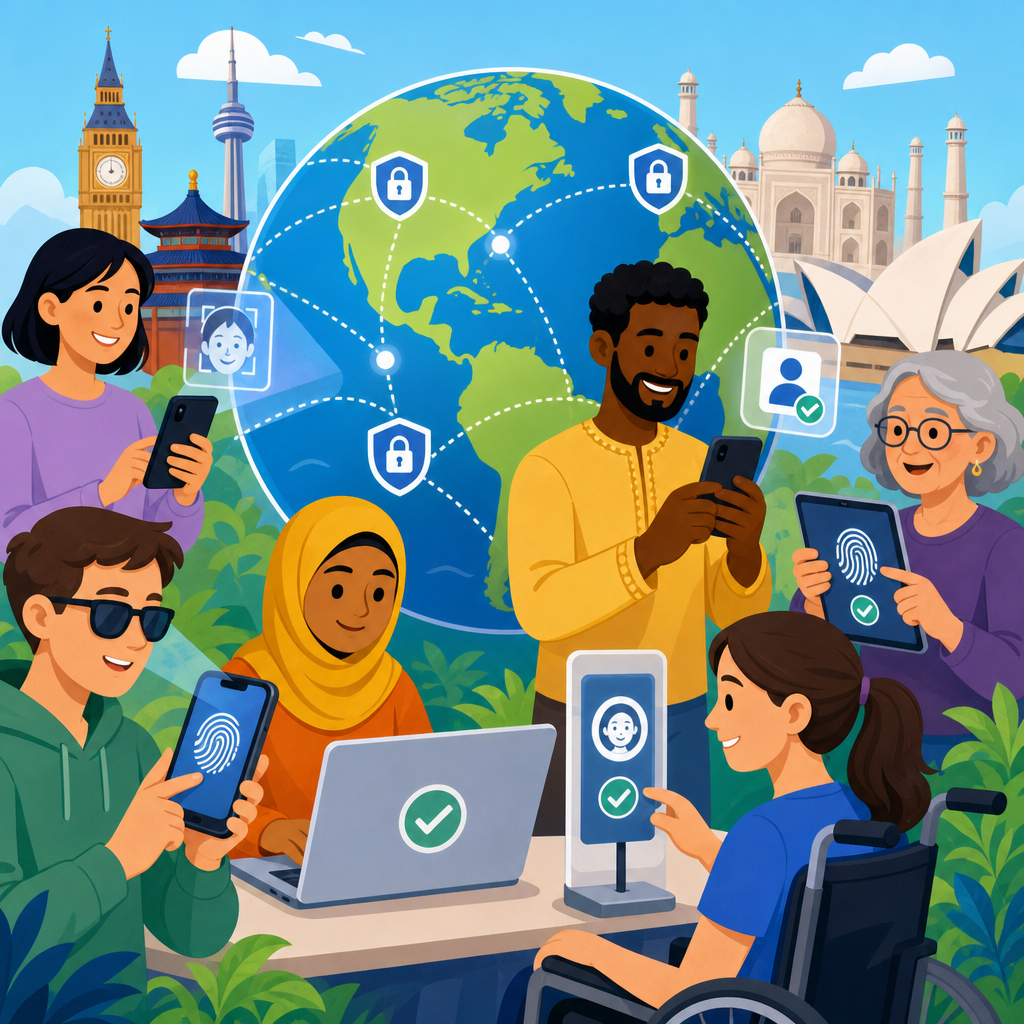
Accessible digital authentication sits at the intersection of cybersecurity, public service delivery, and disability rights. It refers to the methods people use to prove who they are online in ways that work for users with visual, hearing, motor, cognitive, speech, and multiple disabilities. In practice, that includes passwordless sign-in, one-time codes, passkeys, hardware tokens, biometrics, and identity proofing steps that do not block assistive technology. When these systems fail, the result is not just inconvenience. People can be locked out of banking, health portals, government benefits, education systems, and workplace tools.
Across international accessibility work, authentication has become a high-stakes issue because security controls often add barriers at the exact moment a user needs certainty, speed, and privacy. I have seen teams fix polished websites only to discover that the login flow still depended on distorted CAPTCHAs, timed SMS codes, or facial matching that excluded part of the audience. That pattern explains why authentication deserves its own hub within international innovations and strategies in accessibility. It is where legal compliance, product design, procurement, identity infrastructure, and customer support all collide.
Different countries address accessible digital authentication through a mix of law, technical standards, market incentives, and national identity programs. The most influential benchmark is the Web Content Accessibility Guidelines, especially the requirements in version 2.2 related to accessible authentication. Governments also map those principles into their own frameworks, such as EN 301 549 in Europe, Section 508 in the United States, and procurement rules that push vendors toward accessible login experiences. At the same time, consumer ecosystems are shifting toward passkeys and device-based authentication, which can reduce friction but also introduce new setup and recovery risks.
This article explains how other countries approach the problem, what strategies are proving effective, and where the hard tradeoffs remain. As a hub page for international innovations and strategies in accessibility, it connects policy trends, technical design patterns, and implementation lessons that matter across sectors. The central point is simple: the best countries do not treat accessibility as an exception path. They build authentication so the mainstream method is usable by the widest possible range of people, with secure alternatives when one modality fails.
Europe: regulation, procurement, and the move away from cognitive function tests
European countries have pushed the issue forward by linking accessibility obligations to both digital services law and public procurement. A critical reference point is EN 301 549, the European standard for ICT accessibility requirements used in public purchasing and increasingly reflected in product expectations beyond government. The standard aligns with WCAG and gives contracting authorities a concrete basis for asking whether login, identity proofing, and account recovery work with screen readers, voice control, switch devices, captions, zoom, and plain-language instructions. This matters because procurement changes vendor behavior faster than guidance alone.
The European Accessibility Act adds further pressure by extending accessibility expectations into key private-sector services and products. Meanwhile, WCAG 2.2 introduced a major concept for authentication: users should not be forced to complete cognitive function tests, such as remembering complex passwords, transcribing characters, or solving puzzles, unless an alternative is available. That shift is especially important for people with dyslexia, memory impairments, brain injuries, and some neurodivergent users. Several European public service teams now interpret accessible authentication as a design requirement, not merely a compatibility check at the end.
Nordic countries provide useful examples because they combine mature digital identity systems with strong public-sector usability practices. Sweden, Norway, Denmark, and Finland all rely heavily on bank-linked or state-recognized eID approaches for services ranging from taxes to prescriptions. Those systems can streamline sign-in, but they also expose accessibility weaknesses quickly because one credential unlocks many essential services. In audits I have reviewed, the recurring issues were not always the cryptography. More often they involved app pairing flows, inaccessible QR-code steps, timeouts during device switching, and poor recovery paths when a user changed phones or lost a token.
Several European administrations now favor approaches that support platform accessibility features rather than overriding them. Passkeys, device biometrics backed by operating-system accessibility controls, and approval flows with clear text alternatives generally perform better than custom CAPTCHA-heavy login pages. The lesson from Europe is that standards work when they are tied to enforcement, testing, and purchasing power. Countries that combine all three are moving fastest.
United States and Canada: civil rights enforcement and practical design guidance
The United States addresses accessible digital authentication through a combination of civil rights law, procurement rules, and agency guidance rather than a single national digital identity scheme. Section 508 governs federal ICT accessibility, while the Americans with Disabilities Act increasingly shapes expectations for state programs and private services through enforcement actions and litigation. The National Institute of Standards and Technology also influences the market through its Digital Identity Guidelines, especially the emphasis on authenticator choice, phishing resistance, and lifecycle management. While NIST does not function as an accessibility rulebook, its framework helps teams design secure alternatives beyond passwords and SMS.
In practice, U.S. progress is uneven because identity is fragmented across banks, employers, schools, healthcare systems, and federal or state agencies. Yet that fragmentation has produced valuable implementation lessons. Large service providers have invested in screen-reader-tested multifactor flows, support for FIDO security keys, and account recovery procedures that do not rely solely on phone access. The best examples avoid forcing users into one channel. They offer app approval, hardware token, backup code, and assisted recovery options, each documented in accessible help content.
Canada follows a similar pattern but often with stronger alignment between public digital service modernization and accessibility commitments. Federal and provincial teams increasingly treat plain language, bilingual support, and mobile accessibility as integral to authentication. Sign-in services used by tax, immigration, and benefits systems have highlighted a core truth: identity proofing can be more exclusionary than sign-in itself. Asking users to upload documents, angle a phone camera correctly, or complete a live selfie check may satisfy fraud controls while blocking users with low vision, limited dexterity, or unstable connectivity. Canadian design guidance has therefore emphasized alternate channels and human support escalation.
Across both countries, the most durable strategy is not one perfect login method. It is layered choice, tested with disabled users, underpinned by documented support processes and measurable service standards.
Asia-Pacific: national digital identity at scale and mobile-first accessibility challenges
Asia-Pacific countries show how accessible digital authentication behaves when identity systems operate at massive scale and mobile devices are the primary access point. India, Singapore, Australia, New Zealand, Japan, and South Korea each offer different models, but all illustrate the same tension: a frictionless mobile identity flow can broaden access for millions while still excluding users if onboarding, consent, or recovery assume high literacy, stable vision, precise touch interaction, or constant device ownership.
India’s Aadhaar ecosystem demonstrates both the power and complexity of large identity infrastructure. Aadhaar enabled broad digital verification across banking, telecom, and government programs, but debates around consent, biometrics, and service exclusion exposed the risks of overreliance on one identifier or one authentication mode. For accessibility, the key lesson is that biometric authentication alone is not enough. Fingerprints may fail for manual laborers or older adults, facial workflows may not work well for some users or contexts, and assisted service channels remain essential. Inclusive authentication at population scale requires fallback methods that are equally legitimate, not second-class exceptions.
Singapore’s Singpass is often cited for integrating government and commercial access through a mature mobile app and broad service coverage. Its strength is the reduction of repeated logins and stronger protection against phishing through app-based confirmation. Accessibility gains come when the app works smoothly with VoiceOver, TalkBack, larger text, and straightforward approval prompts. However, any app-centered model must still account for people who cannot use a smartphone reliably, share devices, or need caregiver support without violating privacy.
Australia’s myGov and state digital identity efforts have pushed agencies to improve cross-device consistency, error handling, and plain-language instructions, especially for benefits and healthcare access. New Zealand has similarly emphasized trust, indigenous inclusion, and service design quality in public-sector digital transformation. Across the region, mobile-first identity can be highly effective, but only when countries invest in offline support, accessible enrollment, and recovery channels that do not assume one device, one person, one uninterrupted session.
Common design strategies that work across borders
Despite legal and infrastructural differences, countries that improve accessible digital authentication tend to adopt the same practical strategies. They reduce memory burden, support multiple authenticators, preserve compatibility with assistive technology, and plan for failure. Most importantly, they test complete user journeys, including registration, login, step-up verification, and account recovery. Accessibility failures usually appear in the edges: expired codes, inaccessible error messages, hidden focus states, unsupported browser zoom, or customer support scripts that cannot verify identity without speech.
| Strategy | Why it improves accessibility | International example |
|---|---|---|
| Passkeys or device-based sign-in | Reduces password recall and typing demands; works with platform accessibility features | European and North American banks piloting FIDO-based login |
| Multiple authentication options | Lets users choose a method that matches their abilities and context | U.S. and Canadian public services offering app, token, and backup code choices |
| Accessible recovery paths | Prevents lockout when a phone, email account, or token is lost | Australian and Nordic service portals adding staffed fallback support |
| Alternative to cognitive tests | Avoids barriers created by memory tasks, puzzles, and transcription | European services aligning with WCAG 2.2 expectations |
| Inclusive identity proofing | Supports users who cannot complete selfie, document, or camera-based checks | Canada and New Zealand emphasizing assisted verification channels |
Another pattern is the shift from inaccessible CAPTCHAs toward risk-based security controls. Rather than asking every user to solve a challenge, systems analyze device reputation, location, velocity, and behavior signals in the background, then escalate only when risk is high. This approach can improve both usability and fraud prevention, though it must be governed carefully to avoid discriminatory outcomes or unexplained blocks.
Leading teams also write authentication content differently. They replace vague prompts like “Enter valid credentials” with precise instructions, tell users how long a code remains valid, explain what to do if a device is unavailable, and make support contact methods accessible by chat, relay, email, and phone. These details look small, but internationally they mark the difference between compliance theater and real inclusion.
Persistent gaps, tradeoffs, and what this international hub reveals
No country has solved accessible digital authentication completely. Biometrics can reduce typing and memory load but raise concerns about consent, spoofing, bias, and failure to enroll. SMS remains widespread because it is familiar, yet it performs poorly against modern phishing threats and excludes users with limited phone access or delayed message delivery. Passkeys are promising, but cross-device portability, backup, and recovery still confuse many users. National digital identity systems can simplify access across services, but centralization increases the impact of a single inaccessible design choice.
What the international picture reveals is that accessibility improves most when governments and major service providers treat authentication as a service journey, not a security checkpoint. That means policy must address procurement, standards, enforcement, and support operations together. It also means accessibility teams need a seat in identity architecture discussions early, before vendors lock in assumptions about phones, faces, voices, or memory tasks. Countries making progress are the ones that run usability studies with disabled participants, publish design guidance, and update security practices as technology evolves.
As a hub for international innovations and strategies in accessibility, this topic points to a clear direction. Build mainstream authentication that works with assistive technology, minimize cognitive load, offer equivalent alternatives, and design recovery with the same care as login. If you are reviewing your own digital services, start by auditing the full authentication journey against current accessibility standards and real user testing. That is where inclusive access becomes measurable, defensible, and genuinely secure.
Frequently Asked Questions
What does accessible digital authentication mean in an international context?
Accessible digital authentication refers to the ways people verify their identity online without creating barriers for users with disabilities. In an international context, this includes how governments, banks, healthcare systems, and public service platforms design login and identity verification processes so they work with screen readers, voice input, keyboard navigation, captions, alternative input devices, and plain-language instructions. It is not limited to a single technology. Instead, it covers the full authentication journey, including account creation, identity proofing, receiving and entering one-time codes, using passkeys or hardware tokens, recovering locked accounts, and completing step-up verification when additional security checks are required.
Different countries approach this issue through a mix of digital identity programs, accessibility laws, cybersecurity standards, and public procurement rules. Some countries build national digital ID ecosystems and then require accessibility from the start. Others rely more heavily on private-sector authentication tools but enforce accessibility through anti-discrimination law or web accessibility requirements. In both models, the core principle is the same: security controls should not exclude people who are blind, Deaf, hard of hearing, have limited dexterity, cognitive disabilities, speech disabilities, or multiple disabilities.
The most effective international approaches recognize that accessibility is not a special feature added after deployment. It is a design requirement that shapes which authentication methods are offered and how users move between them. For example, a system that depends only on a visual CAPTCHA or on facial matching without alternatives can shut people out. By contrast, a more accessible system may offer device-based passkeys, app-based approvals, accessible hardware keys, support for assistive technology, and recovery options that do not force users into inaccessible call center workflows. Countries that take accessible digital authentication seriously tend to treat it as a matter of equal access, service continuity, and public trust, not just technical compliance.
How do other countries balance strong security with accessibility in digital authentication?
Many countries address this balance by moving away from one-size-fits-all login methods and toward layered, flexible authentication models. Rather than assuming that every user can receive SMS messages, solve visual puzzles, speak clearly on a phone line, or complete a biometric scan, they offer multiple ways to authenticate at different levels of assurance. This allows a user to choose a secure method that matches their abilities, devices, and environment. In practice, that may mean supporting passkeys tied to a device, authenticator apps with accessible interfaces, hardware security keys, email-based verification in lower-risk situations, and documented exceptions or alternatives for identity proofing.
Countries with mature digital identity frameworks often use risk-based authentication to reduce friction. Instead of challenging every user in the same way, systems can evaluate context such as device familiarity, transaction sensitivity, and account history. This helps reduce unnecessary prompts that often create accessibility problems. For example, if a user is signing in from a trusted device to check routine public service information, the system may require fewer steps than it would for changing legal identity data or accessing sensitive health records. Done properly, risk-based design strengthens both usability and security by reserving the most demanding checks for higher-risk events.
Another common strategy is requiring equivalent alternatives. If a country or agency uses biometrics, it should also provide options for people who cannot reliably use facial recognition or fingerprints. If a platform uses one-time codes, those codes should be available through channels that work with different disabilities and do not assume constant mobile service or speech access. The strongest models also address recovery and support. A highly secure login method can still be exclusionary if account recovery depends on inaccessible forms, voice-only support, or in-person verification that is difficult to access. In short, countries balance security and accessibility best when they build redundancy, user choice, and inclusive fallback paths into the authentication system itself.
Which international policies and standards influence accessible digital authentication?
Internationally, accessible digital authentication is shaped by overlapping legal, technical, and human rights frameworks. A major influence is the broader body of disability rights law that requires equal access to digital services, especially when those services are provided by governments or essential institutions. In many regions, public-sector accessibility rules require websites and mobile apps to be usable by people with disabilities, which naturally extends to login and identity verification processes. These requirements often draw from recognized accessibility standards for digital content and user interfaces, even when they do not prescribe a specific authentication technology.
Technical guidance also plays an important role. Authentication standards and identity assurance frameworks increasingly acknowledge that secure methods must be usable in the real world by diverse populations. This has led many implementers to consider factors such as compatibility with assistive technology, avoidance of timeouts that cannot be extended, support for copy-and-paste when appropriate, clear labeling of form fields, and alternatives to inaccessible challenge-response mechanisms. In practice, countries may align national identity schemes or procurement requirements with these principles, especially when launching digital government platforms or nationwide eID initiatives.
Human rights and privacy principles matter as well. In some countries, policymakers are cautious about mandating a single biometric or device-dependent model because it can create exclusion, surveillance concerns, or both. As a result, they emphasize proportionality, data minimization, and meaningful alternatives. The most influential international approaches do not treat accessibility as separate from privacy or security. They recognize that an authentication method is not truly fit for public use if it is technically secure but inaccessible to a portion of the population. That is why countries often combine accessibility regulations, cybersecurity guidance, and inclusive service design standards when developing digital authentication policy.
What authentication methods are generally considered more accessible, and where do countries still struggle?
No authentication method is universally accessible to every user, which is why countries that perform well in this area usually support more than one option. Device-based passkeys are often seen as promising because they can reduce reliance on memorized passwords and manual code entry. When implemented well, they can work smoothly with built-in accessibility features on modern devices, including screen readers, biometric alternatives, switch control, and simplified interaction patterns. Authenticator apps can also be effective if their interfaces are accessible and they do not rely on confusing visual layouts or strict timing requirements. Hardware security keys may be highly usable for some people, especially when they avoid typing, but they can also present physical handling challenges for users with limited dexterity unless designed carefully.
More problematic methods include SMS-only verification, image-based CAPTCHAs, audio CAPTCHAs with poor sound quality, and rigid facial recognition systems. SMS codes can fail for users in low-connectivity areas, people who do not consistently use mobile phones, and users who need extra time or assistive tools to move between devices and screens. CAPTCHAs are a long-standing barrier because they often depend on vision, hearing, speed, or puzzle-solving under pressure. Biometric systems can be exclusionary when they assume a particular physical presentation, require precise movement, or perform poorly across diverse populations and disability-related conditions.
Countries also continue to struggle with identity proofing and account recovery. Even when the primary login is accessible, the onboarding process may require scanning identity documents, recording a selfie video, reading tiny text from official IDs, or completing inaccessible liveness checks. Recovery flows are often even worse, relying on phone trees, inaccessible security questions, or branch visits that create logistical and disability-related barriers. The lesson from international practice is clear: accessibility is not just about the sign-in button. It has to cover the entire lifecycle of digital authentication, from enrollment to everyday use to emergency recovery after a lost device, expired credential, or suspected fraud incident.
What can governments, financial institutions, and service providers learn from how other countries handle accessible digital authentication?
The most important lesson is that accessibility must be built into authentication strategy from the beginning, not treated as a remediation task after rollout. Countries that make meaningful progress usually start by recognizing digital authentication as a core public access issue. If citizens cannot log in, they cannot obtain benefits, file taxes, manage health information, sign documents, or prove identity for essential transactions. That makes inaccessible authentication more than a usability flaw. It becomes a barrier to civic participation, economic inclusion, and equal treatment under the law.
Another lesson is the value of offering secure choice rather than forcing a single method on everyone. Systems should support multiple authentication paths, allow users to select methods that work with their disabilities and devices, and provide accessible alternatives whenever a stronger factor is required. Procurement and vendor management are also critical. Countries that improve outcomes often require accessibility testing, assistive technology compatibility, usability research with disabled participants, and ongoing monitoring as part of contracts for identity platforms and authentication tools. This helps prevent situations where a technically advanced system fails in practice for real users.
Finally, international experience shows that governance matters as much as technology. Clear accountability, published accessibility requirements, complaints processes, exception handling, and regular audits all improve results. Organizations should test not only the primary login flow but also edge cases such as account lockouts, fraud checks, shared device use, and support escalation. They should involve disabled users directly in design and evaluation, because many barriers only become visible through lived experience. Countries that approach accessible digital authentication this way tend to produce systems that are more secure, more resilient, and more trusted by the public overall.