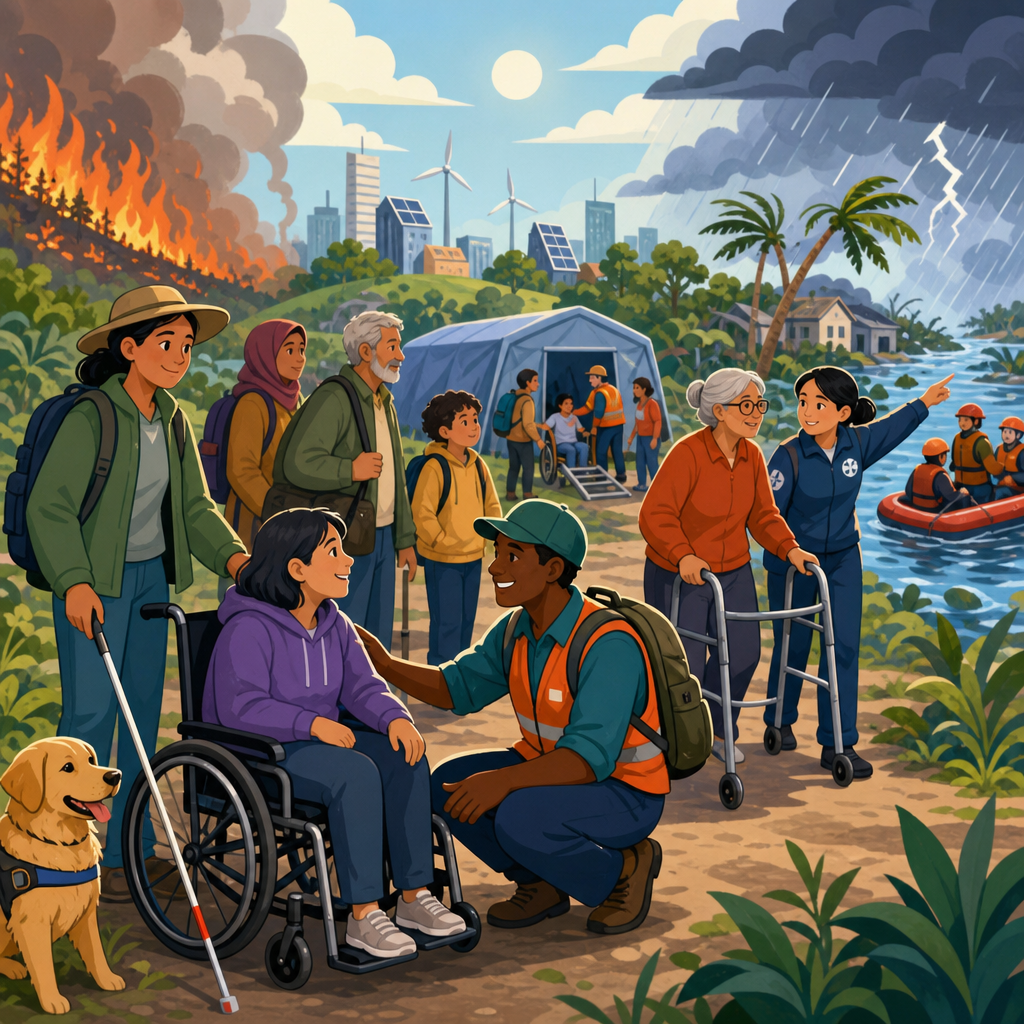
Climate migration and emergency response are rapidly becoming defining disability rights issues, because extreme heat, floods, storms, drought, wildfire, sea level rise, and conflict linked to environmental stress are already displacing millions of people and exposing longstanding failures in accessible planning. Climate migration refers to the movement of people within or across borders due in whole or in part to climate related hazards and environmental degradation. Emergency response includes preparedness, warning systems, evacuation, sheltering, relief distribution, health care continuity, recovery, and long term resettlement. For disabled people, these systems are not neutral. They can either protect life and autonomy or intensify exclusion, institutionalization, poverty, and preventable death.
I have worked with accessibility audits, evacuation planning reviews, and disability inclusion guidance for public services, and the same pattern appears across countries: plans often assume speed, literacy, stable communications, private transport, and standardized shelter environments. Those assumptions fail many people with physical, sensory, intellectual, developmental, psychosocial, and chronic health disabilities. A text only alert is useless to some blind users and inaccessible to many people with low digital access. A shelter without power backup can endanger people who rely on ventilators, oxygen concentrators, refrigeration for medication, or powered mobility devices. A relocation site built far from transit and health care can trap people who survived the immediate crisis.
This topic matters globally because disability and climate vulnerability overlap at scale. The World Health Organization estimates that more than 1.3 billion people live with significant disability, roughly 16 percent of the world population. At the same time, the Internal Displacement Monitoring Centre has documented tens of millions of disaster displacements in many recent years. When those realities intersect, disability rights become central to humanitarian law, urban policy, public health, migration governance, housing, labor protections, and digital communications. The future of global accessibility and disability rights will be shaped by whether governments, aid agencies, and host communities design climate adaptation and emergency systems with disabled people from the start rather than treating accessibility as a late add on.
International law already provides a foundation. The Convention on the Rights of Persons with Disabilities establishes equal recognition before the law, accessibility, independent living, inclusive education, health, and protection in situations of risk and humanitarian emergencies under Article 11. The Sendai Framework for Disaster Risk Reduction calls for inclusive, accessible disaster risk management. The Paris Agreement and climate adaptation agendas increasingly recognize vulnerable populations, but recognition alone is not enough. The practical future question is straightforward: how do countries convert rights language into evacuation routes, cash assistance, inclusive shelters, accessible border procedures, interoperable medical records, and dignified relocation pathways that work under pressure?
Why climate migration creates distinct disability rights challenges
Climate migration affects disabled people differently because displacement disrupts the support networks and service continuity that make daily life possible. A nondisabled evacuee may lose housing and income. A disabled evacuee may also lose a personal assistant, sign language interpretation, a wheelchair repair provider, accessible transport, dialysis scheduling, psychiatric medication management, or a familiar communication routine. In practice, the loss of those supports can turn a temporary move into a life threatening event. After major hurricanes, for example, disability organizations have repeatedly reported people stranded in upper floors without evacuation devices, separated from service animals, or transferred into nursing facilities because accessible temporary housing was unavailable.
Climate migration also raises legal status questions that existing systems do not fully answer. Most countries do not recognize a simple category of climate refugee in treaty law, and internal displacement frameworks often overlook disability specific accommodations. If a person crosses a border because repeated flooding destroyed accessible housing and local health services collapsed, authorities may still process that movement through general migration rules with little attention to disability related evidence. Future policy will need clearer standards for documenting support needs, ensuring non discrimination at borders, and preventing detention or family separation caused by inaccessible intake systems.
Another distinct issue is cumulative displacement. Many households now face repeated evacuations from wildfires, cyclones, or flooding rather than a single one time event. Repetition magnifies barriers. Batteries wear down, medications run out, insurance disputes delay repairs, and mental health impacts deepen. For disabled people already navigating lower average income and higher health costs, each move can erode independence. That is why climate migration policy cannot stop at evacuation. It must cover resilient housing, accessible reconstruction, livelihood recovery, and community based supports in receiving areas.
What inclusive emergency response must include
Inclusive emergency response means disabled people can receive warnings, decide what to do, travel safely, access shelters and services, maintain communication, and participate in recovery on an equal basis. The core components are known and measurable. Warnings should be sent in multiple formats: text, audio, captioned video, plain language, easy read, local languages, and relay compatible channels. Transport plans should include wheelchair accessible vehicles, evacuation chairs, fuel contingencies, and pickup registries that do not become gatekeeping tools. Shelters need step free routes, accessible toilets and bathing, quiet spaces, refrigeration, charging stations, durable cots, backup power, interpreters, and staff trained on disability etiquette and consent.
Health continuity is equally critical. Emergency systems should maintain lists of essential medications and durable medical equipment vendors, but they should not rely on medicalized paternalism. The strongest plans use person centered support profiles created before disasters and controlled by the individual. In several jurisdictions, voluntary registries help responders understand whether someone needs visual guidance, communication support, assistance transferring, or electricity dependent equipment. Registries work only when privacy safeguards, frequent updates, and alternatives for unregistered residents exist. I have seen registries fail when phone numbers were outdated or when responders assumed every disabled resident wanted evacuation rather than in place support.
Cash assistance should also be designed accessibly. In many emergencies, aid is delayed because application portals are incompatible with screen readers, identity requirements are too rigid, or payment points are physically inaccessible. Direct cash can be faster and more dignified than distributing standardized goods, but only if enrollment can happen through accessible websites, phone support, community outreach, and paper alternatives. The lesson from recent disasters is simple: universal systems outperform special exemptions. If every relief channel is accessible by default, fewer people fall into crisis.
| Emergency function | Common failure | Future rights based standard |
|---|---|---|
| Public warning | Single format alerts | Multichannel alerts with captions, audio, plain language, and local language access |
| Evacuation | Inaccessible transport and no support for equipment | Accessible vehicles, trained staff, equipment protection, and flexible pickup plans |
| Sheltering | Crowded sites with stairs, no privacy, no power backup | Accessible layouts, backup electricity, quiet rooms, and disability competent staff |
| Relief benefits | Digital portals that exclude many users | Accessible digital, phone, paper, and in person application options |
| Recovery | Rebuilding without accessibility standards | Universal design in housing, transit, clinics, schools, and public space |
Global law, governance, and the move from principle to enforcement
The future of global accessibility and disability rights depends on enforcement mechanisms, not only aspirational commitments. Article 9 and Article 11 of the disability convention, the Guiding Principles on Internal Displacement, the Sphere Handbook, and national disaster management laws provide a usable framework, yet implementation remains uneven. Many countries have strong disability statutes but weak emergency regulations. Others have robust disaster agencies but no formal consultation with organizations of persons with disabilities. The policy gap often appears in procurement rules, local building codes, emergency communications standards, and budget lines. If accessibility is omitted from those operational tools, rights remain abstract.
A stronger model is emerging through disability inclusive disaster risk reduction. This approach requires disabled people and their representative organizations to participate in risk mapping, drills, shelter inspections, relocation planning, and post disaster review. Participation is not symbolic. It changes outcomes. When Deaf advocates review alerts, captioning and sign language windows improve. When wheelchair users inspect shelters, bottlenecks and inaccessible bathrooms are identified before a storm hits. When neurodivergent people advise on sensory conditions, shelter operators can add quiet areas and predictable routines that reduce distress. Governments that institutionalize this feedback loop build systems that work for more people under stress.
Funding rules are another enforcement lever. Climate adaptation finance, humanitarian grants, and development bank loans should require accessibility benchmarks and disability disaggregated monitoring. This is especially important for relocation and reconstruction projects. Too many resettlement sites repeat old mistakes by placing homes far from employment, schools, transit, and clinics, or by building units that meet minimal mobility access but ignore communication and cognitive accessibility. Future governance should treat accessibility as a core resilience indicator, just like drainage capacity or seismic safety.
Technology, data, and design choices that will shape the next decade
Technology can either reduce risk or deepen inequality. The next decade will bring more sensor driven alerts, digital identity systems, satellite informed evacuation planning, and AI assisted triage. These tools are useful only when accessibility is built into procurement, testing, and oversight. For example, emergency apps should support screen readers, voice control, high contrast modes, offline maps, and location sharing that users can manage safely. Video briefings should include live captions and interpretation. Kiosks at shelters or border points should have tactile controls, audio output, adjustable height, and staff backup. Accessibility cannot be patched on after deployment because crises expose every design shortcut.
Data governance deserves equal attention. Disability disaggregated data helps agencies estimate who may need transport assistance, medication continuity, or communication support. Yet data collection can create risk if it is coercive, inaccurate, or shared without safeguards. The best practice is proportionate collection tied to a clear service purpose, combined with community validation and strict privacy controls. Washington Group questions can improve comparability in surveys, but they do not replace individual support assessments during emergencies. Numbers identify broad need. Person specific planning protects real people.
Low tech design remains essential. In field operations, I have seen battery powered radios, laminated communication boards, color coded wayfinding, and neighborhood check in networks save more time than sophisticated dashboards. Future emergency response should combine advanced systems with redundant analog options. If the mobile network fails, if power is lost, or if literacy barriers are high, the response must still function. Resilience means not depending on a single channel.
Building accessible relocation, recovery, and international cooperation
Long term relocation is where disability rights are most likely to be lost. Governments often focus on moving people quickly from high risk areas, but speed can conceal coercion, segregation, and poor design. A rights based relocation process starts with informed consent wherever possible, transparent criteria, accessible community consultation, and independent grievance mechanisms. It protects the right to family life, continuity of education, access to work, and community participation. It also recognizes that some people will prefer in place adaptation if adequate supports exist, while others will need assisted relocation with robust service coordination.
Accessible recovery means rebuilding communities, not merely replacing structures. Housing should follow universal design principles with step free entry, usable bathrooms, reachable controls, clear signage, and routes to transit and services. Health systems should ensure continuity of rehabilitation, mental health support, assistive technology provision, and maintenance supply chains. Education recovery should include accessible temporary classrooms, inclusive transport, and continuity plans for students who use augmentative communication or individualized supports. Employment recovery should address discrimination in hiring, inaccessible workplaces, and the loss of informal livelihoods that many disabled people depend on.
International cooperation will matter more as cross border climate movement grows. Neighboring states can coordinate accessible reception protocols, recognition of disability documentation, continuity of medication prescriptions, and mutual aid for assistive technology repair. Humanitarian agencies should align standards so displaced people are not forced to restart eligibility assessments at every border or camp. Regional bodies, city networks, and disability led organizations are often the fastest channels for practical innovation. The countries that prepare now will save lives later.
The future of global accessibility and disability rights will be decided in evacuation maps, shelter layouts, migration procedures, rebuilding codes, and budget priorities. Climate migration and emergency response are not side issues within disability policy; they are central tests of whether equal rights survive under pressure. The path forward is clear. Governments should embed accessibility in all hazard planning, fund disability led participation, require inclusive procurement, and measure outcomes across warning, evacuation, shelter, recovery, and relocation. Aid agencies should treat accessibility as operational readiness, not a specialist add on. Cities should audit shelters, transport, and communications before the next disaster, not after it.
The most important takeaway is that inclusive systems help everyone while protecting those at greatest risk. Multiformat alerts reach more residents. Step free shelters support older adults, parents with children, and injured evacuees. Flexible cash delivery reduces exclusion across income and language barriers. Universal design creates communities that are safer in everyday life and more resilient in crisis. If you are shaping policy, funding programs, or publishing guidance under an international perspective, make disability inclusion the organizing principle now. The costs of delay are measured in preventable harm, and the benefits of action are measured in survival, dignity, and freedom.
Frequently Asked Questions
Why are climate migration and emergency response becoming major disability rights issues?
Climate migration and emergency response are becoming central disability rights issues because climate related disasters do not affect everyone equally. Disabled people often face higher risks during extreme heat, floods, storms, drought, wildfire, power outages, and displacement because evacuation plans, shelters, transportation systems, warning alerts, and temporary housing are frequently designed without accessibility in mind. When a person relies on a wheelchair, communication device, ventilator, medication refrigeration, personal care support, service animal, or accessible transportation, even a short disruption can quickly become life threatening. These are not marginal concerns. They are basic civil rights and survival issues.
As climate hazards intensify, more people are being forced to move temporarily or permanently within their own countries and across borders. That movement can interrupt medical care, disability benefits, education services, employment accommodations, and community based support networks. In emergencies, disabled people are too often treated as an afterthought, which leads to preventable injuries, institutionalization, family separation, and exclusion from recovery programs. Looking ahead, disability rights law and policy will increasingly need to address not only equal access during disasters, but also what happens before displacement, during transit, in shelters, in relocation programs, and throughout long term rebuilding.
What are the biggest barriers disabled people face during climate related displacement and disaster response?
The barriers are both physical and systemic. Physically, many evacuation routes, buses, shelters, hotels, and temporary housing sites are not accessible to people with mobility, sensory, intellectual, developmental, or psychosocial disabilities. Emergency announcements may be issued without captioning, plain language, sign language interpretation, screen reader compatibility, or multilingual accessible formats. People who are Deaf, blind, low vision, neurodivergent, or who have cognitive disabilities can be shut out of critical information at the exact moment when timing matters most.
Systemically, emergency planning often assumes people can travel independently, stand in long lines, quickly complete paperwork, and advocate for themselves under stress. That assumption ignores the real needs of people who require medication, dialysis, electricity for medical devices, personal attendants, accessible restrooms, quiet spaces, or trauma informed support. In addition, disabled migrants and evacuees may confront legal and financial barriers, including ineligibility for assistance programs, difficulty replacing medical equipment, lack of accessible documentation systems, and discrimination by landlords, responders, or service providers. The biggest future issue is not simply access to one shelter or one service. It is whether climate response systems will be rebuilt around universal design, continuity of care, and disability led planning instead of crisis driven improvisation.
How should governments and emergency agencies make climate migration and disaster planning more accessible?
Governments and emergency agencies should start by treating accessibility as a core requirement, not a special accommodation added later. That means building disability inclusion into every stage of preparedness, response, relocation, and recovery. Emergency alerts should be available in multiple accessible formats, including captioned video, text, audio, plain language, sign language, and mobile compatible systems. Evacuation plans should include accessible transportation, registries or voluntary support systems that respect privacy, and coordination for people who use durable medical equipment, service animals, and personal care assistance.
Accessible shelters and relocation sites must provide ramps, accessible bathrooms and sleeping areas, refrigeration for medication, backup power, communication access, sensory aware spaces, and trained staff who understand disability rights. Agencies should also ensure continuity of healthcare, benefits, education supports, and community based services when people cross city, state, or national boundaries. Importantly, disabled people and disability organizations should be involved in planning, oversight, and evaluation. The most effective policies are shaped by people with lived experience, not by assumptions about what disabled communities need. In the future, strong climate resilience will depend on legally enforceable accessibility standards, reliable funding, interoperable service systems, and accountability when emergency responses exclude disabled people.
What legal and human rights questions are likely to grow in importance as climate migration increases?
Several legal questions are becoming more urgent. One is whether disability rights protections will follow people as they move during disasters, especially when displacement crosses local, state, or national borders. A person may lose access to home and community based services, accessible education supports, income assistance, or workplace accommodations simply because they have been uprooted. Another major question is how anti discrimination laws apply in shelters, evacuation transport, housing placement, public health systems, and recovery funding. If climate response programs are inaccessible, they can effectively deny disabled people equal protection and equal participation.
There are also major human rights concerns involving autonomy, informed consent, and the right to live in the community. In disaster settings, disabled people may be institutionalized, separated from caregivers, denied communication access, or excluded from decisions about relocation and rebuilding. As climate migration grows, courts, lawmakers, and international bodies will likely face deeper questions about cross border protection, accessible asylum and migration systems, disability inclusive humanitarian aid, and the duties governments owe to people displaced by environmental harm. The future direction of law will likely turn on a simple principle: disabled people must have the same right as anyone else to safety, mobility, dignity, and participation in decisions that shape where and how they live.
What does a disability inclusive future for climate migration and emergency response look like?
A disability inclusive future is one in which disabled people are not merely rescued in crisis, but fully included in planning, governance, and recovery from the beginning. That future includes resilient housing located outside high risk areas, accessible public transportation, decentralized backup power, inclusive communications infrastructure, and evacuation systems that account for real human needs instead of idealized assumptions. It also means emergency management agencies, hospitals, schools, housing authorities, and immigration systems share responsibility for continuity of care and accessibility rather than leaving disabled people to navigate fragmented institutions alone.
Just as important, a disability inclusive future recognizes disabled people as leaders, experts, neighbors, workers, parents, and community members whose knowledge improves outcomes for everyone. Universal design, plain language communication, stronger public health coordination, and accessible infrastructure benefit older adults, children, injured people, and anyone facing temporary limitations during disaster. In practical terms, success will mean fewer preventable deaths, less chaotic displacement, more stable access to services, and recovery programs that support independent living instead of forcing segregation. As climate migration becomes a defining challenge of this century, the measure of a just emergency response system will be whether disabled people can survive, relocate, rebuild, and shape the future on equal terms.