Fire alarm accessibility depends on one simple principle: an alarm must reach every occupant, including people who are deaf, hard of hearing, asleep, distracted, or separated from the source of danger by walls and distance. In practice, that principle sits within ADA Accessibility Standards Chapter 7, which addresses communication elements and features across a building, but fire alarm accessibility is one of the most safety-critical applications because missed notification can become a life safety failure within minutes. Visual notification appliances, audible alarms, sleeping area alerting, and coordinated system design all work together to create an accessible means of warning. When designers, owners, and facility managers understand how these pieces fit, they can make better decisions during planning, renovation, inspection, and maintenance.
I have worked with project teams that assumed a code-compliant horn in a corridor solved notification for everyone. It does not. People who are deaf may never perceive an audible alarm. People who remove hearing aids while sleeping may not hear a horn that seems loud enough during the day. Guests in hotel rooms, residents in apartments, students in dormitories, and patients in transient care settings may be behind closed doors with background noise, HVAC sound, and substantial sound attenuation. That is why fire alarm accessibility requires visual signals such as strobes and, in many sleeping environments, dedicated notification inside the room or unit itself.
Key terms matter here. A visible notification appliance is typically a strobe that flashes at a prescribed intensity and pattern to signal an emergency. An audible notification appliance is usually a horn, speaker, or sounder that produces a recognizable alarm signal. A sleeping area is any room or space intended for sleeping, including hotel guest rooms, apartment bedrooms, dorm rooms, assisted living units, and similar occupancies. Communication features under Chapter 7 extend beyond alarms to items such as assistive listening systems and telephones, but fire alarm notification is often the point where accessibility, building code, and life safety system engineering intersect most directly.
This topic matters because the cost of getting it wrong is measured in evacuation delays, liability exposure, failed inspections, and preventable harm. It also matters because the rules do not live in one place. ADA requirements, model codes, fire alarm performance standards, and product listings each shape the final design. The most reliable approach is to treat accessible alarm notification as a coordinated system rather than a device checklist. This hub article explains the core principles of visual alarm signals and sleeping area notification, then connects them to the wider communication features requirements in Chapter 7 so teams can plan compliant, usable, and safer buildings.
How Chapter 7 Frames Fire Alarm Accessibility
Chapter 7 of the ADA Accessibility Standards addresses communication elements and features, which means it focuses on whether information reaches people with different sensory and communication needs. Fire alarm accessibility fits squarely within that purpose. A warning that depends on hearing alone is not accessible to many occupants, and a warning that depends on vision alone can also fail in noisy, smoky, crowded, or visually obstructed environments. Accessible design therefore emphasizes equivalent notification through multiple sensory channels where required.
For fire alarms, that often means using visible alarms in public and common-use areas where audible alarms are provided, then addressing sleeping rooms and dwelling units with additional care. In my experience reviewing hospitality and multifamily projects, the biggest misunderstanding is assuming ADA only concerns wheelchair turning space or door clearances. Chapter 7 shows that communication access is equally fundamental. If a building offers a sleeping accommodation to the public or residents, notification features cannot stop at the corridor.
The practical question designers ask is this: where are visible alarm signals required, and how do they differ in sleeping spaces? The answer depends on occupancy type, whether the space is public, common use, employee work area support space, or residential, and which standards apply. ADA scoping establishes where accessible features are required, while technical design details are coordinated with fire alarm and electrical standards. That division is why successful projects involve accessibility specialists, fire protection engineers, electrical designers, and authorities having jurisdiction early rather than after rough-in.
Visual Alarm Signals: What They Do and Where They Belong
Visual alarm signals exist to communicate urgent danger through light rather than sound. The standard device is the strobe, which emits a bright flash intended to attract attention quickly across a room or space. The effectiveness of a strobe depends on placement, candela rating, mounting height, room geometry, and synchronization. Poorly placed devices create dead zones, reflections, or disorienting patterns. Correctly designed systems provide clear, recognizable visual notification without relying on occupants to face a single direction or remain near a doorway.
In public and common-use spaces, visible alarms are generally expected wherever an audible fire alarm system serves occupants. Typical examples include lobbies, meeting rooms, classrooms, corridors, restrooms, fitness rooms, laundry rooms, tenant amenity areas, and similar shared spaces. A hotel breakfast area with an audible horn but no strobe leaves deaf guests without equivalent notice. A university lecture hall with strobes only at exits may not provide adequate visibility to students seated far from the doors. The intent is functional coverage, not token installation.
Synchronization is especially important when multiple strobes are visible in one field of view. Unsynchronized flashes can create a confusing, chaotic effect and may increase discomfort for some occupants. Listed devices and control equipment are designed to coordinate flash timing, and project specifications should require that coordination across circuits and spaces where occupants can see more than one strobe. This is one of those details that seems minor on paper but becomes obvious during acceptance testing.
Teams also need to understand the difference between product listing and field performance. A listed strobe can still fail the room if installed on the wrong wall, blocked by millwork, or selected at the wrong intensity. I have seen renovated clubhouses where decorative beams and pendant lighting cut sightlines so badly that compliant devices became ineffective in practice. Accessibility depends on the room people actually occupy, not the room shown on an uncluttered reflected ceiling plan.
Sleeping Areas Need More Than Corridor Coverage
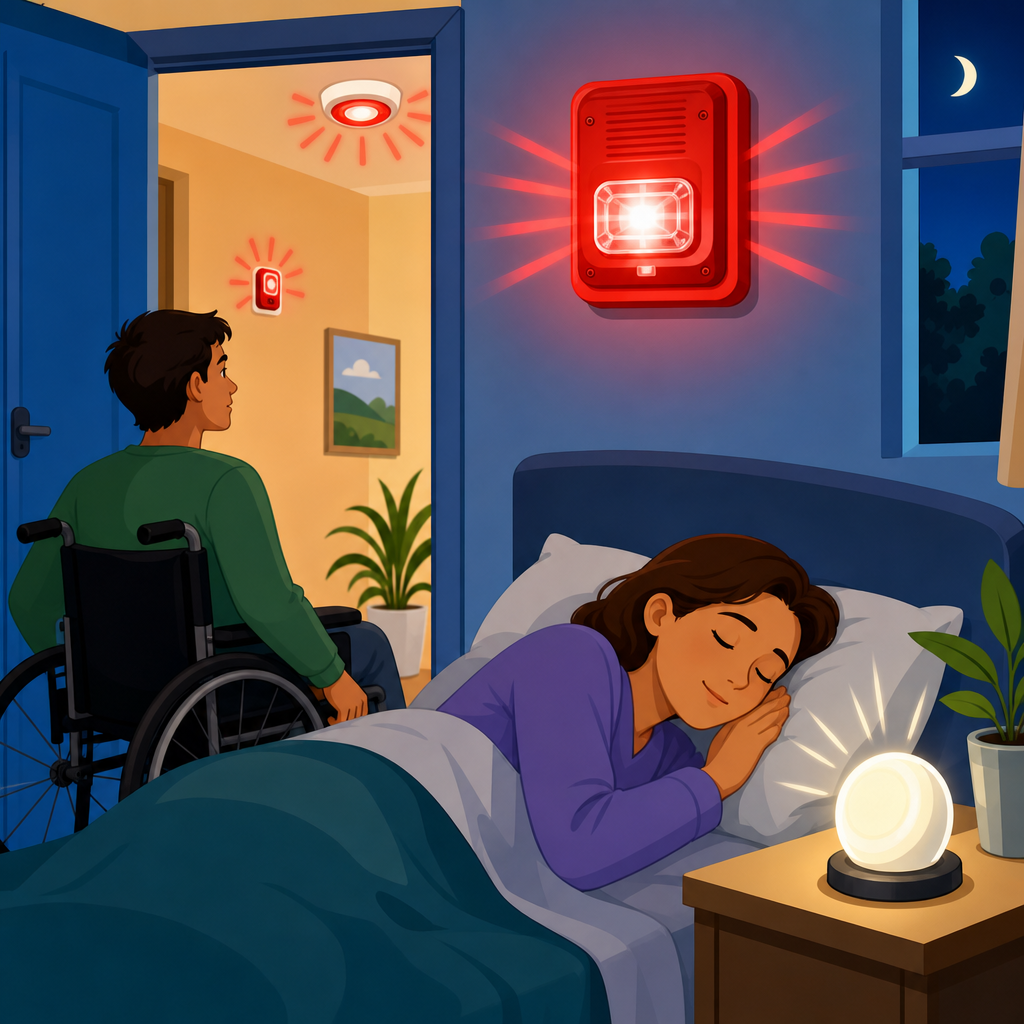
Sleeping areas deserve special attention because occupants are more difficult to alert during sleep and because hearing status changes at night. Many people who are hard of hearing remove hearing aids or cochlear implant processors before bed. Others rely on white noise machines, televisions, air conditioning units, or closed doors that reduce the audibility of corridor alarms. As a result, a corridor horn or strobe outside the room is not an adequate substitute for in-room notification where accessible sleeping accommodations are required.
Hotels provide a clear example. An accessible guest room generally needs visible notification so a deaf or hard of hearing guest can perceive an alarm while awake, but the sleeping function also means notification must be effective when the guest is in bed, in the bathroom, or otherwise not facing the entry. In many projects, that leads to dedicated in-room visible devices, and often activation interfaces that connect the room’s alarm notification to the building system. Similar logic applies in dormitories, transient lodging, apartment dwelling units, and certain residential occupancies depending on the applicable code framework.
Bathrooms attached to sleeping rooms can be overlooked. Yet people use them behind closed doors with exhaust fans running and limited sightlines to the main room strobe. Where required, additional visual notification may be needed so an occupant showering or grooming still receives the alarm. This is why accessible alarm design should follow actual occupant paths rather than simplistic room labels.
| Space type | Common notification issue | Accessible design response |
|---|---|---|
| Hotel guest room | Corridor alarm not perceived through closed door | Provide in-room visible alarm notification tied to the fire alarm system |
| Dormitory sleeping room | Sleeping occupant misses audible signal | Use visible notification within the room and coordinate coverage for attached spaces |
| Apartment bedroom | Alarm from living area may not wake resident | Review unit layout and required appliance locations based on applicable standards |
| Accessible bathroom | Main room strobe not visible inside bathroom | Add visual notification where required by room configuration and standards |
Codes, Standards, and the Need for Coordination
No single document answers every fire alarm accessibility question. ADA standards establish accessibility obligations. Model building and fire codes, such as the International Building Code and International Fire Code where adopted, establish broader life safety triggers. NFPA 72, National Fire Alarm and Signaling Code, provides detailed technical criteria for notification appliance performance, spacing, synchronization, and sleeping area requirements. NFPA 70, the National Electrical Code, governs installation practices. Product standards and listings from recognized testing laboratories confirm that devices perform as intended when used correctly.
Because these layers overlap, teams should avoid the phrase “ADA compliant strobe” as if one label resolves the design. What matters is whether the installed system satisfies accessibility scoping, technical performance criteria, local code amendments, and the building’s actual use. A hospitality renovation may trigger guest room upgrades. A multifamily conversion may change occupancy classification assumptions. A school addition may require new synchronization across an existing system that was never designed for expansion. The earlier these issues are surfaced, the cheaper they are to fix.
Authorities having jurisdiction also matter. Fire marshals, building officials, state accessibility reviewers, and third-party inspectors may focus on different parts of the system. The best documentation package shows appliance type, candela, mounting, synchronization method, room coverage logic, and the relationship between accessible room scoping and the alarm design. When submittals clearly explain intent, approvals move faster and field conflicts shrink.
Design, Testing, and Maintenance in Real Buildings
Accessible fire alarm design does not end with plan review. Devices must be installed at the approved locations, tested under realistic conditions, and maintained so performance remains reliable over time. Acceptance testing should confirm visual appliances activate correctly, synchronize where required, and remain visible from expected occupant positions. In sleeping rooms, that means testing from the bed area, bathroom threshold, and major circulation paths, not simply verifying that a flash exists somewhere in the room.
Maintenance is equally important because strobes can be painted over, obstructed by furniture, disconnected during remodels, or replaced with nonmatching devices that break synchronization. Guest room renovations are a common failure point. I have seen millwork installers place tall wardrobe units directly in front of visible appliances, effectively erasing the notification coverage shown on the permit drawings. Annual inspections catch some of these issues, but facility teams should train operations staff to recognize them during routine room turnover and maintenance walks.
For owners, the main benefit of getting this right is not just avoiding citations. It is creating a building where emergency communication works for more people, more consistently, under stress. That is the real purpose of Chapter 7’s communication features framework. Visual signals and sleeping area alerting are not optional niceties; they are core life safety measures that translate policy into practical protection. If you are planning new construction, a renovation, or an accessibility review, start with your alarm notification strategy early, coordinate it across codes and disciplines, and verify it in the field before occupancy.
Frequently Asked Questions
What does fire alarm accessibility mean in practice?
In practice, fire alarm accessibility means the notification system must effectively alert every building occupant, not just those who can hear a horn in an open corridor. That includes people who are deaf or hard of hearing, people who are asleep, occupants behind closed doors, and anyone separated from the fire alarm signal by distance, background noise, or building layout. The core idea is simple: if a person is expected to respond to an alarm, the alarm must be presented in a way that person can actually perceive.
This is why accessible fire alarm design relies on more than audible devices alone. Visual notification appliances, especially strobes, play a critical role in making emergency communication available to occupants who may not detect sound-based signals. In sleeping areas, accessibility becomes even more important because a sleeping person is harder to notify than someone who is awake and attentive. A compliant design typically considers the function of the space, occupant characteristics, room configuration, and the required notification method so that the alarm is not merely installed, but truly effective.
From a code and standards perspective, this principle is reflected in ADA Accessibility Standards Chapter 7, which addresses communication elements and features, and it works alongside fire alarm and life safety codes that define where and how notification appliances must be provided. The result is a coordinated system intended to reduce the risk of missed alerts during an emergency. Accessibility, in this context, is not an added convenience; it is a life safety requirement.
Why are visual alarm signals so important for people who are deaf or hard of hearing?
Visual alarm signals are essential because audible appliances alone cannot reliably notify everyone in a building. For occupants who are deaf or hard of hearing, a horn, speaker, or tone may be ineffective or completely imperceptible, especially in private rooms, restrooms, work areas, and sleeping spaces. A properly installed visible notification appliance provides a clear, immediate warning through flashing light, helping ensure that the emergency message reaches occupants regardless of hearing ability.
Strobes are especially important in environments where background noise is high or where people may remove hearing devices during parts of the day. In hotels, dormitories, apartments, and similar occupancies, a person may be alone behind a closed door and unable to hear corridor alarms. In those cases, visible alarms inside the room become a critical part of accessible notification. Their purpose is not decorative or redundant; they are often the primary means by which certain occupants receive the alarm at all.
There is also an important consistency benefit. When visual signals are integrated into the building’s fire alarm system and installed in the correct locations, occupants know that the flashing signal indicates an emergency condition requiring action. This predictable, standardized communication reduces confusion and supports faster response. In life safety design, seconds matter, and visible alarms help close a dangerous gap that would otherwise leave some occupants unprotected.
How should fire alarms address accessibility in sleeping areas?
Sleeping areas require special attention because waking a sleeping occupant is fundamentally different from notifying someone who is already awake. Even people without hearing loss can sleep through distant alarms, muffled corridor signals, or sounds blocked by walls and closed doors. For occupants who are deaf or hard of hearing, the challenge is greater still. That is why accessible sleeping rooms often require visible notification appliances within the room itself and, depending on the occupancy and applicable codes, additional features designed to provide effective awakening notification.
The exact requirements depend on the type of facility and the governing standards, but the underlying goal is the same: the alarm must be noticeable from the bed area and usable by the intended occupant. Placement, candela rating, and room size all matter because a strobe that is technically present but poorly located may not serve its purpose. In many cases, sleeping rooms intended to be accessible must be equipped so that guests or residents who are deaf or hard of hearing can receive notification without relying on staff intervention or chance.
This is particularly significant in hospitality, residential, healthcare, and institutional settings where people may be asleep for long periods and may not be familiar with the building. In these environments, accessible alarm notification is a direct safety issue, not just a design detail. A well-planned system accounts for sleeping conditions, closed doors, and occupant vulnerability, helping ensure that a person can wake, understand that an emergency exists, and begin evacuating or following emergency procedures promptly.
Are visual alarms alone enough to make a fire alarm system accessible?
No. Visual alarms are a major part of accessible fire alarm notification, but they are not the whole solution. True accessibility depends on delivering the emergency signal in ways that match the needs of the occupants and the conditions of the space. In many buildings, that means combining audible notification, visible notification, proper appliance placement, and in some cases supplemental alerting technologies. The system must work for people who are hearing, deaf, hard of hearing, asleep, or located in acoustically or visually challenging areas.
For example, a strobe in a corridor may not effectively notify someone inside a guest room with the door closed. Likewise, an audible signal may not help an occupant with hearing loss, and a visible signal may be less effective if a person is not facing it or if the room layout limits visibility. Accessibility is therefore about coverage and performance, not just device count. Designers need to consider where occupants are likely to be, what they are likely doing, and whether the chosen notification method will reliably reach them during an emergency.
It is also important to remember that compliance usually involves multiple standards working together. ADA-related accessibility provisions intersect with fire alarm and life safety requirements that govern installation, synchronization, intensity, and device location. Building owners should avoid the assumption that adding a few strobes automatically solves accessibility concerns. A system is accessible when the full notification strategy is designed to reach all occupants effectively and consistently under real-life conditions.
What should building owners, designers, and facility managers keep in mind when planning accessible fire alarm notification?
The most important thing to keep in mind is that accessible notification should be planned proactively, not treated as a last-minute correction. Fire alarm accessibility is most effective when considered early in design, renovation, or system replacement projects. Owners and design teams should start with the occupant experience: who is in the building, where they sleep, work, or gather, and how an emergency signal will reach them if they cannot rely on hearing alone. This user-focused approach leads to better decisions about appliance type, room coverage, sleeping room features, and coordination with applicable standards.
It is also essential to understand that accessibility is not purely a product selection issue. The performance of the system depends on layout, mounting, candela, spacing, visibility, room geometry, and the way the building is used day to day. A device that is compliant in one space may be inadequate in another. Guest rooms, apartments, dormitories, patient rooms, and other sleeping spaces often demand especially careful review because missed notification in those settings carries higher risk. Routine maintenance and testing are equally important, since even a well-designed system cannot protect occupants if devices are disabled, obstructed, or no longer functioning properly.
Finally, building owners and managers should work with qualified fire alarm professionals and code specialists who understand both accessibility and life safety requirements. Accessible fire alarm notification is a technical area with serious consequences if handled incorrectly. A thoughtful, code-informed approach helps protect occupants, reduce liability, and create a safer environment for everyone in the building, including those who might otherwise be left out of traditional alarm strategies.