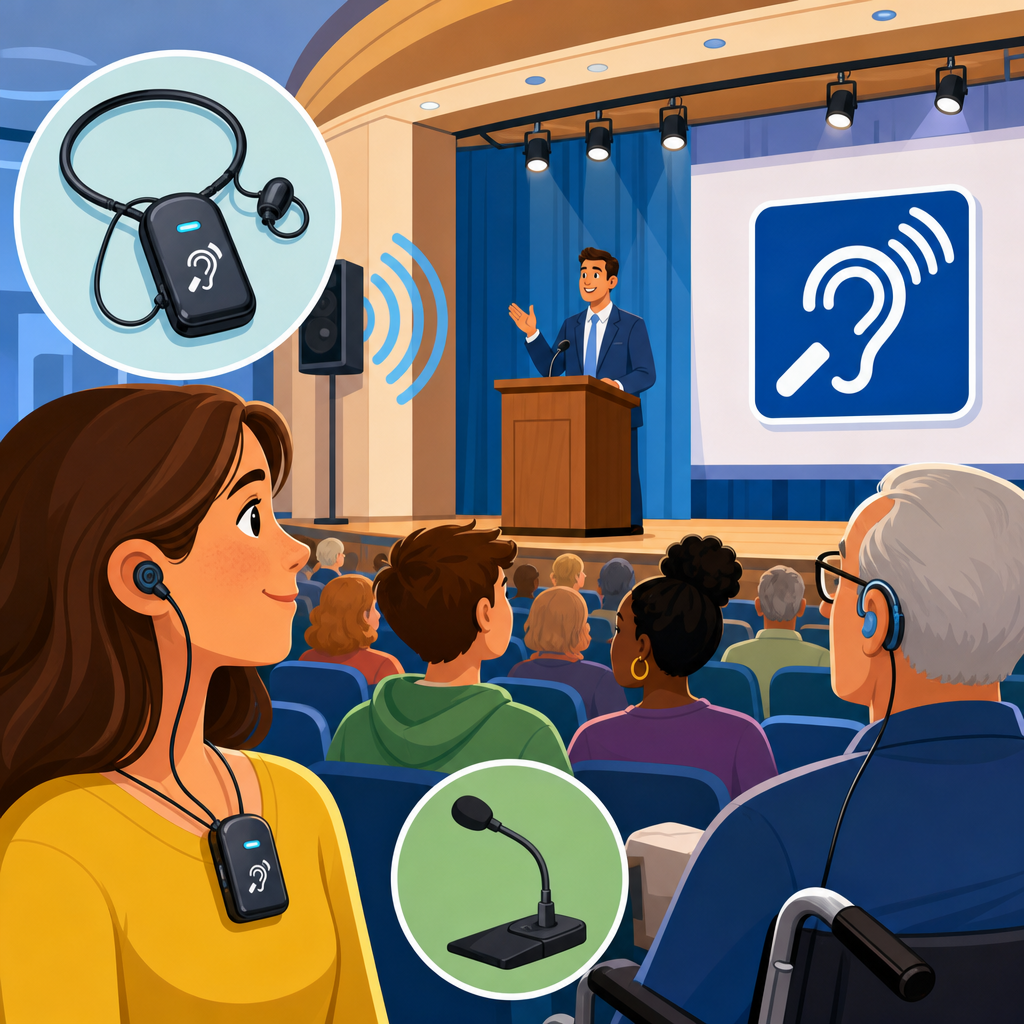
Assistive listening systems in assembly spaces are a core accessibility requirement under ADA Accessibility Standards because they make spoken communication usable for people who are deaf or hard of hearing in places where the public gathers. In practice, assembly spaces include classrooms, courtrooms, theaters, lecture halls, meeting rooms, houses of worship, stadiums, and any other room or area used for civic, educational, entertainment, or public events. An assistive listening system, often shortened to ALS, is a communication feature that sends audio from a microphone or sound system directly to a listener through a receiver, headset, neck loop, or telecoil-equipped hearing aid. I have worked on accessibility reviews for renovation projects, and this is one of the most commonly misunderstood parts of Chapter 7: Communication Elements and Features because owners often assume that a loudspeaker system alone satisfies the rule. It does not. The ADA standards require specific types of communication access, minimum receiver quantities, hearing-aid compatibility, and signage so users can actually find and use the equipment.
This topic matters because inaccessible sound blocks participation just as surely as a stair blocks entry. In a council chamber, missing a motion or public comment affects civic participation. In a lecture hall, poor access affects education. In a performing arts venue, it limits equal enjoyment of the event. The legal framework also matters for planning: the 2010 ADA Standards for Accessible Design, especially Section 219 and related technical criteria in Section 706, set the baseline for when assistive listening systems are required and how they must perform. These rules connect with the broader obligations in Chapter 7, which also covers visible alarms, telephones, and other communication elements. For designers, facility managers, and operators, the hub question is straightforward: when does an assembly area need an assistive listening system, how many receivers are required, what kind of receivers qualify, and how should the system be deployed so it works reliably during actual use rather than only on paper?
When assistive listening systems are required in assembly spaces
The basic rule is direct: where an assembly area has audible communication integral to the use of the space, an assistive listening system is required. “Integral” is the key term. If people need to hear speech, program audio, testimony, announcements, or performance content to participate, the requirement applies. The standards do not limit this to entertainment venues. I regularly see compliance triggered in conference centers, training rooms, jury assembly rooms, classrooms, exhibit presentation spaces, and multipurpose rooms with public address systems. A meeting room used for spoken presentations is covered even if it is modest in size. By contrast, a room without amplified or otherwise integral audible communication may not trigger the same obligation, though equivalent effective communication may still be required under broader ADA duties.
Several exceptions and practical boundaries are important. An assembly area with an audio amplification system or with fixed seating and an audio signal conveyed by a public address system generally needs ALS coverage. Courtrooms are specifically addressed because speech access is essential there. In historic buildings, achieving compliance may require careful equipment selection rather than exemption; portable systems, infrared transmitters, or induction loops can often be installed with minimal visual impact. Temporary events also deserve attention. If a facility regularly hosts public programs in a space with amplified speech, operators should not assume a temporary setup avoids the rule. The obligation follows the communication need, not just the permanence of the furniture. This is why many facilities build ALS planning into room standards, just as they would with wheelchair seating locations or accessible signage.
Receiver counts, hearing-aid compatibility, and the numbers that control design
The most cited requirement in this subject is the receiver count formula. Section 219.3 requires receivers in quantities based on seating capacity, with a portion of those receivers compatible with hearing aids. The technical scoping is taken from a table many designers use early in programming because it affects storage, charging, staffing, and procurement. For spaces with 50 or fewer seats, at least two receivers are required. As seating increases, the minimum rises in increments, and at least 25 percent of the required receivers, but never fewer than two, must be hearing-aid compatible. In current practice, that usually means neck loops for users with telecoil-equipped hearing aids or cochlear implants, though integrated telecoil receivers are also used.
| Seating capacity in assembly area | Minimum receivers required | Minimum hearing-aid compatible receivers |
|---|---|---|
| 50 or fewer | 2 | 2 |
| 51 to 200 | 2, plus 1 per 25 seats over 50 | 2 |
| 201 to 500 | 8, plus 1 per 33 seats over 200 | 2 |
| 501 to 1,000 | 17, plus 1 per 50 seats over 500 | 4 |
| 1,001 to 2,000 | 27, plus 1 per 100 seats over 1,000 | 5 |
| 2,001 and more | 37, plus 1 per 500 seats over 2,000 | 7 |
These figures are minimums, not operating targets. In real venues, I advise owners to exceed them when attendance patterns show frequent demand spikes, multilingual programming, or heavy use by older adults. A 300-seat lecture hall may technically meet the scoping minimum with eleven receivers, but if the campus hosts community lectures and graduate seminars with regular public attendance, fifteen or twenty devices may better match actual need. It is also important to count by the seating capacity of the assembly area, not by average attendance. If the room can hold the audience, the receiver calculation follows that capacity. On projects with divisible rooms, the safest approach is to evaluate each configured assembly use and make sure the available receiver pool and transmitter coverage support the maximum compliant setup.
System types and how to choose the right technology
The ADA standards are performance based; they do not force one transmission technology for every room. In the field, the three common options are induction loop, infrared, and FM or other radio-frequency systems. Each can comply if it delivers clear audio to the required number of users and includes hearing-aid compatible receivers. An induction loop creates an electromagnetic field that a telecoil can pick up directly. Users with telecoil-enabled hearing aids often prefer loops because they can switch their device to the T-coil setting and hear the room audio without borrowing a separate headset. Loops work especially well at ticket counters, service windows, and rooms with a stable seating footprint, though metal in the structure and electromagnetic interference require competent design and testing.
Infrared systems transmit audio using light, which improves privacy because the signal generally stays within the room. That makes infrared a common choice in courtrooms, boardrooms, cinemas, and confidential meeting spaces. The tradeoff is line-of-sight sensitivity and possible interference from strong ambient light if the design is weak. FM and digital radio-frequency systems are flexible and well suited to multipurpose rooms, guided tours, and spaces where portability matters. They are often easier to retrofit than loops and less constrained by sightlines than infrared. The drawback is signal spill beyond the room, which can matter where confidentiality is important. In my experience, the best technology choice depends on room use, confidentiality, ceiling conditions, staffing model, and user profile. There is no universally superior system; there is only a system matched correctly to the assembly space and operated consistently.
Installation, signage, and operational rules that determine real compliance
Buying receivers is not the same as providing access. Section 706 addresses technical criteria such as signal-to-noise ratio, peak clipping limits, and frequency response, all of which affect intelligibility. A system with weak gain structure, distortion, or poor microphone placement can technically exist and still fail users. Speech access depends heavily on the audio chain upstream from the ALS transmitter: podium microphones must be live, handheld microphones must be passed consistently, mixer outputs must feed the listening system, and staff must know how to monitor the result. I have seen otherwise compliant rooms fail because a presenter used only the room speakers while the ALS input remained disconnected from the lectern mic. Commissioning should therefore include live speech testing from the user perspective, not just a powered-on equipment check.
Signage is another nonnegotiable rule. Facilities must identify the availability of assistive listening systems with the International Symbol of Access for Hearing Loss at entrances or locations where patrons can request devices. If hearing-aid compatible receivers are available, signage should communicate that clearly as well, so users know telecoil access is offered. Storage and distribution practices matter too. Receivers hidden in a locked office or available only when one trained employee is present do not create dependable access. Best practice is to place devices at ticketing, reception, or an attended accessible service point with batteries charged, ear pads replaced, neck loops sanitized, and a checkout procedure that does not burden the user. In larger venues, a documented maintenance schedule, periodic listening checks, and spare units are essential because a single dead battery can turn a compliant inventory into a practical failure.
How assistive listening systems fit within Chapter 7 communication features
As a hub topic within ADA Accessibility Standards, assistive listening systems should be understood alongside the rest of Chapter 7: Communication Elements and Features. Chapter 7 addresses how people receive information, not just how they enter a building. That includes visual alarms for people who cannot hear audible alarms, accessible telephones where provided, two-way communication systems that can be used by people with hearing or speech disabilities, and detectable warnings or signage interfaces in certain contexts. The common thread is equal access to information exchange. In assembly spaces, ALS is the primary rule for spoken program content, but it often intersects with other communication measures such as real-time captioning, video displays, microphone discipline, and accessible announcement policies.
This broader view matters because no single feature solves every communication barrier. An assistive listening system helps a person hear amplified speech more clearly, but it does not replace captions for someone who does not rely on residual hearing. A hearing loop at a reception counter improves speech transfer, but it does not substitute for visual notification of emergency instructions. For facility teams building an ADA compliance program, the smartest approach is to treat Chapter 7 as an integrated checklist: identify where information is spoken, displayed, signaled, or exchanged; determine which users may miss that information; then apply the relevant technical standards and operational procedures. If you are using this page as your sub-pillar hub, the next step is to map each assembly space in your portfolio, verify where ALS is required, confirm receiver counts and hearing-aid compatibility, inspect signage and maintenance practices, and correct gaps before the next event puts accessibility to the test.
Assistive listening systems in assembly spaces are not optional convenience features; they are a defined accessibility obligation tied to equal participation in public life. The core rules are clear. If audible communication is integral to the use of an assembly area, an assistive listening system is generally required. Receiver counts are based on seating capacity, and a required portion must be hearing-aid compatible. The system selected may be loop, infrared, or radio frequency, but it must deliver intelligible sound under actual operating conditions. Signage must tell users that the service exists, and staff procedures must make devices easy to obtain, charged, clean, and functional. These details are what turn code language into usable access.
For owners, architects, AV consultants, and facility managers, the main benefit of getting this right is simple: people can participate fully in meetings, performances, classes, hearings, and worship without avoidable communication barriers. That improves compliance, reduces complaints, and creates a better experience for everyone who depends on clearer audio, including many older adults with mild hearing loss who may never identify as disabled. Use this hub as your starting point for Chapter 7 communication features, then review each related article in your ADA Accessibility Standards library and audit every assembly space against the rules outlined here. A short, methodical review now is far easier than fixing access failures after the doors open.
Frequently Asked Questions
What is an assistive listening system, and why is it required in assembly spaces?
An assistive listening system, often abbreviated as ALS, is a technology solution designed to make spoken audio clearer and more accessible for people who are deaf or hard of hearing. Instead of relying only on room acoustics or amplified sound from loudspeakers, these systems send the speaker’s voice directly to a listener through a compatible receiver, headphones, earbuds, or a hearing aid or cochlear implant equipped with a telecoil. This direct transmission helps reduce the effects of distance, reverberation, and background noise, which are common barriers in public gathering spaces.
Under ADA Accessibility Standards, assistive listening systems are a core requirement in many assembly spaces because equal access to communication is a fundamental part of accessibility. If a room or venue is used for public events, civic functions, education, entertainment, worship, meetings, or similar activities, people with hearing loss must have a usable way to follow speech and program audio. That is why ALS requirements apply in places such as classrooms, lecture halls, courtrooms, theaters, meeting rooms, houses of worship, stadiums, and similar venues where the public gathers.
The practical purpose of an ALS is straightforward: it helps ensure that a person can understand the spoken content of an event, not just be physically present in the room. In many assembly environments, standard sound systems make audio louder, but not necessarily clearer. Assistive listening systems are intended to improve intelligibility, which is the real accessibility issue for many users. In other words, compliance is not just about installing equipment; it is about making communication meaningfully accessible.
Which types of assembly spaces typically need an assistive listening system?
Assembly spaces generally include rooms or areas where people come together for public, educational, civic, recreational, entertainment, religious, or similar purposes. This can cover a very broad range of facilities. Common examples include theaters, auditoriums, stadiums, arenas, classrooms, lecture halls, courtrooms, meeting rooms, conference spaces, houses of worship, community centers, and council chambers. If a space is designed for an audience, a gathering, or a formal exchange of spoken information, it may fall into the assembly category.
In general, assistive listening systems are required where audible communication is integral to the use of the space and where there is an audio amplification system or where people need to hear speech clearly as part of the event or program. The exact compliance trigger depends on the design and function of the room, but the key idea is that assembly spaces are not limited to large entertainment venues. Smaller rooms used for public meetings, instruction, presentations, or hearings can also be subject to the requirement.
It is important not to assume that only high-capacity spaces need ALS. A classroom, training room, courtroom, or municipal meeting room may be just as important from an accessibility standpoint as a theater or stadium. If the space is used for spoken presentations, dialogue, performances, announcements, or proceedings, accessibility planning should address how people with hearing loss will receive that audio. In practice, evaluating the use of the space, its occupancy, and whether amplified audio is provided is essential for determining the appropriate ALS solution.
How do assistive listening systems work, and what types are commonly used?
Assistive listening systems work by capturing audio from a microphone or sound system source and transmitting it directly to the listener using a dedicated technology. This bypasses many of the listening challenges created by room acoustics, crowd noise, and speaker distance. Instead of trying to hear a voice that has already bounced around the room, the user receives a much cleaner signal through a receiver or through compatible hearing technology. The result is better speech understanding, especially in environments where even people without hearing loss may struggle to hear clearly.
The most common types of assistive listening systems are hearing loop systems, FM systems, and infrared systems. A hearing loop uses electromagnetic energy to send sound directly to hearing aids and cochlear implants equipped with telecoils, and it can also work with receivers for users who do not have telecoil-enabled devices. FM systems use radio signals to transmit sound to portable receivers, making them flexible and effective in a variety of settings. Infrared systems use light-based transmission and are often selected where confidentiality or room-specific containment is important, such as courtrooms or spaces where signal spillover must be avoided.
Each system type has advantages depending on the venue. Hearing loops are often appreciated for their convenience because users with telecoil-equipped devices can connect without borrowing extra equipment. FM systems can be highly adaptable and are commonly used in multipurpose spaces. Infrared systems can provide strong privacy and can be ideal where line-of-sight conditions are manageable. The right choice depends on the room layout, intended use, user population, operational needs, and maintenance capabilities. A compliant design should also include the necessary receivers, neck loops where required, and clear signage so users know the system is available and how to access it.
How many receivers are required, and do venues need hearing aid compatible options?
ADA Accessibility Standards establish scoping requirements for the number of receivers that must be provided in assembly spaces where assistive listening systems are required. The number is tied to the seating capacity of the venue or space, with larger assembly areas required to provide more receivers. This ensures that access is not merely symbolic, but practical for a meaningful number of users. Simply installing a transmission system without supplying the required listening devices would not satisfy the intent of the standards.
Just as important, a portion of the required receivers must be hearing aid compatible. In practice, this usually means providing receivers or interfaces that work with telecoil-equipped hearing aids and cochlear implants, often through neck loops or other coupling methods. This is a significant requirement because many users do not benefit fully from standard headphones or earbuds alone. Hearing aid compatible options allow sound to be delivered directly into the listener’s personal hearing device, often with much better clarity and comfort.
Venue operators should also think beyond the minimum count. Receivers must be available, charged, maintained, and easy to obtain when needed. Staff should know where they are stored, how to distribute them, and how to explain their use. If a required number of receivers exists only on paper but devices are missing, broken, uncharged, or unknown to staff, the user experience falls short and the venue may face both operational and compliance problems. Good ALS planning includes inventory control, routine testing, replacement procedures, and visible notice to the public that assistive listening is available.
What are the most common compliance mistakes with assistive listening systems in assembly spaces?
One of the most common mistakes is assuming that general sound amplification is the same thing as assistive listening. A loudspeaker system may make sound louder in the room, but it does not necessarily make speech understandable for a person with hearing loss. An ALS must provide a direct, accessible listening path. Another frequent problem is failing to identify all assembly spaces within a facility. Owners may focus on major venues like auditoriums while overlooking classrooms, meeting rooms, chapels, or training spaces that also host spoken programming and may require accessibility features.
Another major compliance issue is incomplete system implementation. For example, a venue may install a transmission backbone but fail to provide enough receivers, fail to include hearing aid compatible options, or fail to post proper signage. In other cases, equipment may technically exist but staff do not know how to issue it, batteries are dead, receivers are locked away, or the system is disconnected from the actual audio source. These operational failures can undermine an otherwise compliant design and create real barriers for users.
Maintenance and user communication are also often overlooked. Assistive listening systems need routine checks, just like microphones and speakers. Receivers should be sanitized, charged, and tested regularly. Signage should be easy to spot and use recognized accessibility symbols so attendees know the system is available before the event begins. Venues should also train frontline staff to answer basic questions, troubleshoot simple issues, and provide the correct type of device, including telecoil-compatible options when needed. The best way to avoid compliance mistakes is to treat ALS as an active accessibility service, not a one-time equipment purchase.