Emergency shelters and disaster communication under the ADA determine whether people with disabilities can evacuate safely, receive life-saving information, and recover with dignity during hurricanes, wildfires, floods, heat waves, and other emergencies. The Americans with Disabilities Act, or ADA, is the core federal civil rights law prohibiting disability discrimination by state and local governments and by many private entities open to the public. In emergency management, that means accessible planning, effective communication, equal access to shelter programs, reasonable modifications to policies, and procurement choices that do not exclude people who use wheelchairs, screen readers, hearing aids, service animals, or personal assistance services.
I have worked with public-facing compliance reviews and emergency communication audits long enough to see the same failure points repeat: alerts sent only as audio, shelters announced without accessibility details, cots packed too tightly for mobility devices, and intake forms that assume every evacuee can read print, hear instructions, and stand in line. Those errors are not minor operational gaps. They can become civil rights violations, operational bottlenecks, and direct threats to health and safety. The ADA intersects with Section 504 of the Rehabilitation Act, the Stafford Act, FEMA guidance, plain language standards, and digital accessibility practices, creating a practical framework that every public agency and shelter operator should understand.
This hub article covers the Public Spaces & Government side of the issue comprehensively. It explains what emergency shelters must provide, how disaster communication must work before, during, and after an event, and where municipalities, counties, transit agencies, school districts, public health departments, and contractors often fall short. It also functions as a sub-pillar overview for related topics such as accessible websites, captioned emergency video, wayfinding in public buildings, service animal access, transportation planning, and procurement of assistive communication tools. If your organization manages public spaces or delivers government services, this is the baseline: emergency access is not a specialized add-on. It is part of core readiness.
What the ADA requires in emergency shelters
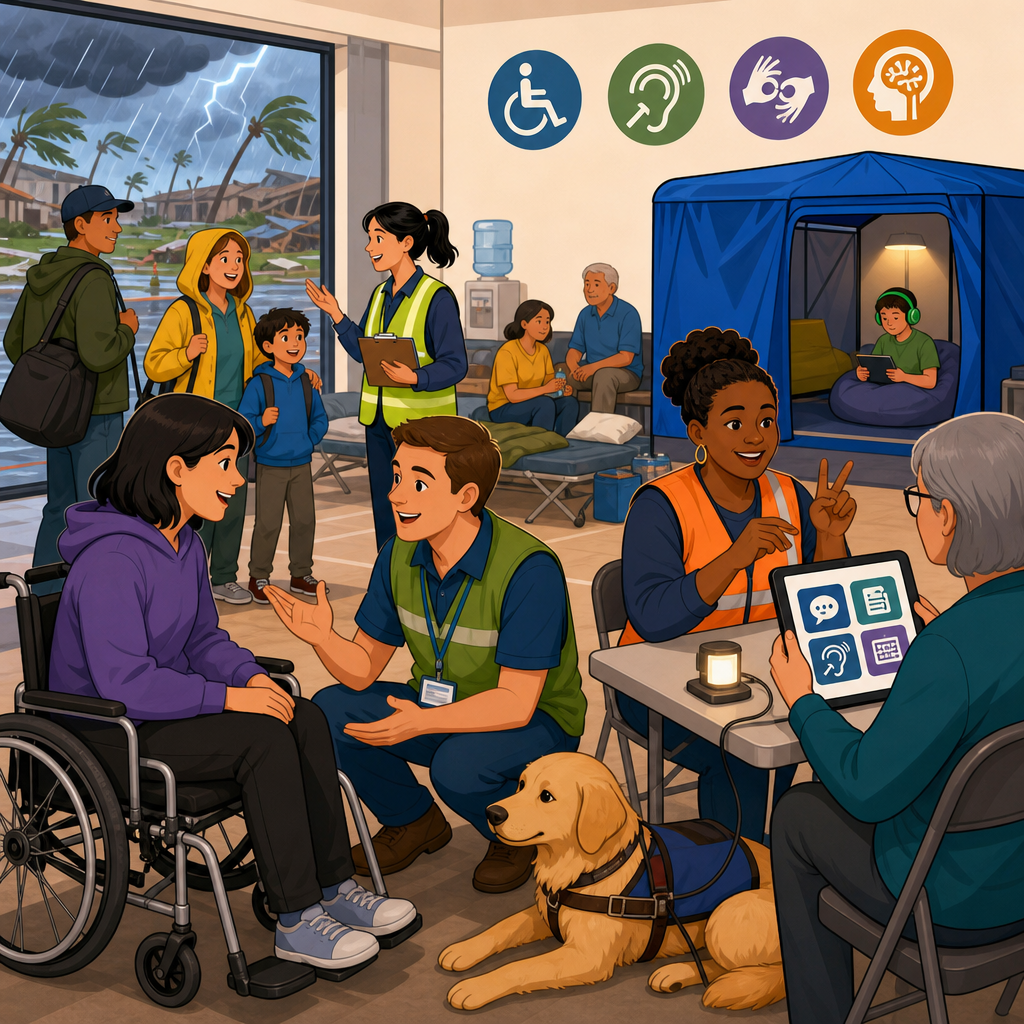
Emergency shelters must provide people with disabilities an equal opportunity to benefit from sheltering services in the most integrated setting appropriate. In practice, that starts with site selection. A shelter is not truly available if the parking area lacks accessible spaces, the route from parking to the entrance has steps or steep slopes, the entry doors are too heavy, or the registration area is arranged so tightly that a wheelchair user cannot maneuver. Inside, accessible toilet rooms, bathing facilities where provided, sleeping areas, dining areas, charging access for durable medical equipment, and clear paths of travel matter just as much as the initial entrance.
Policies also matter. Staff cannot require a person with a disability to bring their own aide as a condition of entry. They cannot separate a person from a service animal. They cannot impose blanket no-medication, no-device, or no-food rules without considering disability-related needs. Reasonable modifications are often simple: permitting refrigeration for insulin, allowing extra space near a cot for a transfer board or oxygen equipment, providing a lower registration surface, or assigning a quieter room for someone with sensory-related disabilities. The U.S. Department of Justice has repeatedly emphasized that equal access covers both physical access and program access.
Medical shelters are often misunderstood. General population shelters must accommodate many disability-related needs and cannot divert people unnecessarily just because they use a wheelchair, need help reading forms, or require electricity for a communication device. A separate medical shelter is appropriate only when a person’s needs exceed what a general shelter can reasonably support. Over-classifying disabled evacuees as “medical” creates segregation, limits family unity, and strains healthcare resources. Good planning defines clear admission criteria, trains intake staff, and equips general shelters to support common access needs from the outset.
Accessible disaster communication before, during, and after an event
Disaster communication under the ADA must be effective communication, not communication in a format that works only for the majority. Emergency alerts, evacuation orders, shelter location updates, boil water notices, curfews, and recovery information should be available through multiple channels and in multiple formats at the same time. Audio-only announcements exclude Deaf and hard of hearing residents. Image-based social media posts without alt text exclude blind users. Dense PDF handouts can fail people with cognitive disabilities and screen reader users. Video briefings without captions or interpreters are still common, and they still create preventable gaps.
Effective communication is built on redundancy. A city should pair Wireless Emergency Alerts and text messages with accessible website updates, captioned livestreams, relay-ready phone lines, TTY compatibility where still needed, email updates, social media posts with alt text, and in-person signage using plain language and strong visual contrast. American Sign Language interpreters should be visible on camera during live briefings, not added as an afterthought. Captions should be accurate, synchronized, and available for both live and recorded content. For blind and low-vision users, screen-reader-friendly web pages outperform scanned flyers every time because they can be navigated quickly during stress.
Timing is part of accessibility. If the spoken press conference happens at 2:00 p.m. but the captioned recording is posted at 6:00 p.m., disabled residents did not receive equal access to timely information. The same principle applies inside shelters. Public address announcements should also appear visually on digital displays or whiteboards, and critical instructions should be repeated one-to-one when necessary. During wildfire smoke events and hurricanes, I have seen agencies prevent confusion simply by publishing standardized shelter cards listing address, entrance details, pet and service animal policy, accessible transportation options, charging availability, and contact methods for accommodation requests.
Designing inclusive shelter operations across public spaces and government agencies
Accessible sheltering is operational, not theoretical. It involves emergency management departments, public works, parks and recreation, school facilities, public health, transit, procurement, IT, and communications teams. Many shelters are located in schools, community centers, libraries, or civic buildings, so facility inventories should identify which sites have accessible entries, toilet rooms, backup power, hearing assistance systems, accessible routes to sleeping areas, and enough circulation space for mobility devices. If that inventory does not exist before disaster season, decision-makers will improvise under pressure and often select a familiar site rather than an accessible one.
Training should cover disability etiquette, intake procedures, confidentiality, service animal rules, effective communication methods, transfer and mobility safety basics, and escalation paths for accommodations that cannot be solved by front-line staff. One common mistake is relying on a single disability specialist. That creates a bottleneck and leaves night shifts unprepared. Instead, agencies should build role-based protocols: communications staff know how to publish accessible alerts, facilities staff know how to reconfigure sleeping areas, transportation staff know how to dispatch accessible vehicles, and shelter managers know when to bring in interpreters, durable medical equipment vendors, or personal assistance support resources.
| Operational area | Common failure | ADA-aligned practice |
|---|---|---|
| Shelter intake | Forms only in small print and verbal-only instructions | Large print, digital accessible forms, plain language, staff assistance on request |
| Sleeping layout | Cots packed with no turning radius for wheelchairs | Maintain accessible routes and extra space for mobility and medical equipment |
| Public updates | Audio announcements only | Simultaneous visual display, captions, and direct communication as needed |
| Transportation | Evacuation buses without lifts or securement | Integrated accessible fleet planning and paratransit coordination |
| Pets and animals | Staff deny service animals under pet rules | Separate pet policy from service animal access and train staff accordingly |
Procurement is another overlooked lever. Accessible cots, portable ramps, signage kits, assistive listening devices, backup batteries, tactile wayfinding elements, and video remote interpreting contracts should be part of pre-event purchasing, not emergency scrambling. Government buyers should also evaluate software used for registration, volunteer coordination, and public information updates against WCAG-based accessibility criteria. If the shelter registration platform cannot be used with a keyboard or screen reader, the ADA problem begins before a resident even reaches the building.
Transportation, wayfinding, and communication inside public shelters
Getting to a shelter is often harder than staying in one. Evacuation planning must include accessible transportation, pickup communication, and destination confirmation. Public agencies should coordinate fixed-route transit, paratransit, school buses with lifts where available, and contracted accessible vans. Riders need to know how to request a ride, what mobility devices are permitted, whether companions can travel together, and where they will be dropped off. During fast-moving events, inaccessible transportation messaging strands people at home even when shelter space exists. Equal access requires that the transportation chain and the shelter chain work together.
Wayfinding inside and around shelters deserves far more attention. A resident arriving under stress may be navigating with low vision, hearing loss, autism, dementia, limited English proficiency, or a temporary injury. Clear exterior signage, high-contrast directional arrows, tactile room identification where feasible, quiet check-in processes, and logically grouped services reduce confusion for everyone. In large public buildings such as convention centers or schools, agencies should establish one accessible entrance and one accessible registration path as the primary route, not a hidden side door reached through loading areas. Dignity is part of access.
Communication inside the facility should assume changing conditions. Power may fail. Internet may degrade. Staff may rotate every twelve hours. The most resilient shelters use layered systems: battery-backed microphones, portable captioning displays where practical, printed large-print maps, multilingual and pictogram signage, and briefing boards updated at scheduled intervals. Simple practices matter, such as writing down key information while speaking, facing the person when communicating, reducing background noise for important interactions, and identifying staff who can obtain auxiliary aids quickly. These are low-cost habits that prevent missed medication times, transportation errors, and family separation.
Compliance risk, documentation, and continuous improvement
ADA compliance in emergency shelters is not judged only by written policy. It is judged by what residents can actually access during a real incident. That is why documentation and after-action review are essential. Agencies should track accommodation requests, communication failures, transportation delays, interpreter response times, generator-dependent equipment needs, and complaints related to inaccessible routes or exclusionary policies. These records help defend good-faith efforts, but more importantly they reveal patterns. If three shelters repeatedly generate the same barrier reports, that is evidence for facility upgrades, contract changes, or revised activation procedures before the next disaster.
Testing matters as much as planning. Conduct shelter drills with disabled participants, disability advocacy groups, and frontline staff from multiple departments. Include realistic injects: a Deaf family arrives during a shift change, a resident needs refrigeration for medication, a screen reader user tries to complete digital intake, an accessible bus arrives at the wrong entrance, or an interpreter connection fails during a briefing. I have seen tabletop exercises expose hidden dependencies in under an hour, especially where one inaccessible vendor system quietly undermined otherwise strong field operations. Exercises should end with assigned corrective actions, deadlines, and ownership.
Public entities should also align shelter planning with digital governance and capital planning. Website accessibility, emergency alert templates, public meeting communication access, and facility transition plans are not separate projects. They are parts of one public access system. The strongest local governments treat disability access as a standing readiness function, supported by procurement standards, memoranda of understanding, pre-scripted accessible communications, and partnerships with independent living centers and community organizations. That approach reduces legal exposure, improves operational performance, and most importantly protects residents who are too often left to solve structural barriers alone during the worst hours of a crisis.
Emergency shelters and disaster communication under the ADA are ultimately about whether public spaces and government systems work for all residents when conditions are hardest. The legal standard is clear: equal access, effective communication, reasonable modification, and integrated service are not optional in emergencies. The operational lesson is just as clear. Accessibility cannot be improvised after an evacuation order, after the livestream begins, or after residents line up outside a school gym that was never evaluated for shelter use. It must be built into site selection, transportation planning, communications workflows, staffing models, purchasing, and drills.
For agencies building out a Public Spaces & Government accessibility program, this topic should anchor the broader sub-pillar. Shelter access connects directly to accessible public buildings, municipal websites, emergency alert systems, public transit, signage, video communication, and service delivery by contractors. Improvements in one area strengthen the others. A captioned, screen-reader-friendly alert drives people to a shelter with an accessible entrance. An accessible registration platform speeds intake. A trained shelter team prevents unnecessary transfers to medical sites. A documented after-action review turns one event into a better system before the next season begins.
The benefit is practical and immediate: better ADA compliance produces better emergency management. Communities communicate faster, shelters run more smoothly, complaints decline, and residents with disabilities can act on information instead of fighting barriers. Review your shelter list, test your alert formats, audit your intake tools, and run one inclusive exercise with disability stakeholders this quarter. That single step will show you where the real risks are and where the most important fixes should start today.
Frequently Asked Questions
What does the ADA require for emergency shelters and disaster communication?
The ADA requires state and local governments, along with many private organizations that operate public-facing services, to ensure that people with disabilities have equal access to emergency programs, services, and activities. In practical terms, that means emergency shelters cannot simply be open in name only; they must be usable by people with mobility, sensory, cognitive, psychiatric, and other disabilities. Accessible parking, step-free entrances, accessible sleeping and toileting areas, clear routes through the facility, and policies that do not screen out people with disabilities are all part of ADA compliance in disaster response.
Disaster communication must also be accessible from the start. Alerts, evacuation instructions, shelter updates, and recovery information should be provided in formats that people with different disabilities can use effectively. That may include captioning for televised briefings, sign language interpreters when appropriate, screen-reader-accessible websites and apps, plain-language materials, audible announcements, and visual messaging for people who are deaf or hard of hearing. The ADA is not limited to physical access; it also applies to communication access and to the policies and practices that determine whether people can actually benefit from emergency services.
Importantly, the ADA is a civil rights law, not a voluntary guideline. Covered entities are expected to plan ahead rather than improvise after a crisis begins. Emergency managers should integrate accessibility into evacuation planning, shelter selection, transportation, communication systems, staff training, and recovery operations. When accessibility is treated as an afterthought, people with disabilities are often placed at greater risk. The ADA’s purpose in this context is to make sure that does not happen.
Are emergency shelters required to accept people with disabilities who use service animals, medical equipment, or personal attendants?
Yes. Under the ADA, emergency shelters generally must modify policies and practices to allow people with disabilities to participate equally, unless doing so would fundamentally alter the service or create a direct threat that cannot be mitigated. A shelter cannot turn someone away simply because they use a service animal, rely on a wheelchair, need oxygen, use a ventilator, or require assistance from a personal care attendant. These are not optional conveniences; for many individuals, they are essential supports that make survival and basic functioning possible during an emergency.
Service animals must generally be permitted in areas where shelter residents are allowed to go. Shelters cannot impose blanket “no pets” rules against service animals, although they may distinguish between trained service animals and pets under the ADA framework. Likewise, people who use durable medical equipment should be able to bring and use that equipment in the shelter. This may require access to electrical outlets, refrigeration for medication, space for equipment storage, or planning for backup power. Shelters should also anticipate the needs of people who use communication devices, mobility aids, and assistive technology rather than treating these items as exceptions.
Personal attendants and caregivers are another critical issue. Some individuals need assistance with eating, toileting, dressing, medication management, communication, or transferring safely. A shelter that excludes an attendant may effectively exclude the person with a disability. Staff should understand that equal access sometimes requires flexibility, problem-solving, and coordination with health and social service partners. The ADA does not require shelters to become hospitals, but it does require them to avoid discriminatory barriers and to make reasonable accommodations so people with disabilities can safely use emergency shelter services.
How should disaster warnings, evacuation notices, and emergency updates be communicated accessibly?
Accessible disaster communication requires redundancy, clarity, and multiple formats delivered at the same time. Relying on a single channel, such as a siren, a spoken press conference, or a social media post with an image, leaves many people behind. Emergency information should be distributed through methods that reach people who are blind or have low vision, deaf or hard of hearing, have limited English proficiency, have intellectual or developmental disabilities, or may process information differently under stress. That means combining visual, auditory, digital, and plain-language tools in a coordinated way.
For example, televised emergency briefings should include accurate real-time captioning and, where appropriate, qualified sign language interpreters who are clearly visible on screen. Websites and mobile alerts should be compatible with screen readers and should avoid inaccessible PDFs or unlabeled graphics when urgent instructions are being shared. Audio messages should be paired with text-based alerts. Visual notices should be written plainly and directly, using simple wording and clear action steps such as where to evacuate, what routes are open, what transportation is available, and how to request assistance. In fast-moving disasters like wildfires or flash floods, delays in accessible communication can be life-threatening.
Accessibility also means planning for communication inside shelters and throughout the recovery process. People need accessible ways to receive updates about meals, medication assistance, weather conditions, curfews, reunification, benefits, debris removal, and temporary housing. Staff should know how to use auxiliary aids and services, how to secure interpreters or communication supports, and how to interact respectfully with people who communicate in different ways. The goal is not merely to publish information, but to ensure that people with disabilities can understand it, act on it, and stay safe because of it.
Does the ADA require accessible evacuation transportation and equal access to emergency services during disasters?
Yes. The ADA’s protections extend beyond the shelter door. If a state or local government offers evacuation transportation, pickup services, call centers, cooling centers, charging stations, emergency medical triage, or recovery assistance, those services must be provided in a way that does not discriminate against people with disabilities. Equal access means a person who uses a wheelchair, has a sensory disability, or needs assistance with communication cannot be left behind simply because the emergency plan did not account for their needs.
Accessible evacuation transportation may include wheelchair-accessible buses or vans, vehicles that can transport mobility devices, drivers trained to assist disabled passengers safely, and systems for helping people who cannot use standard evacuation routes independently. It can also involve coordinated registries or voluntary assistance programs, though governments should not rely solely on self-identification systems because many people may not be registered when a disaster strikes. Effective planning includes outreach, partnerships with disability organizations, and realistic procedures for evacuating people from homes, hospitals, nursing settings, high-rise buildings, and rural areas.
Equal access also applies to how emergency services are delivered once people are displaced. People with disabilities should be able to register for aid, request transportation, obtain medical supplies, charge assistive devices, and access temporary housing without facing communication barriers or inaccessible facilities. Staff should avoid making assumptions about who can travel, who needs help, or what support is reasonable. When emergency systems are designed inclusively, they work better for everyone, including older adults, injured evacuees, and families with temporary access needs created by the disaster itself.
What should emergency managers, shelter operators, and local governments do now to improve ADA compliance before the next disaster?
The most important step is to treat accessibility as a core part of emergency planning, not as a special issue to address later. That begins with reviewing emergency operations plans, shelter agreements, evacuation protocols, public messaging systems, and recovery procedures through an ADA lens. Officials should identify which shelters are physically accessible, where backup power is available, how accessible transportation will be deployed, what communication tools are already in place, and where gaps remain. A written plan is essential, but it must also be practical, funded, and tested under realistic conditions.
Training is equally important. Shelter staff, first responders, public information officers, call center workers, and volunteers need to understand disability rights and know how to implement accessible practices under pressure. That includes interacting respectfully with people with disabilities, allowing service animals, using plain language, obtaining auxiliary aids and services, maintaining clear routes, and handling requests for reasonable modifications. Drills and exercises should include disability scenarios and should involve people with disabilities directly, not just as hypothetical categories in a checklist.
Finally, local governments and operators should build lasting partnerships with disability-led organizations, independent living centers, advocacy groups, and community service providers. These partners often see barriers long before agencies do and can help shape stronger, more inclusive systems. Regular facility audits, accessible procurement standards, multilingual and accessible communications planning, and post-disaster after-action reviews all support better compliance. The ADA is most effective when accessibility is embedded into preparedness, response, and recovery from the outset. That approach not only reduces legal risk, but more importantly helps protect lives, preserve independence, and ensure that disaster response respects the dignity of every community member.