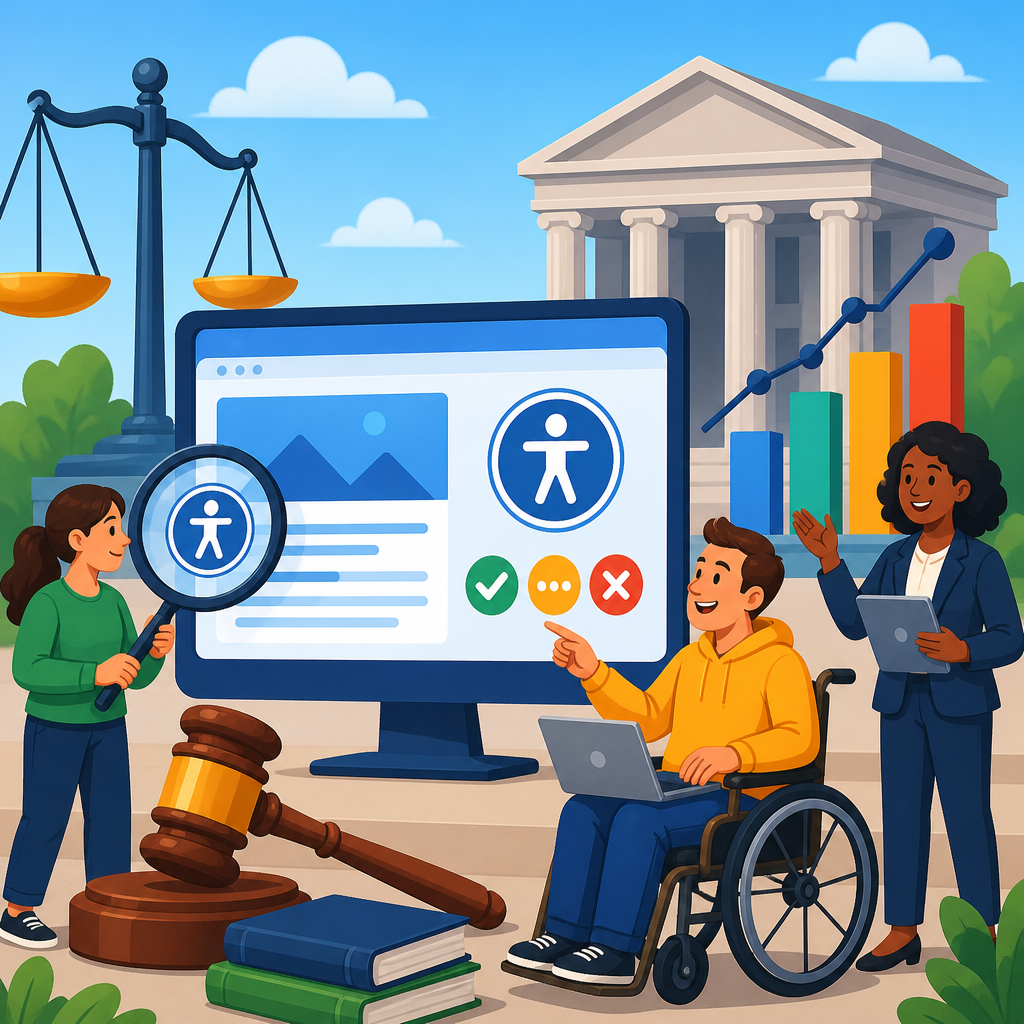
Digital accessibility lawsuits are no longer a niche compliance issue; they are a mainstream business risk, a civil rights concern, and a signal of how courts, regulators, and consumers now interpret equal access online. In 2025, the numbers suggest a legal environment that remains active, targeted, and increasingly shaped by repeat claims, structured settlements, and a closer alignment between technical accessibility standards and litigation strategy. For organizations tracking recent ADA updates and developments, this is the hub topic because digital cases connect nearly every current issue: website remediation, mobile app accessibility, policy governance, procurement standards, and the evolving relationship between the Americans with Disabilities Act, state laws, and technical benchmarks such as WCAG.
When I review accessibility disputes with clients, I start by defining terms clearly. A digital accessibility lawsuit typically alleges that a website, mobile app, kiosk, PDF, or other digital interface is unusable by people with disabilities, often those who rely on screen readers, keyboard navigation, captions, transcripts, voice input, or sufficient color contrast. ADA website lawsuit is the phrase many executives search, but the legal theories often extend beyond websites alone. Plaintiffs may bring claims under Title III of the ADA for places of public accommodation, under state statutes such as New York’s Human Rights Law or California’s Unruh Civil Rights Act, and in some cases under Section 504 or Section 508 where public entities or federally connected programs are involved. The terminology matters because legal exposure depends on both jurisdiction and business model.
Why does this matter in 2025? Because accessibility litigation has moved from reactive complaint handling to enterprise risk management. Boards want trend lines. General counsel want venue analysis. Product teams want to know which defects are most commonly cited. Marketing teams want to understand whether accessibility overlays reduce risk; in my experience, they do not solve underlying code failures and rarely satisfy serious scrutiny. The 2025 numbers do not just indicate volume. They suggest where claims concentrate, which sectors draw the most attention, and why organizations that treat accessibility as a quality standard, not a one-time project, are in a stronger position. This article serves as a hub for recent ADA updates and developments by tying together the legal patterns, technical issues, and practical responses that define the current landscape.
What the 2025 lawsuit numbers actually suggest
The most important point about 2025 lawsuit numbers is that they should be interpreted as directional evidence, not a single universal total. Different trackers count cases differently. Some count federal filings only. Others include state court claims, demand letters, and settlements that never appear on a public docket. Even with that limitation, the trend is consistent: digital accessibility claims remain elevated, and the work is increasingly concentrated in industries with consumer-facing transactions. Retail, hospitality, food service, financial services, healthcare scheduling, and education continue to draw disproportionate attention because inaccessible checkout flows, booking engines, patient portals, and account dashboards create immediate barriers to use.
Another pattern in 2025 is concentration by jurisdiction. New York and California remain central because their state laws create stronger incentives to file, and many businesses serving those markets can be sued there even if headquartered elsewhere. Florida also continues to appear prominently in ADA-related filings. The raw count matters less than the practical takeaway: if a company sells nationwide, it should assume litigation risk is national even if its offices are local. I have seen organizations misread their exposure because they looked only at their home state docket. Plaintiffs’ firms do not.
The numbers also suggest maturity in plaintiff strategy. Claims are more standardized, screen-capture evidence is better organized, and complaints often cite familiar barriers such as missing form labels, empty buttons, inaccessible modal windows, broken keyboard traps, image-only links, unlabeled cart controls, and CAPTCHA barriers without accessible alternatives. In 2025, that consistency tells businesses something useful: the same defects keep driving cases because many organizations still launch redesigns without testing core user journeys with assistive technology.
Where recent ADA updates and developments are changing expectations
The broader updates and developments matter because litigation does not happen in a vacuum. Regulators and courts increasingly look to recognized technical standards when evaluating whether digital experiences provide meaningful access. The most influential benchmark remains the Web Content Accessibility Guidelines, especially WCAG 2.1 Level AA and, increasingly, WCAG 2.2 Level AA as organizations update procurement requirements and design systems. Although the ADA itself does not embed WCAG line by line, these standards function in practice as the common language for remediation plans, expert reports, and settlement commitments.
Another major development is the growing expectation that accessibility applies across the full digital estate. A company may focus on homepage fixes while leaving mobile apps, support chat, embedded third-party widgets, downloadable PDFs, and post-purchase account areas inaccessible. That fragmented approach is exactly what creates repeat complaints. Recent ADA updates and developments point toward a lifecycle model: accessible design, accessible code, regression testing, content governance, and documented issue management. The legal issue is not merely whether a website exists; it is whether the business can show a credible, sustained process for maintaining access.
Public sector changes also influence private sector expectations. As government entities update digital accessibility rules and procurement practices, vendors serving those entities face pressure to document conformance through VPATs based on the Accessibility Conformance Report format. I advise clients to treat these documents carefully. A vague or inflated VPAT can become a credibility problem if product limitations are later exposed. In 2025, accurate disclosure and remediation roadmaps matter as much as aspirational policy statements.
Why certain industries attract more digital accessibility lawsuits
Litigation follows friction. Any industry that asks users to search, compare, fill forms, upload documents, make payments, or manage accounts will attract more claims when accessibility is weak. Retail remains a leading target because a single purchase path can include search filters, product galleries, size selectors, promo code fields, shipping calculators, payment widgets, and confirmation modals. If even one critical control lacks an accessible name or keyboard access, the entire transaction may fail. Hospitality has similar exposure with reservation calendars, room selectors, maps, and loyalty dashboards. Healthcare is especially sensitive because inaccessible intake forms or appointment scheduling can impede timely care.
Higher education and training platforms also face continuing pressure. Course portals often combine videos, PDFs, quizzes, and discussion tools from multiple vendors. I have audited learning systems where the institution had an accessible public website but inaccessible embedded assessment tools that blocked keyboard users and confused screen reader navigation. That kind of gap is common in 2025 because many organizations improved top-level pages after earlier warnings but did not harden the systems behind login walls.
| Industry | Common barriers cited | Why risk stays high |
|---|---|---|
| Retail | Unlabeled buttons, inaccessible checkout, image-only product links | Revenue-critical user journeys fail quickly |
| Hospitality | Date pickers, booking engines, room selection tools | Third-party reservation systems are often weak |
| Healthcare | Patient portals, intake forms, telehealth interfaces | Access barriers can affect essential services |
| Financial services | Authentication flows, statements, calculators, PDF disclosures | Complex security and document requirements create defects |
| Education | Videos without captions, inaccessible LMS tools, scanned PDFs | Multiple content owners and vendors increase inconsistency |
The recurring lesson is straightforward: the more complicated the customer journey, the more likely plaintiffs can identify a barrier that is specific, reproducible, and central to the service being offered.
How courts and settlements are shaping business response
Most organizations ask whether lawsuit counts are rising or falling. A better question is what outcomes are becoming standard. In 2025, many cases still resolve through settlement rather than published court opinions, which means market practice is heavily shaped by negotiated commitments. Typical settlement terms include adopting an accessibility policy, appointing an internal coordinator, training employees, engaging an external consultant, testing against WCAG, fixing barriers within defined timelines, and sometimes paying attorney fees and monitoring costs. The exact terms vary, but the pattern is mature and predictable.
That predictability changes how businesses should respond. If the likely remedy after a lawsuit is the same work the organization could start now, delay has little strategic value. I have seen companies spend months arguing over whether a claim is technically defensible, only to end up funding a full remediation program under tighter deadlines and with less control. Early action is usually cheaper and operationally cleaner. It also produces better evidence if a dispute does arise, because documented audits, ticketing history, and governance records show that accessibility was being managed before the complaint arrived.
Courts also continue to signal that broad promises without implementation carry little weight. An accessibility statement alone is not a defense. Neither is a plug-in that changes font size while leaving code semantics broken. Businesses need accessible components, tested workflows, and a mechanism for users to report problems and receive support. The law increasingly rewards substance over optics.
What organizations should do now to reduce legal and operational risk
The most effective response to digital accessibility lawsuits is an operating model, not a one-time patch. Start with a scoped audit covering your public website, authenticated areas, mobile apps, PDFs, and core third-party integrations. Use both automated tools and manual testing. Automated scanners such as axe, WAVE, and Lighthouse can identify recurring issues like missing alt text, contrast failures, duplicate IDs, and form labeling problems, but they cannot tell you whether a checkout flow makes sense with a screen reader or whether focus order breaks during a modal interaction. Manual testing with NVDA, JAWS, VoiceOver, keyboard-only navigation, zoom, and mobile assistive features is essential.
Next, prioritize by user impact and legal significance. Fix the revenue and service pathways first: login, search, scheduling, account access, cart, checkout, and support. Then address templates and shared components so defects do not replicate across hundreds of pages. Build accessibility acceptance criteria into design and development workflows. Require semantic headings, proper labels, focus indicators, captioning, transcript support, error identification, and accessible authentication patterns from the start. If you rely on vendors, put accessibility commitments in contracts, request current VPATs, and test implementations yourself rather than accepting marketing claims.
Finally, create governance that survives staff turnover. Assign ownership. Train content authors, designers, engineers, QA analysts, and procurement teams. Track issues in the same systems used for security and reliability work. Publish an accessibility statement with a real contact path and an internal escalation procedure. In practice, the companies that reduce risk most effectively are the ones that make accessibility part of release management, not a side project handled only after receiving a demand letter.
The 2025 numbers suggest continuity more than surprise: digital accessibility lawsuits remain a persistent feature of the legal landscape, and recent ADA updates and developments are pushing organizations toward more formal, technical, and continuous compliance practices. The businesses at highest risk are not simply large brands; they are organizations with high-friction digital journeys, weak governance, inaccessible third-party tools, and no reliable testing discipline. Jurisdiction still matters, especially in plaintiff-friendly states, but the broader lesson is national. If you serve the public online, accessibility is part of how you deliver the service itself.
Three conclusions stand out. First, lawsuit volume alone is not the only metric that matters; concentration by industry, defect type, and venue provides the more useful signal. Second, recognized standards such as WCAG now shape expectations even where statutes do not expressly codify every technical requirement. Third, remediation is most effective when it is operationalized through audits, design systems, procurement controls, training, and documented maintenance. That is why this topic serves as a hub for recent ADA updates and developments: every major change in digital accessibility law ultimately affects how organizations build, buy, test, and govern digital experiences.
For leaders deciding what to do next, the answer is simple. Treat accessibility as a standing business function, not an emergency response. Review your highest-risk user journeys, validate vendor claims, align your teams on WCAG-based requirements, and establish a measurable remediation plan. If you act before a complaint arrives, you gain control over timing, cost, and user experience while reducing the chance that accessibility barriers turn into litigation. Start with your most critical digital touchpoints, and build from there.
Frequently Asked Questions
What do the 2025 digital accessibility lawsuit numbers actually suggest?
The 2025 numbers suggest that digital accessibility litigation remains active, strategic, and highly relevant to mainstream business operations. Rather than pointing to a short-term spike or a passing compliance trend, the data indicates that accessibility claims continue to be used as a practical enforcement mechanism where people with disabilities encounter barriers online. In other words, these cases are not just about technical website defects; they reflect how courts, plaintiffs, and consumers increasingly treat digital access as a normal part of equal participation in commerce, services, education, healthcare, and public life.
Just as important, the numbers suggest that the legal environment is maturing. A significant share of claims appears to be concentrated among repeat filers, known industries, and recurring accessibility issues, which means litigation is becoming more structured and predictable in some respects. Businesses are not facing random risk so much as identifiable patterns: inaccessible checkout flows, unlabeled forms, poor keyboard navigation, missing alternative text, and mobile or app barriers that prevent independent use. That pattern matters because it shows that many lawsuits are driven by practical access failures, not abstract regulatory theory.
The 2025 picture also suggests a closer relationship between technical standards and legal strategy. Plaintiffs and defense counsel alike are increasingly framing claims, settlements, and remediation obligations around recognized accessibility benchmarks, especially WCAG-based expectations. Even where the law does not name one exclusive technical standard in every context, the market behavior around litigation shows that technical conformance has become central to risk assessment. For organizations, the takeaway is clear: accessibility lawsuits are still being filed, still being settled, and still signaling that digital accessibility is now a core governance, product, and legal issue.
Why are digital accessibility lawsuits still increasing or staying persistent if organizations have been hearing about ADA web compliance for years?
One reason is that awareness has grown faster than implementation. Many organizations now understand that digital accessibility matters, but understanding the issue and operationalizing it across websites, mobile apps, documents, ecommerce systems, third-party tools, and ongoing content updates are very different things. Accessibility is not a one-time legal checkbox. It requires design standards, development practices, procurement controls, QA testing, content governance, and executive accountability. Companies that addressed only the homepage, ran a one-time scan, or added a widget often discover that major barriers remain in transactional and high-traffic user journeys.
Another reason is that digital access expectations have become more embedded in daily life. More consumers rely on online platforms for shopping, scheduling, banking, healthcare, education, and customer support than ever before. As digital channels become essential rather than optional, barriers become more consequential. A broken keyboard path, inaccessible PDF, or unlabeled button is no longer a minor inconvenience; it can block someone from making a purchase, applying for a job, filling a prescription, or accessing important information. That practical harm helps explain why claims remain persistent.
The enforcement dynamic also matters. In the absence of one simple, universally applied federal website regulation for every private business scenario, litigation has remained one of the main ways accessibility obligations are tested and pushed forward. Plaintiffs’ firms know which sectors attract claims, and many organizations still have unresolved accessibility gaps. That combination keeps the case volume steady. The broader lesson from 2025 is that repeated publicity around ADA compliance has not eliminated risk because many businesses still treat accessibility reactively instead of building it into their digital operations from the start.
Which organizations are most at risk based on recent digital accessibility litigation trends?
Organizations with public-facing digital properties and high-volume customer interactions remain among the most exposed. Ecommerce brands, retailers, restaurants, hospitality companies, healthcare providers, financial institutions, universities, and service businesses are frequent targets because their websites and apps often function as primary gateways to goods and services. If a consumer cannot browse products, schedule an appointment, complete payment, access account information, or submit required forms independently, that creates the kind of barrier that often leads to complaints or legal claims.
Risk also tends to be higher for organizations with complex user flows or rapidly changing content. Businesses that depend on online booking, customized account dashboards, digital documents, embedded third-party tools, promotional landing pages, or mobile app transactions often have more opportunities for accessibility breakdowns. Even companies that made past remediation efforts can remain vulnerable if they lack ongoing monitoring. Accessibility problems frequently reappear through redesigns, CMS updates, plugin changes, marketing campaigns, video content, or vendor integrations that were never properly tested for assistive technology users.
That said, the most important risk factor is often not company size but accessibility maturity. A mid-sized organization with strong governance, documented standards, trained teams, and regular audits may be less exposed than a much larger company that treats accessibility as a side issue. The 2025 trends suggest that litigation is not limited to a narrow category of defendants. Any organization with a digital customer experience can be scrutinized. Companies should therefore evaluate risk based on visibility, transaction volume, legal history, dependence on digital channels, and the presence or absence of a real accessibility program.
How are settlements and remediation strategies changing in response to 2025 accessibility lawsuit trends?
Settlements are increasingly structured around measurable remediation rather than vague promises to improve access. In practical terms, that often means organizations are expected to commit to defined accessibility workstreams, such as auditing websites and apps against recognized standards, fixing priority barriers within a set timeline, training internal teams, appointing responsible personnel, improving complaint handling, and validating remediation through follow-up testing. This reflects a more mature litigation environment in which accessibility is treated as an operational discipline, not merely a legal dispute to be closed out quietly.
There is also a stronger emphasis on sustainability. One reason is that plaintiffs and their counsel know accessibility can degrade over time if organizations do not change how they design, code, publish, and procure digital experiences. As a result, structured settlements often go beyond defect correction and address internal controls. Companies may need to implement policies, include accessibility in vendor contracts, create escalation procedures, and incorporate both automated and manual testing into development cycles. That broader approach is intended to reduce repeat failures and show that remediation is genuine rather than cosmetic.
For businesses, this shift carries an important practical message. Defending or settling a lawsuit without improving internal systems may reduce immediate exposure but leave the underlying risk intact. The 2025 numbers suggest that repeat claims, recurring defects, and plaintiff familiarity with standard remediation terms are shaping expectations. Organizations that respond effectively are the ones that treat legal resolution as the beginning of a more durable accessibility program. The most credible strategy is to connect legal, technical, product, content, and compliance teams so that remediation becomes part of long-term digital quality management.
What should companies do now if they want to reduce the risk of a digital accessibility lawsuit?
Companies should start by treating accessibility as an enterprise risk issue with legal, technical, and customer experience dimensions. The first step is to understand the real condition of public-facing digital assets through a credible assessment that includes both automated scanning and manual testing by knowledgeable professionals. Automated tools can identify common errors, but they cannot fully evaluate keyboard usability, screen reader behavior, focus management, error handling, or the overall accessibility of complex workflows. A meaningful baseline review should cover the pages, forms, transactions, documents, and app functions that matter most to users.
From there, organizations should prioritize remediation based on business impact and legal exposure. High-risk areas typically include homepages, product pages, search, login, registration, checkout, booking flows, account features, contact forms, mobile apps, and downloadable PDFs or statements. Just as important, companies should adopt recognized accessibility standards as internal requirements, usually aligned with current WCAG expectations, and build those requirements into design systems, engineering practices, content publishing workflows, and vendor management. Accessibility becomes much easier to sustain when it is built into how digital work gets approved and released.
Finally, companies should create governance that demonstrates seriousness and continuity. That means assigning responsibility, training designers, developers, marketers, and content teams, establishing an accessibility statement and feedback mechanism, documenting remediation progress, and scheduling recurring audits. Legal counsel can help align these efforts with litigation risk and regulatory developments, but the strongest defense is not a legal argument alone. It is evidence that the organization is actively identifying barriers, fixing them, and preventing new ones. The 2025 lawsuit environment suggests that businesses are best protected when accessibility is handled proactively, systematically, and as part of ordinary digital operations.


