Check-out aisles and service counters are two of the most visible built-in elements covered by ADA accessibility standards, yet they are often confused during design, renovation, and compliance reviews. In practice, they serve different functions, trigger different technical requirements, and create different barriers for customers when dimensions are wrong. Under Chapter 9 of the 2010 ADA Standards for Accessible Design, check-out aisles fall under Section 904.3, while sales and service counters are addressed in Sections 904.4 and 904.4.1, with related provisions for food service lines, queue lines, and fixed or built-in service points across commercial facilities.
This distinction matters because a grocery store, bank branch, pharmacy, ticket office, cafeteria, and municipal payment desk can all appear compliant at a glance while still failing in ways that block independent use. I have walked projects where owners installed a lowered counter but left only inaccessible check-out lanes, and others where the aisle met width requirements but the payment device, writing surface, or parallel approach at the service counter did not. Those mistakes are common because teams treat Chapter 9 as a single checklist instead of a coordinated set of use-specific rules.
Chapter 9 covers built-in elements that people use directly: dining surfaces, work surfaces, dressing rooms, check-out aisles, sales counters, service counters, food service lines, and fixed benches. The core idea is straightforward. If an element is built in and intended for customer or public use, it must be designed so a person with a disability can approach it, reach it, and complete the transaction or activity with substantially equivalent independence. For check-out aisles, the focus is route width and lane usability. For service counters, the focus is counter height, length, and accessible approach. Understanding those differences is the key to compliant planning and effective customer service.
What Chapter 9 Covers and How Check-Out Aisles Differ from Service Counters
Chapter 9 is the ADA chapter most architects, facility managers, and store planners encounter when designing customer-facing built-in features. It works together with Chapter 3 on clear floor space, Chapter 4 on accessible routes, and Chapter 9’s own scoping and technical criteria. In plain terms, Chapter 9 answers practical questions: How many accessible check-out aisles are required? How low must a service counter be? What dimensions allow a wheelchair user to pull alongside, pay, sign, and leave without backtracking or asking for help?
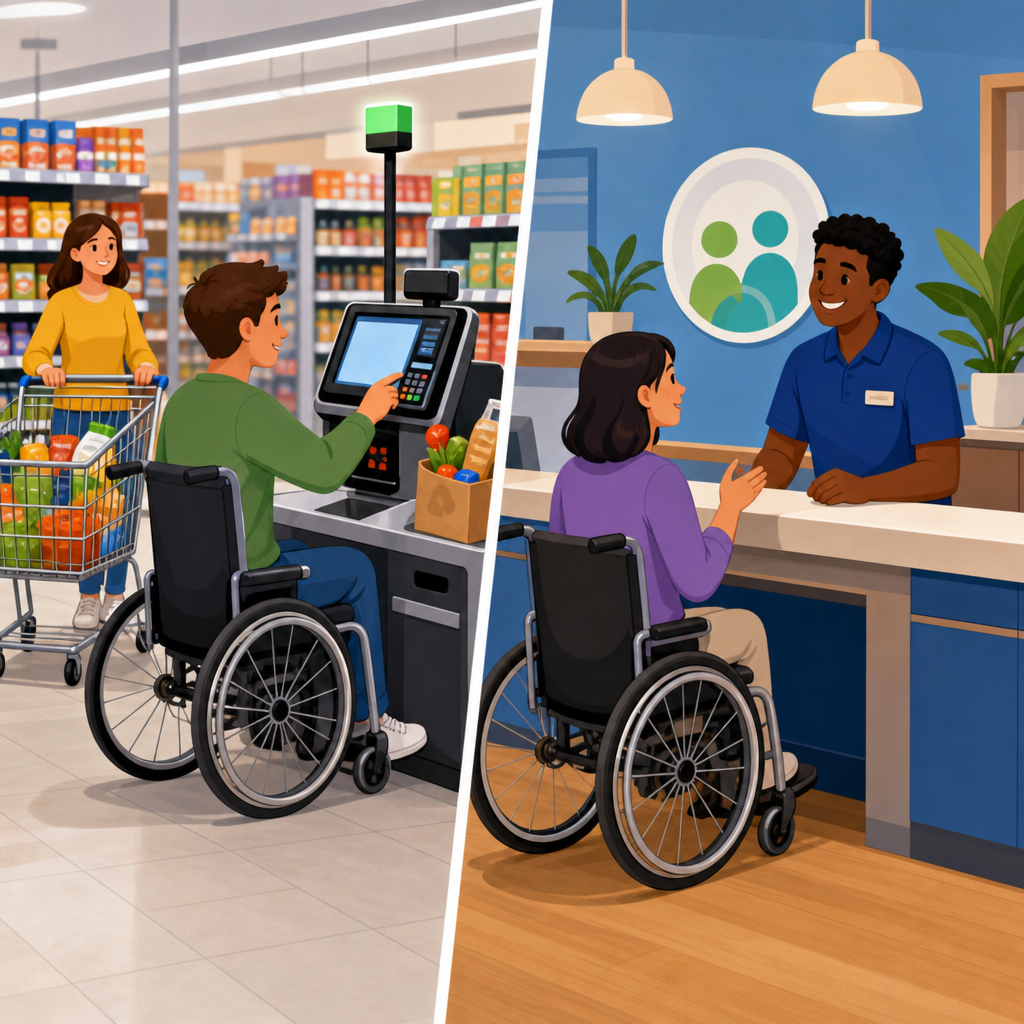
A check-out aisle is a circulation lane used to complete purchases, typically bounded by counters, merchandise fixtures, and queuing rails. Think supermarket lanes, retail point-of-sale aisles, or self-checkout bays arranged as lanes. A service counter is the transaction surface itself, such as a reception desk, pharmacy pick-up counter, admissions window, hotel check-in counter, or customer service station. A facility can have one without the other. For example, a library circulation desk is a service counter, not a check-out aisle. A grocery lane includes both an aisle and transaction counter components, but the accessible obligations are not identical.
The ADA separates them for a reason. A person using a wheelchair may be able to reach a lowered counter but still be unable to maneuver through a narrow check-out lane. Conversely, a lane may be wide enough, but if every payment surface is too high, the transaction is still inaccessible. This is why compliance reviews should evaluate each component independently and then test the customer journey from entry to payment to exit. That is also why this hub page is central within ADA Accessibility Standards: it connects the technical language of Chapter 9 to the real layout decisions designers make every day.
ADA Requirements for Check-Out Aisles
Section 904.3 requires accessible check-out aisles where check-out aisles are provided. The number depends on the total number of lanes. Facilities with one to four check-out aisles must provide at least one accessible lane. Facilities with more than five check-out aisles must provide accessible aisles in a quantity based on the standards, with at least one of the accessible aisles serving each type of check-out, including express lanes where provided. This point is often missed. If a store offers a distinct express format or self-check format, accessibility cannot be limited only to a standard full-service lane located elsewhere.
The accessible check-out aisle must provide an accessible route and comply with width requirements measured at the approach and through the lane. In most plan reviews, the governing issue is whether the lane provides at least 36 inches minimum clear width and whether the route remains clear when merchandising, bagging racks, queue stanchions, and point-of-sale equipment are installed. Field conditions matter. A lane that measures correctly on the architect’s plan can fail after movable displays, impulse racks, or cart corrals reduce clearance. I have seen accessible lanes narrowed by seasonal endcaps within weeks of opening.
Signage also matters operationally. If the accessible lane is not readily identifiable, customers may wait in a noncompliant lane unnecessarily or staff may repurpose the lane for returns, storage, or employee use. The standards do not treat accessibility as a back-of-house accommodation. The accessible lane must function as a normal customer lane during operating hours. In large-format retail, the best practice is to locate it on a primary circulation path, not at an isolated edge where customers must travel farther than everyone else.
| Element | Main ADA Focus | Typical Technical Issue | Common Field Mistake |
|---|---|---|---|
| Check-out aisle | Accessible route and clear width | 36-inch minimum clear passage through lane | Merchandise racks or rails reduce width after opening |
| Service counter | Counter height, length, and approach | 36-inch maximum high portion, 36-inch minimum length | Lowered segment too short or blocked by equipment |
| Food service line | Reach ranges and circulation | Tray slides, utensil stations, and payment points out of reach | Accessible route exists, but self-service items remain unusable |
| Fixed dining/work surface | Knee and toe clearance | Insufficient space under surface for forward approach | Decorative panels or bases eliminate required clearance |
ADA Requirements for Sales and Service Counters
Section 904.4 requires sales counters and service counters to include a portion of the counter that is no more than 36 inches above the finish floor and at least 36 inches long. That accessible portion must be positioned on an accessible route and paired with an appropriate clear floor space for a parallel approach. This requirement applies to transaction points where people buy tickets, check in, ask for assistance, receive packages, complete paperwork, or pay bills. The lowered section is not optional simply because staff can walk around the counter to assist. Programmatic help does not erase a built-environment barrier when a built-in accessible solution is required.
Where counters are altered, the details become important. Designers often create a decorative drop in the countertop that meets the 36-inch maximum height but fails the 36-inch minimum length. Others place computer monitors, receipt printers, brochure holders, sneeze guards, or payment terminals directly on the lowered section, leaving no usable transaction surface. In banks and medical offices, I have frequently seen lowered counter sections placed at the far end of a desk where turning space is compromised by furniture legs or queue barriers. A compliant dimension is only the starting point; the accessible portion must also be practically usable.
Section 904.4.1 provides an alternative for counters where providing a lowered portion is not feasible because of security, such as teller windows with glazed partitions. In those cases, a shelf or counter meeting equivalent height and length criteria can satisfy the standard, provided the approach and communication features are also accessible. For glazed service points, teams should also review related communication requirements, including speech access, assistive listening where applicable, and operable parts within reach ranges. Chapter 9 never operates in isolation from Chapters 3 and 7.
Real-World Comparisons Across Common Facilities
In grocery stores, the distinction between check-out aisles and service counters is easiest to see. A compliant store may provide one accessible full-service lane and one accessible self-checkout type if self-checkout is a distinct offering. The aisle must remain wide enough for passage, and the payment surface or bagging counter used in that lane must still be usable. A store fails when it labels one lane accessible but places bulky candy racks at the entry, routes the queue through tight switchbacks, or mounts card readers beyond reach. Accessibility is measured at the point of use, not in the marketing brochure.
In banks, the primary issue is usually the service counter rather than an aisle. A teller line may have adequate circulation in front, but if every transaction ledge is above 36 inches and the only lower writing surface is off to the side, the service point is deficient. In pharmacies, both concepts appear together. The queuing path and pick-up area must allow approach, and the prescription counter must include an accessible transaction surface. Privacy screens, signature pads, and bins for products or paperwork must be positioned so customers can complete the same process available to others.
Cafeterias, concession stands, and ticket offices show why Chapter 9 should be read as a hub topic. A cafeteria line involves built-in food service elements, tray slides, beverage stations, cashier points, and dining surfaces. A stadium concession counter may include a lowered sales segment yet still fail because condiment stations or napkin dispensers are mounted out of reach. A ticket window may provide a compliant shelf but create a barrier with a deep sill, reflective glazing that impairs communication, or no clear floor space. The lesson is simple: accessible design succeeds when the entire transaction sequence is mapped, not when one dimension is cherry-picked.
Common Compliance Errors in Design, Construction, and Operations
The most frequent design error is assuming one accessible feature can compensate for another missing one. It cannot. A lowered counter does not substitute for an accessible check-out aisle, and a wide aisle does not substitute for a compliant service counter. The second common error is treating dimensions as nominal instead of minimum clear requirements. Millwork overhangs, decorative edge buildups, base cabinets, and equipment mounts often erase the clearances the drawing appeared to provide. During punch walks, I carry a tape measure because half-inch deviations compound quickly at transaction points.
Construction teams also create problems by value-engineering the wrong details. Queue rails get moved after inspections. Countertops are field-trimmed upward to match adjacent casework. Portable displays migrate into accessible routes. Payment devices are mounted where cords will reach rather than where customers can actually use them. None of these are abstract violations; they directly affect whether a customer can pay independently, sign a receipt, or retrieve a bag without strain.
Operations can undermine compliance even in a well-designed space. The accessible lane becomes the cigarette lane, the returns lane, or the lane reserved for overflow storage. The lowered counter becomes a brochure display. Staff direct wheelchair users to a back office instead of using the public service point. Training is therefore part of Chapter 9 success. Managers should know which built-in elements are designated accessible, how they must remain clear, and why temporary obstructions count as real barriers under day-to-day use.
How to Audit Chapter 9 Built-In Elements Effectively
An effective audit starts with inventory. List every built-in customer use element: check-out aisles, self-check stations, reception desks, customer service counters, food service lines, fixed dining surfaces, work surfaces, and benches. Then identify the applicable section of Chapter 9 for each element and review supporting provisions in Chapter 3 for clear floor space, turning space, and reach ranges. This hub approach is more reliable than inspecting counters alone because barriers often appear in the transitions between elements.
Next, measure what customers actually use. For check-out aisles, verify clear width at the narrowest point after all equipment and merchandising are in place. For service counters, verify the maximum height and minimum length of the accessible portion and confirm a clear parallel approach. Test card readers, signature pads, trays, and shelves using actual user positions. If an employee must hand a terminal across the counter every time, the built-in setup may be functionally inaccessible even if the counter itself appears compliant.
Finally, document conditions with photos, dimensions, and operational notes. I recommend capturing both plan-level findings and customer-experience findings: where queues form, whether signage identifies accessible lanes, whether portable fixtures migrate, and whether staff understand the intended use. For remodels, tie corrections to named standards sections, millwork details, and maintenance protocols. That level of specificity is what turns an ADA review into a durable compliance plan rather than a one-time report.
Why This Hub Matters Within ADA Accessibility Standards
As a sub-pillar hub under ADA Accessibility Standards, this page matters because Chapter 9 is where many customer-facing barriers become tangible. People may never notice a slope calculation or door closer adjustment, but they immediately notice when they cannot buy groceries, check in at a hotel, pick up medication, or ask for help at a public counter. Check-out aisles and service counters are not minor details; they are the points where equal access becomes visible and measurable.
The practical takeaway is clear. Check-out aisles are about accessible circulation through the purchasing lane. Service counters are about an accessible transaction surface with proper height, length, and approach. Both must connect to an accessible route, both must remain usable after opening, and both should be reviewed as part of the broader built-in elements framework in Chapter 9. When owners understand that difference, they avoid expensive retrofits, reduce complaint risk, and create a smoother experience for every customer.
Use this hub as the starting point for any Chapter 9 review, then move outward to related built-in elements such as dining surfaces, work surfaces, food service lines, and fixed seating. If you are planning a new facility, remodeling a public space, or auditing an existing location, measure the customer journey one element at a time and correct barriers before they become operational habits. That is the fastest way to turn ADA standards into accessible daily use.
Frequently Asked Questions
What is the main ADA difference between a check-out aisle and a service counter?
The biggest difference is functional: a check-out aisle is the circulation and transaction area where a customer completes a purchase, while a service counter is a built-in counter used for sales, assistance, registration, information, or similar interactions. Because they serve different purposes, the 2010 ADA Standards address them in different sections and apply different technical criteria. Check-out aisles are covered by Section 904.3, which focuses on providing an accessible point of sale within the check-out area. Sales and service counters are addressed under Section 904.4, which focuses on providing an accessible portion of the counter itself.
In practical terms, confusion often happens because both elements involve customer transactions. However, they are not interchangeable from a compliance standpoint. A retail cashier lane with conveyors and queuing space is analyzed as a check-out aisle. A reception desk, customer service desk, ticketing counter, or return counter is generally evaluated as a sales or service counter. The distinction matters because the ADA does not simply ask whether a transaction occurs; it asks what type of built-in element is being provided and what accessible features that specific element must include.
This is why designers, contractors, and owners should avoid using generic labels like “cash wrap” or “service station” without looking at the actual use. Misclassifying the element can lead to the wrong dimensions being applied, which may create barriers for wheelchair users and other customers with disabilities even when the business believes it has complied.
What are the ADA requirements for accessible check-out aisles?
Accessible check-out aisles must comply with Section 904.3 of the 2010 ADA Standards. The general requirement is that when check-out aisles are provided, accessible check-out aisles must also be provided. The number required depends on how many check-out aisles exist in the facility. In smaller installations, at least one accessible check-out aisle is typically required. In larger stores with multiple lanes, additional accessible aisles may be required based on the total number provided. The accessible aisles must be dispersed among the various types of check-out aisles where more than one type is offered, such as express lanes and full-service lanes, so that customers with disabilities are not limited to only one style of service.
From a technical standpoint, one major requirement is width. Accessible check-out aisles must provide sufficient clear width so a customer using a wheelchair, scooter, walker, or other mobility aid can approach, maneuver, and complete the transaction. The standards distinguish between aisles with and without counters, and the required clear width varies accordingly. This is one reason stores cannot rely on visual impressions alone; a lane that “looks wide enough” may still fail if fixtures, queue rails, displays, or bagging stations reduce the required clear passage.
Another critical point is that the accessible route to the check-out aisle must also comply. A compliant aisle is not useful if merchandise racks, promotional displays, stanchions, or seasonal bins block access to it. In enforcement and field reviews, businesses often fail not because they lacked an accessible aisle on paper, but because daily operations narrowed the route or made the accessible lane unusable. The ADA expects the accessible check-out aisle to be truly available to customers, not just technically included in a floor plan.
What are the ADA requirements for accessible service counters?
Accessible sales and service counters are covered by Section 904.4. In general, where a counter is provided for sales or service, an accessible portion of the counter must also be provided. That accessible portion is typically required to be no more than 36 inches high above the finish floor and must provide a parallel approach. The accessible section must also have a minimum length, commonly 36 inches, so that a person using a wheelchair has a usable area for conducting the transaction rather than a token lowered corner that is too short or obstructed to function.
This requirement applies to many common built-in elements: reception desks, pharmacy counters, order pick-up counters, hotel registration desks, bank service counters, customer assistance stations, and similar transaction surfaces. The ADA is concerned not just with whether the staff can see the customer, but whether the customer can comfortably reach, sign documents, exchange money, use equipment, and communicate at the counter. If the lowered counter is too high, too short, blocked by equipment, or used for storage, it may not be compliant even if it was originally designed with good intentions.
There can be exceptions and alternative provisions for certain types of counters, such as those involving security glazing or specialty functions, but the core principle remains the same: the transaction surface must be accessible. Simply offering “assistance on request” or using a clipboard away from the counter does not automatically substitute for a compliant built-in accessible counter. The ADA emphasizes equal access integrated into the design wherever required.
How many accessible check-out aisles or service counters does a business need to provide?
The answer depends on the element involved. For check-out aisles, the ADA uses a scoping approach based on the total number of check-out aisles in the facility. As the total number of lanes increases, the required number of accessible check-out aisles also increases. In addition, accessible aisles must be dispersed among the different types of check-out aisles that are offered. This means a store cannot satisfy the rule by putting all accessible lanes in one isolated area if customers without disabilities are given multiple lane options elsewhere. Equal choice and practical usability are part of the compliance analysis.
For sales and service counters, the scoping is usually tied to whether the counter is part of a built-in transaction point requiring an accessible portion. In many cases, at least one accessible portion must be provided at each location where customer transactions occur. If a facility includes multiple separate counters serving different functions, each relevant function should be evaluated individually. For example, an accessible check-out aisle in the retail area does not eliminate the need for an accessible customer service counter, and an accessible reception desk does not substitute for an inaccessible return counter somewhere else in the store.
This is where businesses often make costly mistakes during renovations. They may assume that because the building has “one ADA counter,” they are covered across all customer interactions. That is not how the standards work. Compliance is tied to the specific built-in element and the specific service being provided. A complete review should look at every transaction point, determine whether it is a check-out aisle or a service counter, and then apply the appropriate scoping and technical requirements to each one.
What are the most common design and compliance mistakes businesses make with check-out aisles and service counters?
One of the most common mistakes is treating check-out aisles and service counters as though they follow the same rules. They do not. A lowered service counter does not automatically make a check-out aisle compliant, and a wide cashier lane does not automatically satisfy the requirements for a service desk. When teams use the wrong standard, they often build elements that are partially accessible in appearance but still noncompliant in function.
Another frequent problem is obstruction. In check-out aisles, queue rails, impulse merchandise, bagging equipment, and movable displays often reduce required clear width. At service counters, businesses may place point-of-sale devices, brochure racks, printers, sneeze guards, or stored materials in the accessible portion of the counter. These operational choices can undermine an otherwise compliant installation. ADA compliance is not just a design issue at opening day; it must be maintained through ongoing use.
A third mistake is focusing only on height while ignoring approach and usability. For service counters, a lowered section that is the correct height may still fail if there is no proper clear floor space for a parallel approach. For check-out aisles, a lane may technically include accessible dimensions at one point but still be unusable if the route into the lane is constricted or the transaction area is blocked. Businesses should also be cautious about remodels that add decorative panels, equipment cabinets, or security features after the original installation, because those changes can create new barriers.
Finally, many facilities fail by not reviewing the entire customer experience. Accessibility is not achieved merely by checking a single measurement. A customer must be able to find the accessible lane or counter, reach it by an accessible route, maneuver into position, complete the transaction, and leave without encountering avoidable barriers. The most reliable way to prevent mistakes is to evaluate the element type correctly, apply the specific ADA section that governs it, verify dimensions in the field, and train staff to keep accessible features clear and usable every day.