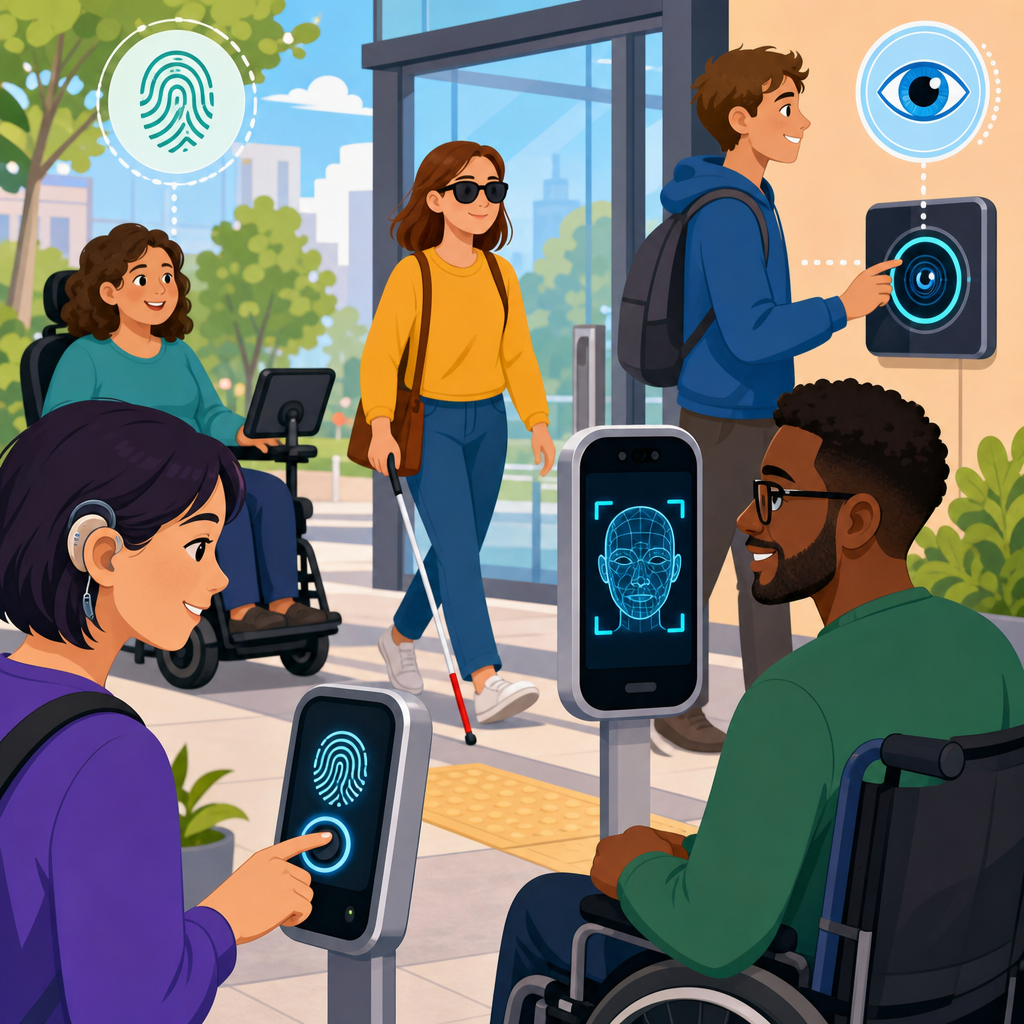
Biometric technologies and ADA accessibility now intersect in ways that affect hiring, building access, healthcare, banking, education, and consumer devices, making this one of the most important compliance and design questions in recent disability law. Biometric technologies use measurable physical or behavioral characteristics such as fingerprints, facial geometry, iris patterns, voiceprints, gait, and keystroke dynamics to verify identity or automate decisions. ADA accessibility refers to the requirement that covered employers, public entities, and places of public accommodation provide equal access, reasonable modifications, and effective communication for people with disabilities. In practice, that means a biometric system cannot become a new barrier where a traditional key, badge, password, or staff-assisted process once worked. I have seen organizations adopt sleek biometric tools for security or fraud prevention, then discover the rollout excluded people with limb differences, speech disabilities, low vision, facial differences, or conditions that affect movement and timing. Recent developments matter because adoption is accelerating, regulators are focusing on digital and self-service access, and inaccessible identity systems can trigger legal exposure, operational delays, and reputational damage.
Recent ADA updates and developments are not limited to one statute, one agency, or one device category. The Americans with Disabilities Act remains technology-neutral, but agencies and courts increasingly apply its core principles to software, kiosks, mobile apps, remote identity proofing, and AI-assisted screening tools that rely on biometric inputs. At the same time, related standards shape implementation. The Web Content Accessibility Guidelines influence digital interfaces used to enroll or authenticate users. Section 508 standards affect federal technology procurement. The Department of Justice has reinforced that digital services can fall within accessibility obligations, while the Equal Employment Opportunity Commission continues to scrutinize employment tools that screen out qualified individuals with disabilities unless the practice is job-related and consistent with business necessity. This hub article explains the major developments, the legal and technical issues behind them, and the practical steps organizations should take now. It is designed as a comprehensive starting point for the broader set of recent ADA updates and developments, especially where accessibility obligations meet identity, security, and automated service delivery.
Why biometric systems create distinct ADA risks
Biometric systems create ADA risks because they often assume a narrow range of bodies, voices, movements, and sensory abilities. A fingerprint scanner may fail for users with amputations, prosthetics, skin conditions, burns, or age-related changes in ridge detail. Facial recognition can misread users with facial paralysis, craniofacial differences, limited head mobility, or dark glasses needed for light sensitivity. Voice authentication can be unusable for people with stutters, aphasia, ALS, hearing-related speech variation, or temporary conditions after surgery. Behavioral biometrics add another layer of concern because typing speed, mouse movement, touch pressure, and gait may reflect disability rather than fraud. When a system treats disability-related variance as suspicious, it may deny access, increase friction, or route a user into endless retries.
The ADA problem is not biometrics alone; it is the absence of an equivalent accessible pathway. In my work reviewing access flows, the biggest failures happen during exception handling. A vendor may advertise high accuracy rates, but the live experience breaks down when the match fails and the fallback requires a call center without relay support, an in-person trip that is impossible for some users, or a photo submission flow incompatible with screen readers. That is why accessibility review must examine the entire journey: notice and consent, enrollment, authentication, error messaging, recovery, human assistance, and record correction. If any stage locks out a qualified user because of disability, the organization has a serious compliance issue.
Recent ADA updates and developments shaping biometric accessibility
Several recent ADA updates and developments have made biometric accessibility more urgent. First, accessibility enforcement has moved beyond physical spaces toward digital services and self-service technology. The Department of Justice rule on web and mobile accessibility for state and local government under Title II confirms that digital access is a concrete compliance expectation, not a theoretical one. Although the rule does not mention biometrics specifically, many public services now use identity verification tools inside websites, apps, and kiosks. If the surrounding interface must be accessible, the biometric step cannot be exempt in practice.
Second, employers are using biometric timekeeping, access control, and remote proctoring more aggressively. That trend increases exposure under Title I, particularly where an employee cannot use the tool because of a disability and no reasonable alternative is offered. The legal standard remains familiar: employers must provide reasonable accommodation absent undue hardship, and qualification standards or selection criteria that screen out individuals with disabilities require strong justification. A mandatory fingerprint time clock with no badge or PIN alternative is a classic example of avoidable risk.
Third, AI governance discussions are now converging with disability access. Many biometric products include liveness detection, anomaly scoring, emotion inference, or fraud models. These features can amplify disability bias because a system may interpret atypical eye movement, speech cadence, facial expression, or motor patterns as deception or noncompliance. Regulators have increasingly emphasized that automated tools must be tested for discriminatory effects, documented, and monitored after deployment. That focus does not replace ADA analysis; it sharpens it.
Where organizations are most exposed
The highest-risk environments are those where biometrics are mandatory, time-sensitive, or tied to essential services. Employment is a leading category. Time clocks, warehouse entry gates, laptop login tools, and video interview platforms can all create barriers. Education is another. Remote exam proctoring systems may require constant eye contact, neutral facial expression, precise head positioning, or uninterrupted speech, assumptions that can conflict with disability-related needs. Healthcare presents similar issues when patient portals use selfie verification or voice authentication for appointment access, prescription management, or telehealth check-in.
Consumer finance and housing are also significant. Banks increasingly use biometric onboarding for account opening and fraud prevention, while landlords and property managers use face or fingerprint access for buildings and package rooms. Travel, entertainment, and stadium security have adopted facial recognition and frictionless entry systems that move quickly but can fail users who need more time, tactile cues, or a staffed lane. In each sector, the legal question is straightforward: can a person with a disability access the same service with substantially equivalent privacy, speed, dignity, and reliability? If the answer is no, remediation is needed.
| Use case | Common barrier | Accessible alternative | Key ADA concern |
|---|---|---|---|
| Employee time clock | Fingerprint mismatch due to limb difference or skin condition | Badge, PIN, or supervisor-assisted attestation | Reasonable accommodation under Title I |
| Mobile account verification | Selfie capture incompatible with low vision or limited mobility | Document review plus live agent verification | Equal access to essential service |
| Voice authentication | Speech disability prevents reliable match | Passphrase, secure app approval, or staffed support | Effective communication and modification |
| Building entry gate | Face scan timeout for wheelchair user or person with tremor | Accessible staffed entrance or credential reader | Program access and comparable convenience |
Technical design practices that reduce legal and usability failures
The most effective accessibility strategy is multimodal design with nonbiometric fallback built in from the start. Every biometric workflow should offer at least one equally available alternative such as a FIDO2 security key, accessible passcode flow, badge, QR credential, or trained staff verification. The fallback must not be hidden, stigmatizing, or slower by design. If a user has to fail three scans before seeing the accessible option, the system is not meaningfully accessible. Enrollment and authentication screens should follow WCAG-based interface principles, including keyboard access, visible focus, text alternatives, error identification, sufficient contrast, and compatibility with screen readers and speech input tools.
Organizations also need disability-inclusive testing, not just generic usability review. In vendor evaluations I look for test participants with low vision, blind users relying on screen readers, Deaf and hard of hearing users, people with speech disabilities, users with limited dexterity, wheelchair users, neurodivergent users affected by timing or cognitive load, and people with facial or limb differences. Technical teams should measure false reject rates across these groups and examine whether liveness checks, timeout values, camera framing, and anti-spoofing controls disproportionately burden disabled users. Procurement documents should require conformance evidence, documented accommodation pathways, API support for alternatives, and service-level commitments for manual review. These steps reduce both operational breakdowns and the likelihood of an ADA complaint.
What recent enforcement and litigation trends signal
Enforcement trends show that regulators and plaintiffs are focusing less on whether a technology is innovative and more on whether it excludes people from jobs, services, or public programs. The ADA does not ban biometrics, but it does prohibit inaccessible implementation. Cases involving inaccessible kiosks, websites, and digital service flows have already established the principle that self-service technology must not displace accessible human assistance or alternative methods. Biometric systems fit that pattern exactly. If a new identity tool becomes the only practical way to enter a workplace, access an account, or receive a government benefit, the organization must be prepared to justify it and modify it.
Another important trend is documentation. When organizations can show they completed an accessibility impact assessment, tested with disabled users, negotiated vendor remediation terms, trained frontline staff, and maintained a clear exception process, they are in a far stronger position. When they cannot explain why an alternative was unavailable or why support staff were told to insist on repeated scans, liability risk rises quickly. This is especially relevant for recent ADA updates and developments because agencies increasingly expect accessibility to be operationalized, not promised in a policy PDF.
How to build a defensible governance program
A defensible governance program starts with inventory and classification. List every biometric use in the organization, including employment systems, customer authentication, physical access, kiosks, fraud tools, remote proctoring, and vendor-managed services. For each one, identify the biometric modality, the purpose, whether use is mandatory, the fallback methods, and the populations affected. Then complete a disability impact review alongside privacy and security review. I recommend assigning ownership jointly to accessibility, legal, security, procurement, and business operations because failures usually occur between teams, not within one team.
Next, create written standards. Require an accessible alternative that provides comparable timeliness and privacy. Require clear instructions, accessible error messages, and human support that understands accommodation procedures. Ban designs that treat repeated biometric failure as misconduct without review. Include contract language requiring vendors to support assistive technology, preserve logs for dispute resolution, remediate defects, and notify the customer before material model changes. Finally, train managers and support staff. The best policy fails if a supervisor tells an employee there is no workaround for a fingerprint clock or if a help desk agent cannot switch a customer from voice verification to another secure path. Strong governance turns recent ADA updates and developments into practical controls rather than reactive cleanup.
Biometric technologies can improve security and convenience, but they must be deployed in ways that preserve equal access for people with disabilities. The central lesson from recent ADA updates and developments is simple: accessibility is not a later patch for identity systems; it is a design requirement, procurement requirement, and operational requirement from day one. Organizations that succeed offer multimodal authentication, test with disabled users, document accommodation pathways, and monitor real-world failures instead of relying on vendor marketing claims.
As the hub for recent ADA updates and developments, this page should anchor your review of digital accessibility rules, employment accommodation obligations, self-service technology standards, and AI-related risk management. Start by auditing every biometric touchpoint, confirming that each one has an equivalent accessible alternative, and fixing exception handling before complaints force the issue. That work lowers legal risk, improves user trust, and makes security systems usable for the people they are supposed to protect. If your organization is expanding biometric tools this year, now is the time to align accessibility, security, and procurement around one clear rule: no essential service should depend on a single body type, voice pattern, or movement profile.
Frequently Asked Questions
What is the connection between biometric technologies and ADA accessibility?
Biometric technologies and ADA accessibility intersect because systems that rely on fingerprints, facial recognition, iris scans, voiceprints, gait analysis, or other physical and behavioral traits can create barriers for people with disabilities if they are not designed and deployed carefully. The Americans with Disabilities Act generally requires equal access to employment, public services, public accommodations, and many aspects of everyday participation. When an employer, school, hospital, bank, landlord, retailer, or technology provider uses biometrics to verify identity, control entry, monitor activity, or automate decisions, the core legal and practical question becomes whether people with disabilities can use that system on equal terms.
This issue matters across many environments. In hiring, an applicant may be screened through facial analysis or voice-based identity verification. In workplaces and buildings, employees or visitors may be required to use fingerprint or facial recognition to gain entry. In healthcare, patient portals, check-in systems, and identity matching tools may use biometric inputs. In banking and consumer technology, mobile apps often depend on face or fingerprint unlock features as a default method of authentication. If a person cannot reliably provide the required biometric input because of a disability, the technology may function as a barrier unless a meaningful alternative is offered.
ADA accessibility in this context is not limited to whether the technology “works” for most users. It also includes whether the system can be used independently, accurately, and with reasonable dignity by individuals with different disabilities, whether accommodations are available, whether the user is unfairly excluded or delayed, and whether design choices unintentionally create discriminatory outcomes. A system that performs well for the general population can still create ADA risk if it has materially lower accuracy rates for people with speech disabilities, limb differences, vision impairments, neurological conditions, or other disabilities. Recent developments have pushed organizations to look beyond convenience and security claims and evaluate whether biometric systems are accessible, flexible, and legally defensible.
How can biometric systems create accessibility problems for people with disabilities?
Biometric systems can create accessibility problems when they assume that every user can present the same physical trait in the same way, under the same conditions, every time. That assumption often breaks down in real-world settings. A fingerprint scanner may not work for someone with missing fingers, limited dexterity, certain skin conditions, or worn fingerprints. A facial recognition system may fail for a person whose facial presentation is affected by paralysis, injury, muscular conditions, scarring, or medical equipment. Voice authentication may be inaccurate for people with speech impairments, deaf or hard of hearing users who communicate differently, or individuals whose speech varies due to neurological or respiratory conditions.
Problems also arise from environmental and interface design choices. If a biometric kiosk is mounted too high, requires precise hand positioning, or provides instructions only visually or only by audio, the technology may be inaccessible even before accuracy is considered. Time limits can be another barrier. Some users need more time to position themselves, speak, understand prompts, or complete a multi-step authentication sequence. In some systems, repeated failed attempts can trigger lockouts, fraud alerts, or adverse consequences, which means accessibility failures can quickly become exclusionary rather than merely inconvenient.
There are also concerns with automated decision-making that uses biometric or behavior-based inputs indirectly. Systems that analyze eye movement, facial expressions, tone of voice, gait, or keystroke patterns may draw conclusions that are skewed by disability-related traits. For example, disability may affect movement, facial expressiveness, speech cadence, or typing style in ways that do not reflect identity fraud, intent, competence, or truthfulness. When those tools are used in hiring, education, security screening, or customer verification, disability-related differences can be misread as anomalies. That is why organizations should evaluate not just whether a biometric product is technically advanced, but whether it has been tested for accessibility, whether it offers equivalent alternatives, and whether it avoids penalizing disabled users for traits closely connected to their disability.
What recent legal and compliance developments are making this issue more important?
Recent developments have made biometric accessibility a higher-stakes issue because regulators, courts, employers, and businesses are paying closer attention to how automated systems affect protected groups, including people with disabilities. While the ADA itself predates modern biometric tools, its core principles apply to new technologies used in places of employment, public accommodations, government services, and increasingly digital environments connected to those spaces and services. Organizations can no longer assume that innovation alone is enough; they are expected to assess whether identity systems, screening tools, and access controls exclude or disadvantage disabled individuals.
Another reason this issue has intensified is the wider adoption of biometric systems in critical settings. What was once optional or limited to high-security facilities is now common in office buildings, schools, hospitals, airports, mobile banking, telehealth, and consumer devices. As these tools become embedded in routine interactions, the lack of an accessible alternative becomes more significant. A failed biometric login is not just a technical glitch when it prevents a patient from accessing care, an applicant from completing an interview process, an employee from entering a workplace, or a customer from accessing financial services.
There is also growing overlap between disability law, privacy law, and anti-discrimination concerns in artificial intelligence and automated decision systems. Biometric technologies often collect sensitive personal information, and they may be used to make or influence decisions about hiring, identity verification, fraud detection, and service eligibility. That creates a layered compliance environment. Even where a specific dispute is framed as privacy, data governance, or algorithmic bias, accessibility failures may still trigger ADA obligations if disabled individuals are denied equal access or reasonable modifications. The practical takeaway is that businesses should treat biometric deployment as both a technical and civil rights issue. The strongest compliance posture comes from building accessibility review into procurement, testing, policy development, training, and ongoing monitoring rather than waiting for complaints or litigation.
What should employers, schools, healthcare providers, and businesses do to make biometric systems more ADA-accessible?
Organizations should start with the principle that biometric authentication must never become the only realistic path to access when some users may be unable to use it because of a disability. The most important safeguard is a genuinely equivalent alternative method for identification, entry, or verification. That alternative might include badge access, PINs, password-based login, human-assisted verification, hardware tokens, accessible multi-factor authentication options, or documented accommodation procedures that can be used promptly and without stigma. An alternative is not truly equivalent if it is much slower, less available, more intrusive, or treated as suspicious by default.
Accessibility should also be addressed at the procurement stage. Before adopting a biometric product, organizations should ask vendors detailed questions about disability access, error rates across different user populations, interface accessibility, compatibility with assistive technology, and the availability of fallback methods. They should request documentation, testing results, and implementation guidance rather than relying on general assurances that the product is “inclusive” or “compliant.” Internal legal, HR, IT, facilities, accessibility, and privacy teams should all be involved because biometric systems often affect multiple obligations at once.
Operational practices matter just as much as design. Staff should be trained to recognize when a biometric tool is not working because of an accessibility issue and to offer alternatives promptly and respectfully. Policies should make clear that users will not be penalized, embarrassed, delayed, or flagged for fraud merely because they request a non-biometric option. Regular audits are also essential. Organizations should review complaint data, lockout rates, accommodation requests, and real-world usage patterns to identify whether disabled users are experiencing disproportionate failures. In higher-risk settings such as hiring, education, patient access, and financial services, it is especially important to test whether the system influences decisions in a way that disadvantages people with disabilities. In short, ADA-accessible biometric deployment requires multiple layers: accessible design, alternative methods, accommodation processes, staff training, and ongoing review.
Can biometric technologies be used lawfully and effectively without violating ADA accessibility principles?
Yes, biometric technologies can be used lawfully and effectively, but only when organizations recognize that accessibility is part of system performance, not an afterthought. A biometric tool is not successful merely because it improves security or speeds up authentication for many users. It must also be deployable in a way that does not screen out, burden, or unfairly disadvantage people with disabilities. That usually means the system should be optional where feasible, supported by accessible alternatives where needed, and implemented with policies that allow prompt reasonable modifications.
In practice, lawful and effective use depends on context. A smartphone face unlock feature may be acceptable if users can easily switch to a passcode or another accessible method. A workplace timekeeping or entry system raises more serious concerns if an employee who cannot use the scanner has no reliable alternative or must repeatedly disclose medical information to gain access. In hiring, the stakes are even higher when biometric or behavior-analysis tools are used to evaluate applicants, because disability-related traits can distort the system’s conclusions. The more essential the service or opportunity, the stronger the need for accessibility safeguards and careful oversight.
The best approach is to design around user variability from the beginning. Organizations should assume that some people will not be able to use a given biometric modality consistently, and they should build systems that preserve equal access without forcing those users into a second-class process. When businesses combine thoughtful technology selection, accessible interfaces, vendor accountability, alternative authentication pathways, and clear accommodation procedures, biometric systems can be both practical and more legally resilient. The bottom


