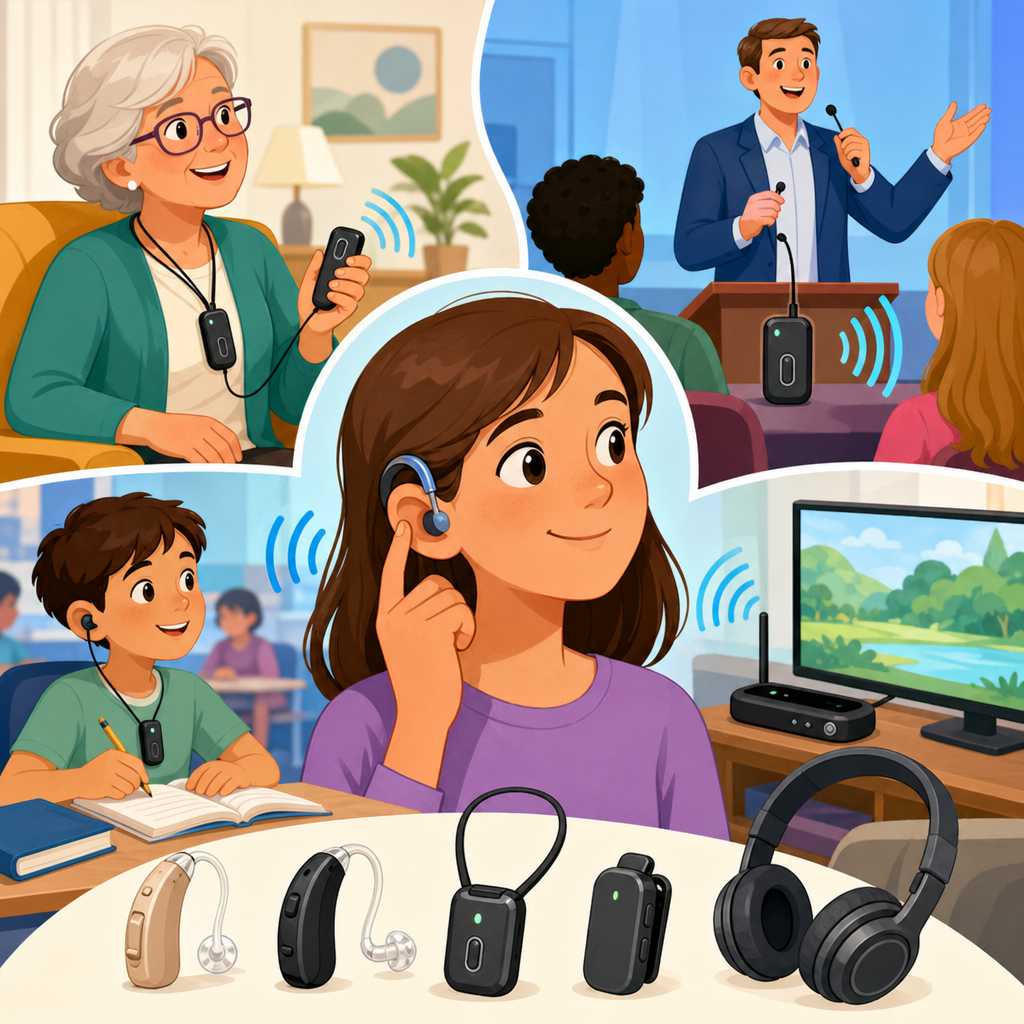
Assistive listening devices and technologies make spoken communication more accessible for people who are deaf, hard of hearing, experience auditory processing challenges, or struggle to hear clearly in noisy rooms, large venues, and daily conversations. In practice, this category includes far more than hearing aids. It covers personal amplifiers, induction loop systems, FM and digital wireless systems, infrared listening systems, captioning tools, alerting products, telecoil-compatible phones, speech-to-text apps, and the software features built into smartphones, televisions, computers, and public address systems. As a hub topic within technology and accessibility, advanced technology for accessibility is about reducing the gap between sound being produced and meaning being understood.
The distinction matters because hearing is not the same as listening. Hearing refers to detecting sound. Listening requires separating speech from background noise, following rapid conversation, identifying direction, and interpreting language in context. I have seen users with clinically mild hearing loss struggle badly in restaurants, classrooms, courtrooms, and hybrid meetings because the environment—not just ear sensitivity—creates the barrier. That is why modern assistive listening technology focuses on signal-to-noise ratio, latency, directional pickup, connectivity, and multimodal access. A good system delivers the speaker’s voice closer to the listener, reduces competing noise, and supports comprehension through amplification, transmission, or text.
This topic matters for both individual independence and legal accessibility. In many jurisdictions, public venues, educational institutions, transportation systems, theaters, houses of worship, and government facilities must provide effective communication under disability access standards. In the United States, the Americans with Disabilities Act shapes many expectations, while standards from the International Electrotechnical Commission, Bluetooth SIG, and hearing care organizations influence device compatibility and performance. The practical goal is simple: if a person cannot reliably access spoken information, they are excluded from education, work, healthcare, safety announcements, and social life. Assistive listening technologies are therefore not optional gadgets; they are core access tools that support equal participation across modern environments.
Choosing the right technology depends on where the listening problem occurs, whether the user wears hearing aids or cochlear implants, and how speech reaches the ear or the screen. Some solutions are personal and portable. Others are installed in buildings and integrated with microphones, mixers, or venue audio systems. Increasingly, the strongest results come from combining tools: for example, hearing aids paired with remote microphones, live captions on a smartphone, and a loop-equipped auditorium. This hub article explains the main device categories, how they work, where each performs best, what tradeoffs to expect, and how advanced technology for accessibility is evolving in consumer products, schools, workplaces, healthcare, and public infrastructure.
Core categories of assistive listening technology
Assistive listening devices fall into three functional groups: amplification, wireless transmission, and text or visual access. Amplification devices increase the loudness of sound that already exists in the room. Personal sound amplification products, sometimes called PSAPs, are the simplest example. They use a microphone and ear-level receiver to make nearby sound louder. They can help in one-to-one conversation, birdwatching, or television listening, but they do not replace properly fitted hearing aids for medical hearing loss management. Hearing aids and cochlear implant processors also belong in this group, though they are more sophisticated because they shape frequencies, apply compression, reduce feedback, and often use directional microphones and noise reduction algorithms.
Wireless transmission systems improve listening by moving the talker’s voice directly to the listener. This is often more effective than simply making all sound louder. FM systems and newer digital remote microphone systems use a microphone worn by the speaker and a receiver used by the listener. In classrooms, I have repeatedly seen this approach outperform conventional amplification because it preserves speech clarity across distance. Induction loop systems transmit audio electromagnetically to telecoils inside hearing aids and cochlear implants. Infrared systems send sound using light waves and are common in courtrooms, theaters, and confidential meeting spaces because signals stay inside the room. Bluetooth-based accessories now add another layer, linking phones, TVs, and laptops directly to compatible hearing devices.
Text and visual access tools support people who benefit from reading speech in addition to hearing it. Real-time captioning, automated speech recognition, CART services, conference caption displays, and transcription apps help in meetings, classes, telehealth visits, and public presentations. Alerting devices convert sound events into light, vibration, or phone notifications for doorbells, alarms, baby monitors, and emergency announcements. These systems are often overlooked in discussions about assistive listening, but they are essential to full communication access. In real-world accessibility planning, the best question is not “What device is most advanced?” but “What barrier are we removing: distance, noise, reverberation, lack of captions, or inability to detect alerts?”
Hearing aids, cochlear implants, and remote microphones
For many users, hearing aids or cochlear implants are the foundation of assistive listening access, but they are rarely enough on their own in difficult acoustic settings. Modern hearing aids use digital signal processing to amplify specific frequencies, compress loud sounds to comfortable levels, and apply directional microphone patterns that prioritize speech from the front. Premium models may add environmental classification, wind noise management, impulse suppression, telecoil support, and direct streaming from iOS, Android, televisions, and computers. Cochlear implants bypass damaged inner-ear structures and stimulate the auditory nerve directly, which can provide access to speech for people with severe to profound hearing loss. Both technologies are powerful, yet neither can fully defeat distance or heavy background noise.
That limitation is why remote microphones are often the single highest-impact upgrade for users who already wear hearing devices. A remote microphone sits near the person speaking and sends the voice wirelessly to the listener’s hearing aid, implant processor, or dedicated receiver. The benefit is dramatic because the voice reaches the listener before room noise and reverberation degrade it. In classrooms, a teacher microphone can improve speech understanding across the day. In workplaces, a table microphone can help during team meetings. In cars, where road noise and poor seating positions make conversation hard, a clipped microphone can transform communication. From direct fitting experience, users often describe remote microphones as the first tool that makes restaurants, lectures, and family gatherings manageable again.
Telecoils deserve special attention because they remain one of the most reliable accessibility features in public listening environments. A telecoil is a tiny receiver built into many hearing aids and implants that picks up magnetic signals from loop systems. When users switch to the T-coil program, they hear the venue audio directly, usually with less background noise than through open microphones. Despite their value, telecoils are sometimes underutilized because consumers are not told how they work, or venues fail to maintain loop installations properly. For anyone comparing hearing technology, questions about telecoil support, remote microphone compatibility, and streaming standards are just as important as questions about battery life or cosmetic style.
Venue systems: loops, FM, infrared, and emerging wireless audio
Public and institutional spaces require systems that work for many users, not just one person at a time. The three classic venue technologies are induction loops, FM or radio-frequency systems, and infrared systems. Each solves a similar access problem with a different transmission method. Loop systems are often the most seamless for hearing aid and cochlear implant users because no separate receiver is needed if telecoils are available. A correctly installed loop can cover a ticket counter, classroom, sanctuary, or auditorium, sending microphone or house audio directly into compatible devices. This simplicity matters. When access depends on borrowing unfamiliar equipment, many people skip it. When access is built into what they already wear, usage rises.
FM and digital RF systems are flexible and common in schools, guided tours, training rooms, and large events. They require receivers, neckloops, or headphones, which adds logistics but allows broad deployment even for users without telecoils. Infrared systems are ideal where confidentiality is important because signals do not pass through walls. That makes them useful in courtrooms, medical facilities, and cinema spaces. However, infrared requires line-of-sight and can be affected by strong light conditions. Venue operators need to understand these differences before installation. I have seen well-intentioned projects fail because the selected system matched the budget but not the actual room use, user profile, or maintenance capacity.
| Technology | Best use case | Main advantage | Main limitation |
|---|---|---|---|
| Induction loop | Theaters, worship spaces, service counters | Works directly with telecoils | Requires compatible hearing devices and proper installation |
| FM or digital RF | Schools, tours, meeting rooms | Long range and flexible deployment | Users need receivers or accessories |
| Infrared | Courtrooms, cinemas, confidential rooms | Signal stays inside the room | Needs line-of-sight and emitter coverage |
| Bluetooth broadcast and Auracast | Airports, consumer audio, future public venues | Uses mainstream wireless ecosystems | Adoption, interoperability, and latency are still evolving |
Emerging broadcast audio standards are pushing venue access toward mainstream wireless platforms. Bluetooth LE Audio and Auracast are especially important because they promise low-power streaming, hearing aid support, and the possibility of public audio broadcasts to many devices at once. The long-term significance is substantial: airports, museums, conference centers, and televisions could eventually stream accessible audio without requiring specialized receivers. Still, the ecosystem is not mature everywhere. Compatibility varies by phone, hearing aid, operating system, and public transmitter hardware. For now, organizations planning accessible infrastructure should treat these technologies as promising additions rather than complete replacements for proven loop, FM, or infrared systems.
Captioning, transcription, and multimodal communication tools
Not every listening problem should be solved with audio alone. Captioning and transcription tools are critical assistive technologies because they convert speech into text, giving users a second path to understanding. Live captioning is now common in video conferencing platforms such as Zoom, Microsoft Teams, and Google Meet, and smartphone operating systems offer features like Live Transcribe or Live Captions. In classrooms, conferences, and legal or medical settings, professional CART captioning remains the most accurate option because a trained captioner can manage specialized vocabulary, multiple speakers, and rapid exchanges better than automated systems. The right choice depends on the consequence of error. A casual video call can tolerate imperfect captions; a diagnosis discussion cannot.
Multimodal communication combines hearing, reading, and visual signaling. This approach works particularly well for people with fluctuating hearing, auditory neuropathy, aging-related hearing changes, or fatigue in noisy environments. In office deployments, I often recommend a layered setup: direct audio streaming for calls, meeting captions on shared screens, clear microphone placement, and vibration or visual alerts for notifications. This reduces cognitive load because the user does not rely on one fragile channel. It also improves access for non-native speakers, people with temporary hearing issues, and anyone trying to follow complex information. Accessibility technology is most successful when it improves communication for the broadest group without stigmatizing the person who needs it most.
Accuracy, privacy, and latency are the three practical issues to evaluate with speech-to-text tools. Automated transcription can mis-handle names, technical terms, accents, or overlapping talkers. Cloud-based services may raise confidentiality concerns in healthcare, education, legal practice, or internal business meetings. Delayed captions can also disrupt turn-taking. For these reasons, organizations should create clear policies about when to use automated captions, when to book human captioners, and how transcripts are stored. The most effective programs treat captions as part of communication design rather than an afterthought added only after a complaint.
How to choose, deploy, and maintain the right solution
Choosing assistive listening technology starts with an honest assessment of the listening environment. Is the barrier distance, noise, reverberation, speaker movement, lack of direct connectivity, or absence of text support? A small counseling room needs a different solution than a lecture hall or transit hub. User factors matter just as much: degree and type of hearing loss, telecoil availability, device compatibility, dexterity, battery tolerance, and comfort with apps or pairing steps. In my experience, failed implementations usually come from buying hardware before mapping the communication task. The best process is needs analysis first, pilot testing second, procurement third, and user training throughout.
Maintenance is not glamorous, but it determines whether accessibility actually works. Microphones need batteries or charging. Loop systems need periodic verification with listening checks and field strength testing. Receivers must be sanitized, labeled, stored, and loaned efficiently. Staff need to know how to explain options in plain language, not just point to a sign. Clear wayfinding is essential: users should know where a loop is available, how to request a receiver, and who to contact if equipment fails. Accessibility breaks down quickly when systems exist on paper but not in reliable daily operation. A modest, well-maintained system almost always outperforms an expensive system that nobody understands.
Procurement should also consider interoperability and future expansion. Devices that support telecoils, Bluetooth LE Audio, standard connectors, and major conferencing platforms are easier to integrate over time. Organizations should ask vendors for coverage maps, latency specifications, compatibility lists, service plans, and training materials. They should test with actual hearing aid and cochlear implant users before sign-off. For individuals, the smartest buying strategy is similar: test devices in your hardest environments, ask about return periods, and prioritize speech understanding over novelty features. A technology is successful only if it improves real conversations consistently.
Assistive listening devices and technologies are central to advanced technology for accessibility because they turn communication from a barrier into an accessible service. The most effective solutions are not defined by novelty but by fit: hearing aids and implants for everyday hearing access, remote microphones for distance and noise, loops and venue systems for public participation, and captioning tools for text-based reinforcement. Each addresses a specific communication gap, and the strongest outcomes usually come from combining them rather than relying on a single device. This hub article provides the framework for understanding that landscape so readers can explore related topics such as hearing aid connectivity, classroom listening systems, accessible meeting design, live captioning workflows, and smart alerting products with a clear baseline.
The main benefit is practical inclusion. When speech is accessible, people can learn, work, travel, worship, receive care, and participate socially with less fatigue and fewer misunderstandings. That outcome depends on thoughtful selection, user training, reliable maintenance, and a willingness to match technology to environment instead of chasing one universal answer. If you are building an accessibility strategy, audit your current listening barriers, test at least one direct audio solution and one text-based solution, and create a deployment plan that users can depend on every day.
Frequently Asked Questions
What are assistive listening devices and technologies, and who can benefit from them?
Assistive listening devices and technologies are tools designed to make spoken communication, alerts, and audio information easier to access in everyday life. While many people first think of hearing aids, this category is much broader. It includes personal amplifiers, induction loop systems, FM and digital wireless systems, infrared listening systems, captioning tools, telecoil-compatible phones, visual and vibrating alerting devices, TV listening systems, and communication accessories for classrooms, workplaces, theaters, places of worship, and public service counters.
These technologies can benefit a wide range of people. They are often used by individuals who are deaf or hard of hearing, but they can also help people with auditory processing challenges, older adults who have difficulty following conversation, and anyone who struggles to hear clearly in noisy spaces or when the speaker is at a distance. For example, someone may hear reasonably well one-on-one in a quiet room but still miss speech in restaurants, lecture halls, airports, or meetings. In those situations, an assistive listening system can improve access by reducing background noise and bringing the speaker’s voice closer and clearer.
They are also valuable for family members, caregivers, students, employees, and organizations that want to improve communication access. In many cases, the right technology reduces listening fatigue, improves understanding, and supports greater independence and participation. Rather than being a niche solution, assistive listening technology is a practical communication support that can make everyday interactions more usable and less stressful.
How are assistive listening devices different from hearing aids?
Hearing aids and assistive listening devices often work together, but they are not the same thing. Hearing aids are personal medical devices programmed to address an individual’s hearing profile. They amplify and process sound based on a person’s specific hearing needs and are typically worn throughout the day. Their main job is to improve access to sound across many listening environments, especially close-range conversation.
Assistive listening devices, by contrast, are often designed for specific situations where hearing aids alone may not be enough. Even the best hearing aids can struggle in challenging environments such as crowded restaurants, classrooms, conference rooms, theaters, or large houses of worship. Distance, background noise, poor acoustics, and reverberation can all reduce speech clarity. Assistive listening technologies help solve those problems by transmitting sound more directly from the source to the listener.
For example, an FM or digital wireless system can send a speaker’s voice from a microphone straight to a receiver, reducing interference from surrounding noise. An induction loop system can send audio directly to hearing aids or cochlear implants that have a telecoil setting. Infrared systems are often used in venues where secure, line-of-sight transmission is preferred. Personal amplifiers can help in one-on-one communication or while watching television. Captioning tools provide text support when listening alone is not enough or not preferred.
In short, hearing aids are general day-to-day hearing devices, while assistive listening technologies are targeted access tools that improve communication in specific real-world situations. Many people get the best results when they use both together.
What types of assistive listening technologies are available, and how do they work?
There are several major categories of assistive listening technologies, and each serves a different purpose. Personal amplifiers are portable devices that use a microphone and headphones or earbuds to make nearby speech louder and often clearer. They are commonly used in small conversations, during travel, or while watching TV. These systems are relatively simple and can be helpful for occasional listening support, though they do not provide the customized processing of hearing aids.
Induction loop systems, also called hearing loop systems, use a wire loop installed around a room or service area to transmit audio electromagnetically. People with telecoil-equipped hearing aids or cochlear implants can switch to the telecoil setting and receive the sound directly, often with better clarity and less background noise. Loops are widely used in theaters, courtrooms, ticket counters, lecture halls, and worship spaces because they are convenient for users and can provide seamless access without extra wearable equipment.
FM and digital wireless systems use microphones and transmitters to send a speaker’s voice directly to a listener’s receiver. These are especially useful in classrooms, guided tours, meetings, training environments, and one-on-one conversations where the speaker may be moving around. Infrared systems also transmit audio wirelessly, but they use light rather than radio waves. They are commonly used in entertainment venues and settings where audio privacy matters, since the signal generally stays contained within the room.
Captioning tools are another important category. These may include real-time captioning apps, captioned telephones, live event captioning, and video captioning. Rather than amplifying sound, they convert speech into text, which can be essential for people who prefer visual access or need both audio and text to fully understand spoken communication. Alerting devices use flashing lights, vibration, or other signals to notify users about doorbells, phone calls, alarms, baby monitors, and timers. Telecoil-compatible phones, amplified phones, and accessible communication accessories further expand options for daily use at home and work.
The best technology depends on the listening situation, the user’s hearing needs, whether they use hearing aids or cochlear implants, and how they prefer to access information. In many cases, a combination of tools provides the most effective support.
How do I choose the right assistive listening device for home, work, school, or public spaces?
Choosing the right assistive listening technology starts with identifying the actual communication problem you want to solve. The most effective device is not necessarily the most advanced one; it is the one that matches the listening environment, the user’s hearing profile, and the task at hand. Begin by asking practical questions. Is the main challenge hearing conversation in background noise? Understanding a speaker from a distance? Following TV dialogue? Hearing the phone ring? Accessing meetings or classes? Once the situation is clear, the choice becomes much easier.
At home, many people benefit from TV listening systems, amplified or captioned telephones, and alerting devices for alarms, doorbells, and household notifications. In one-on-one situations, a personal amplifier may be enough. In workplaces and schools, remote microphone systems, FM or digital wireless solutions, and captioning services are often more effective because they address distance and background noise directly. In public spaces such as theaters, lecture halls, service counters, and worship centers, loop systems, infrared systems, or venue-based assistive listening receivers are often the best fit because they are designed to serve multiple users consistently.
Compatibility also matters. If a person uses hearing aids or cochlear implants, it is important to check whether the devices support telecoils, Bluetooth, direct audio input, or external receivers. Ease of use should be considered as well. A device may perform well technically, but if it is difficult to set up, charge, carry, or connect, it may not be used consistently. Battery life, sound quality, portability, and maintenance requirements all influence long-term success.
Whenever possible, involve an audiologist, hearing care professional, disability services office, or assistive technology specialist. Professional guidance can help match a person’s needs with the right system and avoid trial-and-error purchases that do not solve the real problem. Demonstrations and real-world testing are especially valuable because performance can vary significantly depending on the environment. A thoughtful selection process leads to better communication, less frustration, and more reliable access across daily activities.
Are assistive listening technologies useful even if someone does not wear hearing aids?
Yes, absolutely. Assistive listening technologies can be very useful for people who do not wear hearing aids, either because they do not need them full-time, are not ready for them, are exploring options, or have hearing difficulties that are situational rather than constant. Many people notice communication breakdowns only in specific environments, such as noisy restaurants, meetings, classrooms, airports, or while watching television. In those cases, a targeted listening solution may provide meaningful help without requiring a person to wear hearing aids all day.
Personal amplifiers are one clear example. They can make nearby speech louder and are often used by individuals who want simple support for occasional conversations, travel, or media listening. Captioning tools are another major option, especially for people who understand best when they can both hear and read what is being said. Real-time captioning apps, captioned phones, and media captions can improve comprehension even for people with mild hearing loss or auditory processing difficulties. Alerting devices also serve many users who do not wear hearing aids but still need accessible notifications for alarms, phone calls, or visitors at the door.
These technologies can also be helpful for people with temporary hearing changes, single-sided hearing issues, sound sensitivity, or cognitive and auditory processing challenges that make speech difficult to follow in complex listening environments. In schools and workplaces, remote microphone systems and communication support tools may improve speech access even when a person has normal hearing on a standard screening but still struggles in noise.
The key point is that hearing access is not one-size-fits-all. Hearing aids are only one part of the picture. Assistive listening technologies offer flexible, practical ways to improve communication for many different users, including those who do not wear hearing aids and may never need to.