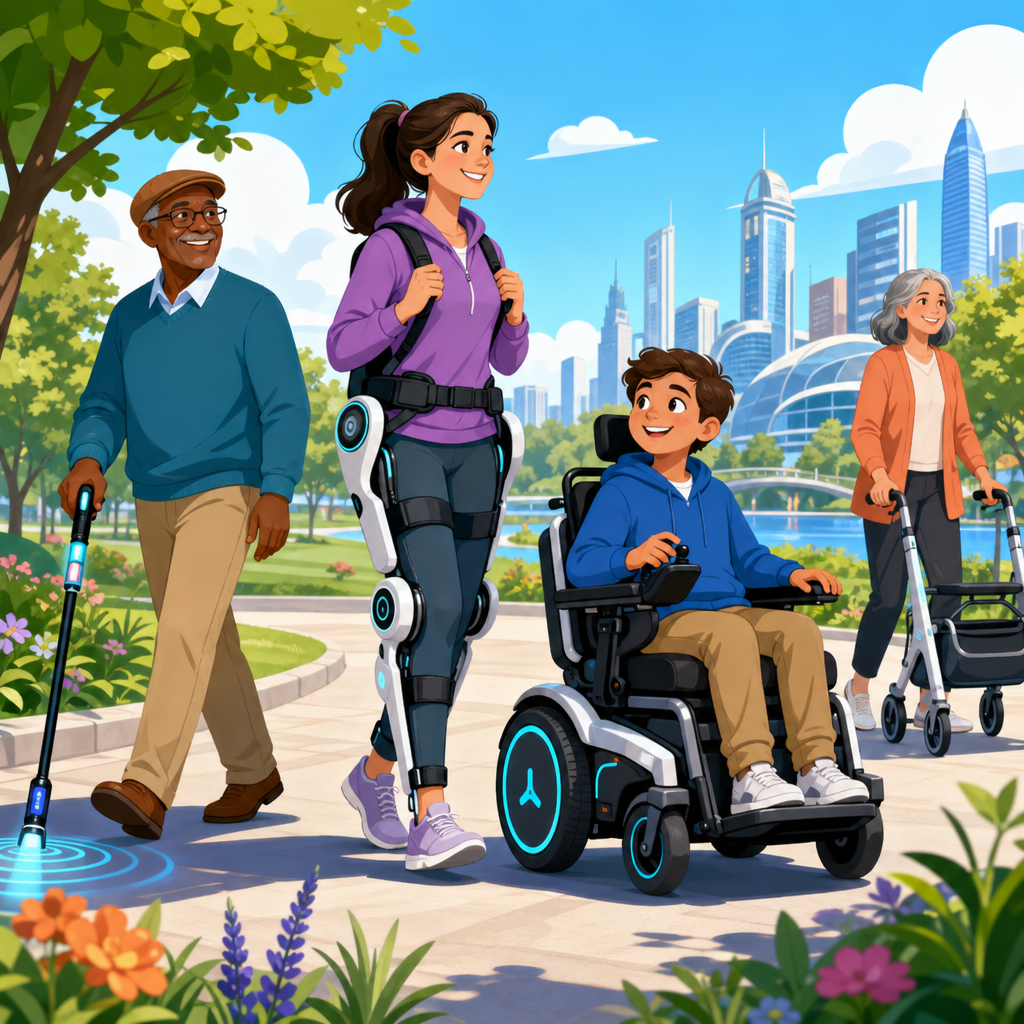
Advanced mobility aids are transforming how people with visual, neurological, and musculoskeletal impairments move through homes, workplaces, hospitals, and public streets. The term covers any device that extends safe, independent movement beyond what a standard cane, walker, wheelchair, or brace can provide. In practice, that now includes smart canes with obstacle detection, sensor-rich wheelchairs, navigation wearables, robotic prosthetics, powered orthoses, and robotic exoskeletons used for gait training or daily ambulation. I have worked with clinicians, assistive technology vendors, and accessibility teams evaluating these systems, and the central lesson is clear: the best device is not the most futuristic one, but the one that reliably fits a person’s body, goals, environment, and support network.
This area matters because mobility is the foundation of education, employment, healthcare access, and social participation. According to the World Health Organization, more than one billion people live with disability worldwide, and mobility limitation is one of the most common barriers to independence. Traditional aids remain essential, but advanced technology for accessibility adds sensing, processing, connectivity, and powered movement that can reduce fall risk, increase endurance, and provide better situational awareness. A smart cane can warn about overhanging obstacles that a standard cane may miss. A power wheelchair with pressure mapping and seat elevation can reduce skin breakdown risk while improving eye-level interaction. An exoskeleton can support repetitive gait practice after spinal cord injury or stroke, helping users and therapists complete training with more consistent biomechanics.
As a hub topic, advanced mobility aids also sits at the intersection of rehabilitation medicine, industrial design, robotics, computer vision, and public policy. Buyers and caregivers often ask the same questions: Who benefits most from each device category? What do these systems actually do well today? How much training, maintenance, and insurance navigation is required? The answers depend on diagnosis, upper-body strength, cognition, home layout, terrain, transportation, and local funding rules. Understanding those variables helps readers evaluate the detailed articles that branch from this page, from smart cane buying guides to exoskeleton therapy evidence. This overview explains the major device classes, the underlying technologies, the tradeoffs that shape real-world use, and the practical standards that should guide decisions.
What counts as an advanced mobility aid
An advanced mobility aid combines mechanical support with electronics, software, or robotics to improve movement or navigation. The simplest examples add sensors and feedback to familiar tools. Smart canes may use ultrasonic sensors, infrared, computer vision, GPS, inertial measurement units, haptic alerts, and smartphone connectivity. More complex systems actively generate or augment movement. Powered wheelchairs use joystick control, alternative access methods such as sip-and-puff or head arrays, environmental controls, tilt and recline functions, and collision avoidance. Robotic prostheses and powered orthoses use motors, microprocessors, and gait algorithms to assist joint motion. Exoskeletons add external frames with actuators around the legs or trunk to support standing and walking.
Three distinctions are useful when comparing products. First, navigation technology helps a person avoid obstacles and find routes, but it does not necessarily bear body weight. Second, powered mobility moves the user through space while the device provides the main propulsion or support. Third, rehabilitation robotics may be designed primarily for therapy rather than all-day community use. Many products span more than one category, which is why marketing language can confuse buyers. A stair-climbing wheelchair, for example, is both powered mobility and a terrain-management system, while a lower-limb exoskeleton may be approved for supervised rehabilitation in one setting and limited personal use in another.
Smart canes and electronic travel aids
Smart canes are often the first step into advanced mobility technology because they preserve familiar cane technique while adding extra layers of information. Most models pair a traditional long cane with ultrasonic sensors that detect obstacles above ground level, such as tree branches, signs, and open truck beds. Feedback usually comes through vibration or audio prompts. Some devices add GPS-based wayfinding, object recognition, or app-based route guidance. In my experience, users value overhead obstacle alerts most consistently, because that is a practical gap in standard cane travel. Flashy features such as object naming sound impressive but often matter less than low-latency, reliable hazard detection.
Electronic travel aids work best when they complement orientation and mobility training instead of replacing it. A blind traveler still needs mental mapping, intersection analysis, shoreline techniques, and confidence using public transit. Good systems improve perception without overloading attention. That design principle explains why haptic feedback frequently outperforms speech output in busy environments. Constant audio directions can mask traffic cues or conversation. Battery life, weather resistance, false positives, and cane tip compatibility also matter more than most first-time buyers expect. A device that triggers constantly near reflective surfaces or drains by midday will be abandoned quickly, no matter how advanced the app looks.
Power wheelchairs, scooters, and intelligent seating
Advanced wheelchair technology has improved faster than many nonusers realize. Modern power wheelchairs can combine suspension, programmable driving profiles, gyro-assisted stability, obstacle sensing, standing functions, seat elevation, and customizable controls for people with limited hand function. Alternative drive systems include chin controls, switches, mini joysticks, touchpads, and eye-gaze interfaces linked through specialty electronics. These options are critical for users with conditions such as muscular dystrophy, spinal muscular atrophy, cerebral palsy, or high-level spinal cord injury. The chair is not just transport; it is a posture management system, communication platform, and daily workstation.
Pressure management is a major reason advanced seating matters. Clinicians use pressure mapping systems from vendors such as XSensor or Permobil to identify hotspots that can lead to skin breakdown. Tilt, recline, elevating leg rests, and dynamic backrests are prescribed not as luxury features but as medical necessities. Seat elevation has become especially important because it improves transfers, kitchen access, retail interactions, and eye-level communication. The practical difference is enormous: a user who can raise the seat several inches can reach shelves, pay at a counter, and talk to colleagues without neck strain. That translates directly into greater independence at work and at home.
Robotic prosthetics, powered orthoses, and exoskeletons
Microprocessor knees, powered ankles, and robotic orthoses have changed expectations for people with limb loss or neuromuscular weakness. A microprocessor knee from manufacturers such as Ottobock or Össur continuously adjusts resistance based on gait speed, slope, and stumble detection. Powered ankles can return push-off energy and improve symmetry, especially on uneven terrain or stairs. Knee-ankle-foot orthoses with stance control can stabilize the limb during weight bearing while allowing swing phase movement. These advances reduce compensatory patterns that commonly cause back pain, hip strain, and fatigue with purely mechanical devices.
Robotic exoskeletons are the most visible category, but they are also the most misunderstood. Systems from companies such as Ekso Bionics, ReWalk, Indego, and Wandercraft vary significantly in target users, supervision requirements, speed, transfer burden, and clinical evidence. In rehabilitation settings, exoskeletons help therapists deliver high-repetition stepping practice with more controlled kinematics than manual assistance alone. In community settings, personal exoskeleton use remains narrower because donning time, crutch dependence, battery duration, environmental limits, and cost are substantial barriers. For selected users, however, standing and walking with an exoskeleton can provide psychological, social, and physiological benefits that wheelchairs alone do not address.
| Device category | Core technology | Best fit | Main limitation |
|---|---|---|---|
| Smart cane | Ultrasonic sensors, haptics, GPS | Blind or low-vision travelers needing obstacle alerts | False positives and battery dependence |
| Advanced power wheelchair | Programmable controls, seating actuators, sensors | Users needing all-day powered mobility and posture support | Size, transport, and funding complexity |
| Robotic prosthesis or orthosis | Microprocessors, motors, gait algorithms | Limb loss or weakness requiring joint-level assistance | Training needs and component cost |
| Robotic exoskeleton | Wearable frame, actuators, balance control | Rehabilitation gait training or selected personal users | High cost, limited environments, supervision demands |
The technologies that make modern mobility aids work
Several technical building blocks appear across nearly every advanced mobility aid. Sensors collect data about the body and the environment. Common examples include inertial measurement units, force sensors, lidar, ultrasonic range finders, pressure sensors, encoders at joints, and cameras. Control systems then interpret that data using rule-based logic or machine learning to adjust movement, detect hazards, or personalize assistance. Actuators such as electric motors generate force in exoskeletons and powered joints, while batteries and power management systems determine range, torque, and runtime. Connectivity layers link devices to mobile apps, clinician dashboards, firmware updates, and sometimes remote diagnostics.
Human factors engineering is just as important as raw performance. If the interface is confusing or physically tiring, users will reject the product. That is why successful devices emphasize low cognitive load, predictable feedback, and fail-safe behavior. Standards and regulatory pathways also shape design. In the United States, many products fall under Food and Drug Administration medical device rules, while wheelchairs and seating often follow RESNA standards and ISO testing for durability, stability, and crashworthiness. For public funding and clinical adoption, evidence matters: pressure relief data, gait metrics, fall data, transfer safety, and patient-reported outcomes carry more weight than promotional demos.
Clinical assessment, training, and safety
No advanced mobility aid should be selected without structured assessment. For wheelchairs, that usually includes a seating and mobility evaluation by an occupational therapist or physical therapist, often alongside an Assistive Technology Professional. For prosthetics and orthotics, prosthetists and orthotists evaluate residual limb condition, strength, alignment, skin tolerance, and gait goals. Exoskeleton candidacy may involve height and weight limits, bone density review, range-of-motion testing, spasticity assessment, cardiovascular screening, and transfer ability. These details are not bureaucratic hurdles; they determine whether the technology will be safe and effective.
Training is where outcomes are won or lost. I have seen expensive systems fail because families expected instant independence and underestimated the practice required. Smart cane users need enough repetition to trust haptic patterns without abandoning established orientation skills. Power wheelchair users need driving drills for ramps, thresholds, elevators, and crowded spaces. Prosthesis users need progressive gait training and socket follow-up. Exoskeleton users require repeated sessions for sit-to-stand transitions, crutch sequencing, turning, and fatigue management. Safety plans should address charging routines, emergency shutdown procedures, skin checks, weather exposure, transportation, and what happens when the device is unavailable.
Cost, coverage, and procurement realities
Advanced mobility technology often fails at the funding stage, so cost must be discussed honestly. A well-configured power wheelchair with custom seating can cost as much as a small car, and exoskeletons may exceed that by a wide margin. Smart canes are less expensive but may still be out of reach if they are not covered by insurance or vocational rehabilitation funding. Coverage depends on medical necessity definitions, payer policy, place of use, and documentation quality. In many markets, insurers are more willing to fund devices that clearly support activities of daily living in the home than devices aimed primarily at community participation or wellness.
Successful procurement usually requires detailed letters of medical necessity, trial data, and clear comparison to lower-cost alternatives. For example, a clinician may document why a scooter cannot meet postural needs that require tilt and custom seating, or why a mechanical knee creates instability that justifies a microprocessor knee. Buyers should also budget for maintenance, replacement batteries, software support, repairs, and loaner access during downtime. A device with weak service coverage can become useless after a single component failure. For this reason, supplier reputation, local technician availability, and parts logistics deserve nearly as much attention as the headline features.
Designing accessible environments around advanced devices
Even the most capable mobility aid cannot compensate for inaccessible environments. A standing wheelchair still needs door clearances, reachable controls, and reliable elevators. A smart cane user benefits when transit apps, tactile paving, and audio crossing signals are consistent. Exoskeleton users face major constraints on wet surfaces, irregular curbs, and narrow bathrooms. Accessibility planning should therefore combine personal technology with universal design: step-free entrances, adequate turning radii, charging access, non-slip flooring, visual contrast, wayfinding cues, and staff training. When organizations implement both, mobility technology becomes significantly more effective and less fatiguing to use.
For readers exploring advanced technology for accessibility across this content hub, the key takeaway is practical fit. Start with the user’s goals, body mechanics, daily routes, and support system; then match technology to those realities. Ask for trials, objective outcome measures, and service details before purchase. Learn the standards, verify funding pathways, and plan for training and maintenance from day one. Smart canes, intelligent wheelchairs, robotic prosthetics, and exoskeletons can all expand independence, but only when selected carefully and used in accessible environments. Use this hub as your starting point, then dive into the linked device-specific guides to make a confident next decision.
Frequently Asked Questions
What are advanced mobility aids, and how are they different from traditional mobility devices?
Advanced mobility aids are mobility technologies designed to go beyond the basic support offered by standard canes, walkers, wheelchairs, braces, or manual prosthetic devices. While traditional devices primarily provide structural support or assist with balance and movement in a general way, advanced systems often add sensors, software, powered components, connectivity, and adaptive controls that respond to the user’s environment and physical needs in real time. This can include smart canes that detect obstacles above ground level, wheelchairs with pressure mapping and terrain-responsive driving systems, wearable navigation tools for people with low vision, robotic prosthetics that interpret movement intent, powered orthoses that assist weakened joints, and robotic exoskeletons that support standing and walking.
The key difference is intelligence and responsiveness. A traditional cane, for example, helps a user detect the ground directly in front of them, but a smart cane may also use ultrasonic or infrared sensing to identify obstacles at head or chest height and provide vibration feedback before contact occurs. A conventional wheelchair relies almost entirely on user propulsion or standard joystick input, while an advanced wheelchair may include anti-tip systems, seat elevation, obstacle avoidance, programmable positioning, and environmental controls. In other words, these newer devices do not simply support movement; they actively enhance safety, efficiency, endurance, and independence across homes, workplaces, hospitals, and public spaces.
Who can benefit most from smart canes, sensor-based wheelchairs, robotic prosthetics, powered orthoses, and exoskeletons?
Advanced mobility aids can benefit a wide range of people, but the best match depends on the person’s diagnosis, strength, balance, sensation, endurance, cognitive function, home environment, and daily goals. People with visual impairments may benefit from smart canes or navigation wearables that detect obstacles and assist with route awareness. Individuals with spinal cord injury, stroke, multiple sclerosis, cerebral palsy, muscular dystrophy, Parkinson’s disease, limb loss, osteoarthritis, peripheral neuropathy, traumatic injury, or post-surgical weakness may benefit from one or more types of advanced support depending on how their mobility is affected.
For example, someone with limb loss may benefit most from a robotic prosthetic that improves gait efficiency and adapts to varied walking speeds or terrain. A person with foot drop or lower-limb weakness may do well with a powered orthosis that assists joint motion during walking. A wheelchair user with complex seating and positioning needs may gain more from a sensor-rich power chair that improves pressure management, stability, and independence with transfers and daily activities. Robotic exoskeletons are often considered for users who may benefit from supported standing and stepping, especially in rehabilitation settings, although some systems are intended for personal use in the community.
The most suitable candidates are usually identified through a multidisciplinary evaluation involving rehabilitation physicians, physical and occupational therapists, prosthetists and orthotists, mobility specialists, and, when appropriate, low-vision professionals. The right device is not necessarily the most advanced one on the market; it is the one that fits the user’s body, abilities, goals, and environment safely and sustainably.
How do smart canes and wearable navigation devices improve safety for people with visual impairments?
Smart canes and navigation wearables improve safety by expanding the amount of information a user can receive about their surroundings before a collision or misstep occurs. Traditional long canes are highly effective for detecting changes in walking surfaces, curbs, drop-offs, and obstacles in the immediate path near ground level. Smart versions build on that foundation by adding technologies such as ultrasonic sensors, cameras, GPS integration, Bluetooth connectivity, and haptic or audio feedback. These added layers can help detect overhead hazards, parked objects, narrow passages, or route changes that a standard cane may not identify until later in the travel sequence.
Wearable navigation devices can also support orientation and mobility by delivering turn-by-turn cues, identifying landmarks, or helping users maintain direction in unfamiliar environments. Some systems vibrate on one side of the body to indicate where to turn, while others provide spoken guidance through bone-conduction or discreet audio systems. In indoor environments such as hospitals, airports, offices, and shopping centers, certain platforms may integrate with digital maps or beacons to improve wayfinding where GPS alone is less reliable.
That said, these devices work best as complements to good orientation and mobility training, not as replacements for core travel skills. Their real value is in reducing uncertainty, improving awareness, and helping users react earlier to hazards. Proper setup, training, battery management, and realistic expectations are essential. The safest outcomes happen when the technology is matched to the user’s travel style and used consistently as part of a broader mobility strategy.
Are robotic exoskeletons practical for everyday use, or are they mainly used in rehabilitation settings?
Robotic exoskeletons are most commonly used today in rehabilitation settings, but their role is steadily expanding. In clinics and hospitals, exoskeletons are often used to support repetitive gait training, upright positioning, weight shifting, and stepping practice for people recovering from neurological injuries or managing long-term mobility impairments. Therapists use them to deliver structured walking sessions with controlled levels of support, which can help with endurance, cardiovascular activity, gait mechanics, and task-specific training. In these settings, the device is usually part of a broader rehabilitation program rather than a standalone solution.
For everyday personal use, practicality depends on several factors: the user’s physical condition, transfer ability, bone health, upper-body strength, spasticity, home layout, caregiver availability, transportation needs, device weight, battery duration, and regulatory clearance for the intended use. Some exoskeletons are designed primarily for supervised clinical use, while others are intended for community or personal environments. Even when technically available for home use, users often need extensive training and may still rely on additional supports such as crutches, walkers, or standby assistance.
So, while exoskeletons are no longer limited to research labs, they are not yet a universal replacement for wheelchairs or other established mobility solutions. Their greatest current value is often highly individualized: helping certain users stand and walk in specific contexts, supporting rehabilitation goals, or providing access to therapeutic upright mobility that would otherwise be difficult. As devices become lighter, smarter, and more adaptable, their everyday use will likely broaden, but careful screening and training remain essential.
What should someone consider before choosing an advanced mobility aid?
Choosing an advanced mobility aid requires more than comparing product features. The first step is understanding the user’s primary goals: safer community walking, reduced fatigue, better balance, pain reduction, improved posture, enhanced independence at work, support during recovery, or more efficient mobility at home. A device that performs well in a clinic demo may not be the best choice if it does not fit through doorways, handle local sidewalks, accommodate transportation, or integrate with the user’s daily routine. Practical fit matters just as much as technological sophistication.
Clinical assessment is equally important. The user’s range of motion, strength, sensation, skin integrity, coordination, vision, cognition, cardiovascular tolerance, and fall risk all influence whether a device will be safe and effective. For powered systems, it is also important to evaluate battery life, charging requirements, maintenance needs, software reliability, and what happens if the device loses power or connectivity. Training should never be treated as optional. Even the most advanced mobility aid only performs well when the user understands how to control it, interpret feedback, and use it in real-world settings.
Cost and long-term support are also major considerations. Buyers should ask about insurance coverage, documentation requirements, trial periods, service plans, software updates, replacement parts, and local repair access. An advanced device may promise impressive benefits, but if it is difficult to maintain or impossible to service quickly, that can undermine independence rather than improve it. The best decision typically comes from a structured evaluation, a supervised trial, and a realistic discussion of how the device will function not just on day one, but months and years into everyday use.