ADA compliance for libraries, museums, and cultural venues is the practical process of making buildings, programs, services, and digital experiences accessible to people with disabilities under the Americans with Disabilities Act and related standards. For cultural institutions, accessibility is not a side project. It determines who can enter a gallery independently, borrow materials from a library website, hear a lecture, navigate a historic theater, or participate in a children’s workshop with dignity. In my work reviewing public-facing facilities and digital services, I have seen the same pattern repeatedly: organizations assume accessibility means adding a ramp or an elevator, but true compliance is broader. It includes physical access, effective communication, policy design, staff training, procurement, and ongoing maintenance.
The ADA is a civil rights law enacted in 1990. For libraries, museums, archives, performing arts centers, botanical gardens, historic houses, and similar venues, the most relevant legal framework usually includes Title II for state and local government entities and Title III for private places of public accommodation. The 2010 ADA Standards for Accessible Design provide technical scoping for many built-environment features, while program access, reasonable modifications, auxiliary aids and services, and nondiscrimination rules shape operations. Other requirements may also apply, including Section 504 for federally funded entities, Section 508 in certain government technology contexts, state accessibility codes, and obligations tied to grants or accreditation. The result is a layered compliance environment that cultural institutions need to understand in operational terms.
This matters because cultural venues serve the public across nearly every mode of engagement: physical visits, educational programs, ticketing, online collections, research databases, donor events, tours, performances, and community outreach. A single inaccessible touchpoint can block participation even when the rest of the institution performs well. For example, a museum may have an accessible entrance but fail to caption exhibit videos. A library may offer adaptive computers on-site but use an inaccessible ebook platform. A theater may provide wheelchair seating but no clear policy for companion seats, assistive listening, or service animals. ADA compliance is therefore best understood as a system. When libraries, museums, and cultural venues build that system deliberately, they reduce legal risk, improve visitor experience, expand audience reach, and better fulfill their public mission.
What ADA compliance means in cultural settings
Sector-specific ADA compliance starts with understanding how cultural institutions differ from other public-serving environments. A library is both a physical space and an information service. A museum combines circulation routes, interpretive content, timed admissions, retail, and educational programming. A historic theater adds fixed seating, stage access, acoustics, and emergency egress concerns. Because of that mix, compliance cannot be delegated only to facilities staff or only to a web team. It must cover the full visitor journey: planning a visit, arriving on-site, entering the space, using amenities, accessing content, participating in programs, making purchases, and receiving post-visit materials.
Program access is a central concept. Under the ADA, an organization cannot simply point to one accessible room or one occasional accommodation and assume the requirement is met. People with disabilities must have an opportunity to participate that is equal in substance, not merely symbolic. In practice, that means accessible restrooms, routes, exhibits, service counters, seating choices, websites, registration forms, event communications, and emergency procedures all matter. It also means policies must support access. If a museum bans all outside mobility devices, if a library requires phone-only reservations, or if a venue allows only printed handouts for program content, the policy itself may create discrimination even when the building appears compliant.
For hub-level planning, institutions should organize compliance work into four categories: built environment, communication access, digital accessibility, and operational practices. That structure helps teams connect this page to deeper subtopic articles, such as accessible website remediation, historic property strategies, event accessibility planning, wayfinding design, or service animal policy development. It also creates accountability. Every department should know which compliance responsibilities sit with facilities, collections and exhibitions, education, marketing, IT, front-of-house staff, and executive leadership.
Physical accessibility in libraries, museums, and venues
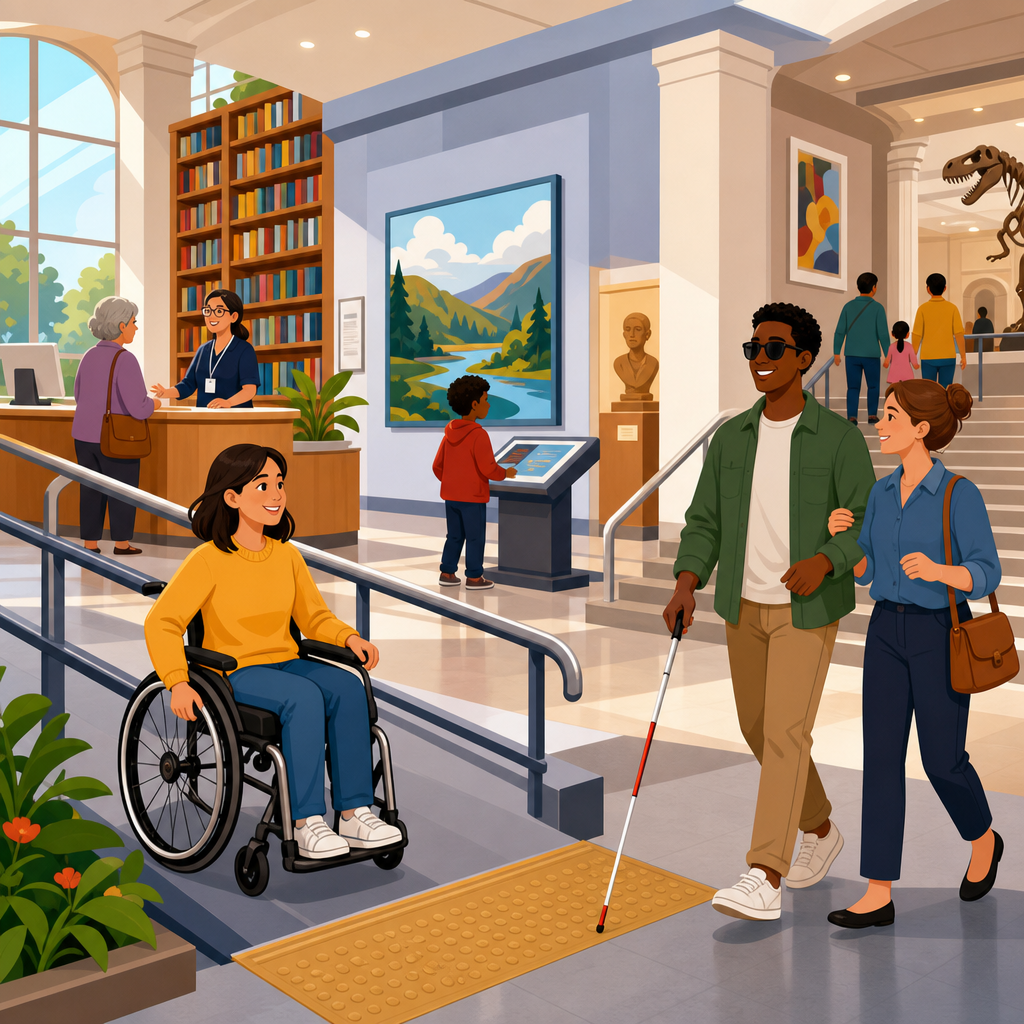
Physical access begins before a visitor reaches the front door. Parking, passenger loading, sidewalks, curb ramps, and exterior routes shape whether a person can arrive independently. Inside, the essentials include accessible entrances, doors with appropriate clear width and hardware, continuous routes, ramps or elevators where level changes occur, accessible restrooms, drinking fountains, service counters, and seating. In libraries, stack spacing, computer stations, study rooms, circulation desks, and self-check machines require attention. In museums, exhibit case height, interactive components, floor surfaces, ticket counters, and gallery circulation are common pressure points. In performance venues, wheelchair seating locations, companion seating, sight lines, stage or backstage access where relevant, and listening systems are especially important.
Historic properties create a common challenge in this sector. The ADA recognizes that some historic features may limit how changes are made, but historic designation is not a blanket exemption. I have seen institutions delay action for years because they assume preservation rules prevent upgrades. In reality, many improvements are possible through careful design: portable ramps used with trained staff, sensitively placed lifts, alternate accessible entrances with equivalent staffing and signage, tactile wayfinding, lighting improvements, and program relocation when a specific room cannot be made accessible immediately. The right approach is to document constraints, evaluate alternatives, and choose solutions that provide the greatest feasible access without unnecessary delay.
Maintenance is as important as initial design. An accessible route blocked by exhibit crates, a power-assisted door left unserviced, or a restroom used for storage can create noncompliance overnight. The same is true for temporary exhibitions and events. I advise institutions to use pre-opening accessibility walkthroughs for every major installation, because many access failures happen during changeovers rather than capital projects. Compliance is operational, not one-and-done.
Communication access and inclusive programming
Effective communication requires institutions to provide information in ways that people with hearing, vision, speech, cognitive, and language-related disabilities can use. This is broader than handing out a large-print brochure. It includes qualified sign language interpreters when needed, real-time captioning for certain events, captioned and audio-described video, assistive listening systems, accessible printed and digital materials, plain-language instructions, and staff who know how to respond to accommodation requests. For guided tours, lectures, films, readings, classes, and public meetings, communication access should be built into planning rather than treated as an exception.
Libraries have particular responsibilities because they are core information providers. Public computers may need screen reader software such as JAWS or NVDA, screen magnification, accessible keyboards, and adjustable workstations. Makerspaces and media labs should also be assessed, because inaccessible equipment can exclude users from modern library services even when traditional reading rooms are usable. Museums need to think through label readability, tactile engagement where appropriate, orientation materials, and multisensory interpretation. Cultural venues hosting performances should ensure ticket buyers can request captioning, interpreting, or accessible seating through the same channels as other customers, without hidden friction.
One area often overlooked is staff communication. Front-line employees need scripts and authority. If a visitor asks for an accessible route, requests a sighted guide, or raises a concern about a blocked path, the response should be immediate and competent. Access fails when staff improvise inconsistently. Written procedures, role-based training, and incident logging solve this. They also generate the operational record institutions need if a complaint arises.
Digital accessibility and online public services
For many organizations in this sector, the website is now the front door. Visitors buy tickets, reserve timed entry, search catalogs, access finding aids, stream programs, submit accommodation requests, and read policy information online before ever visiting in person. If those tools are inaccessible, the institution may effectively deny access at the earliest point of engagement. Although the ADA does not contain a single technical website standard within its statutory text, the most widely recognized benchmark for conformance is WCAG 2.1 Level AA, and many institutions also design toward WCAG 2.2 Level AA for current best practice.
The most common failures are predictable: images without meaningful alternative text, poor heading structure, low color contrast, inaccessible PDFs, forms that cannot be completed by keyboard, unlabeled buttons in ticketing tools, carousels that trap focus, and videos without captions or transcripts. Libraries face additional complexity with third-party ebook systems, discovery layers, archival platforms, and vendor databases. Museums often rely on collection management front ends, event plugins, and membership portals that were not selected with accessibility in mind. In audits I have led, third-party systems routinely represent the highest legal and reputational risk because institutions assume the vendor owns the problem. Under the ADA, that assumption is unsafe.
| Area | Typical Risk | Practical Control |
|---|---|---|
| Website content | Missing alt text, weak headings, low contrast | Editorial standards, automated scans, manual QA |
| Ticketing and registration | Keyboard traps, unlabeled fields, inaccessible seat maps | Vendor testing, remediation clauses, user testing |
| Video and media | No captions, no transcripts, no audio description | Caption workflow, transcript library, event planning checklist |
| Documents and PDFs | Scanned files, bad reading order, missing tags | Accessible templates, OCR, tagged PDF review |
| Third-party platforms | Inaccessible catalogs, databases, membership tools | Procurement standards, VPAT review, contract accountability |
Strong digital compliance requires governance. Publish an accessibility statement, identify a contact method for problems, test key user journeys, train content editors, and include accessibility requirements in procurement. Ask vendors for current accessibility conformance reports, but do not stop there. Validate claims with real testing, especially for high-impact functions such as payments, reservations, catalog search, and educational content delivery.
Policies, training, and risk management
Policies are where compliance becomes durable. Every cultural institution should maintain written procedures for accommodation requests, service animals, mobility devices, accessible seating, companion tickets, emergency evacuation assistance, captioning and interpreting requests, accessible document production, and digital remediation intake. These policies should be public where appropriate and embedded in staff training. Without them, compliance depends on memory and goodwill, which is unreliable during busy events or staff turnover.
Training should be recurring and role-specific. Facilities teams need to understand route clearance, door pressure, signage, and restroom upkeep. Visitor services staff need to know respectful interaction practices, ticketing protocols, and escalation paths. Educators need guidance on accessible instructional design. Marketing teams should learn how to publish accessible event pages, social media graphics, and email campaigns. IT and procurement teams must know how to evaluate accessibility in software and vendor contracts. The Department of Justice has consistently emphasized that effective implementation requires more than a written policy; it requires actual operational competence.
Risk management is not only about litigation, though that is a real concern. Complaints often begin with a single failed interaction that could have been prevented by planning. The best internal tool is an accessibility management cycle: audit, prioritize, remediate, train, document, retest, and report. Documentation matters. If an institution can show it has assessed barriers, budgeted improvements, created interim accommodations, and assigned responsibility, it is in a stronger position legally and operationally than one with no record of action. This is especially important for multi-building campuses and organizations with rotating exhibits, seasonal programming, or decentralized web publishing.
Building a sector-specific ADA compliance roadmap
A practical roadmap starts with inventory. List all public touchpoints: facilities, entrances, galleries, reading rooms, classrooms, stages, restrooms, parking, websites, catalogs, apps, ticketing systems, kiosks, documents, videos, and live programs. Then classify each item by impact and exposure. High-priority items are the barriers most likely to block core participation, such as inaccessible entry routes, unusable restrooms, inaccessible ticket purchasing, or uncaptained educational media. Next, assign standards and owners. Facilities may use the 2010 ADA Standards and state building code requirements. Digital teams may use WCAG-based checklists and assistive technology testing. Program teams should use event accessibility planning templates and communication access protocols.
Budgeting should balance quick wins and capital improvements. Quick wins include repairing door hardware, improving signage, adding captioning workflows, remediating top-traffic web pages, creating large-print materials, and publishing accommodation request procedures. Larger projects may include elevator modernization, restroom renovation, exhibit redesign, hearing loop installation, website rebuilds, and replacement of inaccessible kiosks or vendors. The institutions that make the most progress are not always the ones with the largest budgets. They are the ones that integrate accessibility into normal governance: project charters, procurement reviews, design approvals, and board reporting.
As the hub for sector-specific ADA compliance, this topic should connect outward to detailed guidance on accessible events, library technology, museum exhibition design, historic building obligations, digital document accessibility, and vendor management. The central principle is simple: access must be planned across the entire visitor journey, measured against recognized standards, and maintained over time. Start with your highest-impact barriers, document every decision, train every team, and review accessibility as a standing operational requirement. Libraries, museums, and cultural venues exist to widen public access to knowledge and culture. ADA compliance is how that mission becomes real for everyone. Audit your institution, set a roadmap, and begin closing the gaps now.
Frequently Asked Questions
What does ADA compliance mean for libraries, museums, and cultural venues?
ADA compliance for libraries, museums, and cultural venues means making sure people with disabilities can access and use the institution’s spaces, programs, services, and digital tools in a way that is equitable and practical. In these settings, compliance goes far beyond installing a ramp at the entrance. It includes accessible parking and pathways, doors and restrooms that meet usable dimensions, clear wayfinding, seating options, service counters at accessible heights, and exhibit layouts that allow wheelchair users and visitors with mobility aids to move independently. It also includes communication access, such as assistive listening systems, captioning, sign language interpretation when appropriate, accessible print materials, and policies that support visitors with service animals or sensory disabilities.
For libraries, compliance often extends to public computers, online catalogs, e-books, self-checkout systems, event registration tools, and research databases. For museums and cultural venues, it may include tactile interpretation, audio description, exhibit readability, accessible ticketing, and inclusive programming. Historic theaters and landmark buildings may have unique structural limitations, but that does not remove the responsibility to provide access. Instead, institutions are generally expected to make access available to the maximum extent feasible and to use alternative methods when full physical alteration is not possible. In practice, ADA compliance is about reducing barriers so that people with disabilities can participate fully in the same cultural, educational, and civic experiences offered to everyone else.
Do historic buildings and older cultural venues have to meet the same accessibility expectations?
Historic properties and older buildings are not exempt from accessibility obligations simply because they were built before modern accessibility standards. Libraries, museums, and cultural venues operating in older or protected structures are still expected to provide access under the ADA, but the way that access is achieved may differ depending on what changes are technically feasible and whether certain alterations would threaten the historic significance of the property. This is especially important for institutions housed in landmark buildings, former homes, converted industrial sites, or architecturally significant theaters where structural changes may be more complicated.
In these cases, the goal is still meaningful access. That may involve installing a platform lift where an elevator is not feasible, creating an accessible entrance at a side or secondary location if the main entrance cannot be modified without damaging historic features, reconfiguring seating areas, improving signage, providing staff assistance, relocating programs to accessible spaces, or offering alternative ways to experience exhibits. A venue may also need to improve restroom access, ticket counters, route widths, or emergency planning even if some original building elements remain unchanged. Historic status can affect how modifications are designed, but it usually does not eliminate the duty to remove barriers when removal is readily achievable or to provide program access through other effective methods. The strongest approach is to work with accessibility professionals who understand both ADA requirements and preservation constraints so that access improvements are practical, defensible, and respectful of the building’s history.
What are the most common ADA issues on library, museum, and cultural venue websites?
Digital accessibility is one of the most overlooked parts of ADA compliance for cultural institutions, even though websites and online services are often the first point of contact for visitors. Common problems include poor color contrast, missing alternative text for images, navigation that does not work by keyboard alone, forms that are not labeled correctly, PDFs that screen readers cannot interpret, videos without captions, audio content without transcripts, and event calendars or ticketing systems that are difficult to use with assistive technology. Many institutions also run into issues with third-party tools, such as donation platforms, room reservation systems, membership portals, digital collections, and virtual exhibit software that were never properly tested for accessibility.
For libraries, inaccessible online catalogs, e-book apps, and research tools can create major barriers to basic services. For museums and performance venues, inaccessible event pages, online ticket purchases, membership renewals, digital maps, and educational resources can exclude visitors before they even arrive. ADA compliance in the digital environment generally means designing and maintaining web content in line with recognized accessibility standards, most commonly WCAG. That includes making content perceivable, operable, understandable, and robust for users with disabilities. A good compliance strategy includes regular audits, remediation of existing content, accessible procurement practices for third-party platforms, staff training, and a process for responding quickly when users report barriers. Digital access should be treated as an ongoing operational responsibility, not a one-time project.
How can cultural institutions make exhibits, programs, and events more accessible?
Making exhibits, programs, and events accessible starts with planning for a wide range of visitor needs rather than trying to solve barriers one at a time after complaints arise. In a museum or gallery, that may include providing readable exhibit text, non-glare materials, accessible mounting heights, seating throughout exhibit spaces, tactile elements when appropriate, audio description, large-print guides, captioned media, and quiet areas for visitors who may become overstimulated. In libraries, accessible programming can involve wheelchair-friendly room layouts, microphones and assistive listening technology for speakers, visual presentation materials that are easy to read, sensory-friendly story times, and inclusive workshop design for children and adults with differing communication and mobility needs.
For lectures, performances, tours, and educational programming, accessibility often depends on communication supports as much as physical access. Captioning, CART services, sign language interpretation, advance access information, flexible seating, and clear procedures for accommodation requests can make a significant difference in participation. Staff training matters as well. Frontline employees should know how to welcome visitors with disabilities, explain available accommodations, respond appropriately to access requests, and avoid creating unnecessary barriers through inconsistent policies. It is also important to review emergency procedures, ticketing practices, companion seating, service animal policies, and marketing materials so they reflect actual access options. The most effective institutions build accessibility into exhibit design, program development, and event operations from the beginning, which improves both compliance and the visitor experience.
What is the best way for a library, museum, or cultural venue to improve ADA compliance over time?
The best approach is to treat accessibility as an ongoing institutional commitment rather than a one-time renovation or checklist. A strong ADA compliance strategy usually begins with a comprehensive assessment of the facility, website, programs, and policies to identify current barriers. That review should look at entrances, circulation routes, restrooms, service desks, seating, signage, emergency procedures, digital content, online services, and public programming. It should also examine less obvious issues, such as staff training, procurement standards, accommodation request processes, and whether accessibility information is clearly communicated to the public.
After the assessment, institutions should prioritize improvements based on legal risk, frequency of use, severity of the barrier, and the impact on meaningful participation. Some issues can be fixed quickly, such as updating website content, adjusting furniture layouts, adding signage, or revising event registration forms. Others may require budgeting and phased capital planning, such as restroom renovations, route improvements, lift installation, or technology upgrades. It is also wise to document decisions, timelines, and remediation efforts so the organization can show good-faith progress. Many institutions benefit from appointing an accessibility coordinator or cross-functional team to monitor compliance, oversee projects, and gather feedback from patrons with disabilities. The most successful cultural organizations understand that accessibility evolves with programming, technology, and visitor expectations, so regular audits, policy updates, and direct engagement with disability communities should remain part of long-term operations.