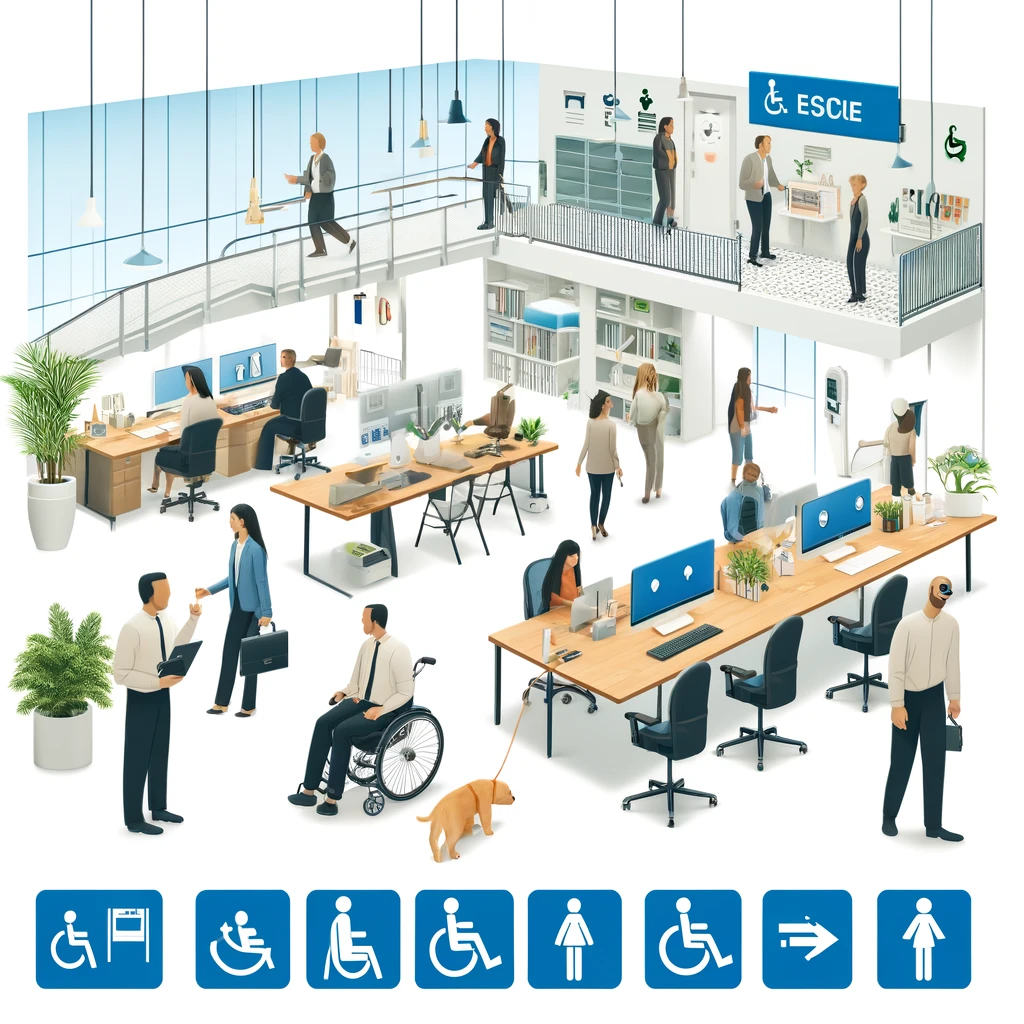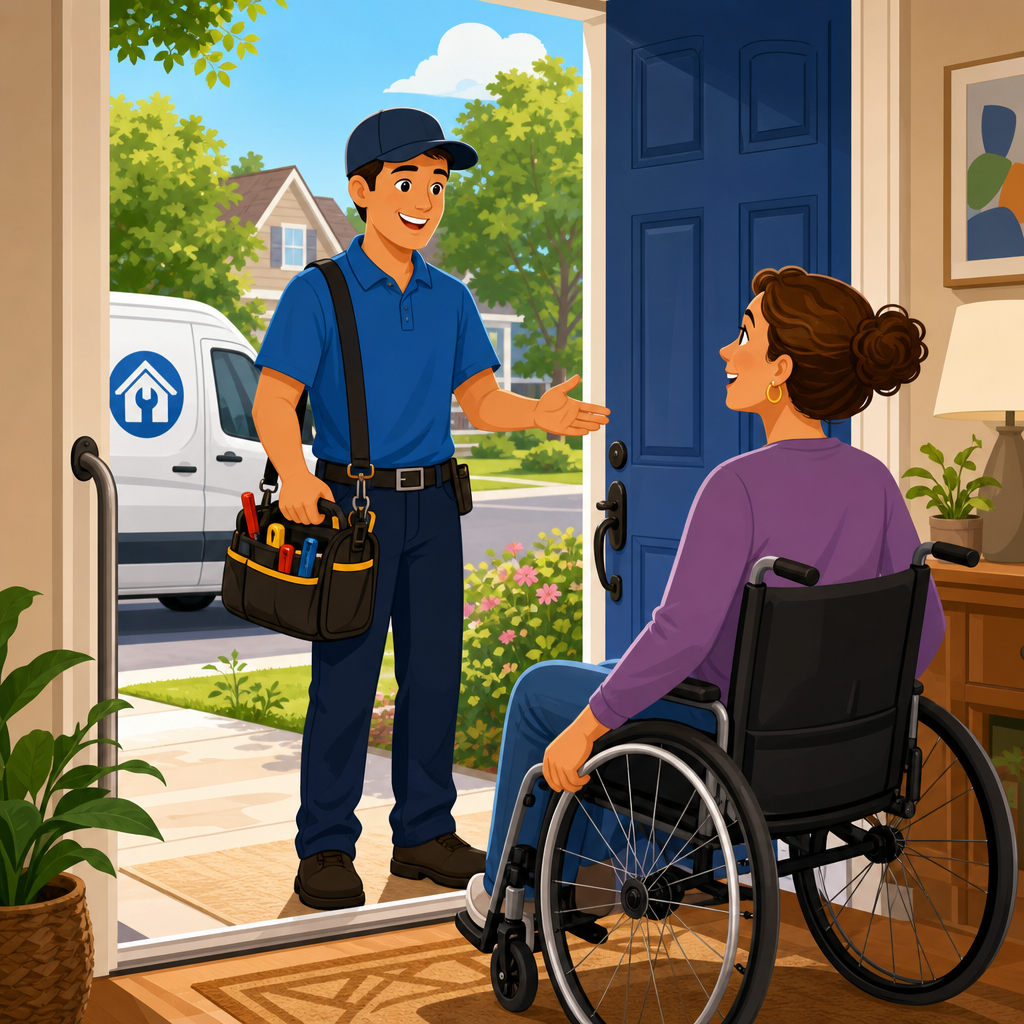
ADA compliance for home services businesses that enter customer homes is more nuanced than many owners expect, because the legal duties, operational risks, and customer experience issues extend far beyond a wheelchair ramp at an office door. For plumbers, electricians, HVAC contractors, cleaners, restoration crews, landscapers, pest control technicians, and in-home care providers, compliance means delivering services in ways that do not unlawfully exclude people with disabilities, while also training teams to communicate clearly, document decisions, and adapt standard processes when reasonable modifications are needed.
The Americans with Disabilities Act, or ADA, is a federal civil rights law that prohibits discrimination based on disability in employment, state and local government services, public accommodations, commercial facilities, transportation, and telecommunications. For home services companies, the most relevant parts are usually Title I, which covers employment, and Title III, which covers private businesses that serve the public. Many companies assume that because most work happens in a customer’s private residence, the ADA does not apply. In practice, the business itself still must provide equal access to its services, customer communications, scheduling systems, websites, call centers, invoices, and in-person interactions.
This matters because home services often involve essential needs: heat, water, electricity, sanitation, mobility support, safety monitoring, and environmental health. If a deaf customer cannot book an emergency repair, a blind homeowner cannot review digital estimates, or a customer with a mobility impairment is denied a practical service accommodation, the problem is not just poor service; it can become a discrimination claim, a complaint to regulators, litigation exposure, reputational damage, or lost recurring revenue. I have seen routine dispatch issues escalate simply because no one had defined how technicians should handle service animals, interpreters, accessible documents, or a request to explain work verbally instead of pointing to a screen.
Sector-specific ADA compliance is the discipline of translating broad disability access rules into the daily realities of a particular industry. In home services, that means mapping legal duties to dispatch workflows, field operations, customer communication, payment collection, safety protocols, subcontractor oversight, and digital tools. This hub article explains the core standards that apply across the sector and sets the foundation for deeper articles on websites, service animals, communication access, physical office accessibility, employee accommodations, and complaint handling.
How the ADA Applies to Home Services Businesses
The central question is simple: if your company offers services to the public, can a person with a disability access those services on terms that are as effective as those offered to others? For most home services businesses, the answer depends less on the customer’s house and more on the business policies controlling intake, scheduling, communication, and service delivery. A private residence is not usually transformed into a public accommodation just because a technician enters it, but the company remains responsible for discriminatory decisions made before, during, and after the visit.
Common examples include refusing to communicate with a customer who uses relay services, insisting that all approvals be signed only on a technician’s mobile phone screen, charging extra because a customer needs information read aloud, or declining to enter a home because of a trained service dog. The Department of Justice has long treated unnecessary eligibility criteria, ineffective communication, and failure to make reasonable modifications as recurring ADA problems. In practical terms, if your process works only for customers who can hear well, see standard print, speak clearly on the phone, stand for long periods, or navigate an app without assistive technology, your process likely needs revision.
Owners should also understand the difference between legal coverage and operational best practice. A company may not be legally required to modify every aspect of work inside a residence, especially where safety or structural limits apply, but it is expected to assess requests individually rather than rely on blanket rules. That is why a written decision framework matters. It helps staff distinguish between a reasonable modification, such as providing appointment updates by text instead of voice call, and an undue burden or direct threat, such as asking a technician to disable critical safety controls to accommodate a preference.
Customer-Facing Access: Communication, Scheduling, and Digital Tools
Most accessibility failures happen before a truck arrives. A customer first encounters your business through search results, local listings, ads, a website, a chatbot, online booking, or a call center. If any of those channels are inaccessible, the service itself is effectively blocked. For that reason, home services companies should treat communication access as the core of ADA compliance. In my audits, the most common fixes are not construction projects; they are workflow changes such as adding text-capable phone numbers, captioned video estimates, screen-reader-friendly forms, and documented procedures for relay calls.
Website accessibility is a major part of this. Service area pages, financing applications, maintenance plan signups, contact forms, coupon pages, and emergency request tools should work with keyboard navigation, appropriate color contrast, meaningful form labels, alt text for informative images, and clear error identification. The Web Content Accessibility Guidelines, currently most often referenced at Level AA, remain the recognized benchmark for digital accessibility. Courts and settlements have repeatedly treated inaccessible websites and mobile experiences as barriers to public-facing services, especially when booking or account management cannot be completed another way.
Phone and field communication deserve equal attention. Customers may request large-print estimates, emailed invoices instead of paper slips, plain-language explanations, or extra time to process options. Deaf or hard-of-hearing customers may use Video Relay Service or text. Blind customers may prefer documents that are readable by screen readers. Customers with cognitive disabilities may need step-by-step explanations without rushed jargon. None of these requests is unusual in the field. A dispatcher script and technician checklist can solve most of them consistently.
| Operational area | Typical barrier | Practical compliance action |
|---|---|---|
| Booking | Phone-only scheduling | Add accessible web forms, text options, and relay-call training |
| Estimates | Signature required on small tablet screen | Offer email, accessible PDF, verbal review, and alternate signature methods |
| Arrival updates | Audio-only robocalls | Provide SMS and email notifications with clear technician details |
| In-home explanation | Fast verbal walkthrough only | Use plain language, written summaries, photos, and confirmation questions |
| Payments | Inaccessible financing portal | Vet vendor accessibility and provide assisted completion options |
Reasonable Modifications in the Home Service Context
A reasonable modification is a change to a policy, practice, or procedure when needed to give a person with a disability equal access, unless the change would fundamentally alter the service or create a direct safety risk that cannot be mitigated. In home services, this often sounds more complicated than it is. If a customer asks a technician to knock instead of using a doorbell that they cannot hear, to speak facing them for lip reading, to move a portable payment device within reach, or to describe visual findings aloud, the answer is usually yes.
More complex requests require structured analysis. Suppose a pest control company has a standard rule that customers and animals must leave during treatment. If a customer uses a service animal, the company should not deny service automatically. It should assess whether the treatment chemicals, label instructions, and environmental conditions permit a safe alternative, such as timing adjustments, room-by-room sequencing, or temporary separation. The correct approach is individualized assessment grounded in safety data sheets, product labeling, and technician training, not assumptions about disability.
Another common issue is appointment windows. A customer with a disability may need a narrower service window because of medication schedules, caregiver coordination, or fatigue. While a company may not be required to guarantee an exact minute of arrival in every case, it should examine whether priority scheduling, first-call dispatch, or live ETA updates are feasible. These small changes often cost little and materially improve access. What creates risk is a rigid policy applied without considering alternatives.
Field Staff Training, Safety, and Service Animals
Technicians carry the compliance burden into the home, so training must be practical, brief, and repeated. Staff should know how to interact respectfully with customers who have speech, hearing, vision, mobility, cognitive, or psychiatric disabilities. They should avoid touching mobility aids, speaking only to companions, or making assumptions about competence. They should know when to pause, rephrase, write information down, or call a supervisor for help. In real operations, a two-page field guide and scenario-based training outperform a long legal memo every time.
Service animals require special attention because confusion is common. In most customer-facing business settings, trained service dogs are generally allowed to accompany a person with a disability. Staff may ask only limited questions when the need is not obvious: whether the dog is required because of a disability and what work or task the dog has been trained to perform. They should not demand documentation, require a vest, or treat the animal as a pet. If a legitimate safety issue exists during a repair, the discussion should focus on temporary positioning or environmental controls, not exclusion.
Safety is not a loophole for convenience, but it is a real factor in field work. Electrical panels, confined spaces, gas leaks, mold remediation zones, and ladder setups create hazards that can limit what modifications are possible. The right standard is objective risk assessment. If a requested change would violate OSHA practices, manufacturer instructions, building code requirements, or chemical application rules, document the reason and propose an alternative. Well-run companies teach technicians to explain, not just refuse.
Employment Compliance for Teams That Work in the Field
Home services employers also need ADA-compliant employment practices. Recruitment, interviews, medical inquiries, return-to-work decisions, and on-the-job accommodations must be handled carefully. The Equal Employment Opportunity Commission expects employers to engage in an interactive process when an employee or applicant needs an accommodation. In field roles, accommodations can include modified schedules, reassignment of marginal tasks, voice-to-text software, ergonomic tools, vehicle step assists, hearing protection alternatives, or leave as an accommodation when reasonable.
Not every requested accommodation is required. A technician must still be able to perform the essential functions of the job, with or without reasonable accommodation. That means job descriptions should identify the true essentials: lifting thresholds, ladder climbing, driving, use of diagnostic tools, customer communication, and emergency response duties. I regularly find job descriptions that are either so vague they are useless or so inflated they list nonessential functions as mandatory. Both mistakes create risk when an accommodation request arrives.
Confidentiality matters too. Medical information must be stored separately and shared only with those who need it. Supervisors can be told about necessary restrictions and accommodations, but not broad diagnostic details. Companies with decentralized branch operations should standardize forms, designate accommodation decision-makers, and train frontline managers not to make off-the-cuff medical judgments. Consistency is what protects both the employer and the employee.
Implementation, Documentation, and Ongoing Governance
Effective compliance is built through systems, not slogans. Start with a gap assessment covering customer touchpoints, field procedures, employment practices, digital assets, vendor platforms, and complaint logs. Then create written policies for communication access, reasonable modifications, service animals, website updates, field escalation, and employee accommodations. Assign ownership across operations, HR, marketing, and IT. If nobody owns accessibility, it will drift until a complaint forces attention under pressure.
Documentation should be simple and usable. Keep records of requests, actions taken, alternatives offered, and reasons for denials. Review call recordings and dispatch notes for patterns. Audit forms, financing links, and maintenance agreement portals after major software updates. Include accessibility expectations in vendor contracts, especially for booking tools, payment systems, and customer portals. Third-party software is a frequent hidden failure point, and your customer will still blame your brand when a portal is unusable.
Finally, treat this hub topic as a living compliance program. Sector-specific ADA compliance for home services connects directly to web accessibility, accessible documents, office accessibility, employee accommodation procedures, and complaint response playbooks. Businesses that build these processes early reduce legal exposure, serve more households effectively, and earn trust in moments when customers are stressed and need help fast. Review your policies, train your teams, test your customer journey, and fix the barriers before a customer has to point them out.
Frequently Asked Questions
Does the ADA apply to home services businesses if most of the work happens inside a customer’s private residence?
Yes, in many situations it does, but the answer is more nuanced than owners often assume. A home services business may not operate a traditional customer-facing storefront, yet it can still have obligations under the Americans with Disabilities Act depending on how it offers services, communicates with customers, manages scheduling, handles intake, and interacts with the public. The fact that a plumber, electrician, HVAC company, cleaning service, pest control provider, or in-home care agency performs work in private homes does not automatically remove it from disability access requirements. If the business has an office open to the public, a showroom, a website used for booking, customer service phone systems, or standard policies that affect who can receive services and how, those touchpoints can create ADA-related responsibilities.
For many home services businesses, the practical compliance question is not simply whether a building has a ramp. It is whether the company provides equal access to its services. That includes making reasonable modifications to policies when needed, communicating effectively with customers who have hearing, vision, speech, cognitive, or mobility disabilities, and avoiding blanket rules that unnecessarily exclude disabled customers. For example, requiring all scheduling to happen only through a difficult-to-use online form, refusing to communicate by text or email when needed for accessibility, or failing to accommodate a customer who needs more time to answer the door could create real legal and customer service problems.
It is also important to separate the customer’s home from the business’s conduct. The ADA does not generally require a business to remodel a customer’s private residence. However, it can still require the business to deliver services in a nondiscriminatory way. That means training field staff, documenting accommodation procedures, reviewing dispatch and communications systems, and making sure disabled customers are not turned away or treated as too difficult to serve. In short, even when the work happens in a private home, the business itself still needs to operate in a way that provides fair and usable access to the people it serves.
What does ADA compliance look like in day-to-day operations for plumbers, electricians, HVAC contractors, cleaners, and similar in-home service providers?
In daily operations, ADA compliance usually shows up in policies, communication methods, scheduling practices, and technician behavior more than in construction features. For home services companies, the most important issue is whether customers with disabilities can actually request, receive, understand, and benefit from the service on substantially equal terms. That begins with intake. Can a customer book by phone, email, text, or another practical method if one format is inaccessible to them? Are staff trained to speak clearly, listen patiently, and avoid assumptions about what a disabled customer can or cannot manage? Can appointment reminders be delivered in an accessible way?
Once a job is scheduled, compliance continues through field service procedures. Technicians may need to identify themselves clearly, wait longer at the door, call upon arrival instead of relying only on knocking, or explain repair recommendations in plain language if a customer has a cognitive or communication disability. A cleaner or restoration crew may need to coordinate pathways through the home for a customer using a wheelchair or walker. An HVAC technician may need to provide written follow-up instructions in a larger, easier-to-read format. A pest control provider may need to communicate chemical safety guidance in a way the customer can understand and use. None of these steps are extreme; they are examples of providing service access in a practical and respectful way.
Policies deserve special attention because they are where many avoidable ADA issues begin. A “no third-party communications” rule, a strict “customer must answer the door immediately or we leave” rule, or a refusal to deal with interpreters, caregivers, or authorized family members can create barriers. So can inflexible payment procedures, inaccessible digital invoices, or failure to accommodate service animals when the business interacts with customers at an office location. Strong compliance in this setting means building flexibility into normal procedures, giving staff guidance on reasonable modifications, and treating accessibility as part of service quality rather than as an exception handled only when a complaint arises.
Are home services businesses required to make accommodations for customers with disabilities inside the customer’s home?
Often, yes, to the extent that the accommodation relates to how the business delivers its service and does not fundamentally alter the work or create a legitimate safety issue. This is where many owners need clarity. The law generally does not require a home services company to renovate or control the customer’s home environment, but it can require the company to change the way it communicates, schedules, enters, explains, and performs services so the customer has meaningful access. These are usually called reasonable modifications, and they are highly fact-specific.
Examples can help. A technician may need to call when arriving because the customer cannot hear knocking. A dispatcher may need to communicate with a deaf customer by text or email instead of insisting on voice calls. An in-home estimate may need to include a caregiver or support person at the customer’s request. A service provider may need to explain next steps more slowly or in writing for a customer with a cognitive disability. A cleaning crew may need to work around mobility equipment rather than asking the customer to move it without assistance. In many cases, these are simple adjustments that improve both compliance and customer trust.
That said, accommodation is not unlimited. A business does not usually have to accept a request that would create a direct threat to health or safety, require specialized services outside the scope of the business, or fundamentally change the nature of the work. For example, if an electrician cannot safely perform a repair unless a certain area is cleared, safety can still come first. The key is to avoid using safety as a pretext for inflexibility. Instead, businesses should engage in a practical problem-solving process: identify the barrier, consider alternatives, communicate respectfully, and document the outcome. That approach helps owners serve customers more effectively while reducing the risk of discrimination claims based on rigid or poorly explained decisions.
What are the biggest ADA risk areas for home services businesses beyond physical accessibility?
The biggest risk areas are often communication failures, inaccessible technology, inconsistent field practices, and poorly written policies. Many home services businesses focus on whether their office entry is accessible, but the larger exposure may come from the customer journey before the technician ever arrives. If a disabled customer cannot navigate the website, complete a service request form, understand the pricing process, receive appointment updates, or communicate effectively with dispatch, the business may already be creating a barrier to access. These issues are especially important today because so much scheduling, payment, and customer support now happens online or through mobile devices.
Another common risk area is employee discretion without training. Field technicians, sales staff, estimators, and dispatchers often make real-time decisions that affect accessibility. If they have no guidance, they may unintentionally deny service, speak only to a companion instead of the customer, refuse a reasonable scheduling adjustment, or react defensively to an accommodation request. Even well-meaning employees can create legal and reputational problems when there is no clear protocol. Written procedures for communication access, service animals where applicable, accompaniment by caregivers, accessible documents, and complaint handling are essential.
Documentation and consistency also matter. Businesses get into trouble when they say they accommodate disabilities but cannot show how that works in practice. A strong compliance program includes staff training, internal escalation paths for unusual situations, and records showing that requests were evaluated thoughtfully rather than dismissed. Companies should also review third-party systems, such as booking platforms, call centers, payment vendors, and customer portals, because accessibility problems in those tools can still affect the customer’s access to service. In this industry, ADA risk is not limited to premises liability; it is deeply tied to operations, technology, and customer-facing decision-making.
How can a home services business improve ADA compliance without overcomplicating operations or creating major costs?
The most effective approach is to build accessibility into existing service systems instead of treating it as a separate project. Start with the customer journey from first contact through payment and follow-up. Review how customers book appointments, receive estimates, communicate with dispatch, confirm arrivals, understand service recommendations, and access invoices or receipts. Look for avoidable barriers. Can customers use more than one communication channel? Are website forms and digital documents reasonably accessible? Do staff know what to do if a customer requests extra time, written instructions, text-based communication, or the involvement of a caregiver or interpreter?
Next, create a short but practical policy framework. Staff do not need a legal treatise; they need usable guidance. Define who handles accommodation requests, what kinds of modifications are commonly available, when safety concerns should be escalated, and how to document exceptions. Train dispatchers, office staff, estimators, and field technicians together so everyone understands that accessibility is part of service delivery, not just a legal issue for management. Real-world scenarios work especially well: a customer who cannot hear the doorbell, a customer who needs instructions in writing, a customer with limited speech, or a customer who needs a flexible arrival protocol.
Finally, treat ADA compliance as an ongoing quality-improvement issue. Ask for feedback, review complaints, and revisit recurring problems in scheduling, communication, and technician conduct. Many improvements cost little or nothing, such as allowing text confirmations, using plain-language explanations, extending wait times at arrival, or standardizing respectful communication practices. Where costs do exist, they are often modest compared with the expense of lost