ADA compliance for community festivals and seasonal attractions determines whether temporary public events are genuinely open to everyone, including people with mobility, vision, hearing, cognitive, and sensory disabilities. In practical terms, it means planning accessible routes, parking, ticketing, stages, restrooms, food service, communication, and emergency procedures so guests can participate with dignity and independence. Community festivals, pumpkin patches, holiday light shows, county fairs, street markets, haunted houses, and pop-up winter villages often operate on compressed timelines and in improvised spaces, which makes accessibility both more difficult and more important. I have worked with event teams that assumed temporary meant exempt, only to discover that the Americans with Disabilities Act still applies to public accommodations, state and local government programs, and many private operators serving the public. The core legal idea is straightforward: if you invite the public, you must remove barriers where readily achievable, provide effective communication, and make reasonable modifications unless doing so would fundamentally alter the activity or create an undue burden. For organizers, this matters because accessible events expand attendance, reduce complaint risk, improve safety, and strengthen community trust. For this sector-specific ADA compliance hub, the goal is to give planners, venue managers, vendors, municipal partners, and nonprofit boards a clear framework they can use across every seasonal event they host.
What ADA compliance means for temporary events and seasonal venues
Sector-specific ADA compliance starts with understanding which rules apply to which operator. Title II covers programs and services of state and local governments, including city-sponsored festivals in parks or on downtown streets. Title III covers private businesses and nonprofits operating places of public accommodation, such as ticketed holiday attractions, corn mazes, craft fairs, or private fairgrounds open to the public. Temporary status does not erase accessibility duties. If a route is created with portable flooring, if a box office is set up under a tent, or if toilets are rented for a weekend, those elements still need to be accessible to the extent required by law and by practical event design standards.
The most useful way to think about compliance is by the guest journey. A person must be able to find information before arrival, travel from transportation or parking to the entrance, move around key activity areas, use restrooms, buy food or merchandise, receive announcements, and exit safely during normal operations or an emergency. Problems often arise because organizers focus on one point, such as an accessible portable toilet, while overlooking the route to reach it, the turning space inside, the handwashing station height, or nighttime lighting. Effective planning treats accessibility as a continuous system, not a checklist of disconnected items.
Seasonal attractions add special complexity. Grounds may be muddy, icy, sloped, or dark. Crowds surge at set times. Features such as hayrides, scare zones, sensory-heavy performances, and temporary bleachers create unique barriers. Because these events change annually, each season requires a fresh accessibility review. Returning to last year’s site plan without verifying grades, routes, queue layouts, signage placement, and vendor arrangements is a common source of preventable failures.
Accessible site planning: routes, parking, entrances, and circulation
The physical layout of a festival is where most compliance problems become visible. Start with accessible parking if parking is provided. Spaces should include compliant access aisles, firm and stable surfaces, clear signage, and an accessible route to the event entrance. Overflow lots on grass may work for many drivers but not for wheelchair users if the soil is soft or rutted. When I audit festival sites, temporary matting or paved drop-off zones often solve more access problems than adding more inaccessible parking spaces farther away. If valet or shuttle service is offered, accessible vehicles and boarding procedures must be part of the transportation plan.
Entrances need enough width, stable surfaces, and queue management that does not trap wheelchair users behind ropes, curbs, or narrow turnstiles. Portable ticket counters should include a lowered service position. Security screening should allow equivalent access, including alternate inspection methods for mobility devices and medical equipment. Once guests enter, organizers need at least one accessible route connecting major functions: admission, stages, restrooms, food areas, first aid, merchandise, children’s zones, and exits. This route should be firm, slip resistant, and reasonably level. Gravel, mulch, deep grass, and uneven cobblestone are recurring barriers at seasonal sites.
Because community events often use streets, farms, fairgrounds, or parks not originally designed for inclusive circulation, planners should map primary and secondary routes before assigning booths or attractions. Place high-demand destinations on the most accessible path. Avoid forcing disabled guests into long detours to reach seating, concessions, or family activities. Good route planning also improves stroller access, vendor deliveries, and emergency response.
| Event element | Common barrier | Practical ADA-focused fix |
|---|---|---|
| Parking | Grass lot with no marked accessible spaces | Create signed spaces on firm matting near an accessible entry route |
| Entrance | Narrow gate and high portable threshold | Use a wider gate panel and flush threshold treatment |
| Main route | Loose gravel between zones | Install compacted surface or temporary access flooring |
| Queue | Switchbacks too tight for wheelchairs | Widen turns and provide an equivalent accessible waiting path |
| Seating | Wheelchair users placed only at the rear | Disperse companion seating with varied sightlines |
Communication access, ticketing, and digital information
Many event operators underestimate communication access, yet complaints frequently stem from inaccessible information rather than physical barriers alone. Event websites, ticketing pages, maps, schedules, waiver forms, and parking instructions should work with screen readers, keyboard navigation, zoom, and color-contrast needs. If online ticketing includes timed entry, discount codes, or mandatory account creation, those features must be operable without a mouse and understandable to users with assistive technology. PDF maps posted the night before an event are a poor substitute for accessible web content.
At the event itself, effective communication may require qualified sign language interpreters, real-time captioning for major announcements, assistive listening systems, printed material in large print, tactile or high-contrast wayfinding, and staff trained to answer accessibility questions accurately. The standard is not identical accommodation for every program, but communication that is as effective as communication with others. For a music festival, that can mean captioned video screens, clearly marked interpreter viewing areas, and accessible emergency announcements. For a haunted attraction, it may include pre-show written safety instructions, sensory warnings, and alternative participation options for guests who cannot navigate intense audio or visual effects.
Service animal policies also need precise communication. Staff should know the two permitted questions under federal guidance when the disability and task are not obvious, and they should not demand documentation. Clear online accessibility pages reduce confusion by explaining parking, routes, restroom locations, sensory considerations, companion policies, and request procedures in advance. That page should be part of every compliance and implementation workflow for sector-specific ADA compliance, because guests plan attendance decisions around reliable information.
Stages, rides, food service, restrooms, and high-risk seasonal features
Program access goes beyond getting through the gate. If a festival offers performances, guests using wheelchairs need integrated seating with companion locations and comparable sightlines, not a token space beside a trash can or in a blocked egress path. Temporary stages should include performer access where performers, speakers, or award recipients with disabilities may need to participate. Back-of-house accessibility is often overlooked at community events run by volunteers, but it matters for inclusive employment, community recognition, and public participation.
Food and retail vendors should be arranged so aisles remain navigable and counters are usable. Menus posted only on high chalkboards are not effective for many guests. A simple printed menu, staff assistance policy, and reachable condiment area make a major difference. Portable restrooms must include compliant accessible units placed on firm surfaces with sufficient clearances outside the door. If sinks, soap, and paper towels are in separate handwashing stations, their operability and route access must be checked too. I regularly see accessible portable toilets rendered unusable by mud, slopes, or crowd-control fencing.
Seasonal attractions frequently include specialized features with their own accessibility considerations. Hayrides may require transfer procedures, clear staff instructions, and alternative experiences when lift-equipped boarding is not feasible. Corn mazes need route information, rest points, and emergency extraction planning. Ice rinks may provide sled-style adaptive equipment or scheduled sessions with reduced crowd density. Holiday light trails should account for glare, low vision wayfinding, and cold-weather resting areas. Haunted houses and immersive scare attractions need careful assessment of strobe effects, narrow passageways, air blasts, crawling segments, and evacuation methods. Not every feature can be made identical for every guest, but operators must evaluate reasonable modifications and equivalent experiences rather than defaulting to exclusion.
Operations, staff training, emergency planning, and continuous improvement
Even a well-designed site can fail if operations are inconsistent. Staff training should cover accessible routes, restroom locations, seating policies, service animals, mobility device etiquette, communication assistance, evacuation support, and complaint escalation. Volunteers especially need concise scripts and maps. When a guest asks where the accessible entrance is, the answer should never be, “I think it’s somewhere around back.” A designated accessibility coordinator, radio call sign, and documented response protocol prevent small issues from becoming public incidents.
Emergency planning is a major part of ADA compliance for community festivals and seasonal attractions. Organizers should align accessibility procedures with broader life-safety planning, including severe weather, fire, medical response, lost child incidents, and crowd surges. Accessible evacuation routes, areas of refuge where applicable, backup lighting, visual and audible alerts, and transportation contingencies for guests with mobility disabilities should be addressed in advance. Public agencies often use Incident Command System principles; private operators benefit from the same structure because roles, communications, and decision authority become clear under pressure.
Continuous improvement is what turns one compliant event into a repeatable compliance and implementation program. Conduct pre-opening walkthroughs, mid-event spot checks, and post-event debriefs focused specifically on accessibility. Collect feedback from disabled attendees, interpreters, wheelchair users, parents of autistic children, and vendors. Track recurring issues such as inaccessible queue layouts, poor sign placement, or muddy routes after rain. The strongest sector-specific ADA compliance programs build accessibility into procurement, site maps, vendor agreements, sponsorship planning, and capital budgeting instead of treating it as a last-minute accommodation request.
Community festivals and seasonal attractions succeed when accessibility is planned as a core operational standard rather than a special add-on. The essential lessons are consistent across this sector-specific ADA compliance hub: temporary events are not exempt, the guest journey must be accessible from digital information through exit, and every major program element deserves review under real operating conditions. Strong compliance and implementation practices combine legal knowledge with practical field decisions about surfaces, routes, seating, communication, staffing, and emergency readiness. They also recognize tradeoffs honestly. A farm field will never behave like a convention center, but thoughtful route design, clear disclosures, reasonable modifications, and equivalent experiences can dramatically expand access. Organizers that do this well reduce risk, welcome more families, and build a reputation for professionalism that carries from one season to the next. Use this hub as the starting point for deeper work on parking, restrooms, communication access, temporary structures, vendor management, and event policies, then audit your next festival before the first ticket is sold.
Frequently Asked Questions
What does ADA compliance mean for community festivals and seasonal attractions?
ADA compliance for community festivals and seasonal attractions means making sure temporary public events are designed and operated so people with disabilities can participate as fully and independently as possible. For event organizers, that goes far beyond avoiding obvious barriers. It includes accessible parking, clear arrival paths, stable walking surfaces, ticketing and entry procedures, seating options, restrooms, food and beverage service, wayfinding, communication access, and emergency planning. Because these events are often held in parks, fields, fairgrounds, downtown streets, or other temporary spaces, accessibility must be planned intentionally rather than assumed.
In practice, compliance starts with understanding that accessibility affects guests with mobility disabilities, vision loss, hearing loss, cognitive disabilities, sensory sensitivities, and other access needs. A guest using a wheelchair may need an accessible route from parking to ticketing, then to attractions, restrooms, and concessions. A guest who is deaf or hard of hearing may need effective communication at performances, announcements, or guest services. A guest with low vision may rely on high-contrast signage and predictable layouts. A guest with sensory sensitivities may benefit from quieter areas, reduced overstimulation, and clear pre-visit information.
It also means thinking about the entire guest experience, not just a single feature. An event is not meaningfully accessible if there is one accessible entrance but no accessible restroom nearby, or if an accessible viewing area exists but is impossible to reach over mud, gravel, or steep slopes. The ADA is about equal access to the program, service, or activity as a whole. For festivals, haunted attractions, county fairs, holiday light displays, and pumpkin patches, that requires site-specific planning, staff training, and a willingness to adjust operations before and during the event.
What are the most important accessibility features to plan before a festival or seasonal event opens?
The most important accessibility features usually begin with arrival and circulation. Accessible parking should be provided in enough quantity, located as close as possible to the accessible entrance, and connected by a stable, slip-resistant route. If parking is off-site and guests are shuttled in, organizers should confirm that the shuttle system itself is accessible. Once guests arrive, routes to ticketing, attractions, seating, restrooms, and concessions should be wide enough, clearly marked, and usable for people with mobility devices, strollers, service animals, and guests who need extra personal space.
Temporary surfaces deserve special attention because they are one of the most common weak points at seasonal attractions. Grass, gravel, hay, mulch, uneven pavement, cable covers, and soft dirt can all create access problems. Organizers should evaluate where mats, decking, temporary ramps, or alternative routes are needed. Restroom access is equally critical. If portable toilets are used, accessible units should be included and placed on an accessible route, with enough maneuvering space around them. The same principle applies to handwashing stations, water stations, and food service counters.
Communication access is another major priority. Guests should be able to find accurate accessibility information before they arrive, including parking details, route conditions, restroom availability, service animal policies, and contact information for accommodation requests. On-site signage should be readable, consistent, and placed where people can actually see it. For performances, presentations, or amplified announcements, event planners should consider captioning, assistive listening options, interpreters when appropriate, and visual methods for sharing urgent updates. Finally, staff training is essential. Even a well-designed site can fail if frontline workers do not know where accessible entrances are, how to respond to accommodation requests, or how to communicate respectfully with guests with disabilities.
How can temporary events make outdoor spaces like fairgrounds, farms, and parks more accessible?
Outdoor spaces can absolutely be made more accessible, but they require realistic planning and honest evaluation. Organizers should start by mapping the guest journey from arrival to departure and identifying where natural terrain, weather, and temporary infrastructure create barriers. A community event held on a farm or in a park may not be able to make every inch of the site fully accessible, but it should provide meaningful access to the core experiences being offered. That may mean establishing firm pathways to major attractions, creating accessible viewing areas, adjusting queue layouts, and offering alternatives where terrain makes a particular feature impractical.
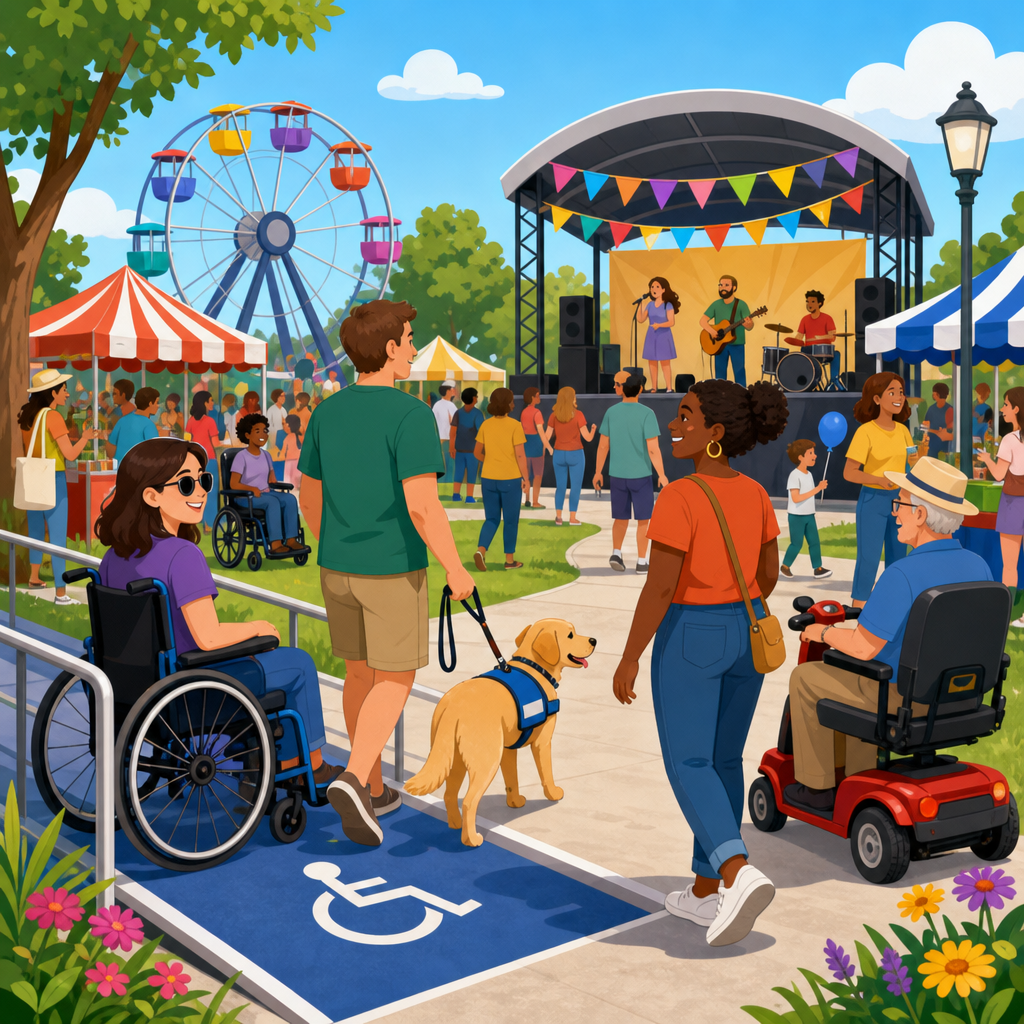
One of the best strategies is to define a primary accessible route that connects the most important parts of the event. That route should be stable, clearly marked, and maintained throughout the event. If rain, mud, dust, or heavy foot traffic changes conditions, staff should be ready to respond quickly with maintenance, rerouting, or assistance. Seating areas should include spaces for wheelchair users and companions, with lines of sight that allow guests to actually enjoy performances or displays. If the event includes hayrides, mazes, petting zoos, cornfields, carnival areas, or light trails, planners should evaluate whether each activity is accessible as offered, can be modified, or needs an alternative experience to provide comparable participation.
Accessible design outdoors also includes sensory and cognitive considerations. Crowded, noisy, high-stimulation environments can be difficult for many guests. Quiet spaces, clear maps, predictable schedules, and staff who can answer questions calmly and consistently make a significant difference. Lighting should support safety without creating unnecessary confusion, especially at evening and holiday events. Organizers should also think through service animal navigation, rest breaks, shelter from weather, and emergency egress. Outdoor accessibility is rarely solved by one feature; it is achieved by combining route planning, operational flexibility, communication, and ongoing site monitoring.
Do seasonal attractions need accessible communication, ticketing, and customer service, or is physical access enough?
Physical access alone is not enough. ADA compliance also involves effective communication and equal access to the processes that surround the event, including marketing, reservations, ticket purchasing, check-in, on-site announcements, and customer service. If a guest cannot understand how to attend, cannot buy a ticket through the website, cannot hear instructions, or cannot request an accommodation easily, the event is still creating barriers even if the path from the parking lot is accessible.
Accessible ticketing should start online. Event websites and ticket platforms should be usable with screen readers and keyboard navigation, and they should clearly explain accessibility features such as parking, entrances, seating, restroom availability, and whom to contact for specific needs. If timed-entry systems are used, the policies should not unintentionally disadvantage guests who need more time, flexibility, or support. If the event requires mobile ticket scanning, organizers should also be prepared to assist guests who use different technology or who cannot navigate the process independently in a busy environment.
On-site communication matters just as much. Important information should not be delivered only over loudspeakers or only through small-print signs. Guest services staff should know how to communicate with people who are deaf, hard of hearing, blind, low vision, or who have speech or cognitive disabilities. That may include written communication tools, visual alert methods, patient verbal instructions, and knowledge of where to direct guests for accommodations. Customer service should be respectful and practical, not improvisational or dismissive. The goal is simple: every guest should be able to get information, ask for help, understand procedures, and enjoy the event without unnecessary confusion or dependence on others.
How should event organizers handle ADA compliance for emergency procedures and day-of operations?
Emergency procedures and day-of operations are where accessibility planning is truly tested. An event may look accessible on paper, but if staff do not know what to do during a weather evacuation, medical incident, crowd surge, or power outage, guests with disabilities can be placed at disproportionate risk. Organizers should build accessibility into emergency planning from the beginning, not treat it as an afterthought. That includes evacuation routes, shelter locations, transportation contingencies, communication methods, and staff assignments.
Effective emergency planning accounts for different disability-related needs. Guests with mobility disabilities may need routes that avoid stairs, curbs, mud, or bottlenecks. Guests who are deaf or hard of hearing need visual access to emergency messages, not just verbal announcements. Guests who are blind or low vision may need clear verbal directions and trained staff support in chaotic conditions. Guests with cognitive or sensory disabilities may need calm, simple instructions and spaces that reduce overload. If the event uses temporary structures, dark pathways, special effects, or loud attractions, planners should consider how those features affect emergency response and orientation under stress.
Day-of operations should include accessibility checks before opening and throughout the event. Staff should confirm that accessible parking remains available, routes are not blocked, mats and ramps are secure, restroom access is maintained, and signage is visible. There should be a clear process for responding to accommodation requests, equipment failures, changing ground conditions, and guest complaints. Many accessibility problems at festivals are not caused by the original plan but by operational drift: vendors move into circulation space, cords cross walkways, accessible seating fills with general guests, or portable toilets are relocated without route review. A strong operations plan prevents those breakdowns. When accessibility is monitored in real time and backed by trained staff, community festivals and seasonal attractions are far more likely to be welcoming, safer, and legally defensible.