Disability access in jails and prisons is not a narrow facilities issue; it is a core civil rights obligation that determines whether people in custody can safely use housing, medical care, communication systems, grievance procedures, educational programs, work assignments, visitation, and release planning. Title II protects qualified people with disabilities from discrimination by state and local governments, and that protection reaches correctional systems because county jails, city lockups, sheriff-run detention centers, and state prisons are public entities. In practice, that means correctional agencies must provide equal access to services, programs, and activities, make reasonable modifications to policies when needed, communicate effectively, and avoid placing people with disabilities in segregated settings unless a legitimate safety requirement truly demands it.
Over years of reviewing detention policies and accommodation requests, I have seen the same misunderstanding repeated: some facilities treat disability access as optional customer service, when the law treats it as operational compliance. A deaf detainee who cannot understand a disciplinary hearing, a wheelchair user assigned to an inaccessible shower, or a person with diabetes denied equal access to meal timing is not facing inconvenience alone. They may be experiencing exclusion from a public service. The legal framework matters because incarceration removes freedom of movement, but it does not erase the right to nondiscriminatory treatment.
Key terms help clarify the issue. A disability generally means a physical or mental impairment that substantially limits one or more major life activities. A qualified individual with a disability is someone who meets the essential eligibility requirements for a service, program, or activity, with or without reasonable modifications. Public entity means a state or local government department, agency, or instrumentality. In corrections, services, programs, and activities are interpreted broadly. Courts and the U.S. Department of Justice have treated housing, meals, medical intake, recreation, telephones, disciplinary processes, educational classes, religious services, and reentry planning as covered functions. Accessibility is therefore not limited to ramps and handrails; it includes policy, communication, and participation.
This topic matters beyond jail walls because correctional systems are part of public services and civic access. A person in custody still needs access to voting information where state law allows, court appearances, legal mail, grievance systems, visitation, educational credentials, and release preparation. If disability barriers block those pathways, the person can lose not only daily safety and dignity but also due process, family connection, and successful reentry. For advocates, families, and administrators, understanding what Title II protects is the foundation for identifying violations, improving compliance, and linking this issue to the wider rights-and-protections landscape.
Why Title II Applies in Correctional Facilities
Title II applies to state and local correctional facilities because they are governmental operations. The Supreme Court confirmed this in Pennsylvania Department of Corrections v. Yeskey, holding that state prisons fall within the statute. That ruling matters because it ended any serious argument that incarceration places a person outside the reach of public-service disability protections. Once that legal point is established, the analysis shifts from whether the law applies to how the facility must comply.
Compliance begins with equal opportunity. A jail cannot deny a person access to classification review, health services, library time, substance use treatment, or work programs because staff assume disability makes participation too difficult. It must assess actual needs and consider reasonable modifications. In one county facility I reviewed, a detainee with limited mobility was repeatedly marked as refusing recreation because the yard was reached only by stairs. On paper, staff saw nonparticipation; in reality, the facility had created exclusion. A simple schedule change to an accessible area corrected the problem and reduced grievances immediately.
Title II also works alongside other legal duties. Section 504 of the Rehabilitation Act may apply when a correctional agency receives federal funding, which many do. Constitutional standards, including the Eighth and Fourteenth Amendments, may address deliberate indifference or due process concerns. But Title II remains uniquely useful because it targets disability discrimination directly. It asks whether a public entity denied meaningful access and whether reasonable modifications, accessible design, or effective communication were required.
What Counts as Access: Programs, Services, and Activities
In corrections, access must be understood expansively. The protected universe includes intake screening, classification, housing assignments, meals, medication lines, sick call, toilets and showers, law library use, educational programming, vocational training, mental health services, disciplinary hearings, visitation, telephone systems, mail procedures, commissary, religious observance, recreation, emergency evacuation, and discharge planning. If the institution offers it to others, it generally must be available to people with disabilities on an equal basis.
That broad coverage is important because many barriers arise in routine procedures rather than formal denials. For example, a blind prisoner may technically be permitted to use the grievance system, but if forms, deadlines, and responses are available only in standard print without reader assistance or alternate formats, access is not meaningful. A person with an intellectual disability may be handed orientation papers and rulebooks they cannot understand. A detainee with a mobility impairment may be placed in a medical unit for months, not because treatment requires it, but because it is the only accessible housing area. That can become discriminatory segregation if it limits programs or visitation without necessity.
Facilities should evaluate each function through the lens of usability: can the person actually receive, understand, and participate in the service safely and with reasonable independence? That is the practical test staff need to apply every day.
Reasonable Modifications and Physical Accessibility
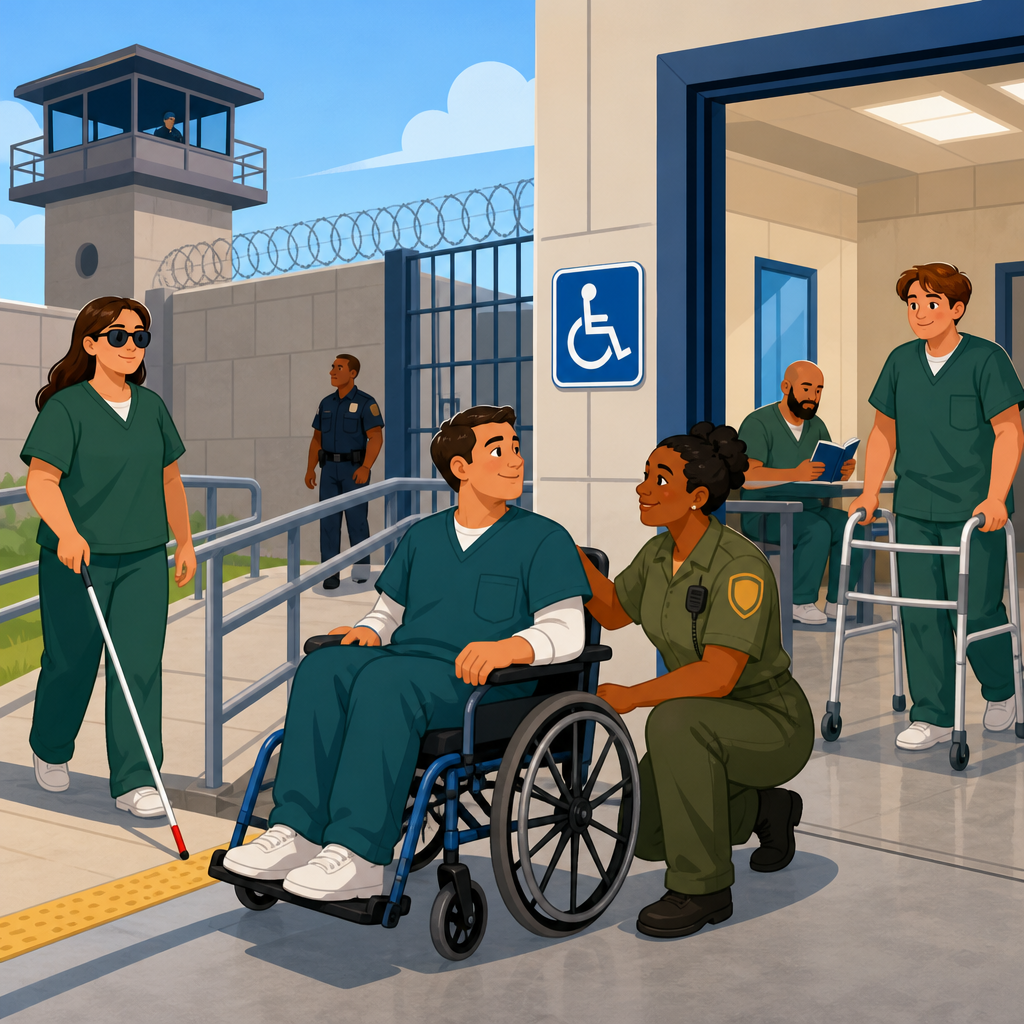
Reasonable modifications are changes to rules, practices, or procedures that allow a person with a disability to access a service unless the change would fundamentally alter the program or create a legitimate safety risk that cannot be mitigated. In jails and prisons, that may include lower-bunk assignments, extra time to reach pill call, alternate meal delivery methods, escort procedures for people with vision disabilities, flexible cuffing methods consistent with medical restrictions, or permission to keep necessary adaptive equipment.
Physical accessibility remains essential. The ADA Standards for Accessible Design shape expectations for routes, cells, showers, toilets, counters, and alarms. Older facilities are not exempt from all obligations; even when structural changes are complex, programs must still be operated so they are readily accessible when viewed in their entirety. In plain terms, a jail cannot defend inaccessible booking, court-holding, or medical areas by saying the building is old. It must relocate services, modify schedules, or renovate where required. New construction and alterations face stricter design duties.
| Correctional function | Common barrier | Typical modification or access measure |
|---|---|---|
| Housing | Upper bunks, narrow routes, inaccessible toilets | Accessible cell, lower bunk, grab bars, transfer space |
| Communication | No interpreter, no captioning, unreadable forms | ASL interpreter, captioned video, large print, reader assistance |
| Programs | Classes only in inaccessible rooms | Relocate class, accessible seating, schedule adjustment |
| Discipline | Rules not understood because of cognitive disability | Simplified explanation, support person, modified process |
| Medical access | Long lines or stairs prevent attendance | Priority movement, alternate route, bedside delivery when needed |
Not every requested change is required. Security and safety are real constraints in custody settings. However, corrections agencies must rely on individualized assessment, not blanket assumptions. Saying no because a modification is unfamiliar, inconvenient, or different from standard practice is not enough.
Effective Communication for Deaf, Blind, and Cognitively Disabled People
Communication failures are among the most serious Title II problems in detention. Effective communication means the information provided to others must also be conveyed to the person with a disability in a way they can understand and use. For deaf people, that may require qualified sign language interpreters for medical evaluations, mental health assessments, disciplinary hearings, classification interviews, and educational programming. Written notes may work for a brief exchange about a meal tray, but they are often inadequate for complex, lengthy, or high-stakes interactions.
For blind or low-vision prisoners, effective communication may include large print, Braille in limited contexts, electronic text, audio, reader assistance, orientation to the physical environment, and help completing forms. For people with intellectual disabilities, traumatic brain injuries, or psychiatric disabilities that affect comprehension, staff may need to use plain-language explanations, repeat instructions, confirm understanding, or adapt disciplinary and grievance procedures. In my experience, preventable rule violations often stem from communication breakdowns during intake. If a person does not understand count procedures, medication requests, or emergency commands, the institution creates both legal exposure and operational risk.
Technology can help, but it must be used carefully. Video remote interpreting may be effective only when the connection is stable, the screen is visible, and the setting permits confidential communication. Captioned tablets, text telephones where still relevant, and accessible kiosk systems can improve access, but they do not eliminate the need for trained staff and individualized judgment.
Medical, Mental Health, and Program Access
Title II does not turn every medical dispute into a disability discrimination claim, but it does require equal access to healthcare systems and related programs. If a person with mobility limitations cannot reach sick call, if a deaf prisoner cannot communicate symptoms during an evaluation, or if a person with a mental health disability is disciplined for behavior staff should have accommodated through policy adjustments, Title II issues are squarely present. The same is true when medication lines, specialty diets, or chronic care appointments are administered in ways that exclude disabled people.
Mental health disabilities deserve particular attention in correctional settings. People with psychiatric conditions may need modified communication, sensory considerations, or alternatives to punitive responses for disability-related conduct. Solitary confinement can also create or worsen disability-related harms. While Title II does not ban restrictive housing outright, a facility should examine whether the placement is being used because staff failed to provide accommodation in general population or programming.
Program access affects reentry. If a prison requires completion of a class for parole consideration or housing eligibility, it cannot place that class in inaccessible rooms or deny auxiliary aids needed for participation. Equal access to GED courses, substance use treatment, vocational certification, and release planning has long-term effects on employment, housing stability, and recidivism.
Common Violations, Grievances, and Enforcement Paths
Common Title II violations in jails and prisons include inaccessible cells and showers, denial of mobility devices, failure to provide interpreters, inaccessible grievance systems, exclusion from classes or jobs, disability-based segregation, punishment for disability-related behavior without accommodation review, and emergency procedures that ignore disabled prisoners. Another recurring problem is documentation failure. Staff may verbally approve an accommodation on one shift, only for another shift to reverse it because nothing is recorded in the classification or medical file.
Internal grievance systems are usually the first documentation path, and they matter because the Prison Litigation Reform Act often requires exhaustion before a federal lawsuit about prison conditions can proceed. Grievances should identify the disability, the barrier, the requested accommodation, dates, staff involved, and any resulting harm. Families and advocates can support fact gathering, but privacy rules and facility policies shape what information can be shared. Administrative complaints may also be filed with the U.S. Department of Justice Civil Rights Division, and in some cases with state protection and advocacy agencies or local oversight bodies. Remedies can include policy changes, staff training, facility modifications, interpreter services, and damages in appropriate litigation.
This article serves as the hub for public services and civic access within the broader rights-and-protections topic. Related issues include court access, police interactions, public transit, voting access, digital government services, emergency preparedness, and school or library accessibility. In each area, the same core principle applies: a public entity must provide meaningful access, not paper access alone.
Title II protects people with disabilities in jails and prisons by requiring equal access to public services, reasonable modifications, effective communication, and accessible facilities. The strongest compliance programs treat disability access as part of daily operations, not a special exception. That means screening for needs at intake, documenting accommodations clearly, training custody and medical staff together, auditing physical barriers, and reviewing grievances for patterns rather than isolated complaints.
For incarcerated people, these protections can determine whether they understand orders, reach medical care, maintain family contact, avoid unnecessary discipline, and prepare for release. For agencies, proper compliance reduces injury, litigation, and operational failure while improving safety for everyone in the facility. If you are building out a rights-and-protections resource, use this page as your starting hub for public services and civic access, then connect it to deeper guides on communication access, grievance rights, court participation, transportation, and voting-related protections.
The practical takeaway is simple: incarceration does not cancel disability rights. When a jail or prison offers a service, program, or activity, it must make that function meaningfully accessible to qualified people with disabilities unless a specific legal limitation applies. Review local policies, document barriers carefully, and escalate unresolved access problems through grievances, oversight channels, or legal counsel when necessary. That is how Title II moves from statute to real protection.
Frequently Asked Questions
What does Title II require jails and prisons to do for people with disabilities?
Title II of the Americans with Disabilities Act requires state and local government entities, including county jails, city lockups, and state prison systems, to give qualified people with disabilities equal access to their services, programs, and activities. In a correctional setting, that duty reaches far beyond wheelchair ramps or accessible cells. It applies to housing assignments, showers and toilets, medical and mental health services, medication lines, disciplinary hearings, educational classes, work programs, religious services, visitation, telephones, video calls, grievance systems, reentry planning, and emergency procedures.
In practical terms, correctional officials must avoid policies and practices that exclude or disadvantage incarcerated people because of disability. They may need to make reasonable modifications to rules, provide auxiliary aids and services for effective communication, and ensure that facilities are accessible when access is required for participation in programs or daily living. For example, a jail may need to provide sign language interpreters for medical appointments or disciplinary proceedings, accessible showers and bunks for people with mobility impairments, materials in large print or audio format for people with vision disabilities, or assistance navigating procedures for someone with an intellectual or psychiatric disability.
Title II is fundamentally about equal opportunity and non-discrimination. A person in custody should be able to understand rules, request care, use complaint systems, communicate with staff and family, and participate in available programs in a way that is as effective as it is for others, unless a specific legal exception applies. Correctional administrators do have legitimate security concerns, but they cannot use security as a blanket reason to deny access when a reasonable, workable accommodation is available.
Does Title II apply only to physical barriers, or does it also cover communication, medical access, and prison programs?
Title II covers all of those areas. Physical access is only one part of disability rights in correctional institutions. A jail or prison may violate Title II not just by lacking accessible housing or toilets, but also by failing to provide effective communication, by using policies that prevent people with disabilities from accessing medical care, or by excluding them from education, job assignments, treatment programs, and release planning.
Communication access is a major issue. Deaf or hard of hearing individuals may need qualified interpreters, captioning, amplified devices, visual alerts, or other aids depending on the situation. People who are blind or have low vision may need forms, handbooks, disciplinary notices, or grievance materials in accessible formats. People with speech, cognitive, intellectual, or psychiatric disabilities may need communication support, simplified explanations, extra time, or help understanding and completing procedures. If a person cannot effectively communicate with staff, they may miss medication, lose access to hearings, fail to report abuse, or be unable to advocate for their own safety.
Medical access is also closely tied to Title II. While not every medical dispute is automatically an ADA issue, disability discrimination can occur when inaccessible policies or environments prevent someone from obtaining care. For example, if a person cannot get to the clinic because the route is inaccessible, cannot understand medical instructions because no interpreter is provided, or is denied assistive devices needed for daily functioning, that can raise serious Title II concerns. The same is true when a person is screened out of programs because disability-related limitations are not accommodated. Equal access means correctional systems must look at how disability affects participation across the full range of institutional life, not just whether a building has a ramp.
What are reasonable modifications and accommodations in a jail or prison setting?
Reasonable modifications and accommodations are changes that allow a person with a disability to have meaningful access to the correctional system’s services, programs, and activities. In jails and prisons, these changes can take many forms because the barriers people face are not all the same. One person may need a lower bunk, grab bars, and an accessible shower. Another may need a hearing aid battery supply, TTY or other accessible telecommunications, or a qualified sign language interpreter during classification, medical appointments, and disciplinary proceedings. Someone with a vision disability may need mobility assistance, Braille or audio materials, or help reading posted rules and deadlines. A person with a cognitive or psychiatric disability may need clearer instructions, reminders, assistance completing forms, or modified procedures that account for functional limitations.
The key question is whether the accommodation gives the person a fair chance to access what the institution offers. A modification does not have to be the person’s preferred option in every case, but it must be effective. For example, handing written notes to a deaf person is not always an effective substitute for an interpreter, especially in complex or high-stakes interactions such as medical consent, mental health treatment, disciplinary charges, or grievance investigations. Likewise, assigning a wheelchair user to an “accessible” cell is not enough if the path to meals, recreation, clinic visits, or visitation remains inaccessible.
Correctional facilities may argue that a requested accommodation would create a legitimate security problem or fundamentally alter the nature of a program, but those are not automatic defenses. They are expected to assess the actual request, consider alternatives, and make individualized decisions. Title II generally disfavors reflexive denials based on convenience, cost alone, stereotypes, or assumptions about what incarcerated people with disabilities can or cannot do. A workable accommodation process should identify needs early, respond promptly, document decisions, and adjust over time as the person’s condition or housing status changes.
Can a jail or prison exclude someone with a disability from programs, work assignments, discipline procedures, or release planning?
No, not simply because the person has a disability. Title II prohibits correctional systems from denying access to programs and opportunities on the basis of disability when the individual is otherwise qualified and can participate with reasonable modifications or accommodations. That rule matters in many parts of confinement. People with disabilities are often steered away from educational programs, substance use treatment, work assignments, parenting classes, religious services, and reentry services because facilities assume participation will be too difficult, too resource-intensive, or too risky. Those assumptions can lead to unlawful exclusion.
The same principle applies to disciplinary systems. If a person does not understand a direct order because of a hearing disability, cannot comply quickly because of a mobility impairment, or reacts in ways linked to a psychiatric or cognitive disability, staff cannot ignore those facts and treat the situation as ordinary misconduct without considering disability-related needs. Effective communication and reasonable modification may be required in investigations, hearings, and sanctions. Otherwise, people with disabilities can be punished for limitations the institution failed to accommodate.
Release planning is another critical area. Access to transition services, parole-related processes, medication continuity, assistive devices, housing coordination, and community referrals can determine whether a person leaves custody safely. If a jail or prison fails to communicate release instructions in an accessible way, does not plan for disability-related needs, or denies participation in pre-release programs because of inaccessible policies, that may amount to disability discrimination. Title II’s reach is broad because equal access in corrections is not limited to surviving the day-to-day environment; it includes a meaningful opportunity to benefit from programs and procedures that affect safety, progress, and successful reentry.
What should families, advocates, or incarcerated people look for if they think a correctional facility is violating Title II?
Common warning signs include inaccessible housing or bathing facilities, denial of mobility aids or communication devices, refusal to provide interpreters or accessible written materials, placement decisions that isolate people with disabilities without a valid reason, missed medical appointments caused by inaccessible transport or escort practices, exclusion from classes or work details, and grievance systems that a person cannot actually use because forms, deadlines, or instructions are not accessible. Another frequent problem is when staff treat disability-related behavior as defiance or misconduct without evaluating whether an accommodation is needed.
It is also important to look at patterns, not just single events. Repeated failures to respond to accommodation requests, blanket policies that deny assistive devices, a lack of accessible emergency alerts, or routine exclusion from visitation and telecommunication systems can show a systemic Title II problem. Documentation often matters. Helpful information may include dates, names of staff, copies of request forms or grievances, medical or classification records, disciplinary reports, housing assignments, and descriptions of how the disability affected access to a specific service or program. The strongest claims often connect the disability to a concrete denial of access, safety risk, or exclusion from participation.
When these issues arise, people often use internal grievance systems, ADA coordinators, administrative complaints, or legal counsel to push for corrective action. The central question is usually whether the facility provided equal access through reasonable modifications and effective communication, or instead allowed disability-related barriers to block participation in core correctional functions. Because disability access in jails and prisons is a civil rights issue, not merely an operational preference, facilities are expected to address these barriers proactively rather than waiting for serious harm to occur.