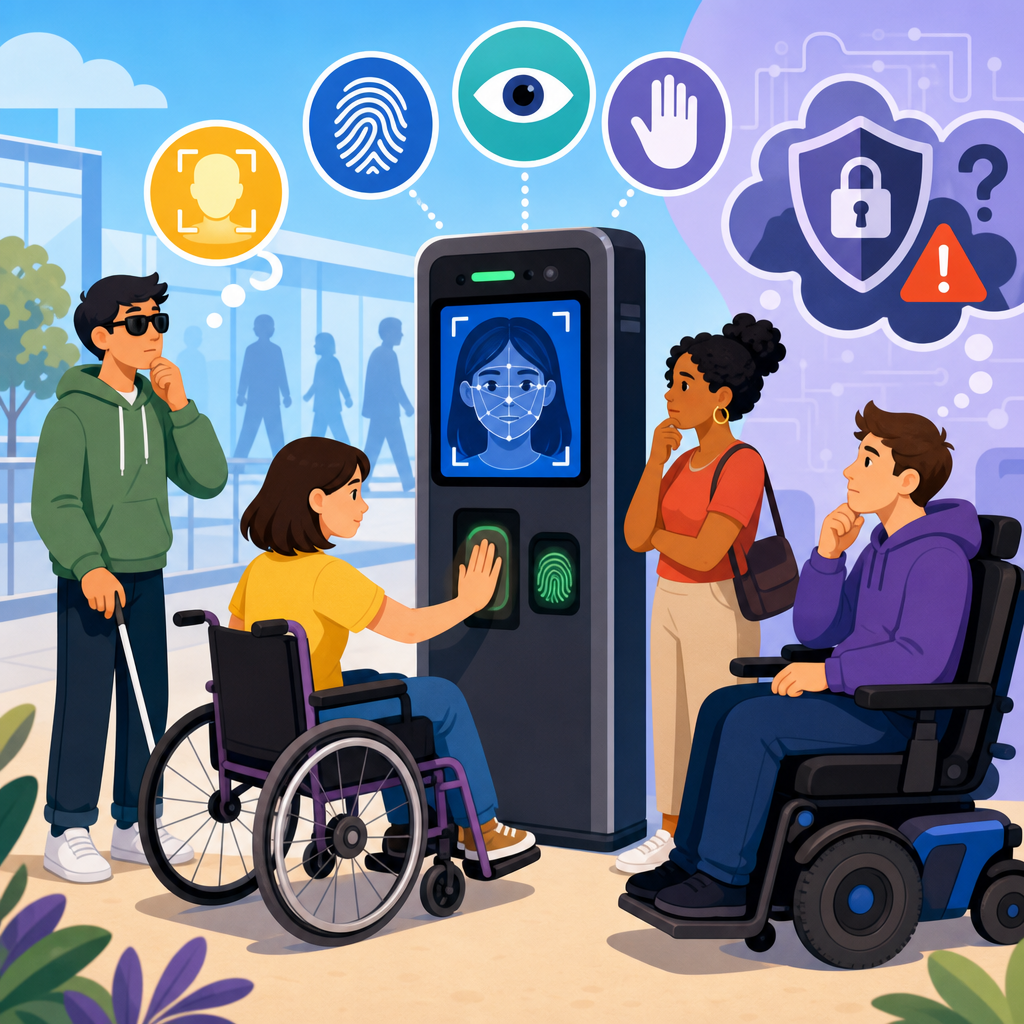
Biometric identity systems are rapidly becoming part of everyday life, but for many disabled people they create access barriers that are poorly understood, legally complex, and technically avoidable. A biometric identity system verifies or identifies a person using physical or behavioral traits such as fingerprints, facial geometry, iris patterns, voiceprints, gait, or keystroke dynamics. Governments use these systems for border control, benefits administration, and digital identity programs. Employers use them for timekeeping and site access. Banks, hospitals, landlords, schools, and consumer platforms deploy them for fraud prevention, authentication, and remote onboarding. Because these tools now sit at the intersection of civil rights, cybersecurity, procurement, and platform design, they belong squarely within the emerging technologies landscape.
The disability access risk arises when a system assumes a body, voice, movement pattern, or cognitive workflow that many users do not have. A fingerprint reader may fail for a person with limb differences, scar tissue, tremor, or age-related skin changes. Facial recognition can misread a user whose face differs from training data because of paralysis, craniofacial difference, injury, or medical equipment. Voice authentication may break for people with speech disabilities, stutters, ALS, Parkinsonian dysarthria, or post-stroke changes. Behavioral biometrics can flag atypical typing, mouse use, or gaze patterns that result from assistive technology rather than fraud. In practice, I have seen teams celebrate low false acceptance rates while ignoring the operational reality that a single failed verification can lock someone out of wages, medicine, housing, or public services.
This matters because exclusion is often built into system design long before any complaint is filed. Enrollment workflows may require a pose, phrase, or hand position that some users cannot perform. Liveness checks can reject wheelchairs, oxygen tubing, dark rooms needed for sensory regulation, or support workers visible in frame. Backup options may exist on paper yet be hidden behind support queues, impossible deadlines, or discretionary approval. The result is not merely inconvenience. It can amount to discrimination under disability law, a denial of meaningful access, or an unlawful failure to provide reasonable accommodation. As biometric identity systems spread across critical services, understanding these risks is essential for regulators, procurement teams, product leaders, and anyone building the next wave of emerging technologies.
What biometric identity systems include in practice
Biometric identity systems are not one technology but a stack of components: enrollment, template creation, storage, matching, decisioning, audit logging, and fallback procedures. The key distinction is verification versus identification. Verification asks whether a person is who they claim to be, often by comparing a live sample to one stored template. Identification asks who the person is by searching across many templates. That difference matters because one-to-many identification generally introduces higher error exposure, greater privacy risk, and more potential for disparate impact. In disability contexts, the more steps a user must complete under time pressure, the more likely the system will fail them.
Common modalities include fingerprints, face, iris, retina, voice, palm vein, and behavioral signals. Fingerprint and face remain dominant because sensors are cheap and built into consumer devices. Voice is popular in call centers. Behavioral biometrics are marketed as passive fraud controls in banking and e-commerce because they monitor how a person types, swipes, or moves through an app. Each modality has a different risk profile. Fingerprints can degrade with manual labor, eczema, burns, or chemotherapy. Face systems depend heavily on camera quality, lighting, and model training. Voice systems are sensitive to illness, stress, fatigue, and microphone distortion. Behavioral systems are especially problematic for disabled users because deviation from an average pattern can look suspicious by design.
Most organizations also underestimate the role of environment. A person using eye gaze software, switch controls, screen readers, prosthetics, AAC devices, or adaptive keyboards may interact with interfaces in ways models were never trained on. Remote identity proofing vendors frequently combine document capture, selfie comparison, and liveness detection in a single funnel, but that funnel assumes camera control, fine motor precision, and the ability to follow rapid visual prompts. When these assumptions fail, the issue is not user error. It is a foreseeable accessibility defect in a production system.
Where disability access risks appear across the lifecycle
Access risk appears at every stage of deployment, not just at the moment of authentication. Procurement is the first pressure point. Buyers often ask about spoof resistance, throughput, and integration, but fail to ask for disability impact testing, accommodation pathways, or conformance with accessibility standards such as WCAG for the digital interface. During design, teams optimize for fraud loss reduction and conversion metrics, then add accessibility as an afterthought. In implementation, organizations configure thresholds and exception handling rules without understanding how false rejects affect disabled users at higher rates. In operations, front-line staff may not know when they are allowed to bypass a failed biometric check.
Enrollment is a particularly sensitive stage because poor initial capture degrades all downstream performance. If a person cannot provide the required biometric sample in the expected format, the system may create a weak template or deny enrollment altogether. I have reviewed deployments where a person with limited dexterity had to retry fingerprint capture dozens of times, causing staff to assume noncooperation. Similar problems occur when a facial capture tool requires users to center their face, remove headgear, maintain eye contact, or perform blink-based liveness tests that some people cannot complete. Once enrollment fails, the user may never reach the service the system was meant to protect.
Post-deployment monitoring creates another hidden risk. Many vendors report aggregate accuracy figures but not accessibility outcomes. Without segmented data on completion rates, retry counts, fallback usage, and manual review times, organizations cannot see who is being excluded. This is why disability access must be treated as a measurable operational requirement, not an abstract value statement.
Examples of modality-specific barriers and their consequences
Different biometrics fail in different ways, and those failure modes map directly onto disability experiences. Fingerprint systems can be inaccessible for people with amputations, congenital limb differences, skin conditions, neuropathy, or involuntary movement. Facial recognition can struggle when a user has ptosis, facial palsy, asymmetry, craniofacial variation, or visible medical supports. Voice biometrics may reject users with changing speech patterns caused by neurological or respiratory conditions. Iris systems can be difficult for users with nystagmus, low vision, photophobia, or inability to maintain a fixed gaze. Behavioral tools can misclassify users who rely on dictation, switch scanning, screen magnification, dwell clicking, or alternative input devices.
| Modality | Typical barrier | Disability-related example | Practical safeguard |
|---|---|---|---|
| Fingerprint | Low-quality or missing prints | Scar tissue, prosthetic use, tremor | Offer PIN or supervised document check |
| Face | Pose, lighting, or liveness failure | Facial paralysis, wheelchair angle, oxygen tubing | Accessible manual review and adjustable prompts |
| Voice | Template drift or speech mismatch | Stutter, ALS, post-stroke speech change | Knowledge-based or app-based alternative login |
| Iris | Gaze fixation difficulty | Nystagmus, photophobia, low vision | Nonvisual authentication path |
| Behavioral | Atypical interaction flagged as fraud | Screen reader, eye gaze, switch access | Disable passive scoring for flagged assistive sessions |
The consequences extend beyond inconvenience. In employment settings, inaccessible biometric time clocks have led to wage disputes when workers cannot clock in independently. In housing, remote identity proofing can block disabled tenants from completing lease applications. In healthcare, patient portal authentication failures can delay access to records, prescriptions, or telehealth. Public benefits systems create perhaps the highest stakes, because an authentication failure can interrupt income, food assistance, or disability support itself. When critical services depend on a biometric match, every false rejection becomes a rights issue.
The legal and regulatory landscape shaping accountability
Disability law does not prohibit biometrics outright, but it does require equal access, reasonable modifications, and nondiscriminatory administration in many contexts. In the United States, the Americans with Disabilities Act, Section 504 of the Rehabilitation Act, and Section 1557 in healthcare can all become relevant depending on the entity and service. Digital interfaces tied to biometric systems may also trigger web and mobile accessibility obligations through settlement practice and agency enforcement. In the United Kingdom, the Equality Act 2010 frames duties around reasonable adjustments. In the European Union, accessibility, data protection, and AI governance increasingly overlap, especially where identity proofing affects essential services.
Privacy and biometric laws add another layer. The Illinois Biometric Information Privacy Act is the best known US example because it requires informed consent and has generated major litigation. State consumer privacy laws, sectoral rules, and federal agency guidance also affect notice, retention, vendor management, and security. Under the EU General Data Protection Regulation, biometric data used for unique identification is a special category of personal data, which means organizations need a lawful basis, strong safeguards, and clear necessity analysis. None of these frameworks automatically solves disability access, but together they create pressure to justify design choices, document risks, and provide alternatives.
Regulators increasingly focus on automated decision systems that create exclusion without meaningful recourse. That trend matters for emerging technologies more broadly. If an organization cannot explain how users seek review, obtain accommodation, and complete a transaction by another route, it is taking legal risk. The strongest compliance posture is therefore proactive: build a nonbiometric path, train staff to use it, and treat denial logs as evidence for continuous remediation.
How to design inclusive systems without weakening security
Accessibility and security are not opposing goals. The best systems use layered authentication and clear exception handling instead of forcing a single biometric gate on everyone. Start with modality choice. Do not assume the cheapest sensor is the most inclusive option. Match the modality to the context, threat model, and user population. For a low-risk employee attendance tool, a PIN plus supervisor attestation may outperform biometrics when accessibility costs are considered. For high-risk account recovery, combine possession factors, document review, device reputation, and human verification rather than depending on a liveness selfie alone.
Next, make fallback paths real, not symbolic. A valid alternative must be available at the same point of service, within the same hours, and without punitive delay. Requiring a disabled customer to call a separate line, mail paperwork, or wait days for manual review is not equivalent access. In implementation work, I advise teams to define service-level objectives for fallback completion, manual review turnaround, and accommodation success rates. If those metrics are not on the dashboard, the accommodation will fail in practice.
Testing must include disabled participants and assistive technology users before launch. Vendor claims are not enough. Run scenario-based tests with screen readers, voice control, alternative keyboards, prosthetics, low-vision settings, and varied speech patterns. Measure not only matching accuracy but completion time, abandonment, support contact rate, and user confidence. Procurement contracts should require audit rights, accessibility defect remediation, data retention limits, and disclosure of model changes that could affect performance. That is how organizations deploy biometric identity systems responsibly while preserving fraud controls.
Why this topic anchors the emerging technologies hub
Biometric identity systems and disability access risks sit at the center of the wider emerging technologies debate because the same governance questions recur across AI, remote verification, smart environments, digital credentials, and sensor-driven platforms. Who gets excluded by default assumptions? What data is truly necessary? How is error measured, contested, and corrected? Which standards govern procurement, audits, and appeals? A hub page on emerging technologies must answer these questions because they apply far beyond face or fingerprint tools. They shape automated hiring, age estimation, emotion inference, wearable monitoring, and next-generation identity wallets as well.
This is also a practical navigation point for deeper coverage. From here, related articles should examine facial recognition bias, voice authentication and speech disability, behavioral biometrics in banking apps, digital identity regulation, public-sector procurement standards, AI impact assessments, and complaint pathways under disability and privacy law. Readers need the hub structure because teams rarely deploy one tool in isolation. A hospital may combine patient portal login, remote proofing, kiosk check-in, and staff badge access. A transit agency may use mobile ticketing, account recovery, and incident review with overlapping biometric features. Understanding the hub helps decision-makers see systemwide risk instead of treating each failure as a separate incident.
Biometric identity systems can improve security and streamline access, but only when organizations design for human variation from the start. The central lesson is simple: when a system treats atypical bodies, voices, movements, or workflows as errors, disabled people pay the price first. That price can be lost time, lost privacy, lost wages, or complete denial of essential services. The risk is not hypothetical. It appears in enrollment failures, inaccessible liveness checks, hidden fallback processes, and passive fraud models that misread assistive technology as suspicious behavior.
The most effective response is not to abandon innovation. It is to govern emerging technologies with measurable accessibility requirements, lawful data practices, and operational alternatives that work in the real world. Organizations should choose modalities carefully, test with disabled users, publish accommodation routes, train staff on exception handling, and monitor false rejects, manual review delays, and abandonment rates. Regulators and buyers should insist on evidence, not vendor assurances. Product teams should remember that a secure identity system is only successful if the intended user can actually use it.
If you manage legal, compliance, procurement, security, or product strategy, treat this page as your starting point for the broader emerging technologies hub. Review your biometric workflows, map where disability access can fail, and build a nonbiometric path before the next deployment goes live. That is the clearest way to reduce legal exposure, strengthen trust, and deliver identity systems that work for everyone.
Frequently Asked Questions
1. Why can biometric identity systems create unique access barriers for disabled people?
Biometric identity systems can create barriers because they are often designed around assumptions about what a “normal” body or behavior looks like. In practice, many disabled people do not consistently match those assumptions. A fingerprint scanner may fail for someone with limb differences, burns, scar tissue, arthritis, or skin conditions. Facial recognition may perform poorly for people with facial differences, limited facial mobility, involuntary movements, or those who use medical equipment that partially obscures the face. Voice recognition can be unreliable for people with speech impairments, neurological conditions, respiratory disabilities, or fluctuating symptoms. Even behavioral biometrics, such as gait or keystroke dynamics, can misread disability-related movement patterns as suspicious or inconsistent.
The access problem is not only about technical error rates. It is also about the consequences of failure. If a biometric check is required to receive benefits, cross a border, unlock a digital account, or prove identity for healthcare or housing, a disabled user may be blocked from essential services. In many cases the system treats a mismatch as a security problem rather than an accessibility issue, which can lead to delays, repeated verification attempts, intrusive questioning, or outright exclusion. That makes disability-related access failures both a civil rights issue and a service design issue.
Another major concern is that many systems are built with limited testing across disabled populations. Vendors may validate performance across age, gender, or skin tone categories while overlooking disability-specific variations. As a result, barriers are poorly documented until people encounter them in the real world. The key point is that these risks are not inevitable. They usually stem from choices in procurement, training data, interface design, fallback procedures, and policy rules. When organizations plan for multiple ways to verify identity and avoid making biometrics the only path to access, many of the most serious barriers can be prevented.
2. What kinds of disabilities are most likely to be affected by biometric verification failures?
There is no single disability group affected in the same way, because different biometric tools create different risks. People with physical disabilities may face difficulty with fingerprint or palm-based systems if they have missing fingers, limited dexterity, tremors, chronic pain, contractures, or difficulty positioning a hand correctly on a scanner. People with low vision or blindness may struggle with systems that depend on visual prompts, face alignment, or selfie capture instructions that are not accessible through screen readers or audio guidance. Users with mobility disabilities may encounter inaccessible hardware placements, short timeouts, or kiosks that cannot be reached from a wheelchair.
People with speech disabilities, Deaf or hard of hearing users, and people with certain neurological or respiratory conditions may be disproportionately affected by voice biometrics, especially if the system expects a narrow range of speech patterns or fails to account for assistive communication methods. Neurodivergent users and people with psychosocial disabilities can also be affected by systems that require highly specific, timed, repetitive steps under pressure. If someone is asked to stare at a camera, repeat phrases, hold still, or complete liveness checks in a precise sequence, anxiety, sensory sensitivity, attention-related conditions, or involuntary movement may interfere with successful completion.
Facial recognition can raise particular concerns for people with facial differences, facial paralysis, craniofacial conditions, post-surgical changes, or fluctuating appearance related to health conditions and treatment. Behavioral biometrics introduce additional complexity because they often infer identity from patterns such as typing rhythm, walking style, mouse movement, or device handling. Those patterns may change due to fatigue, pain, medication, prosthetics, assistive technologies, or progression of a condition. In short, the risk is broad and cross-cutting. The more rigid the system and the fewer alternatives it offers, the more likely disabled people are to be excluded.
3. Are these disability access risks mainly technical problems, or are there legal and policy issues too?
They are both technical and legal, and the legal dimension is often just as important as the engineering. From a technical standpoint, systems may fail because the sensor cannot capture the relevant trait, the matching model was not trained on sufficiently diverse users, the user interface is inaccessible, or the workflow lacks flexibility. But even if the technology is imperfect, organizations still make policy choices about whether biometric verification is mandatory, whether alternatives are available, how many retries are allowed, and what happens when the system fails. Those choices can either reduce or deepen exclusion.
Legally, disability rights frameworks in many jurisdictions require reasonable accommodation, equal access to services, and non-discrimination in public-facing systems. If a government agency, employer, bank, school, or service provider relies on biometrics without a practical alternative, it may create barriers that trigger accessibility and discrimination concerns. Data protection and privacy laws can also matter because biometric data is generally sensitive personal data. Organizations may need a strong legal basis to collect it, clear limits on use, safeguards against misuse, and retention policies that do not expose disabled users to disproportionate harm. A badly designed exception process can become a legal risk if it forces disabled people to disclose unnecessary medical information or subjects them to more intrusive treatment than other users.
Policy design is where many avoidable problems appear. A system may technically support an exception, but if front-line staff do not know about it, if the exemption is hard to obtain, or if it causes long delays, the access barrier remains. Likewise, a privacy notice may exist, but if it is not presented in accessible formats, meaningful consent is undermined. The most legally resilient approach is to treat accessibility as a core requirement at the procurement and governance stage: conduct disability impact assessments, test with disabled users, document non-biometric alternatives, train staff, and establish review procedures when automated decisions affect access to important services.
4. What should governments and companies do to reduce disability-related harms in biometric identity systems?
The first and most important step is simple: never make biometrics the only way to prove identity when access to essential services, benefits, travel, employment, education, finance, or healthcare is at stake. There should always be reliable alternative methods, such as secure document-based verification, human-assisted review, PINs, tokens, trusted representative processes, or hybrid identity checks that do not depend on a single physical or behavioral trait. Alternatives must be genuinely usable, not hidden behind delays, stigma, or extra burdens that effectively punish disabled users for needing them.
Second, accessibility needs to be built into the full system lifecycle. That includes procurement requirements, technical testing, interface design, hardware placement, timeout settings, and error handling. Organizations should test systems with a wide range of disabled users in realistic conditions, not just controlled lab environments. They should assess whether scanners can accommodate different body positions, whether instructions are available in multiple accessible formats, whether liveness detection can be completed without impossible movements, and whether behavioral models tolerate disability-related variation without treating it as fraud. Independent audits and disability-focused impact assessments are especially valuable because vendors may not identify these issues on their own.
Third, there must be clear governance and accountability. Staff need training on accessibility failures so they can recognize when a mismatch is a disability-related issue rather than suspicious behavior. Appeals and exception procedures should be fast, respectful, and easy to access. Organizations should minimize biometric data collection, avoid repurposing data beyond the original need, and establish strict retention and security controls. Finally, disabled people and disability advocacy groups should be involved early in design and oversight. Systems become much safer when affected communities are treated as experts in the risk, not as afterthoughts once deployment has already begun.
5. How can readers evaluate whether a biometric identity system is fair, accessible, and safe for disabled users?
A good starting point is to ask whether the system offers a real choice. If the biometric check is mandatory and there is no quick, equal alternative, that is a major warning sign. Accessibility is not just about whether a scanner works under ideal conditions; it is about whether people can complete the process with dignity, privacy, and without being denied service. Readers should look for signs that the organization has planned for exceptions from the beginning, including documented fallback methods, trained staff, and clear appeal routes when the system fails.
It is also worth examining transparency. Does the organization explain what biometric data it collects, how it is used, how long it is stored, and whether it is shared with third parties? Does it disclose whether the system has been tested for accessibility and accuracy across different disability groups? Are instructions available in accessible formats, and is there a way to complete the process without relying on inaccessible kiosks, visual prompts, or rigid liveness checks? If these details are vague or missing, that often signals weak governance. Another important question is whether the system’s errors carry serious consequences. A false rejection in a low-stakes setting is frustrating; a false rejection that interrupts benefits, travel, or medical access is much more serious.
Finally, readers should pay attention to how organizations respond when problems are raised. A trustworthy operator will treat disability access failures as design defects to be fixed, not as rare user mistakes. It will gather feedback, publish contact points for assistance, update procedures, and involve disabled stakeholders in ongoing review. Fair and safe biometric identity systems are possible only when accessibility, privacy, and human oversight are treated as baseline requirements. If a system cannot accommodate human variation without excluding people, the problem is not the user. It is the system.


