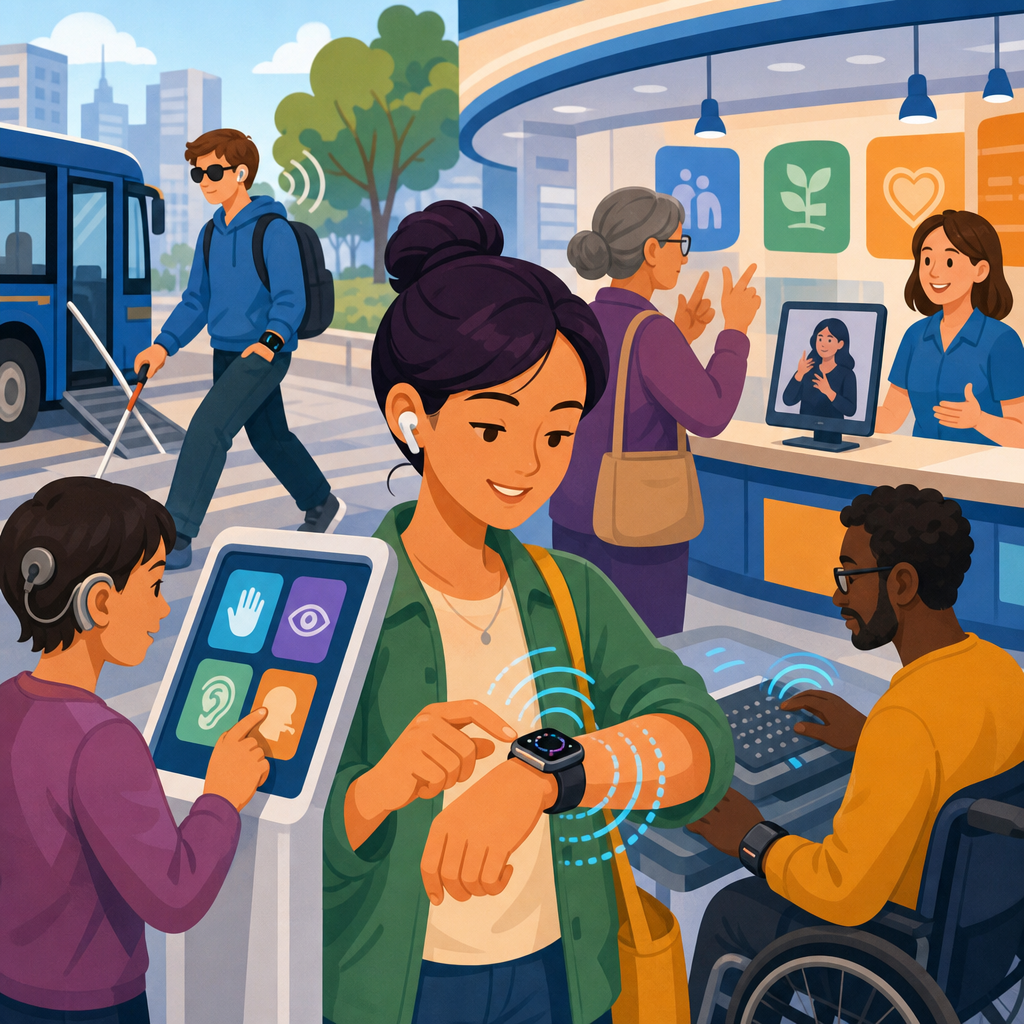
Wearables, haptics, and multimodal access are reshaping how public services reach people, especially those who have been excluded by designs built around a single sense, device, or language. In practical terms, wearables are body-worn technologies such as smartwatches, hearing devices, smart glasses, biometric bands, and connected emergency pendants. Haptics refers to tactile feedback, including vibrations, pressure, motion cues, and force responses that communicate information through touch. Multimodal access means delivering the same service through multiple channels at once, such as visual text, spoken guidance, captions, tactile prompts, gesture input, simplified language, and location-aware alerts. Together, these tools matter because public services are only truly public when people can use them regardless of disability, literacy level, language, connectivity, or the conditions of the environment around them.
I have worked on accessibility and digital service design projects where a well-timed vibration on a wrist device did more for a user than another page of instructions ever could. A transit rider with low vision may need tactile turn alerts rather than a map. A patient leaving a public clinic may benefit from medication reminders that combine icons, speech, and vibrations. A deaf resident trying to follow an emergency evacuation order may need captions, geofenced notifications, and haptic cues simultaneously. These are not edge cases. They are routine service conditions in transport, health, courts, education, housing, and emergency management. As governments digitize, emerging technologies can either widen exclusion or close it decisively.
This article serves as a hub for emerging technologies within public-service access. It explains where wearables and haptics fit, what multimodal access looks like in daily operations, which standards and procurement questions matter, and how agencies can evaluate privacy, safety, and equity before deployment. It also connects this topic to broader issues across legal and technological frontiers, including algorithmic decision-making, digital identity, smart infrastructure, and accessibility compliance. The core principle is simple: the best public systems do not force residents to adapt to technology; they adapt technology to the realities of residents.
How wearables improve access across public services
Wearables improve access when they reduce friction at key moments: finding information, receiving alerts, confirming identity, navigating space, and completing tasks hands-free. In transit, smartwatch haptics can signal an approaching stop without requiring constant screen attention. Transport for London and similar agencies have long invested in real-time disruption data; when that data reaches users through wrist notifications or hearing wearables, it becomes actionable in motion. In healthcare, connected wearables support appointment reminders, remote monitoring, fall detection, and post-discharge adherence. The value is not novelty. The value is lower cognitive load during stressful interactions with the state.
Public safety applications are equally strong. During severe weather, a phone alert may be missed in a noisy street, inside a bag, or by a user with hearing loss. A paired wearable can add urgency through repeated vibration patterns. Some municipal pilots have explored lone-worker devices for social staff and inspectors, using discreet panic triggers and location transmission. In courts and service centers, wearables can support queue notifications, interpretation prompts, and wayfinding. The strongest use cases share three traits: they address time-sensitive information, they work in real-world conditions, and they complement rather than replace existing channels.
There are limits. Consumer wearables vary in battery life, operating systems, accessibility features, and security update cycles. Agencies should not design critical services that assume residents own premium devices. A robust public-service model treats wearables as one access route among several. Borrowed devices, kiosks, SMS, voice lines, printed materials, and in-person support still matter. The deployment question is not whether every citizen should use a wearable. It is whether a service can expose information and actions in standardized ways so residents can choose the interface that works for them.
What haptics add that screens and audio cannot
Haptics add a communication channel that is private, immediate, and resilient in settings where visual or audio signals fail. A vibration can cut through glare, crowd noise, limited literacy, language barriers, and divided attention. Distinct haptic patterns can encode meaning: a long pulse for urgent action, double taps for turn-by-turn navigation, rhythmic patterns for confirmation or countdown. In accessible design, touch is not a backup; it is a primary modality with unique strengths. For deafblind users in particular, tactile communication can be essential rather than optional.
I have seen haptics work best when teams avoid overloading users with too many patterns. Three to five memorable cues outperform a library of subtle variations nobody can learn under pressure. The same principle applies in emergency management. Wireless Emergency Alerts on phones are effective, but adding consistent wearable haptic signatures can improve recognition speed. In buildings, tactile wayfinding can combine floor textures, elevator button standards, beacon-triggered vibrations, and simple spatial prompts delivered through a wearable. Museums and civic spaces are also using haptic interfaces to extend exhibits and public information beyond visual signage, widening participation without creating separate experiences for disabled visitors.
The technical design of haptics matters. Actuators differ in strength and precision, and placement on the body changes perception. A wrist-worn alert may be noticed faster than a phone vibration in a pocket, but prolonged patterns can cause fatigue or be ignored if overused. Agencies should test for noticeability, comprehensibility, and false-alarm tolerance across user groups, including older adults, neurodivergent users, and people with neuropathy. Clear tactile semantics, conservative alert frequency, and fallback channels are the difference between helpful design and sensory clutter.
Multimodal access as a public-service baseline
Multimodal access means residents can start, continue, and finish a public task through more than one mode without losing context. A person should be able to hear a bus disruption, read the same update on a screen, feel a haptic prompt on a wearable, and ask a voice assistant for alternative routes. A patient should be able to receive a clinic reminder as text, spoken audio, pictograms, and vibration cues. A multilingual parent interacting with a school district should be able to move between translated text, speech, captions, and assisted chat. This is not duplication for its own sake. It is service continuity across human differences and situational constraints.
Recognized standards already support this direction. The Web Content Accessibility Guidelines provide a foundation for perceivable, operable, understandable, and robust digital content. EN 301 549 in Europe and Section 508 in the United States influence procurement and ICT accessibility expectations. For health information exchange and device integration, FHIR, HL7, and Bluetooth profiles can affect whether systems communicate reliably. For plain-language obligations and language access policies, agencies often have separate legal duties beyond technical accessibility. Multimodal service design sits at the intersection of all these requirements, which is why siloed teams often miss critical dependencies.
| Public service area | Wearable or haptic function | Multimodal access benefit | Key implementation concern |
|---|---|---|---|
| Public transit | Turn alerts and stop notifications on smartwatches | Supports low-vision navigation and hands-free travel | Real-time data quality and battery reliability |
| Healthcare | Medication reminders with vibration and speech | Improves adherence for users with memory or literacy barriers | Consent, privacy, and clinical escalation rules |
| Emergency management | Geofenced tactile alerts paired with captions and audio | Reaches users in noisy or inaccessible environments | Alert accuracy and false positives |
| Courts and civic offices | Queue updates and indoor navigation prompts | Reduces confusion and dependence on staff mediation | Building mapping and multilingual support |
As a hub topic, multimodal access also links outward to adjacent emerging technology areas. Smart city sensors produce the event data that powers adaptive alerts. Digital identity systems determine how a resident securely receives personalized notifications. Conversational agents can present the same service through voice or chat, while assistive AI can summarize or translate complex instructions. Extended reality may support immersive training or remote assistance. The lesson is that multimodal access is not a single feature. It is the organizing logic that lets multiple technologies work together in a way people can actually use.
Legal, ethical, and procurement issues agencies cannot ignore
Emerging technologies in public services trigger legal and ethical questions immediately because they process sensitive data, shape access to rights, and can fail in unequal ways. Wearables may collect location, heart rate, motion, or proximity data. Haptic systems tied to emergency alerts or safety workflows can influence user behavior during high-stakes events. Agencies therefore need explicit lawful bases for processing, clear retention limits, data minimization, vendor due diligence, and documented accessibility testing. In many jurisdictions, disability rights law, privacy law, records rules, and public procurement law all apply at once. Treating accessibility as an add-on after vendor selection is one of the most expensive mistakes public bodies make.
Procurement language should specify interoperability, exportable data, accessibility conformance reports, security patch commitments, and offline behavior. Ask whether haptic alerts are customizable. Ask whether watch notifications support captions, plain language, and multiple languages. Ask whether the system degrades safely when Bluetooth disconnects, batteries die, or location permissions are denied. If a resident depends on a tactile alert to navigate a station or receive a medication reminder, failure modes are not abstract technical defects; they are service failures. Procurement teams should also request evidence of user testing with disabled participants rather than relying on generic vendor claims.
Ethically, agencies must avoid creating two-tier services where advanced access only exists for tech-savvy residents. Equity requires public options for device lending, alternative channels, and staff support. It also requires caution around surveillance creep. A wearable used for accessibility should not become a backdoor for unnecessary tracking or behavior profiling. Strong governance includes purpose limitation, transparent notices, appeal routes, human support, and regular audits. Public trust increases when agencies explain exactly what the technology does, what it does not do, and how people can opt for another method.
Implementation roadmap: from pilot to scaled service
The most successful programs start with a narrow service journey and a measurable problem. Begin by mapping where users currently fail, wait, miss, or disengage. In a hospital outpatient pathway, that might be missed check-ins, confusion about wayfinding, and poor follow-through on discharge instructions. In transit, it might be uncertainty during disruptions and missed stop requests. Then define the modality mix that could reduce those failures: tactile prompts, voice confirmations, icons, captions, translated text, or wearable notifications. Starting with a concrete journey avoids the common problem of buying a device first and searching for a purpose later.
Next, run co-design sessions with affected users, frontline staff, interpreters, accessibility specialists, and legal teams. Build prototypes quickly and test them in realistic conditions, not just quiet labs. Measure task completion, response time, comprehension, error rates, alert fatigue, and satisfaction. Include edge conditions such as poor connectivity, glove use, low lighting, and multilingual scenarios. For public agencies, pilot documentation should capture accessibility findings, incident handling, procurement adjustments, and the operational cost of support. A pilot that ignores training, replacement logistics, and help-desk workflows is not a pilot; it is a demo.
Scaling requires governance and architecture, not just enthusiasm. Standardize content models so the same message can feed SMS, apps, smart speakers, displays, and wearables. Use APIs and event-driven systems to trigger updates consistently across channels. Create a pattern library for tactile cues, message hierarchy, and consent flows. Establish service-level objectives for timeliness and reliability. Then connect this work to related articles in the broader emerging technologies hub: accessible AI assistants, digital ID, sensor-rich public spaces, inclusive mobility systems, and trustworthy data governance. These links matter because residents experience services as one ecosystem, not as separate procurement categories.
How to measure success and what the next wave looks like
Success is not the number of devices distributed or app downloads achieved. Success is measurable improvement in equitable service outcomes. Track missed appointments, successful journeys, alert acknowledgment rates, time to complete forms, customer support demand, and accessibility complaint trends. Break metrics down by disability status where lawful and appropriate, language, age group, and access channel. Qualitative evidence is equally important: can users explain what a haptic alert means, switch modes without losing progress, and trust the system during stressful moments? If not, the design is not finished no matter how polished the interface appears.
The next wave will combine ambient computing, on-device AI, and better interoperability. Smart glasses may overlay real-time captions and navigation in public buildings. Hearing wearables will increasingly connect to broadcast audio and service counters. Tactile interfaces may become more expressive through directional cues and richer vibration control. Standards work around remote identity proofing, authentication, and accessibility APIs will shape what becomes feasible at scale. Yet the strategic direction is already clear. Public services should move from one-size-fits-all delivery toward adaptive access that respects privacy, choice, and human variability.
Wearables, haptics, and multimodal access belong at the center of modern public-service design because they translate policy into usable action at the exact moment people need help. The strongest programs focus on real service barriers, combine channels rather than forcing a single interface, and procure technology with accessibility, privacy, and interoperability built in from the start. As this hub shows, emerging technologies are most valuable when they improve access across the wider ecosystem of health, transport, justice, education, and emergency response. Use this page as your starting point, then explore the connected topics under Legal and Technological Frontiers to build inclusive services that work in the real world.
Frequently Asked Questions
What do wearables, haptics, and multimodal access mean in public services?
In public services, wearables are body-worn or body-adjacent devices that help people receive, send, or confirm information in real time. These can include smartwatches, hearing devices, smart glasses, biometric bands, connected emergency pendants, and other assistive or mainstream tools people already use in daily life. Haptics refers to communication through touch, such as vibrations, pulse patterns, motion cues, pressure, or force feedback that can alert, guide, warn, reassure, or confirm an action without relying only on sound or visuals. Multimodal access means the same service can be used through more than one channel or sensory pathway, such as text, speech, touch, symbols, visuals, gesture, translation, and device-based prompts.
That matters because many public systems have historically assumed one “default” way to interact, often a printed notice, a spoken announcement, a website, or a smartphone screen. In practice, that leaves people out. A transit update delivered only by audio excludes some deaf or hard-of-hearing riders. A benefits portal designed only for visual navigation creates barriers for blind or low-vision users. A text-heavy interface can be difficult for people with cognitive disabilities, limited literacy, or limited proficiency in the service’s primary language. By combining wearables, haptic cues, and multimodal design, public agencies can build services that work more reliably across different abilities, contexts, and environments. The goal is not to add technology for its own sake, but to make access more flexible, dignified, and usable in real-world conditions.
How can these technologies improve accessibility and inclusion in everyday public services?
Wearables and haptic systems can improve accessibility by delivering information in ways that match different needs, preferences, and situations. For example, a public transit system can send route changes or platform alerts to a smartwatch using distinct vibration patterns, while also displaying plain-language text and offering spoken guidance. A health service can use a connected pendant or wrist device to confirm appointment reminders with a tactile cue, reducing dependence on paper mail, robocalls, or app notifications that may be missed. In emergency management, wearable alerts can provide silent but urgent tactile warnings for evacuation instructions, shelter information, or severe weather notices when audio announcements are hard to hear or impossible to understand in crowded, noisy, or multilingual environments.
Inclusion improves because multimodal systems recognize that people do not experience access barriers in only one way. Someone may have perfect vision but need hands-free interaction while pushing a wheelchair or carrying children. Another person may understand spoken language better than written text. Someone else may rely on touch feedback because they are in a loud setting, have sensory processing differences, or use assistive technology that works best with tactile prompts. Well-designed public services account for all of these realities. They do not force residents into a single device, a single language, or a single sensory channel. Instead, they offer redundancy and choice. That approach is especially valuable for older adults, disabled people, people with temporary injuries, migrants, low-connectivity users, and anyone who benefits from clearer, more adaptable communication.
What are some practical examples of wearables and haptics being used in government, healthcare, and transit?
In government services, practical use cases include appointment reminders, queue updates, identity verification support, and safety notifications. A municipal office could allow residents to receive service-call progress updates through smartwatch notifications paired with haptic confirmations. A courthouse or social services center could use tactile wayfinding cues linked to indoor navigation, helping visitors move through buildings more confidently. Public safety departments can also use connected wearables for vulnerable residents, such as emergency pendants that contact responders or caregivers when a fall, health event, or distress signal is detected.
In healthcare, wearables can support medication reminders, remote monitoring, appointment check-ins, and communication between patients and care teams. Haptic feedback can confirm that a reading was captured, a request was sent, or a telehealth session is about to begin. For patients managing chronic conditions, body-worn devices can reduce friction by making information more immediate and less dependent on logging into complex portals. In public health outreach, multimodal alerts can combine vibration, visual symbols, and multilingual prompts to improve follow-through on screenings, vaccinations, or follow-up care.
In transit, the potential is especially visible. Riders can receive tactile prompts for stops, transfer points, delays, safety alerts, or station navigation. Smart glasses or hearing devices might supplement that with captions or directional guidance. A rider who is blind or low vision may use haptic turn-by-turn station assistance, while a rider who is deaf may rely on visual and wearable notifications rather than overhead announcements. Importantly, strong implementations do not assume everyone owns the same technology. Public services should pair advanced features with accessible kiosks, signage, human assistance, SMS options, and non-app-based pathways so the benefits are broad rather than exclusive.
What should public agencies consider when designing or adopting these tools?
Public agencies should start with accessibility, equity, privacy, and interoperability rather than treating them as afterthoughts. First, services should be designed to work across multiple senses, multiple devices, and multiple levels of digital confidence. That means plain language, multilingual content, captioning, screen reader compatibility, tactile feedback options, and alternatives to app-only experiences. It also means testing with disabled users, older adults, low-income residents, and people from diverse language communities from the earliest design stages. Co-design is critical because many barriers are only visible when real users interact with a system in realistic conditions.
Second, agencies need to think carefully about data governance. Wearables often collect highly sensitive information, including location, biometrics, movement patterns, or health-related signals. Public trust depends on clear consent, data minimization, secure storage, strict access controls, and transparent explanations of how information is used, shared, and retained. Residents should be able to understand what is optional, what is necessary, and what alternatives exist if they choose not to use a wearable or connected device.
Third, procurement and implementation decisions should prioritize open standards and compatibility with assistive technologies and common consumer devices. If a system works only on one brand, one operating system, or one expensive device class, it will likely deepen inequity. Agencies should also plan for maintenance, staff training, battery and connectivity limitations, offline contingencies, and support for people who need human help. The strongest programs combine technical innovation with service design discipline. They do not simply deploy hardware; they create dependable, understandable, and inclusive user journeys.
Are there risks or limitations with wearables and haptic public service tools?
Yes, and acknowledging those risks is essential to responsible adoption. One major concern is exclusion through uneven access. Not everyone owns a smartwatch, smart glasses, or a connected health device, and not everyone wants to wear technology on their body. Cost, charging requirements, connectivity gaps, language barriers, and comfort issues can all limit adoption. Public services should never make critical access dependent on a wearable. Instead, wearable support should extend and improve access while preserving equivalent alternatives such as phone lines, in-person help, accessible websites, printed materials, and community-based assistance.
There are also usability limitations. Haptic cues can be powerful, but only if they are meaningful, distinguishable, and not overwhelming. Poorly designed vibration patterns may confuse users or go unnoticed. Some people have reduced tactile sensitivity, while others may find repetitive touch feedback stressful or distracting. Similarly, multimodal does not automatically mean accessible. If agencies layer many channels without consistency, users may receive conflicting information or face unnecessary complexity. Good design requires careful prioritization, clear hierarchies, and user testing across different disability and context scenarios.
Privacy and surveillance risks are another serious issue. Devices that track movement, biometrics, or real-time behavior can create understandable concerns about monitoring, profiling, or secondary data use. In public service contexts, those concerns are especially sensitive because residents may feel they have little choice when interacting with government or healthcare systems. Agencies must therefore be conservative, transparent, and accountable in how they deploy these technologies. When done well, wearables, haptics, and multimodal access can make public services more responsive and inclusive. When done poorly, they can reproduce old barriers in new forms. The difference lies in governance, design quality, and a genuine commitment to universal access.


