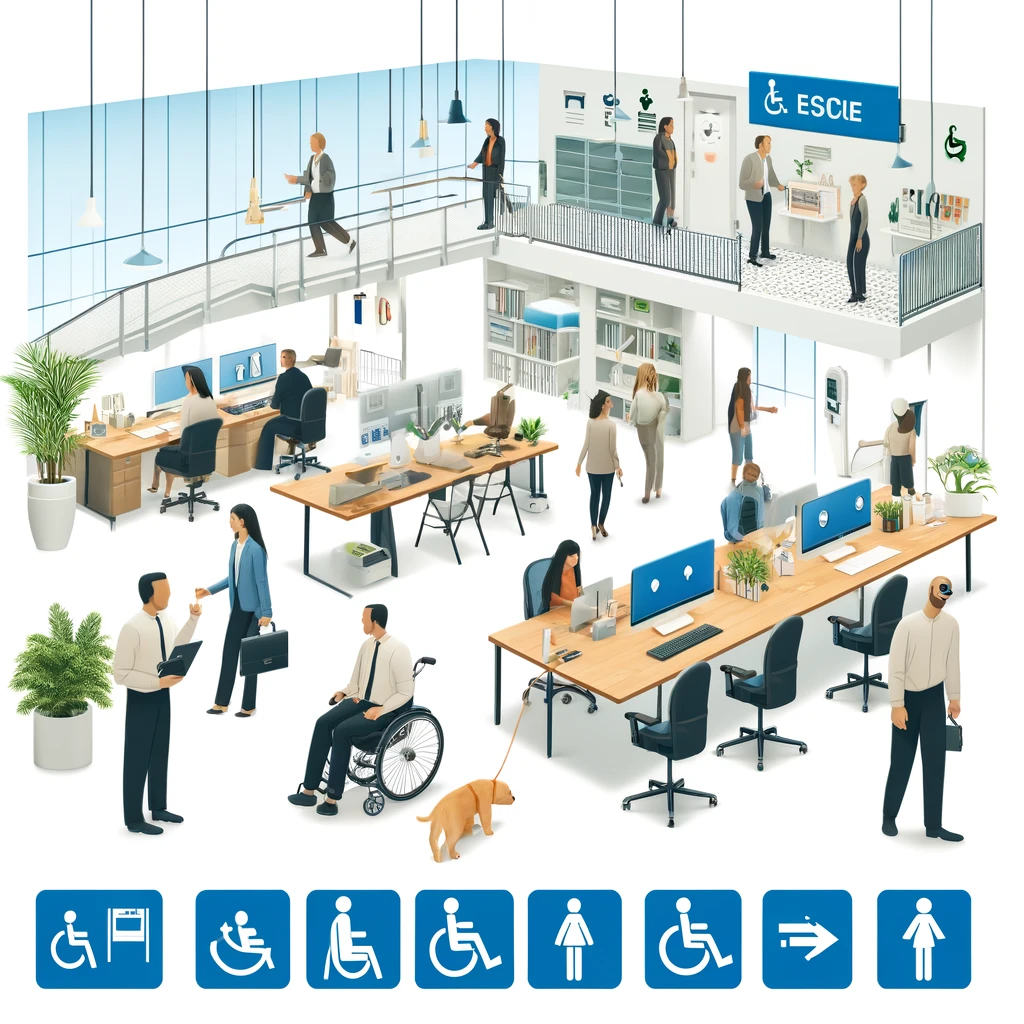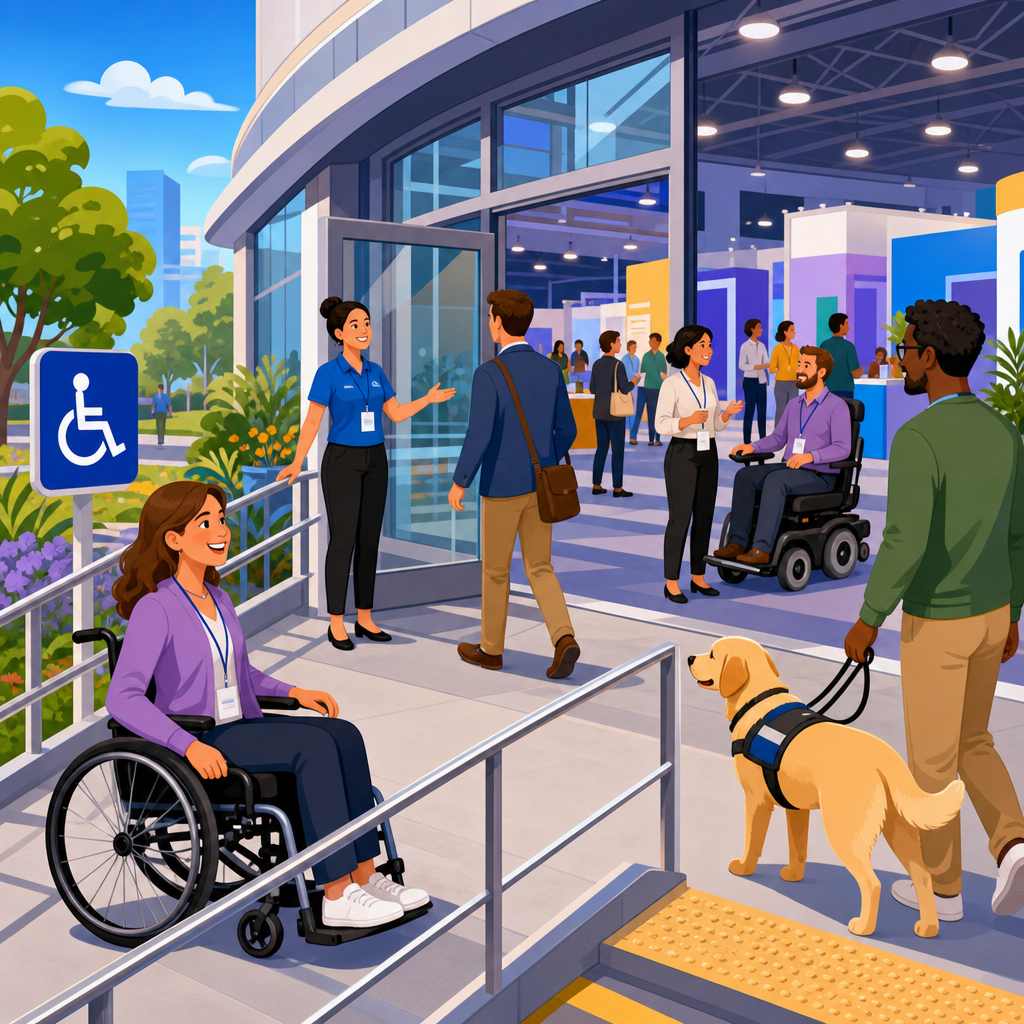
ADA compliance for event venues, conferences, and expos is not a box-checking exercise; it is the operational framework that determines whether people with disabilities can enter, navigate, participate, communicate, and exit with dignity and safety. In practical terms, ADA compliance means aligning the built environment, digital touchpoints, customer service practices, and emergency procedures with the Americans with Disabilities Act, related federal regulations, and applicable state and local accessibility codes. For operators of stadiums, convention centers, hotels, museums, fairgrounds, temporary event sites, and trade show floors, the stakes are legal, financial, and reputational. More importantly, the stakes are human: inaccessible registration counters, poor captioning, blocked wheelchair routes, or inaccessible restrooms can exclude attendees, exhibitors, speakers, job seekers, and sponsors from core experiences that others take for granted.
The ADA applies differently depending on the entity involved, but the core idea is consistent. Title II generally covers state and local government facilities and programs, while Title III applies to private businesses that are places of public accommodation, including many event venues and conference settings. Event organizers also have obligations when they lease or operate spaces they do not own. In my work reviewing conferences and expo halls, the most common mistake is assuming the venue alone is responsible. In reality, responsibility is shared across landlords, operators, show managers, general service contractors, exhibitors, audiovisual teams, caterers, transportation vendors, and digital registration providers. Accessibility fails when any one of those links breaks.
This matters because events are layered experiences. A guest may first encounter the event through a website or ticketing portal, then an email confirmation, parking lot, shuttle stop, security checkpoint, registration desk, keynote room, breakout session, food service line, exhibit booth, networking app, restroom, and evacuation route. ADA compliance for conferences and expos therefore requires systems thinking. It is not enough for a ballroom to have an accessible entrance if the mobile app is unusable with a screen reader, the stage has no ramp, and the panel discussion lacks live captioning. A compliant venue experience anticipates barriers before attendees do and resolves them across every touchpoint.
Sector-specific ADA compliance also matters because events are temporary, high-density, and variable. A theater may be accessible on an ordinary day but become noncompliant during a conference if exhibitors narrow aisles, cable ramps obstruct circulation, or seating layouts remove companion seating. Expos add complexity with modular booths, temporary signage, product demonstrations, and loud ambient noise that affects communication access. Conferences add deadlines for accommodation requests, speaker materials, interpreters, livestreams, and hybrid participation. Venues that understand these patterns are better equipped to reduce risk and improve attendance, satisfaction, and repeat bookings. This article serves as the central guide to the full compliance and implementation landscape for event venues, conferences, and expos.
Built Environment Requirements for Venues and Temporary Event Layouts
The starting point for ADA compliance is the physical environment. The 2010 ADA Standards for Accessible Design establish baseline requirements for accessible routes, entrances, doors, restrooms, assembly areas, service counters, parking, seating, signage, and other core features. For event venues, compliance begins long before event day with site surveys, architectural reviews, and operational walkthroughs. I advise teams to assess both the permanent facility and the temporary event overlay because many accessibility failures are created by event setup, not original construction.
Accessible routes must connect parking or drop-off points to entrances and then continue to registration, session rooms, exhibit halls, food service, restrooms, and emergency exits. Routes must remain unobstructed throughout the event. On expo floors, this means verifying aisle widths after booths, drape lines, furniture, and product displays are installed. It also means controlling cords, power drops, portable stages, and storage carts. A route that measures correctly on a floor plan can become unusable in operation if exhibitors place literature racks or demo equipment in circulation space.
Assembly areas require special attention. Seating plans should include wheelchair spaces integrated into the room, not isolated at the back, with adjacent companion seating and clear sight lines even when others stand. Stages used for award ceremonies, panels, or keynotes need accessible access, typically via ramp or lift. Podiums should be reachable, and speaker confidence monitors or teleprompters should not force presenters with low vision into unsafe positions. Registration counters and help desks need accessible transaction surfaces. Restrooms should be checked for door hardware, turning space, grab bars, sink clearance, and paper dispenser placement, especially in older facilities that technically have accessible rooms but poor maintenance.
Communication Access for Attendees, Speakers, and Exhibitors
Communication access is where many otherwise polished events fall short. The ADA requires effective communication, which means organizers must provide appropriate auxiliary aids and services when needed unless doing so would fundamentally alter the program or impose an undue burden. In real operations, that translates into planning for captioning, sign language interpreters, assistive listening systems, accessible presentation materials, readable signage, and trained staff who know how to respond to accommodation requests.
For conferences, live captioning should be considered standard for keynotes and major sessions, particularly in hybrid formats. CART captioning supports attendees who are deaf or hard of hearing, non-native speakers, and people in noisy overflow areas. Sign language interpreters may be necessary for plenaries, breakout sessions, networking events, and exhibitor presentations, depending on attendee needs. Assistive listening systems such as induction loops, FM, or infrared systems are often required in assembly spaces and should be tested before doors open. I have seen venues own compliant equipment that was useless because no one charged receivers or trained staff to distribute them.
Presentations and event materials also need accessible design. Slide decks should use sufficient color contrast, readable fonts, plain language where appropriate, and verbal description of charts or images. PDFs distributed to attendees should be tagged for screen readers. Session videos should include captions, and prerecorded content should be reviewed for audio description needs. Wayfinding signs must be legible and consistently placed. For expos, product demos should account for hearing, vision, speech, and mobility differences, especially when sales staff rely on fast verbal explanations in crowded booths.
| Event Touchpoint | Common Accessibility Risk | Practical Compliance Action |
|---|---|---|
| Registration | Inaccessible counters and kiosks | Provide lowered counters, staffed alternatives, and keyboard-accessible forms |
| Keynotes | No captions or assistive listening | Book CART, test audio feeds, and publish accommodation details in advance |
| Expo floor | Narrow aisles and booth obstructions | Inspect after move-in and enforce exhibitor setup rules |
| Mobile app | Screen reader failures | Audit against WCAG, test with VoiceOver and NVDA, and fix navigation labels |
| Emergency response | No evacuation plan for disabled guests | Train staff, map refuge areas, and assign communication protocols |
Digital Accessibility Across Registration, Apps, and Event Content
Event accessibility now begins online. Before attendees ever arrive, they interact with websites, ticketing systems, hotel blocks, agenda builders, exhibitor portals, and event apps. If those systems are inaccessible, the event experience is already compromised. Although the ADA does not prescribe a single technical web standard in the statute itself, the Web Content Accessibility Guidelines are the accepted benchmark used by accessibility professionals, courts, and settlement agreements. For conference organizers, aiming for WCAG 2.1 AA is the practical baseline.
Registration workflows should support keyboard navigation, visible focus indicators, screen reader labels, error identification, and accessible payment steps. Accommodation request forms should be easy to find and specific enough to collect actionable information, such as mobility needs, interpreting, captioning, dietary overlap related to disability, and accessible lodging requests. Confirmation emails must be readable with assistive technology and should repeat accessibility contacts, venue access notes, and deadlines. If the event app contains maps, schedules, messaging, or lead retrieval functions, those features must also be usable by attendees with disabilities, not offered as inaccessible conveniences for everyone else.
Content accessibility is equally important. Speaker handouts, exhibitor brochures, menus, and floor plans should be available in accessible digital formats. Video libraries and virtual sessions require captions and navigable media players. Maps should not rely solely on color, and critical venue instructions should not appear only in image-based graphics. In audits, I often find event teams using accessible main websites but embedding inaccessible third-party widgets for badges, housing, or sponsorship applications. Vendor management is therefore part of ADA compliance. Contracts should require accessibility conformance, remediation timelines, and testing support from registration platforms, app developers, and virtual event providers.
Operations, Staffing, and Emergency Planning
Accessibility succeeds or fails in operations. A compliant building can still deliver an exclusionary experience if front-line staff are untrained, security procedures are rigid, or emergency plans ignore disabled occupants. Every event should have an accessibility lead empowered to coordinate venue management, registration, audiovisual, security, food and beverage, exhibitors, and guest services. That person should maintain an accommodation log, confirm fulfillment deadlines, and serve as the escalation point during the event.
Staff training should cover respectful communication, service animal rules, mobility equipment etiquette, queue management, and the difference between offering assistance and taking control. Teams need scripts for common situations: how to guide a blind attendee to a room, how to relocate seating without embarrassment, how to troubleshoot a caption feed, and how to handle a last-minute request for an accessible shuttle. Security screening is another frequent pressure point. Cane users, wheelchair users, people with prosthetics, and attendees with communication disabilities should be processed efficiently with reasonable modifications that preserve safety without causing unnecessary delay or public scrutiny.
Emergency planning must include evacuation, shelter-in-place, severe weather, and medical response procedures that account for disability. This includes identifying accessible egress routes, areas of refuge where applicable, visual and audible alarms, backup communication methods, and staffing assignments for assisted evacuation. Temporary structures such as tents and outdoor festivals need special scrutiny because weather, ground conditions, lighting, and generator noise can create new barriers quickly. After-action reviews should document accessibility issues alongside other operational findings. That discipline turns isolated fixes into repeatable compliance practices.
Contracts, Exhibitor Rules, and Ongoing Compliance Management
Because conferences and expos involve multiple parties, contracts are one of the strongest compliance tools available. Lease agreements, event service orders, exhibitor manuals, speaker guidelines, and vendor statements of work should assign accessibility responsibilities clearly. The venue may control parking, entrances, restrooms, and house assistive listening systems. The organizer may control registration, room sets, interpreters, captioning, and policy communications. Exhibitors may control booth design, staffing, product demonstrations, and handout accessibility. When those boundaries are vague, gaps appear.
Exhibitor rules should address aisle encroachment, counter heights, flooring transitions, interactive demo access, captioning for booth videos, and alternative formats for printed materials. Booths with raised platforms are a recurring issue at expos because they often omit ramps or create unsafe edge conditions. Sponsors also need guidance on accessible networking events, branded activations, and off-site receptions. If a sponsor hosts an inaccessible rooftop party reached only by stairs, the organizer may still face complaints because the event was promoted as part of the conference experience.
Ongoing compliance management requires documentation. Maintain venue audits, remediation logs, accommodation records, training rosters, equipment test results, and complaint resolution steps. Use recognized tools where appropriate: WAVE or axe for web checks, PAC for PDF review, and structured pre-event site inspections for physical access. For complex venues or major shows, engage a qualified accessibility consultant and, when necessary, legal counsel familiar with public accommodation requirements. The goal is not merely to defend against claims. It is to build repeatable systems that make each event more inclusive and easier to operate than the last.
Conclusion
ADA compliance for event venues, conferences, and expos is the discipline of making every layer of the event experience accessible: physical space, communication, digital tools, staffing, transportation, and emergency response. The most effective programs treat accessibility as shared operational responsibility rather than a late-stage accommodation task. When organizers survey routes, specify accessible room sets, caption major sessions, audit registration systems, train staff, and write clear vendor obligations, they reduce legal exposure while creating events that more people can fully attend and enjoy.
The central lesson across sector-specific ADA compliance is simple. Accessibility is not achieved by one ramp, one policy, or one checklist. It is achieved by coordinated planning across venue teams, event managers, exhibitors, and technology vendors. That coordination improves attendee satisfaction, protects brand trust, and expands participation for audiences, employees, and partners alike. Use this hub as the starting point for your compliance and implementation work, then audit your next event from registration to exit and close the gaps before your attendees find them.
Frequently Asked Questions
What does ADA compliance actually mean for event venues, conferences, and expos?
ADA compliance for events means far more than having a wheelchair ramp at the entrance. It is the full set of legal and operational practices that make it possible for attendees, exhibitors, speakers, staff, and vendors with disabilities to access and participate in the event on equal terms. For venues, conferences, and expos, that includes the physical environment, such as accessible parking, entrances, registration areas, seating, restrooms, exhibit halls, stages, food service areas, and paths of travel. It also includes communication access, such as captioning, assistive listening systems, accessible signage, effective communication for guests who are blind or low vision, and policies that support service animals and reasonable modifications.
Just as important, ADA compliance extends to digital and procedural touchpoints. Registration websites, mobile event apps, digital agendas, ticketing systems, exhibitor portals, and post-event materials should be accessible to people using screen readers, keyboard navigation, captioning, and other assistive technologies. Event operators should also train staff on disability etiquette, accommodation procedures, and emergency evacuation protocols that do not leave disabled attendees behind. In practice, ADA compliance is the framework that determines whether people with disabilities can enter, navigate, communicate, participate, and exit safely and with dignity. Treating it as a core part of event planning rather than a last-minute checklist reduces legal risk, improves attendee experience, and creates a more inclusive and professional event overall.
Who is responsible for ADA compliance when an event is hosted at a third-party venue?
Responsibility is often shared, which is why ADA planning must be coordinated early between the event organizer and the venue. In many cases, the venue is responsible for permanent architectural features and elements of the facility, such as accessible entrances, elevators, restrooms, parking, and fixed seating areas. The event organizer, however, may be responsible for temporary event features and operations, including registration layouts, exhibit booth configurations, stage access, seating plans, communication accommodations, staffing procedures, and the accessibility of digital platforms used for the event.
This shared responsibility is where problems commonly arise. Organizers sometimes assume the venue is handling everything, while venues assume the organizer will manage event-specific access needs. A better approach is to define responsibilities in writing before contracts are finalized. Accessibility expectations should be built into venue agreements, exhibitor rules, production plans, and vendor scopes of work. For example, the parties should determine who provides accessible podium access, where wheelchair seating will be located, who handles captioning and interpreters, how service animal relief areas will be designated, and what backup procedures are in place if equipment fails. Clear coordination helps prevent last-minute barriers and demonstrates that accessibility is being managed as an operational priority rather than an afterthought.
What are the most commonly overlooked ADA issues at conferences and expos?
Many accessibility failures happen in places that are easy to miss during standard event planning. One common issue is registration and check-in design. Counters may be too high, lines may be difficult to navigate, printed badges may use unreadable small text, and check-in kiosks may not work for people using screen readers or limited dexterity. Another major problem area is the exhibit floor, where tight aisles, raised flooring, power cables, crowded booth layouts, and inaccessible product demonstrations can create barriers even inside an otherwise accessible venue.
Communication access is another frequent gap. Events often overlook live captioning, sign language interpreters, assistive listening devices, and accessible presentation materials. Speakers may use visually dense slides without verbal descriptions, videos may play without captions, and microphones may not be used consistently, making content difficult or impossible to follow for some attendees. Temporary stages and networking spaces are also often problematic if they lack ramp access, integrated wheelchair seating, or clear paths through furniture layouts.
Digital accessibility is equally overlooked. Registration forms may time out too quickly, PDFs may not be tagged for screen readers, event apps may not support keyboard navigation, and schedule changes may be pushed in ways that are not accessible to all users. Emergency planning is another critical blind spot. If evacuation procedures do not address mobility, sensory, cognitive, or communication disabilities, the event may fail attendees when it matters most. The most effective way to catch these issues is to conduct an accessibility review of the attendee journey from pre-event registration through post-event follow-up, rather than evaluating only the building itself.
How can event organizers make digital event tools and communications ADA compliant?
Digital accessibility should be treated as part of the event experience from the beginning, not as a separate technical issue. For conferences and expos, this starts with the event website, registration process, ticketing flow, email communications, agenda pages, exhibitor listings, speaker bios, mobile apps, downloadable documents, and any livestream or hybrid event platform. These tools should be usable by people relying on screen readers, keyboard-only navigation, voice input, magnification, captions, transcripts, and other assistive technologies. In practical terms, that means using clear heading structures, meaningful link text, sufficient color contrast, resizable text, labeled form fields, logical tab order, error messages that are easy to understand, and media content with captions and transcripts.
Organizers should also pay attention to how information is distributed under real event conditions. Last-minute room changes, schedule updates, exhibitor alerts, and emergency messages must be communicated in accessible formats, not just through visual app notifications or inaccessible graphics. Documents such as maps, menus, session handouts, and exhibitor materials should be available in accessible digital formats, and key information should not be locked inside image-based PDFs. If third-party tools are being used, accessibility should be part of procurement and vendor review. Ask platforms whether they conform to recognized accessibility standards, whether they have been tested with assistive technology, and how users can request support.
Most importantly, provide a clear method for attendees to request accommodations or report access issues before and during the event. A visible accessibility contact, a published accommodation process, and responsive support can prevent small digital barriers from turning into major participation problems. When digital tools are accessible, the event becomes easier to use for everyone, including attendees on mobile devices, in noisy environments, or with temporary impairments.
What should an ADA compliance plan for an event include?
An effective ADA compliance plan should cover the full lifecycle of the event and assign responsibility for each area. At a minimum, it should include an accessibility review of the venue and event layout; policies for registration, admissions, and accommodation requests; communication access measures such as captioning, interpreters, assistive listening, and accessible signage; digital accessibility standards for websites, apps, and documents; and procedures for exhibitors, sponsors, speakers, and vendors to follow. It should also identify accessible routes, seating options, restroom access, food service considerations, service animal policies, transportation and parking arrangements, and methods for providing information in alternative formats.
The plan should also address staffing and execution. Team members need training on disability etiquette, accommodation response, use of accessibility equipment, and how to resolve barriers in real time. Speakers and exhibitors should receive guidance on accessible presentations, booth design, and audience interaction. Security and emergency personnel must understand evacuation and shelter procedures that account for mobility, sensory, cognitive, and communication disabilities. In addition, the plan should include a process for documenting requests, tracking resolutions, testing key systems before the event opens, and conducting post-event review to identify gaps and improvements.
In short, a strong ADA compliance plan is both strategic and practical. It translates legal obligations into decisions, workflows, contracts, staff behavior, and attendee support. When done well, it helps reduce liability, improve safety, support broader participation, and create an event environment where accessibility is built into operations rather than retrofitted under pressure.