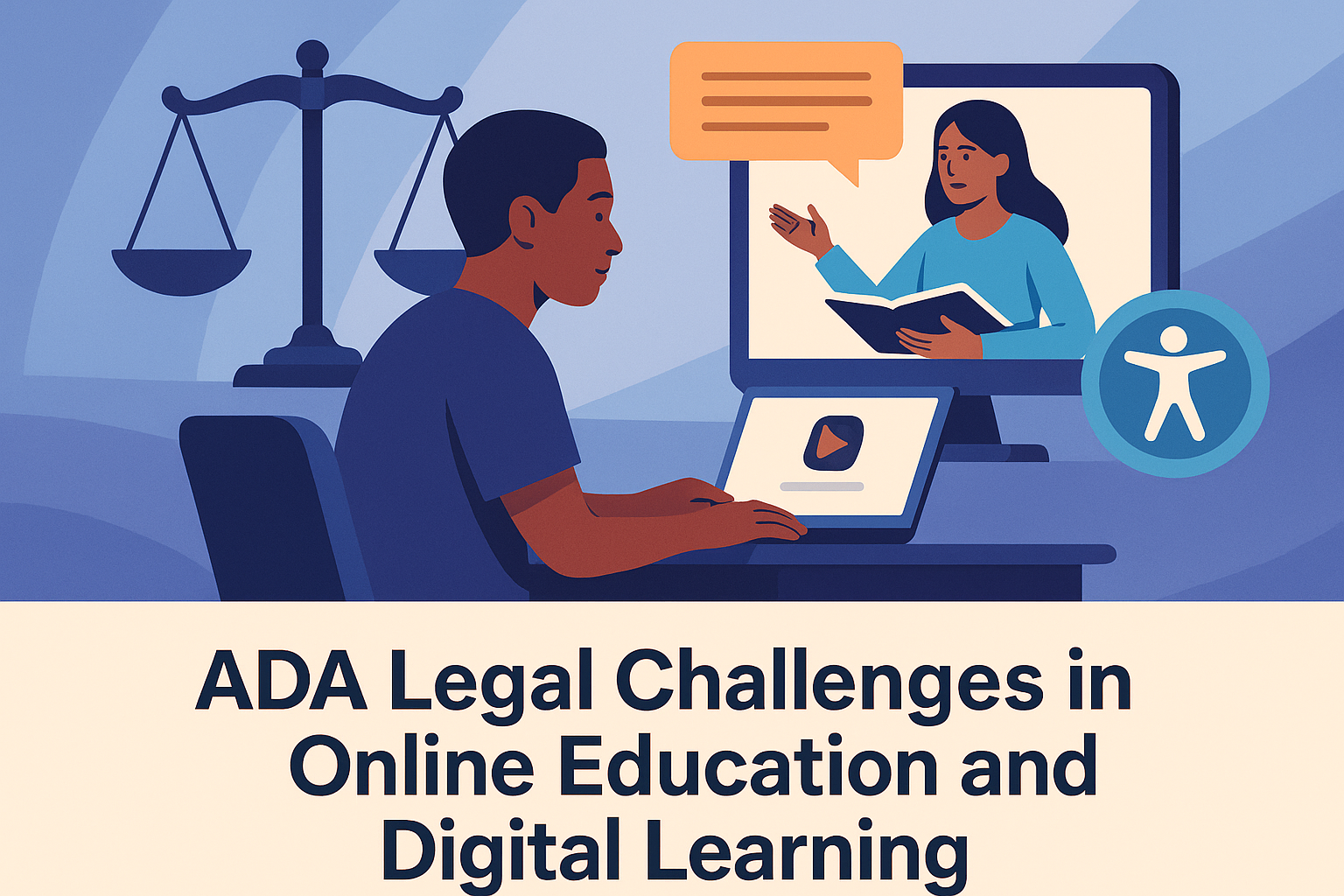
Online education and digital learning have revolutionized the way students access courses, interactions with instructors, and collaborations. However, the rapid growth of these platforms has raised concerns about their accessibility, particularly concerning compliance with the Americans with Disabilities Act (ADA). This landmark civil rights law aims to prohibit discrimination based on disability. While originally focused more on physical spaces, ADA regulations have increasingly been interpreted to cover digital spaces, including online education platforms.
Defining key terms is essential to understanding the scope of this issue. ADA compliance in the context of digital learning refers to making educational content and platforms accessible to students with disabilities, such as those with visual, hearing, or cognitive impairments. Accessible design ensures that all students can engage with digital content effectively. This is crucial as online education often becomes a primary or sole educational resource for students unable to attend traditional schools. Failing to provide accessible education not only violates legal standards but also deprives students with disabilities of their right to equal education.
The significance of ADA legal challenges in digital learning extends beyond mere compliance. It’s about embracing inclusivity, enhancing educational outcomes for all students, and avoiding potential lawsuits that can arise from inaccessible technologies. Engaging intentionally with these challenges supports a learning environment where every student, regardless of ability, has equitable access to education. Thus, understanding the ADA’s application to digital learning is vital for educators, institutions, and developers striving to foster inclusive educational experiences.
Understanding ADA Compliance in Online Education
ADA compliance in online education requires platforms and content to be accessible to all users, including those with disabilities. This encompasses a wide range of requirements, from ensuring that videos have accurate captions and transcripts for the hearing impaired to designing websites that can be navigated using keyboard shortcuts for those unable to use a mouse.
A notable example of this challenge involves the University of California, Berkeley, which faced legal action due to the inaccessibility of its publicly available online course content. The Department of Justice intervened, asserting that the university’s failure to provide accessible educational material was a violation of the ADA. Consequently, the university had to revamp its online offerings to ensure they met ADA standards, demonstrating the significant impact of compliance—or lack thereof—on educational institutions.
The Role of Universal Design in Learning (UDL)
Universal Design for Learning (UDL) is a framework aimed at improving and optimizing learning for all individuals by providing multiple means of engagement, representation, and action and expression. UDL plays a crucial role in achieving ADA compliance because it emphasizes building accessibility into the educational content and curriculum from the ground up, rather than as an afterthought.
Consider a case study from CAST (Center for Applied Special Technology), where UDL principles were employed to create digital textbooks for schools. These books were designed with adaptability in mind, allowing students various ways to absorb and interact with the material, whether through text-to-speech functions or customizable display options. This proactive approach reduces the likelihood of legal challenges and offers a seamless learning experience for all students.
| Key UDL Principles | Description |
|---|---|
| Engagement | Offering choices to increase autonomy and contextual relevance |
| Representation | Providing content in different modalities (visual, auditory) |
| Action and Expression | Allowing multiple means of communication and expression (text, video, audio) |
Legal Landscapes and Institutional Responsibilities
The legal landscape for ADA compliance in digital learning can be daunting. The Department of Education’s Office for Civil Rights (OCR) and the Department of Justice (DOJ) are key regulatory bodies ensuring compliance. They investigate complaints, provide guidelines, and sometimes litigate against entities that fail to comply with ADA standards.
A significant outcome of non-compliance is seen through the example of Louisiana Tech University, which reached a settlement with the DOJ after a blind student filed a complaint about the inaccessibility of the university’s online learning platform. The settlement required the university to procure accessible technology and train faculty on accessibility measures, highlighting the importance of institutional awareness and proactive adjustments to prevent legal issues.
Technological Solutions to Enhance Accessibility
Innovations in technology have significantly advanced the capacity to deliver accessible online education. Tools and practices such as screen readers, voice recognition software, and video captioning play critical roles in enhancing accessibility.
For instance, Blackboard, a well-known learning management system, has integrated features that support ADA compliance, like the Ally tool, which helps instructors make their digital course materials more accessible. By identifying accessibility issues and offering guidance on fixing them, tools like Ally facilitate the creation of inclusive educational content, reducing the chances of legal complications.
The Importance of Training and Awareness
Training and awareness among educators and administrative staff about ADA requirements are vital components of ensuring compliance. A significant barrier to accessibility is often a lack of awareness or understanding of the necessary steps to take in making digital content accessible.
Vanderbilt University serves as an example of implementing comprehensive training programs. They developed workshops and resources aimed at educating faculty and staff on ADA compliance and accessible content creation. This proactive approach helps institutions seamlessly integrate accessibility into their workflows, reduces the risk of overlooking critical accessibility needs, and enhances the educational experience for all students.
Future Directions: Artificial Intelligence and Accessibility
The future of ADA compliance in online education is intertwined with emerging technologies such as Artificial Intelligence (AI). AI can help address accessibility challenges by automating many aspects of content creation and customization, making it easier to provide accessible learning materials.
Microsoft’s AI for Accessibility initiative is a prime example of leveraging technology to improve access. By utilizing AI algorithms, they have developed tools that can generate automatic captions, transcriptions, and even image descriptions, thereby supporting educators in delivering accessible content without extensive manual effort.
Summary and Call-to-Action
In summary, ADA compliance in online education is crucial in ensuring that all students, regardless of physical or cognitive disabilities, have equal access to educational opportunities. Legal challenges, while significant, can be mitigated by implementing universal design principles, leveraging technology, and fostering an environment of awareness and proactive engagement among educators and staff.
The main benefit to stakeholders—be it educators, institutions, or students—lies in understanding and addressing ADA requirements helps create more inclusive, effective, and legally sound educational environments. By embracing these practices, institutions can not only avoid legal pitfalls but also provide a richer, more accessible learning experience.
As a call-to-action, educational institutions and educators should invest in training programs, accessibility audits, and technological solutions to ensure that their online platforms and content meet ADA standards. They should also foster a culture of inclusivity and awareness that prioritizes the needs of all students. By doing so, they prepare for an uncertain future with confidence, ensuring equitable access to education for all.
Frequently Asked Questions
1. What is the significance of ADA compliance in online education and digital learning?
The Americans with Disabilities Act (ADA) is a crucial piece of legislation designed to ensure people with disabilities have equal access to services and opportunities that are available to the general public. In the context of online education and digital learning, ADA compliance is significant for several reasons. Firstly, it ensures that educational materials and learning platforms are accessible to students with disabilities, such as those who are blind, deaf, or have physical, emotional, or cognitive impairments. This means that all students have the opportunity to engage with course content and participate in educational activities fully. For example, ensuring that video lectures are accompanied by captions and transcripts benefits deaf or hard-of-hearing students, while alternative text descriptions for images help those using screen readers. ADA compliance also reflects an institution’s commitment to inclusivity and diversity, fostering a learning environment that respects and accommodates the needs of all students. Moreover, adhering to ADA standards can shield educational institutions from potential legal challenges and financial penalties that can arise from non-compliance. Ultimately, ADA compliance in online education exemplifies a dedication to upholding civil rights and promoting equal education opportunities for everyone.
2. How can educational institutions ensure their online platforms meet ADA standards?
Ensuring that online platforms meet ADA standards involves a comprehensive approach that includes policy development, technology adoption, training, and ongoing evaluation. Educational institutions can start by creating accessibility policies that align with the ADA guidelines and emphasize the importance of making digital content accessible to all students. They should also conduct accessibility audits of their existing online platforms and course materials to identify areas that need improvement. This includes analyzing websites, learning management systems, and digital content for compatibility with screen readers and other assistive technologies. Implementing standards such as the Web Content Accessibility Guidelines (WCAG) can guide the development of accessible online content. Technology decisions must prioritize compatibility with these guidelines. Furthermore, providing training for faculty and staff on creating accessible courses and understanding the diversity of student needs is vital. Lastly, institutions should establish a system for regular monitoring and evaluation of their online education offerings to ensure continued compliance and address evolving needs. By taking a proactive approach to accessibility, educational institutions demonstrate a commitment to inclusivity and comply with legal requirements.
3. What are some common ADA compliance issues that online learning platforms encounter?
Online learning platforms often encounter a range of ADA compliance issues, many of which revolve around digital inaccessibility. Common issues include the lack of captions or transcripts for video and audio content, which can hinder access for hearing-impaired students. Similarly, images without alternative text can be inaccessible to visually impaired students who rely on screen readers. Another frequent problem is the creation of documents, whether in PDF or other formats, that aren’t readable by these assistive technologies due to their structure or formatting. Additionally, some platforms have navigation issues, such as users unable to navigate effectively with a keyboard instead of a mouse, posing challenges for individuals with mobility impairments. The failure to ensure that color contrasts are adequate can also prevent students with vision issues from accurately perceiving on-screen elements. Beyond these technical hurdles, online platforms may fail to address a variety of learning needs in their design, such as cognitive overload, which can be particularly challenging for students with learning disabilities. By identifying and addressing these common problems, online learning platforms can make strides toward ADA compliance and accessible education.
4. Why might schools face legal challenges related to ADA compliance in digital learning?
Schools may face legal challenges related to ADA compliance in digital learning when they fail to ensure that their online educational offerings are accessible to students with disabilities. These legal challenges typically arise when students or advocacy groups identify accessibility barriers that prevent students with disabilities from fully participating in the educational program. For instance, if a student who is blind encounters a learning management system that’s incompatible with screen readers, this can lead to grievances and potential litigation claiming non-compliance with ADA mandates. Other scenarios that might prompt legal action include inaccessible course materials, lack of reasonable accommodations, or insufficient policy frameworks for addressing accessibility issues. Additionally, as digital learning environments become a primary mode of education delivery, the expectation for compliance increases. This heightened scrutiny implies that any neglect in making digital content accessible can be seen both as a failure to support diverse learning needs and as a violation of federal civil rights legislation. Schools are encouraged to proactively address potential barriers, thereby reducing the risk of legal repercussions and ensuring that all students have equitable access to educational opportunities.
5. What steps can students take if they encounter accessibility issues in online courses?
If students encounter accessibility issues in online courses, they have several steps at their disposal to seek resolution. First, they should report the issue to the course instructor or the institution’s disability services office. Schools typically have procedures in place to address accessibility concerns, and faculty and staff may need to be made aware of specific issues. Providing detailed information, such as the nature of the barrier, how it affects their learning, and any specific accommodations needed, can assist in a quicker resolution. Students can also advocate for themselves by requesting specific accommodations, such as alternative formats for course materials or additional time for assignments. If the issue persists and the institution is non-responsive, students can consider escalating the matter to higher administrative levels or seeking assistance from a disability rights advocate or organization. In situations where compliance is in question, filing a formal complaint with the Department of Education’s Office for Civil Rights might be an option. It’s crucial for students to understand their rights under the ADA and advocate for the education that they are entitled to receive. By being proactive in addressing accessibility concerns, students contribute to creating a more inclusive educational environment for all.


