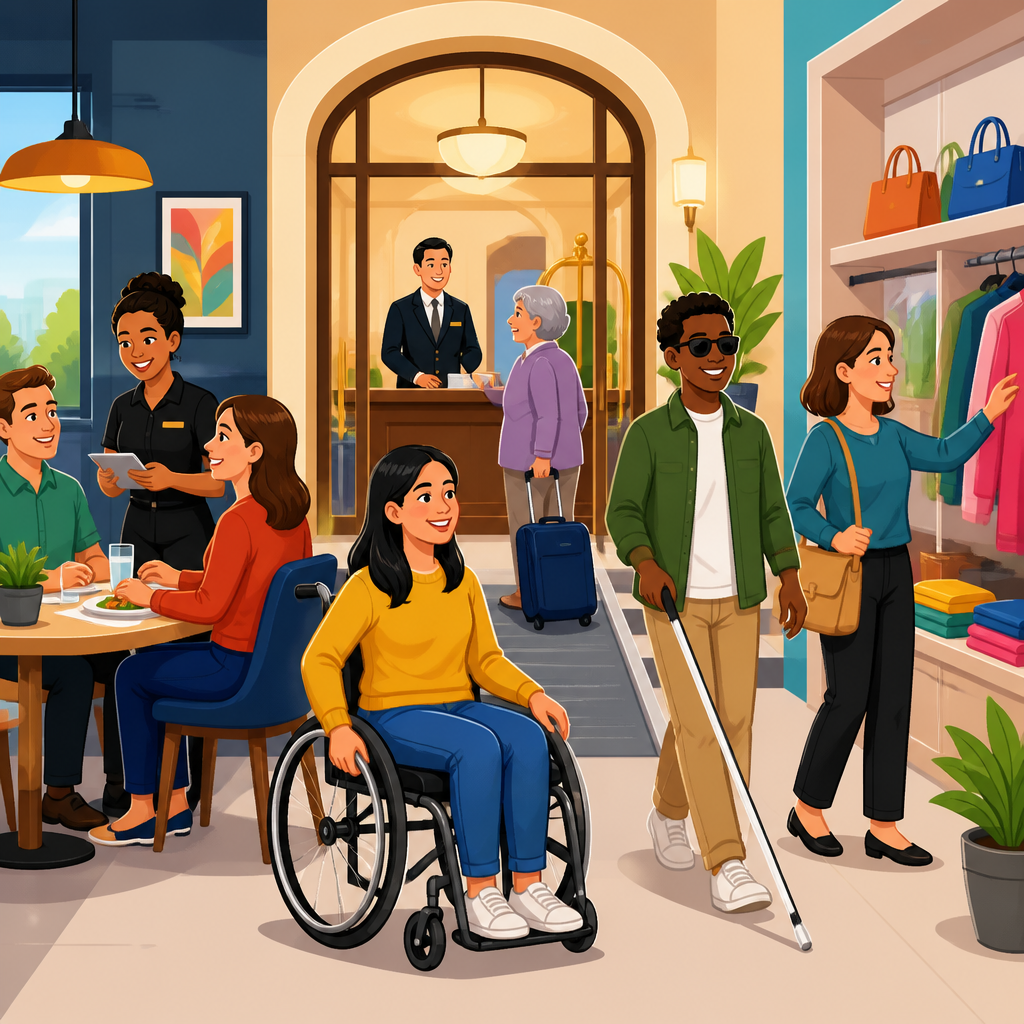
Your right to equal access in restaurants, hotels, and stores is one of the clearest promises of the Americans with Disabilities Act, yet it is still one of the most misunderstood in daily life. Equal access means a business that serves the public must give people with disabilities a fair opportunity to enter, use, and enjoy the same goods, services, facilities, privileges, and advantages offered to everyone else. In practical terms, that covers whether a wheelchair user can get through the front door, whether a blind customer can read a menu with assistance, whether a hotel can modify a routine policy, and whether a shopper with a service animal can complete a purchase without harassment.
When people talk about basic rights under the ADA, they usually mean the rules in Title III, the part of federal law that applies to places of public accommodation. Public accommodations include restaurants, bars, retail stores, shopping centers, hotels, theaters, banks, museums, doctors’ offices, pharmacies, gyms, private schools, and many other privately owned businesses open to the public. The law does not require perfection, and it does not erase every physical or operational barrier overnight. What it does require is equal access through reasonable changes in policies, effective communication, barrier removal when readily achievable, and accessible design in new construction and alterations.
I have seen the same pattern across industries: many businesses focus only on ramps and parking, while customers actually experience access through dozens of smaller interactions. Can someone reserve an accessible room online? Can staff describe daily specials to a blind guest? Will a cashier talk directly to a customer who has a speech disability instead of only to a companion? Can a hotel provide an accessible check-in counter or an alternative method? These are not edge cases. They are the substance of civil rights in the marketplace, and they matter because exclusion in ordinary places can block work, travel, healthcare, education, and community life.
This hub explains the basic rights under the ADA that most often affect visits to restaurants, hotels, and stores. It also clarifies the limits of those rights, because businesses often cite safety, cost, or convenience without understanding what the law actually permits. If you know the core standards, you can identify problems faster, ask for the right fix, and decide when an informal conversation is enough and when a formal complaint is necessary. For families, travelers, advocates, and business owners, understanding these rules is the foundation for making public spaces genuinely usable.
Which businesses must provide equal access
Under Title III of the ADA, most private businesses that are open to the public must provide equal access. The law lists twelve broad categories of public accommodations, including places of lodging, establishments serving food or drink, places of exhibition or entertainment, places of public gathering, sales or rental establishments, service establishments, public transportation terminals, places of recreation, schools, social service centers, and places of exercise or recreation. That broad coverage is why equal access questions show up in everyday settings from coffee shops to chain hotels to local boutiques.
Restaurants must allow disabled guests to enter, order, dine, and use restrooms on equal terms unless a specific exception applies. Hotels must make accessible features available, identify those features accurately during reservations, and hold accessible rooms for people who need them under the same booking conditions offered to others. Stores must provide access to entrances, aisles when feasible, service counters, fitting rooms when altered or newly built, and assistance policies that do not screen out disabled customers. A business cannot avoid these duties by saying it is small, old, busy, or independently owned. Size can affect what is readily achievable, but not whether the ADA applies at all.
Some businesses are exempt or covered differently. Religious entities and private clubs have limited obligations under this title. Historic properties may use alternative methods where standard modifications would threaten historic significance, though access is still required to the maximum extent feasible. Residential facilities are generally not public accommodations unless areas are open to the public, such as a rental office. These distinctions matter, but most restaurants, hotels, and stores that consumers use every day fall squarely within the ADA’s coverage.
What equal access requires in practice
Equal access under the ADA is built from four core duties. First, businesses must remove architectural barriers in existing facilities when removal is readily achievable, meaning easily accomplishable without much difficulty or expense. Second, new construction and alterations must comply with the ADA Standards for Accessible Design. Third, businesses must make reasonable modifications to policies, practices, and procedures when necessary to serve people with disabilities, unless the change would fundamentally alter the nature of the business. Fourth, they must provide effective communication, including auxiliary aids and services, unless doing so would create an undue burden or fundamental alteration.
These standards work together. A restaurant with a step at the entrance may need a ramp if readily achievable. If the restroom cannot be fully remodeled immediately, staff may still need to offer table service in an accessible area and read printed materials aloud when needed. A hotel may have compliant guest rooms, but it can still violate the law if its reservation system does not describe accessibility features well enough for a guest to assess whether the room meets individual needs. A store may have an accessible entrance but fail equal access if merchandise displays narrow routes so much that wheelchair users cannot navigate them.
The law focuses on access to the full experience, not just physical entry. Being allowed inside is not enough if a disabled customer cannot complete the same transaction, use the same amenities, or receive information in a usable form. In enforcement work, this is where many disputes arise. Businesses often fix one obvious barrier and miss the service design issue that keeps excluding people.
Physical accessibility in restaurants, hotels, and stores
Physical accessibility starts before a customer reaches the door. Accessible parking, passenger loading zones, curb ramps, and route surfaces affect whether someone can even approach the building. Inside, common problem areas include heavy doors, narrow routes caused by furniture or displays, inaccessible restrooms, service counters that are too high, and seating layouts that isolate wheelchair users. The ADA Standards contain technical measurements for many of these features, including door width, turning space, accessible toilet compartments, counter height, and maneuvering clearance. Those measurements matter because a few inches can determine whether a space is usable.
In restaurants, accessible seating must be integrated, not pushed to a leftover corner near the kitchen. In hotels, accessible guest rooms must include the specific features promised, such as roll-in showers, visual alarms, accessible hardware, or communication devices where required. In stores, routes through merchandise should remain accessible even during seasonal promotions, restocking, or sales events. Temporary clutter can be just as exclusionary as bad construction. I have repeatedly seen businesses pass a one-time inspection, then lose accessibility through daily operations.
| Setting | Common barrier | ADA principle | Practical fix |
|---|---|---|---|
| Restaurant | Only high-top tables available | Integrated accessible seating | Keep standard-height accessible tables available throughout service |
| Hotel | Accessible room cannot be booked online clearly | Accessible reservations | List room features in detail and reserve inventory properly |
| Store | Aisles narrowed by displays | Accessible route maintenance | Set display limits and train staff to preserve clear paths |
| All three | Service counter too high for some customers | Equal transaction access | Provide a lowered section or complete service at an alternative accessible location |
Not every old building must be rebuilt immediately, but businesses do have an ongoing duty to consider barrier removal. Installing grab bars, adding offset hinges to widen usable door space, lowering paper towel dispensers, rearranging tables, adding accessible signage, and adjusting door closers are common examples often considered readily achievable. More expensive changes may depend on resources and site conditions, but a business needs a real assessment, not a reflexive no.
Policies, service animals, and effective communication
Many of the most important ADA rights have nothing to do with construction. Reasonable modification rules require businesses to adjust normal policies when needed to serve a disabled customer, unless the requested change would fundamentally alter the business. A restaurant may need to allow a person with diabetes to bring food needed to manage blood sugar. A store may need to assist with retrieving items from high shelves if that assistance is part of normal customer service. A hotel may need to permit a later checkout related to disability needs when doing so is reasonable and available.
Service animal rules are a frequent source of conflict. In most restaurants, hotels, and stores, a dog trained to do work or perform tasks for a person with a disability must be allowed in areas where the public can go. Staff may ask only two questions when the disability is not obvious: whether the dog is required because of a disability and what work or task the dog has been trained to perform. Staff cannot demand documentation, require a special vest, or ask about the person’s diagnosis. A service animal can be excluded if it is out of control and the handler does not take effective action, or if it is not housebroken, but fear of dogs or allergies alone is not enough.
Effective communication means information must be conveyed in a way the customer can actually use. For blind or low-vision customers, that may mean staff reading menus, receipts, or policies aloud, providing digital text, or assisting with wayfinding. For deaf or hard of hearing customers, it can mean exchanging written notes for simple transactions, ensuring captioning on televisions in guest rooms upon request, or arranging a qualified sign language interpreter for complex, lengthy interactions when necessary. The right aid depends on the context. Ordering lunch may require something different from discussing surgery instructions at a medical office, but the basic rule is the same: communication must be as effective as communication with others.
Reservations, websites, and the digital side of access
Equal access increasingly depends on digital systems. Hotels are a prime example because reservation platforms must let guests identify and reserve accessible rooms during the same hours and in the same manner as other rooms. The Department of Justice has been clear that accessibility descriptions must be detailed enough for travelers to assess whether a room meets their needs. Saying “ADA room available” is usually not enough. Guests often need to know whether the bathroom has a roll-in shower or transfer tub, whether bed height is manageable, and whether visual notification devices are installed.
Restaurants and stores also create access barriers through websites, mobile ordering, digital coupons, and self-service kiosks. If a restaurant’s menu exists only as an unreadable image, a blind customer may not be able to order independently. If a retailer offers loyalty discounts only through an inaccessible app, disabled shoppers can be excluded from pricing benefits offered to others. Courts have addressed website accessibility in different ways, but the compliance trend is unmistakable: digital tools tied to a public-facing business should be accessible. Many organizations use the Web Content Accessibility Guidelines, version 2.1 AA, as the operational benchmark because it covers text alternatives, keyboard access, color contrast, form labels, and other essentials.
Digital access is not separate from in-person access. It is part of the customer journey. In my work, inaccessible reservation systems and payment flows often create more practical harm than a missing sign because they stop the customer before the visit begins. Businesses that treat accessibility as a full service pathway, from search to booking to checkout, consistently perform better and face fewer complaints.
Limits, defenses, and what businesses do not have to do
The ADA is broad, but it is not unlimited. A business does not have to make a requested change if it would fundamentally alter the nature of the goods or services. A fine-dining restaurant, for example, does not have to let a customer enter a commercial kitchen because that changes the nature of the space and creates legitimate safety concerns. A store does not have to provide personal services such as individual dressing or eating assistance if those services are not normally offered. For auxiliary aids and policy modifications, a business can also raise an undue burden defense, meaning significant difficulty or expense in light of overall resources.
These defenses are narrower than many businesses assume. “We have never done that before” is not a legal defense. Neither is “other customers might complain.” Safety rules must be based on actual risk, not stereotypes about disability. If a business excludes a customer for safety reasons, it should be able to explain the specific direct threat analysis behind that decision, including whether reasonable modifications could reduce the risk. Blanket bans tend to fail when challenged.
Readily achievable barrier removal is also flexible, not optional. A small shop in a century-old building may not be able to install an elevator, but it may still be able to add a portable point-of-sale device, relocate services to an accessible area, improve signage, or modify display layouts. The legal question is not whether perfect access is possible instantly. It is what access improvements are feasible now, with this business, in this setting.
What to do if your rights are denied
If you are denied equal access, start by documenting the facts carefully. Record the date, time, location, names of employees if available, what you requested, what response you received, and how the barrier affected your access. Photos, screenshots, confirmation emails, and receipts can be useful. In many cases, a calm request to a manager solves the problem quickly, especially when the issue involves staff training, a removable obstacle, or confusion about service animal rules. Be specific about the fix you need. “I need an accessible route to the register” is more effective than “This place is not accessible.”
If the issue is not resolved, you can file a complaint with the U.S. Department of Justice Civil Rights Division. State civil rights agencies, local human rights offices, and private attorneys may also help, and some state laws provide additional remedies beyond federal law. For hotels and chains, a corporate accessibility or guest relations department may be more responsive than local staff. Keep copies of all communication and note whether the business offers a temporary workaround or a permanent correction plan.
The main takeaway is simple: equal access in restaurants, hotels, and stores is not a courtesy. It is a legal right grounded in the ADA’s promise that people with disabilities must be able to participate in ordinary public life on equal terms. Physical features, policies, communication methods, and digital tools all shape whether that promise is real. Learn the core rules, ask for concrete solutions, and escalate when needed. If you want stronger protection in everyday life, start by reviewing the access barriers you encounter most often and taking action on the next one.
Frequently Asked Questions
What does “equal access” mean under the ADA for restaurants, hotels, and stores?
Equal access means that businesses open to the public must give people with disabilities a real and meaningful opportunity to enter, use, and enjoy the same goods, services, and spaces available to everyone else. Under the Americans with Disabilities Act, restaurants, hotels, retail stores, and many other public-facing businesses cannot exclude people with disabilities, create unnecessary barriers, or offer a lower level of service simply because access requires some adjustment. The standard is not perfection in every situation, but fairness and usability in the way the business operates.
In everyday terms, equal access can include a wide range of issues. It may involve whether a wheelchair user can get through the front entrance, whether aisles are wide enough to move through safely, whether seating is available in accessible locations, whether a hotel room has usable features such as grab bars and clear floor space, or whether a store’s checkout counter can be used by someone with mobility limitations. It also includes communication access, such as reading menus or signage, understanding policies, or interacting with staff in a way that allows a customer with a hearing, vision, or speech disability to participate effectively.
Just as important, equal access is about the full customer experience, not just getting in the door. A business may have an accessible entrance but still create barriers if staff refuse to read a menu to a blind customer, deny entry to a service animal, or relocate disabled customers to a separate area without a valid reason. The law is designed to ensure that people with disabilities have the same opportunity to enjoy meals, lodging, shopping, and services with dignity, independence, and as much integration as possible.
Are businesses required to remove physical barriers like steps, narrow aisles, or inaccessible restrooms?
In many cases, yes. Businesses that serve the public generally have a duty under the ADA to remove architectural barriers when doing so is “readily achievable,” meaning it can be accomplished without much difficulty or expense in light of the business’s resources and circumstances. That can include installing ramps, rearranging furniture, widening paths of travel, lowering shelves or counters where appropriate, improving door hardware, adding accessible parking, or making restroom features more usable. The law recognizes that older buildings may not be perfectly designed, but it does not allow businesses to ignore obvious, fixable access problems.
Whether a particular change is required often depends on the nature of the barrier and the business’s size, finances, and facility layout. A large national chain may be expected to do more than a very small independently owned shop, but both are still covered by the principle of accessibility. For example, moving displays that block a path or keeping an accessible entrance unlocked may be simple steps that are clearly required. More extensive construction may involve a more detailed legal and factual analysis, especially if structural changes are expensive or technically difficult.
Even when complete barrier removal is not immediately possible, a business still should look for practical ways to provide access. That might mean offering service at an accessible entrance, bringing merchandise to a customer, helping someone navigate a space, or modifying the layout of tables and racks. However, alternative methods are not always a substitute for physical access when barriers can reasonably be removed. The ADA expects businesses to make good-faith efforts to improve access rather than wait until a customer complains or assume that disability accommodations are optional.
Can a restaurant, hotel, or store refuse a service animal or charge extra fees?
In most situations, no. Businesses covered by the ADA must generally allow a service animal to accompany a person with a disability in areas where customers are normally allowed to go. A service animal is not treated as a pet under the law. It is an animal trained to do work or perform tasks for a person with a disability, and its presence is part of the person’s ability to access the business on equal terms. A restaurant cannot deny access simply because it serves food, a hotel cannot impose a “no pets” rule on a service animal, and a store cannot require the customer to leave the animal outside.
Businesses are also generally not allowed to charge pet fees, cleaning fees in advance, or other surcharges just because a customer uses a service animal. The person with a disability must be treated like other customers. If the business would normally charge any customer for actual damage they cause, it may apply that same rule if real damage occurs, but it cannot single out service animal handlers for extra deposits or special penalties. That distinction matters because equal access includes freedom from discriminatory financial burdens.
There are limited circumstances in which a service animal can be excluded, such as when the animal is out of control and the handler does not take effective action to control it, or when the animal is not housebroken. Even then, the business should still offer the person the chance to obtain goods or services without the animal present if possible. Staff may ask limited questions when the need for the animal is not obvious, but they may not demand documentation, require the animal to demonstrate its task, or interrogate the customer about their medical condition. A calm, lawful policy and staff training can prevent many of the service animal disputes that arise in public places.
What kinds of policy changes or customer service modifications might a business have to make?
The ADA does not only address buildings; it also requires businesses to make reasonable modifications to policies, practices, and procedures when necessary to serve people with disabilities, unless doing so would fundamentally alter the nature of the business. This is a major part of equal access because many barriers are created not by walls or stairs, but by inflexible rules. A restaurant, hotel, or store may need to adjust how it normally does things so that a disabled customer can use the service in a meaningful way.
Examples can include permitting a service animal despite a no-pets policy, reading a menu or product information aloud to a customer with a vision disability, assisting with carrying merchandise when appropriate, allowing extra time for communication, or modifying a rule about where a customer may wait or sit. In a hotel setting, it may involve honoring an accessible room reservation properly, ensuring that accessible features are available as promised, or adjusting check-in practices so a guest with a communication disability can complete the process effectively. In retail environments, it might mean helping retrieve items from shelves that are otherwise out of reach or adjusting a queueing practice that excludes someone using a mobility device.
What businesses are not required to do is make changes that would fundamentally change what they offer or create an undue burden in a specific context. But many common modifications are straightforward, low-cost, and clearly required. The key legal idea is that disabled customers should not be blocked by standard procedures when a reasonable adjustment would allow equal participation. Businesses that train employees to think in terms of access, dignity, and problem-solving are far more likely to comply with the law and create a welcoming experience for everyone.
What should someone do if they believe a restaurant, hotel, or store denied them equal access?
If someone believes their rights were violated, the first step is often to document what happened as clearly as possible. That can include noting the date, time, location, names of employees involved, specific barriers encountered, statements that were made, and how the problem affected access to the business. Photos, receipts, reservation confirmations, screenshots, and written follow-up can also be helpful. Good documentation matters because accessibility disputes often turn on practical details, such as whether an entrance was usable, whether staff refused a lawful request, or whether an accessible feature was unavailable despite being advertised.
In some situations, raising the issue directly with a manager or business owner can lead to a quick resolution. Many access problems stem from poor training, temporary obstructions, or misunderstandings about ADA requirements. A respectful complaint may result in a policy correction, barrier removal, or a commitment to improve. However, people do not have to accept repeated discrimination or rely solely on informal conversations if the issue is serious or ongoing.
When the problem is not resolved, a person may choose to file a complaint with the U.S. Department of Justice or seek legal advice from an attorney who handles disability rights matters. An attorney can evaluate whether the facts suggest a violation of the ADA or related state laws, explain possible remedies, and help determine the best next step. Depending on the circumstances, the goal may be to fix the barrier, change a policy, preserve evidence, or pursue formal action. The most important point is that equal access is not a courtesy businesses may choose to extend. It is a civil right, and people who are denied it have options for enforcing that right.