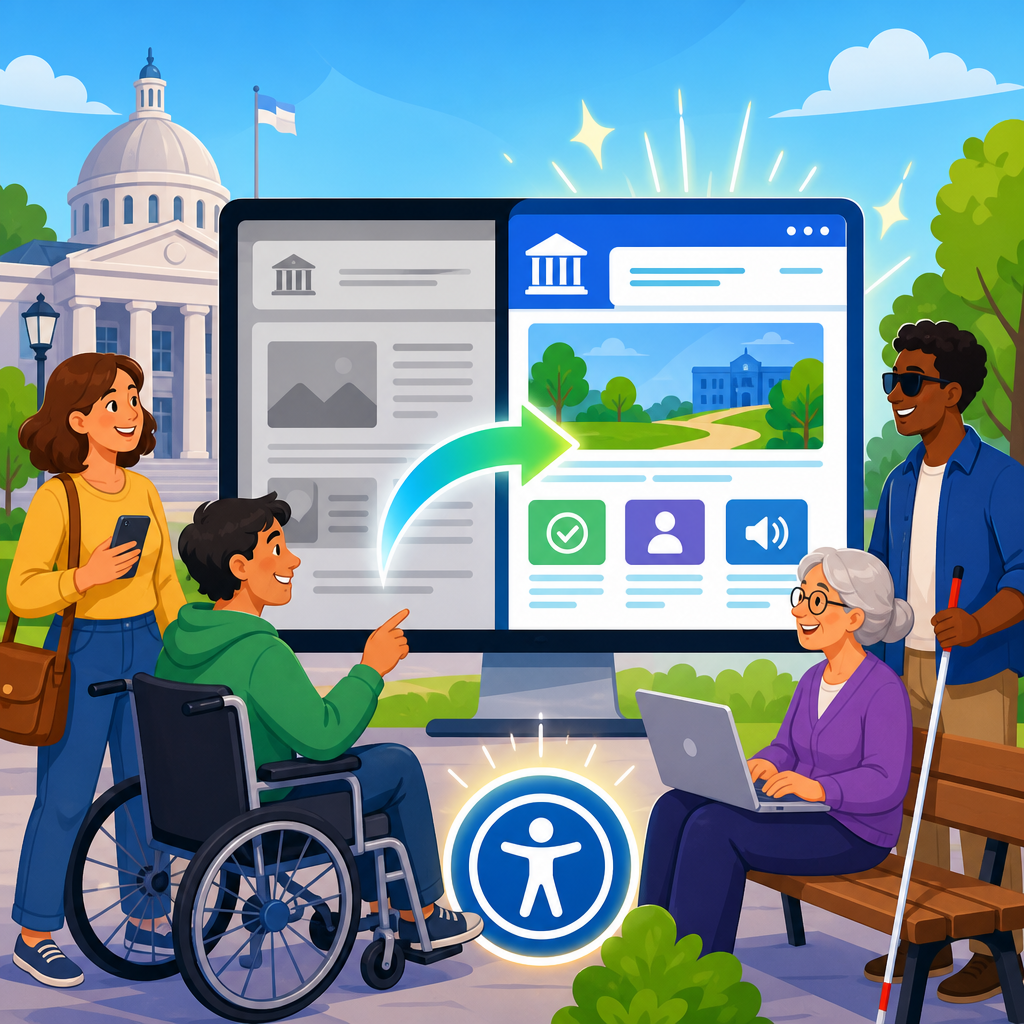
The 2026 landscape for ADA Title II web compliance is defined less by a brand-new legal theory than by a sharper operational reality: public entities now have a clearer federal rule for digital accessibility, firmer deadlines, and less room to treat websites, mobile apps, and online services as optional accessibility projects. ADA Title II applies to state and local governments and the agencies, districts, courts, libraries, colleges, and public health systems they operate. When people ask what changed in the ADA Title II web rule in 2026, the practical answer is that 2026 became the first major compliance year in which many public entities had to move from planning to execution under the Department of Justice rule adopted in 2024.
That distinction matters because accessibility rules often change in stages. First, a legal obligation is announced. Then technical standards are identified. After that, organizations map inventory, budget remediation, train staff, revise procurement, and implement governance. I have worked with public-sector web teams through that exact sequence, and 2026 is where the conversation became more concrete: Which pages must be fixed first? What about archived documents? How do mobile apps fit in? What evidence shows reasonable compliance efforts? Those are no longer abstract compliance questions. They drive procurement decisions, publishing workflows, vendor contracts, and litigation risk.
At the center of the rule is a simple requirement: web content and mobile apps offered by public entities must be accessible to people with disabilities. The Department of Justice tied that requirement to WCAG 2.1 Level AA, the globally recognized technical benchmark published by the World Wide Web Consortium. WCAG addresses barriers affecting screen reader users, keyboard-only users, people with low vision, Deaf and hard-of-hearing users, and people with cognitive or motor disabilities. In practice, that means text alternatives for images, sufficient color contrast, keyboard operability, captions for video, meaningful form labels, consistent navigation, and error identification that users can understand.
For organizations tracking recent ADA updates and developments, this topic now serves as a hub because the Title II web rule intersects with enforcement trends, procurement standards, document accessibility, app development, higher education obligations, and emerging expectations around AI-generated content. The 2026 update is not just about one deadline. It signals that digital accessibility has been normalized as a core public service requirement, much like language access, records retention, cybersecurity, and privacy. Public entities that understand what changed can prioritize the right remediation work, document good-faith progress, and reduce the gap between legal compliance and everyday user experience.
What the DOJ Rule Changed and Why 2026 Matters
The Department of Justice finalized its ADA Title II web and mobile application accessibility rule in April 2024. The rule did not invent accessibility duties from scratch; courts and DOJ enforcement had long treated inaccessible digital services as potential discrimination under Title II. What changed was the move from broad obligation to explicit technical standard. Public entities now have a defined benchmark, WCAG 2.1 Level AA, plus compliance dates based largely on population size. For many entities, 2026 is the first year those dates become operationally urgent rather than merely informational.
The rule also narrowed a major source of confusion. Before the update, many agencies relied on older settlement language, inconsistent court decisions, or internal references to Section 508. Section 508 remains important for federal agencies and as a procurement signal, but Title II now has its own direct regulatory path for state and local governments. That reduces ambiguity in accessibility planning. If a county posts permit applications online, if a public university runs an enrollment portal, or if a city delivers utility payments through a mobile app, those digital services fall squarely into the compliance conversation.
Another meaningful change is the explicit inclusion of mobile apps. In accessibility reviews, I regularly saw agencies focus heavily on websites while overlooking native apps used for transit, emergency alerts, parking, recreation, or patient access. The 2026 discussion corrected that imbalance. A public entity cannot claim broad digital access while its app blocks screen reader navigation, traps keyboard focus on tablet interfaces, or relies on color alone to communicate essential status information. The rule treats web and app access as part of the same service-delivery responsibility.
Compliance Deadlines, Scope, and Common Exceptions
The rule established compliance timelines based primarily on population. Public entities serving populations of 50,000 or more generally face an earlier deadline than smaller public entities, with many large entities focusing on April 2026 and many smaller entities on April 2027. Special district governments have separate considerations, and organizations should verify how they are classified rather than assume size alone resolves the issue. The key point for 2026 is that larger entities cannot credibly remain in assessment mode. They need documented remediation, testing, and governance already underway or completed.
Scope is broad. Websites, web applications, online forms, digital payment systems, calendars, course materials, and mobile apps can all be covered when they are used to provide programs, services, or activities. That includes third-party platforms used on behalf of a public entity. If a school district outsources meal payments, or a municipality uses a vendor-hosted permitting portal, accessibility responsibility does not disappear because the tool sits outside the main domain. Procurement language, vendor due diligence, and acceptance testing became far more important as 2026 approached.
The rule does contain limited exceptions, but they are narrower than many organizations expect. Archived web content, preexisting conventional electronic documents in some circumstances, certain individualized or password-protected documents, and content posted by third parties in spaces where the public entity does not control posting may be treated differently. Yet these carve-outs are not blanket safe harbors. If an older PDF is necessary to access a current government service, or a public-facing form remains in routine use, accessibility issues still create real exposure. The safest interpretation is functional: if residents need it, users with disabilities must be able to use it.
| Area | What changed in practice by 2026 | Example |
|---|---|---|
| Technical standard | WCAG 2.1 Level AA became the explicit baseline for Title II digital services | A city replaces image-only buttons, adds form labels, and fixes keyboard traps |
| Coverage | Mobile apps were clearly included alongside websites and web tools | A transit app adds screen reader labels and accessible trip-planning flows |
| Deadlines | Large public entities moved into active compliance periods starting in 2026 | A county shifts from audit planning to agency-wide remediation tracking |
| Procurement | Third-party tools became a frontline compliance issue | A university requires VPAT review and user testing before renewing a portal |
| Documentation | Proof of governance and testing became more valuable | A school district maintains issue logs, exceptions analysis, and retest reports |
How Public Entities Are Adjusting Their Accessibility Programs
The strongest response I have seen is not a one-time audit but a repeatable operating model. Public entities entering 2026 successfully usually started with a digital asset inventory, ranked services by public impact, and separated quick fixes from structural rebuilds. High-priority items often included homepage navigation, payment flows, appointment systems, emergency notices, employment applications, and PDF forms tied to benefits or licensing. That prioritization matters because accessibility backlogs can be large, especially in decentralized institutions like universities or county systems with many departments.
Testing practices also matured. Automated scanners such as axe, WAVE, Siteimprove, and Monsido can find missing alt text, low contrast, empty links, and heading errors, but they do not reliably catch screen reader confusion, inaccessible modal behavior, misleading link text, or broken focus order. By 2026, credible programs increasingly paired automated scanning with manual keyboard testing, screen reader checks using NVDA, JAWS, or VoiceOver, and workflow reviews by trained specialists. Public entities that relied only on an automated score often discovered late that the user experience was still unusable.
Governance became the other major shift. Agencies are assigning ownership, usually through a digital accessibility coordinator, legal counsel, procurement lead, web platform manager, and content governance group. That structure helps solve recurring failures: inaccessible PDFs uploaded by separate departments, video without captions, event platforms chosen without accessibility review, and emergency banners launched without keyboard support. Training content authors is especially important. Many accessibility defects are introduced after remediation, through routine publishing habits like pasting tables as images, using unlabeled forms, or posting scanned documents with no text layer.
Enforcement Trends, Litigation Risk, and Related Developments
Recent ADA updates and developments extend beyond the rule text itself. Enforcement risk is shaped by DOJ investigations, private lawsuits, demand letters, and public complaints. Even before the current rule, inaccessible digital services could trigger legal action under the ADA and, in some contexts, under Section 504, state disability laws, or state civil rights statutes. The 2026 environment raises the stakes because defendants can no longer argue there was no clearly identified technical target. WCAG 2.1 Level AA gives plaintiffs, regulators, and courts a more concrete yardstick.
Education, healthcare, and elections remain especially sensitive sectors. Public universities manage admissions, course registration, housing, financial aid, and learning platforms; hospitals and clinics operate patient portals, telehealth systems, and intake forms; election offices publish polling information, absentee ballot instructions, and deadlines under intense public scrutiny. In each area, accessibility failures can block equal participation in a government program. That is why remediation plans increasingly focus first on task-critical journeys rather than cosmetic homepage compliance.
Another development in 2026 is the tighter relationship between accessibility and procurement. Many entities now require a current VPAT based on the Accessibility Conformance Report format, but experienced teams do not stop there. A VPAT is self-reported and often incomplete. Stronger review includes contract language, demo testing, issue remediation timelines, indemnity terms where appropriate, and acceptance criteria tied to user tasks. This matters because some of the most serious accessibility barriers appear inside SaaS products a public entity does not directly code. If procurement is weak, accessibility debt scales quickly across departments.
What Organizations Should Do Next
For any public entity asking what changed in the ADA Title II web rule in 2026, the answer should lead directly to action. Start by confirming classification, deadline, and system inventory. Then identify the digital services residents use most and test those first against WCAG 2.1 Level AA with both automated and manual methods. Fix barriers in templates, components, navigation, and forms before chasing isolated page errors. Review mobile apps with the same rigor as websites. Update procurement workflows so new tools do not recreate old problems. Most important, document every step: audits, issue logs, retesting, governance decisions, training records, and vendor communications.
This hub on recent ADA updates and developments should anchor a broader compliance strategy because the rule touches nearly every digital channel a public entity operates. The biggest benefit is not just reduced legal risk. It is service access. When a blind resident can pay a bill independently, a Deaf student can watch captioned instructional content, or a keyboard-only user can submit a permit application without help, accessibility is doing what the ADA intended: removing barriers to civic participation. Use 2026 as the year to move from awareness to durable implementation, and build a digital accessibility program that can withstand future audits, redesigns, and policy shifts.
Frequently Asked Questions
What actually changed in the ADA Title II web rule in 2026?
The biggest change in 2026 is not that public entities suddenly became responsible for digital accessibility for the first time. That obligation already existed under ADA Title II. What changed is that the federal government now provides a much clearer, more operational rule for how state and local governments should make their websites, mobile apps, and digital services accessible. In practical terms, 2026 marks the point where compliance is defined less by general nondiscrimination language alone and more by specific expectations, timelines, and technical benchmarks.
For public entities, this means web accessibility is no longer something that can be treated as a best-practice initiative, a future improvement project, or a secondary IT concern. The rule makes it much harder to delay remediation or argue that digital barriers can be handled informally. Agencies, school districts, public colleges, courts, transit authorities, libraries, and public health systems are expected to look at the full user experience across their digital properties and make accessibility part of routine operations.
Another important shift is enforcement clarity. Before, many organizations understood that inaccessible digital services could create ADA risk, but they often faced uncertainty about what standard they would be judged against and how quickly they needed to act. By 2026, the compliance conversation is much more concrete. Public entities are expected to know their obligations, identify inaccessible content and functionality, prioritize fixes, and implement sustainable processes so new content does not recreate old problems.
Who has to comply with the ADA Title II web rule?
The rule applies to public entities covered by ADA Title II, which generally means state and local governments and the organizations, departments, and systems they operate. That includes a wide range of institutions: city and county governments, public school districts, community colleges, state universities, courts, police departments, public hospitals, health departments, election offices, parks departments, transportation systems, and public libraries, among many others. If an organization is part of state or local government operations, its digital services are likely within scope.
Importantly, compliance is not limited to a government agency’s main website homepage. The rule reaches the broader digital ecosystem people use to access public services. That may include online forms, payment systems, permit applications, emergency notices, public records portals, job application systems, benefits platforms, scheduling tools, GIS maps, mobile apps, and third-party systems used to deliver services on the entity’s behalf. In other words, the question is not just whether the entity has a website, but how the public interacts with its digital programs, services, and activities.
This is why many public entities in 2026 are taking a wider inventory approach. They are reviewing not only their own content management systems and mobile apps, but also vendor-provided tools, embedded documents, archived materials still used by the public, and accessibility barriers introduced through decentralized publishing. The legal responsibility generally remains with the public entity, even when technology is purchased from or managed by outside providers.
Does the 2026 rule require compliance with WCAG, and if so, why does that matter?
Yes, the rule is widely understood through a defined technical accessibility standard, and that matters because it turns a broad legal obligation into a measurable compliance target. Instead of relying only on the general idea that digital services must be accessible, public entities now have a clearer framework for what accessibility should look like in practice. That includes issues such as keyboard navigation, color contrast, alternative text for images, accessible forms, captions for video, clear headings and labels, compatibility with screen readers, and predictable interaction patterns.
This matters because accessibility failures are often highly technical but deeply practical. For example, if a resident cannot submit a permit application without using a mouse, if a blind user cannot interpret a PDF budget document, if a deaf user cannot access video-based public information, or if a person with a cognitive disability cannot understand an inconsistent navigation structure, the barrier is not theoretical. It directly limits equal access to government services. A recognized technical standard gives public entities and their vendors a common language for testing, remediation, procurement, and quality assurance.
In 2026, this also changes governance. Accessibility is no longer just a legal or communications issue. It becomes part of design standards, development workflows, document publishing, procurement reviews, and content training. Agencies that understand this tend to perform better because they stop treating accessibility as one large one-time audit and instead build it into how digital services are created and maintained every day.
What kinds of digital content and services are most likely to create compliance problems for public entities?
The most common problem areas are usually not limited to a government entity’s core webpages. In many cases, the greatest compliance risks come from the broader mix of digital assets that have accumulated over time. This often includes PDFs and other downloadable documents, online forms, payment and registration systems, meeting agendas and minutes, maps, calendars, third-party scheduling tools, legacy databases, public-facing dashboards, and mobile app features that were developed without accessibility testing.
Documents are a particularly common issue. Many public entities have years of posted forms, notices, reports, and policy files that were created for visual reading only and are difficult or impossible for screen reader users to navigate. Videos can also create risk when they are missing captions, transcripts, or audio-accessible context. Forms are another high-priority area because even a small labeling error, missing instructions, or inaccessible error message can block someone from completing a critical task such as applying for housing assistance, paying a fee, registering for classes, or reporting a public safety concern.
Another frequent challenge is organizational complexity. Many Title II entities publish content through multiple departments, offices, and campuses, each using different tools and habits. That decentralization often results in inconsistent heading structures, inaccessible embedded media, broken keyboard flows, duplicated inaccessible templates, and vendor platforms that were never properly vetted. In 2026, the entities making the most progress are the ones that identify these repeat patterns, assign internal ownership, and focus on high-impact services first while building a long-term remediation program.
What should a public entity do in 2026 if it is behind on ADA Title II web compliance?
The first step is to stop thinking of accessibility as a side project and start treating it as an operational compliance program. A public entity that is behind should begin with a realistic inventory of its digital footprint: websites, subdomains, online service portals, mobile apps, public documents, video content, and third-party tools. From there, it should assess which assets support essential public services and where the most serious accessibility barriers exist. This helps establish a defensible remediation roadmap based on user impact and legal exposure, rather than guesswork.
Next, the entity should conduct accessibility testing using both automated tools and manual review. Automated scans can identify some recurring code issues, but they do not catch everything. Manual testing is essential for keyboard access, screen reader usability, form workflows, modal dialogs, focus order, error recovery, and overall task completion. Public entities should also review internal publishing practices, because many accessibility problems are reintroduced by routine content updates, inaccessible document uploads, or vendor changes.
Just as important, the organization needs structure. That usually means assigning responsibility, adopting accessible design and development standards, training content authors, updating procurement requirements, establishing a process for accessible document creation, and setting up ongoing monitoring. In 2026, the strongest compliance posture comes from showing active governance, documented remediation efforts, and a good-faith commitment to equal digital access. Even if an entity is not yet where it should be, a disciplined and visible accessibility program is far better than delay, fragmentation, or assuming the issue can be handled only when complaints arise.


