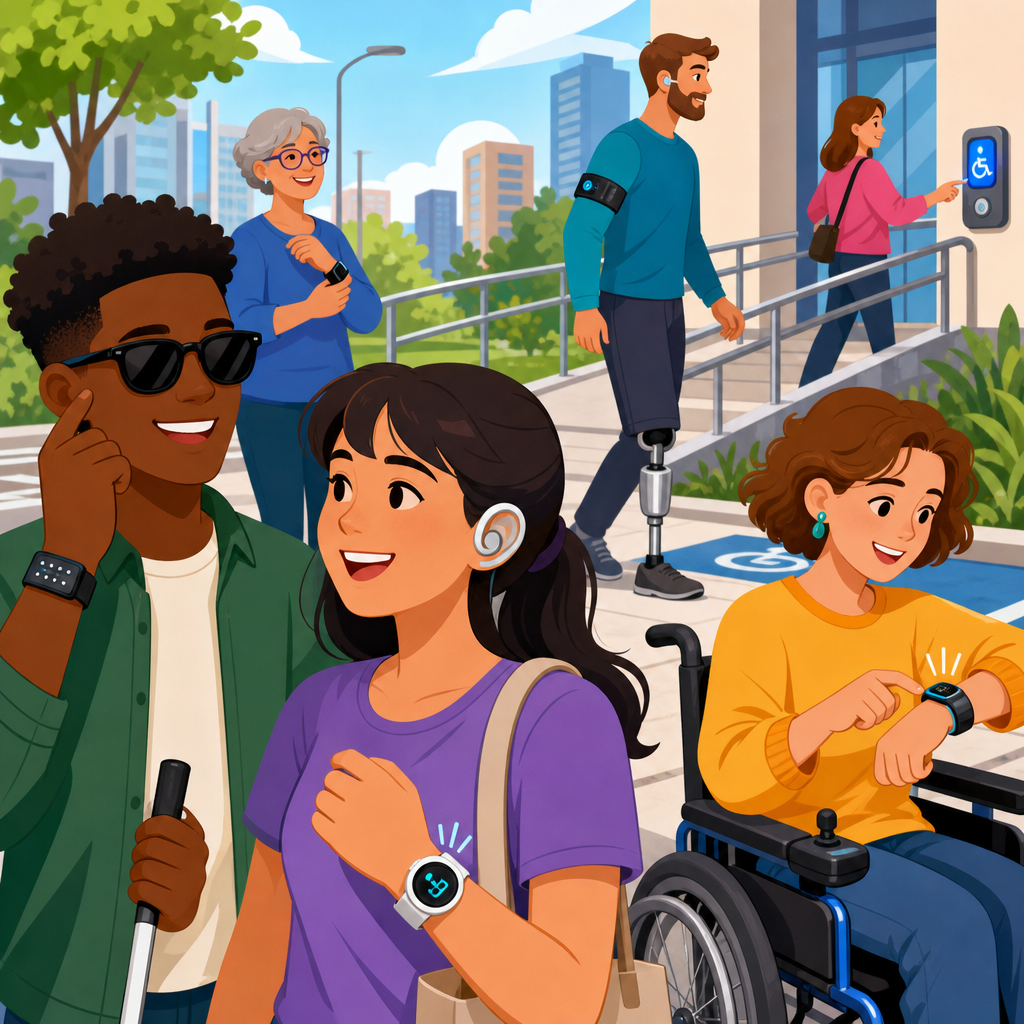
Wearable tech is reshaping accessibility and ADA compliance by moving assistance from the environment into the daily routines of the person who needs it, and that shift is changing how organizations plan for future disability access. In practical terms, wearable technology includes smartwatches, hearing devices, haptic navigation bands, biometric sensors, smart glasses, and connected medical or communication tools worn on the body. Accessibility means people with disabilities can use spaces, services, products, and digital systems effectively. ADA compliance refers to meeting the requirements of the Americans with Disabilities Act and related standards so qualified individuals are not excluded, denied equal access, or forced into inferior alternatives.
I have worked with digital accessibility teams, facilities managers, and product leaders long enough to see a clear pattern: policy updates often lag behind technology adoption, but expectations from users do not. When a transit rider uses a smartwatch for turn-by-turn vibration cues, or an employee relies on hearing augmentation through Bluetooth-enabled devices, the question is no longer whether wearables matter. The question is how businesses, schools, healthcare systems, and public agencies can support them responsibly while staying aligned with legal duties and inclusive design principles.
This topic matters because wearable tech now intersects with core ADA issues: effective communication, reasonable accommodation, program access, employment equity, digital usability, privacy, procurement, and safety. It also matters because future ADA developments will likely be shaped by technologies that personalize access in real time. As this hub article explores, the next phase will not be about gadgets alone. It will be about standards, interoperability, evidence of effectiveness, and clearer rules for when wearable-enabled access becomes expected rather than optional.
What wearable tech means for accessibility today
Wearable technology improves accessibility when it reduces friction between a person and a task. For blind and low-vision users, smart glasses can provide object recognition, text reading, and directional guidance. For Deaf and hard-of-hearing users, smart hearing devices and companion wearables can stream audio directly, strengthen speech clarity in noisy settings, or trigger visual and haptic alerts. For people with mobility disabilities, wearables can support fall detection, fatigue monitoring, or hands-free control. For neurodivergent users, sensory regulation devices and smart prompts can reduce overload and improve task completion.
The ADA does not require a specific device category, but it does require equal opportunity and effective access. That distinction is important. A wearable may be a personal aid in one setting and part of an organization’s accommodation strategy in another. I have seen employers assume an employee’s smartwatch or hearing wearable solves communication barriers by default. That is risky. If the meeting platform lacks captioning, room acoustics are poor, or emergency notifications are inaccessible, the employer still has obligations. Wearables can enhance access, but they rarely replace inclusive systems.
Adoption is also expanding beyond disability-specific products. Mainstream smartwatches now include fall detection, medication reminders, voice input, screen readers, vibration alerts, and health sensors. This mainstreaming lowers stigma and broadens adoption, but it creates a compliance challenge: organizations must understand that accessibility increasingly depends on compatibility with consumer devices as well as specialized assistive technology.
How ADA compliance is evolving around wearable use
Future ADA developments will likely focus less on whether wearable technology exists and more on whether environments and services work with it. The legal trend across accessibility enforcement is functional access. Regulators and courts tend to examine whether a person can participate effectively, not whether a particular brand or device was offered. That means wearable-related compliance will center on outcomes: Can a customer receive alerts in a perceivable format? Can an employee authenticate securely without inaccessible steps? Can a patient use a remote monitoring system without being screened out by dexterity, vision, hearing, or cognitive barriers?
Several established standards already shape the discussion. Web Content Accessibility Guidelines remain central for digital interfaces that pair with wearables, especially mobile apps, dashboards, account portals, and notifications. Section 508 standards influence federal procurement and often guide state and higher education purchasing decisions. In healthcare, HIPAA affects data handling, while FDA oversight may apply to certain wearable medical devices. Occupational safety rules can also intersect with accessibility when wearables are used for monitoring, alerts, or environmental hazard detection.
In practice, ADA compliance teams should expect more scrutiny in four areas: interoperability, equal alternative access, data transparency, and individualized accommodation. If a building access system requires a wearable credential, there must be an accessible alternative. If public-facing wayfinding relies on haptic prompts through an app and watch, the app itself must be accessible. If biometric wearables are used to measure productivity or wellness, organizations must explain data collection clearly and avoid discriminatory outcomes.
Key wearable categories driving future accessibility changes
Not all wearables have the same compliance impact. The most important categories are those tied directly to communication, navigation, health, safety, and identity verification. Smart hearing systems are one example. New over-the-counter hearing aids, Bluetooth LE Audio, and Auracast broadcast audio are expanding how people receive announcements in theaters, airports, lecture halls, and worship spaces. If these systems become widespread, organizations may face stronger expectations to support them as part of effective communication strategies.
Navigation wearables are another major category. Haptic belts, vibrating wristbands, and smart glasses can guide users through airports, campuses, hospitals, and public venues. I have seen pilots where indoor maps paired with beacon systems significantly reduced reliance on staff escorts. The compliance implication is not that every building must issue smart bands. It is that accessible wayfinding may increasingly include digital navigation layers, especially in complex environments where signage alone is not enough.
Biometric and health wearables also matter. Remote patient monitoring, seizure detection bands, cardiac sensors, and fall alerts can improve independence and safety. However, they raise difficult questions about false positives, uneven skin-tone performance in optical sensors, battery reliability, and data ownership. These are not minor technical details. They determine whether a wearable provides dependable access or creates a new barrier under the appearance of innovation.
| Wearable category | Accessibility benefit | Primary compliance issue | Example |
|---|---|---|---|
| Smart hearing devices | Clearer audio and direct streaming | Effective communication and compatibility | Auracast-ready auditorium audio |
| Haptic navigation wearables | Nonvisual wayfinding | Program access and app usability | Hospital indoor guidance via watch vibrations |
| Smart glasses | Text reading and object recognition | Accuracy, privacy, and training | Retail assistance for low-vision shoppers |
| Biometric health sensors | Safety monitoring and alerts | Data governance and reliability | Fall detection for independent living |
| Wearable credentials | Hands-free authentication | Alternative access methods | Employee entry using a wrist device |
Future trends and predictions in ADA developments
The strongest prediction is that accessibility policy will move toward ecosystem accountability. Instead of treating a wearable as a standalone tool, organizations will be judged on the full chain: hardware, mobile app, cloud service, physical environment, staff support, and fallback options. This is already happening in procurement reviews. Buyers increasingly ask whether a wearable works with iOS VoiceOver, Android TalkBack, captioning workflows, single-sign-on systems, and enterprise mobile management. That ecosystem approach will become standard.
A second likely development is broader recognition of personalization as a valid accessibility method. Traditional compliance often focused on fixed features such as ramps, captions, and tactile signage. Those remain essential, but wearables introduce adaptive access that changes by user need, location, and context. Expect future guidance to address personalized alerts, configurable sensory settings, and context-aware assistance, while still requiring a non-discriminatory baseline experience for people who do not use wearables.
A third trend is more explicit attention to algorithmic fairness. Accessibility professionals have learned the hard way that AI-enabled wearables can fail unevenly across disability types, accents, skin tones, body shapes, and movement patterns. Speech recognition may underperform for users with dysarthria. Optical sensors may read poorly on darker skin under certain conditions. Gait analysis may misclassify mobility device users. Future ADA-related developments will likely demand stronger testing evidence, documented limitations, and human review when wearable outputs affect employment, healthcare, education, or public services.
Fourth, expect emergency communication rules and best practices to expand. Wearables are becoming key channels for urgent alerts through vibration, text, sound, flashing indicators, and location-based prompts. Schools, employers, stadiums, and transit agencies will face increasing pressure to ensure emergency systems are multimodal and compatible with personal devices. A siren and wall strobe are no longer enough in many environments.
Finally, enforcement and risk assessment will become more data-driven. Organizations that deploy wearables without retention limits, consent procedures, accessibility testing, or accommodation pathways are building future legal exposure. The winning approach will be documented governance, not just enthusiastic adoption.
What organizations should do now
Organizations do not need to predict every regulation to prepare effectively. They need a disciplined accessibility process. Start with a wearable impact assessment that asks five direct questions: who benefits, who may be excluded, what data is collected, what standards apply, and what alternative access exists if the wearable fails or is not used. This approach works for employers, healthcare providers, universities, retailers, and public entities.
Next, make procurement more rigorous. Require vendors to document compatibility with assistive technologies and mobile accessibility features. Ask for VPATs where relevant, but do not stop there. I have reviewed many accessibility claims that sounded strong until hands-on testing revealed inaccessible setup flows, unlabeled controls, poor color contrast, or notifications that could not be customized. Real testing with disabled users is indispensable.
Training is equally important. Staff need to understand that wearables can support accommodations, but they cannot override individual preferences. One employee may prefer direct streaming to hearing devices; another may need CART captioning. One student may use a smartwatch for schedule prompts; another may need a human note taker or adjusted deadlines. ADA compliance remains individualized even as technology becomes more sophisticated.
Organizations should also connect this work across departments. Accessibility, IT, facilities, legal, HR, procurement, privacy, and security often make separate decisions that affect the same wearable deployment. A coordinated governance model prevents common failures such as inaccessible enrollment, overbroad data collection, or a badge system with no accessible backup for users who cannot wear the credential.
The limits, risks, and lasting opportunity
Wearable tech will not solve accessibility on its own, and responsible planning requires saying that clearly. Devices can be expensive, fragile, hard to charge, difficult to learn, or unsuitable for some disabilities. Battery failure during travel, inaccurate object recognition, poor speech transcription in noisy rooms, and inaccessible companion apps are all common problems. There is also a serious equity issue: if access depends on owning a recent smartphone or wearable, low-income users may be left behind.
Still, the long-term opportunity is substantial. Wearables can deliver discreet, personalized, real-time access in ways fixed infrastructure often cannot. They can support independence without removing the organization’s duty to build inclusive systems. The future of ADA developments in this area will reward institutions that treat wearable tech as one layer in a broader accessibility strategy grounded in standards, testing, user feedback, and clear policies.
For teams managing updates and developments, this hub should guide the next step: audit current systems, review wearable-related policies, and identify where future compliance will depend on interoperability, privacy, and individualized access. Organizations that act now will be better prepared for new guidance, better positioned to serve disabled users, and less likely to confuse innovation with inclusion. Start with one program, test it thoroughly, and build from evidence.
Frequently Asked Questions
1. What counts as wearable tech in the context of accessibility and ADA compliance?
In the accessibility and ADA compliance context, wearable tech refers to digital tools worn on the body that help a person perceive, navigate, communicate, monitor health, or interact with their environment more effectively. This includes smartwatches with voice control and fall detection, hearing devices and assistive listening systems, haptic navigation bands that provide vibration-based directions, smart glasses that offer visual or audio prompts, biometric sensors that track health or stress indicators, and connected communication tools that support speech, text, or alerts. What makes these devices especially important is that they move assistance closer to the individual rather than relying only on fixed accommodations in a building or service environment.
That said, wearable tech is not a replacement for accessibility obligations under the ADA. The law still expects businesses, public entities, employers, and organizations to provide accessible spaces, effective communication, and reasonable modifications where required. Wearables can enhance independence and improve access, but organizations should think of them as part of a broader accessibility strategy rather than a shortcut around compliance. For example, a haptic navigation device may help one user move through a space, but clear signage, accessible routes, and physical barrier removal may still be required. In other words, wearable technology expands what is possible for users, while ADA compliance continues to define what organizations must do to ensure access.
2. How is wearable technology changing the way organizations think about accessibility planning?
Wearable technology is shifting accessibility planning from a purely location-based model to a more person-centered one. Traditionally, accessibility efforts focused heavily on the environment: ramps, elevators, signage, captioning systems, accessible restrooms, and workstation modifications. Those elements still matter deeply, but wearable devices are introducing a new layer of support that travels with the user throughout the day. This means accessibility planning is becoming more dynamic. Organizations are now considering how their buildings, services, apps, policies, and communication systems interact with personal assistive devices that users already depend on.
For employers, schools, healthcare providers, retailers, transportation systems, and public-facing organizations, this changes practical planning decisions. They may need to ensure digital systems work with voice assistants, Bluetooth-enabled hearing devices, or smartwatch alerts. They may also need to think about whether emergency notifications can be delivered in multiple formats, including vibrations, visual messages, and audio cues. In workplace settings, wearable tech can support productivity and safety, but organizations still need a structured accommodation process and should not assume every employee will use or want the same device. The most effective planning approach is to design environments and services that remain accessible on their own while also supporting interoperability with wearable tools. This creates a stronger, future-ready accessibility strategy that serves more people with fewer barriers.
3. Can wearable devices help with ADA compliance, or are they just a personal convenience?
Wearable devices can absolutely support accessibility goals and help organizations improve the user experience, but they are not automatically a substitute for ADA compliance. This distinction is important. The ADA is a civil rights law that focuses on equal access, nondiscrimination, and reasonable accommodation or modification, depending on the setting. A wearable may help an individual user overcome a barrier in practice, but if the barrier should not be there in the first place, the organization may still have legal responsibilities to address it. For example, a blind visitor may use smart glasses or audio navigation tools, but that does not eliminate the need for accessible digital information, staff assistance when appropriate, or compliant wayfinding practices where required.
Where wearables do provide meaningful value is in strengthening accessibility outcomes. They can improve real-time communication, reduce dependence on fixed infrastructure, support health and safety monitoring, and offer users more autonomy. A smartwatch can deliver discreet reminders or emergency alerts. A hearing device can improve communication in meetings. A haptic band can support independent navigation in unfamiliar settings. These tools can be part of an accommodation process and may, in some cases, be considered when identifying effective solutions. However, organizations should avoid shifting all responsibility onto the individual by saying, in effect, “use your device and solve the access problem yourself.” A compliant and inclusive approach is to maintain accessible facilities, policies, and digital systems while also recognizing that wearable technology can be a valuable complementary aid.
4. What accessibility features should organizations support as wearable tech becomes more common?
Organizations should focus on compatibility, flexibility, and multimodal communication. Compatibility means digital platforms, kiosks, mobile apps, websites, workplace tools, and communication systems should work well with assistive technologies and common wearable devices. That includes support for screen readers, voice commands, captioning, Bluetooth audio, text-based alerts, and accessible authentication methods. Flexibility means users should have more than one way to receive information or complete a task. If an alert is only audible, it may exclude some users. If it is only visual, it may exclude others. The best systems provide layered options, such as sound, text, vibration, and visual display.
Organizations should also think operationally, not just technically. Staff training matters. Employees should understand that people may rely on wearable hearing technology, communication devices, medical alert systems, or navigation aids and should be prepared to interact respectfully and effectively. Policies should also address privacy and data sensitivity, particularly where wearable devices collect health or biometric information. In some environments, security screening, device restrictions, or communication protocols can unintentionally create barriers if they do not account for assistive wearables. A strong accessibility program anticipates these issues by reviewing both physical and digital touchpoints. The goal is not to support one specific gadget, but to create an ecosystem where a wide range of wearable tools can function alongside accessible design and ADA-conscious practices.
5. What are the biggest risks or misconceptions when relying on wearable tech for disability access?
One of the biggest misconceptions is that wearable technology makes traditional accessibility measures less necessary. In reality, wearables can enhance access, but they do not erase structural, communication, or policy barriers. If an entrance is inaccessible, a smartwatch does not fix that. If a video lacks captions, a wearable device may not provide effective communication. If a workplace policy is inflexible, no personal technology can fully solve the problem. Another common mistake is assuming all people with disabilities want the same technology or are comfortable using connected devices. Disability access is not one-size-fits-all, and neither is wearable tech. Cost, usability, battery life, internet dependence, maintenance, training, and personal preference all affect whether a device is truly helpful.
There are also important concerns around privacy, security, and equity. Many wearables collect sensitive personal data, including health, location, movement, and communication patterns. Organizations should be careful not to require disclosure or device usage in ways that create legal or ethical problems. They should also consider whether their accessibility strategy unintentionally favors people who can afford newer devices while leaving others behind. The best approach is balanced: treat wearable tech as a powerful innovation that can improve independence, safety, and participation, but continue to invest in accessible environments, inclusive design, and ADA-aligned policies. When organizations understand both the promise and the limits of wearable technology, they are far better positioned to create access that is durable, respectful, and genuinely inclusive.


