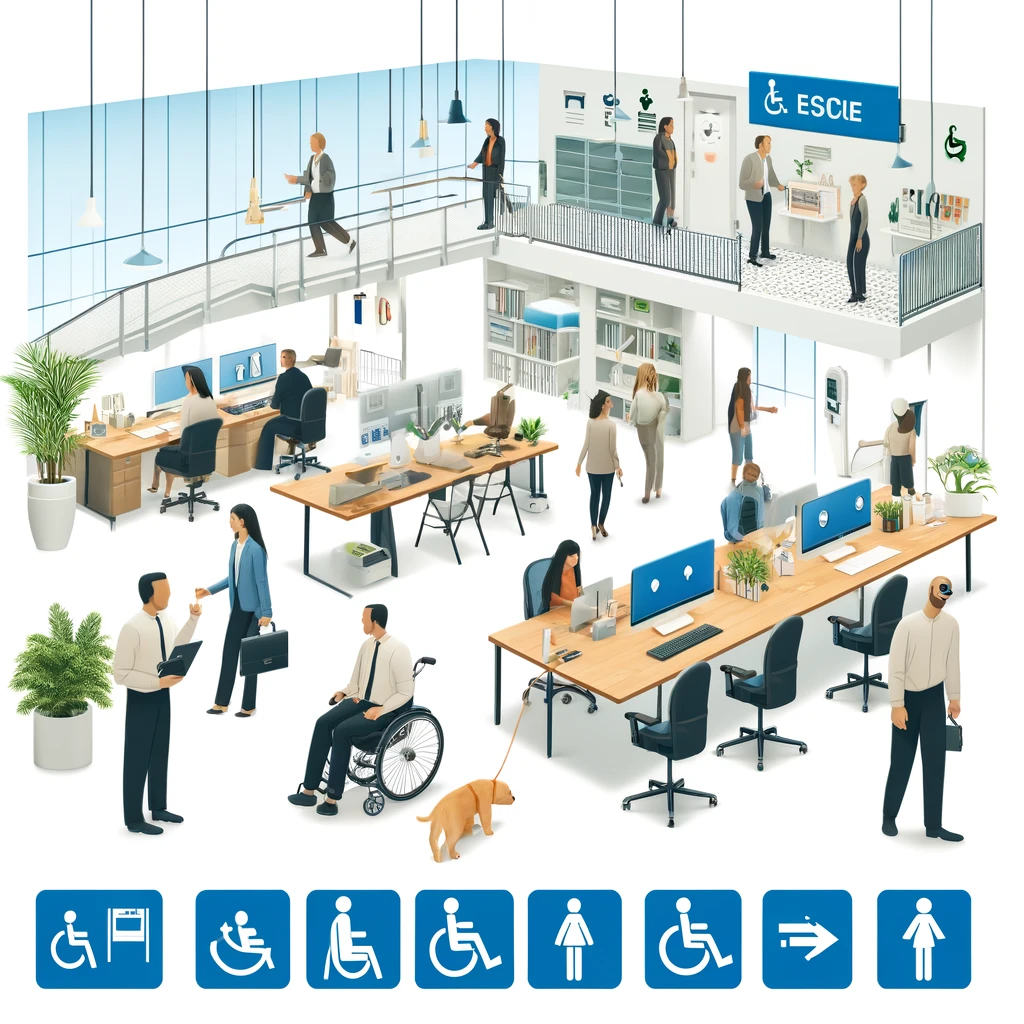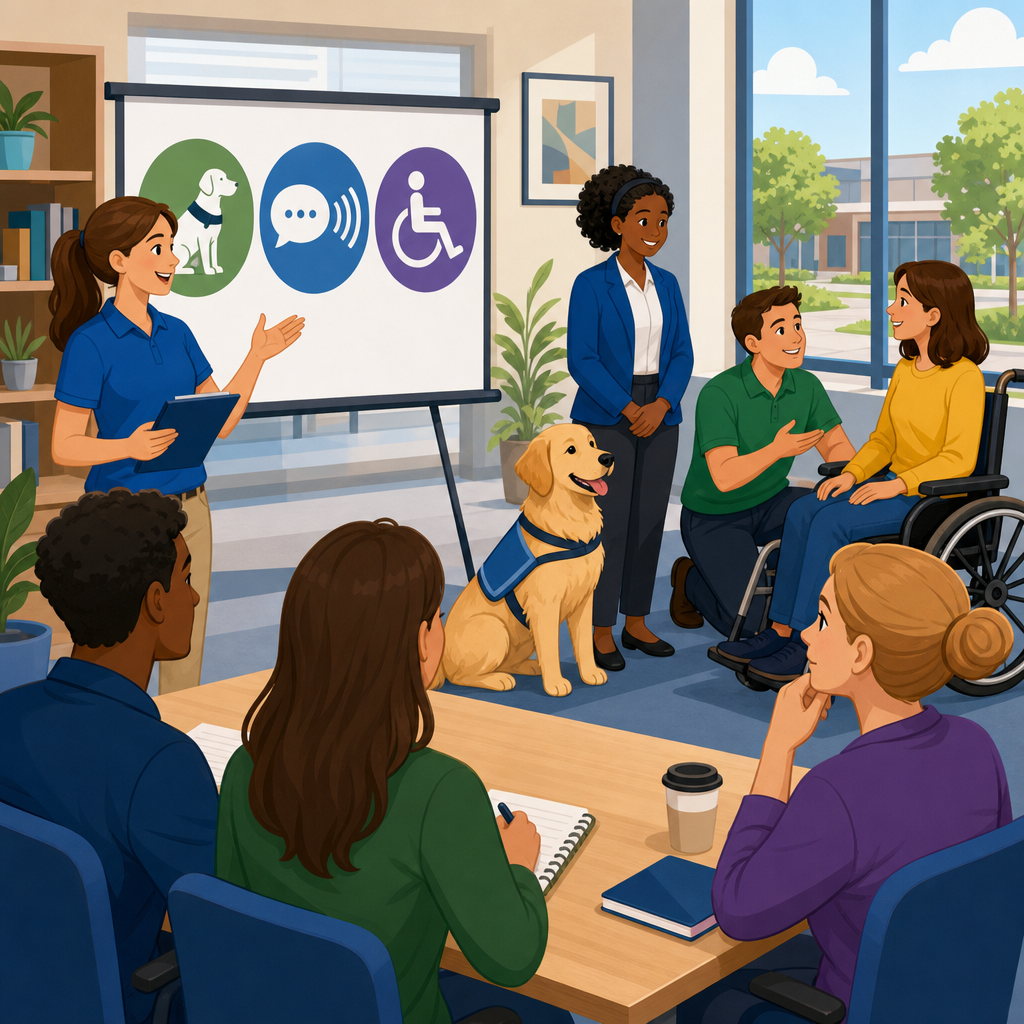
Training staff for service animal, effective communication, and mobility requests is one of the most practical parts of ADA compliance because it turns legal obligations into daily actions at front desks, call centers, classrooms, clinics, stores, and workplaces. In this context, ADA compliance means aligning policies, facilities, technology, and staff behavior with the Americans with Disabilities Act so people with disabilities can access goods, services, programs, and employment on equal terms. Practical implementation of ADA compliance is the operational side of that duty: training staff on what to say, what not to ask, how to provide auxiliary aids, and how to remove barriers before a complaint occurs. I have worked with organizations that thought compliance was mainly a facilities checklist, then discovered that most failures happened during human interactions. A perfect ramp does not help if staff question a legitimate service animal, ignore a request for captioning, or offer unsafe assistance to a wheelchair user. That is why this hub article focuses on three high-frequency situations that shape real access: service animal handling, effective communication, and mobility-related requests. Together, they affect customer experience, litigation risk, employee confidence, and institutional trust. They also connect to every other implementation topic, from policy drafting and vendor management to website accessibility and emergency planning.
For organizations in hospitality, healthcare, education, retail, local government, and multifamily housing, these situations arise constantly and often with little warning. Staff need practical scripts, not just broad principles. They must understand the difference between a service animal and an emotional support animal under federal public access rules, know when a sign language interpreter may be necessary, and recognize why grabbing a person’s wheelchair can be both disrespectful and dangerous. Training matters because the ADA is enforced not only through agency action and lawsuits, but through individual moments that either preserve dignity or create exclusion. The strongest programs combine written procedures, scenario-based instruction, manager escalation paths, and periodic refreshers tied to incident reviews. This article serves as a hub for practical implementation of ADA compliance by explaining the core standards, the most common errors, and the operational methods that make compliance consistent across teams.
Building an ADA implementation program that staff can actually use
Practical ADA implementation starts with role-based training, not generic annual slides. Frontline staff need short rules and examples; supervisors need decision trees and escalation authority; compliance leaders need documentation protocols, audit schedules, and vendor oversight. In my experience, the best programs map training to the customer journey: arrival, check-in, transaction, service delivery, restroom access, emergency response, and complaint handling. That approach reveals where requests typically occur and what staff must do in those moments. It also creates internal linking between issues that are often siloed, such as facility access, digital forms, and communication supports.
Every program should define four terms clearly: disability, reasonable modification, auxiliary aids and services, and undue burden or fundamental alteration. Those concepts guide daily decisions. A reasonable modification is a change in policy or practice that allows access unless it fundamentally alters the nature of the service. Auxiliary aids and services include qualified interpreters, captioning, note-taking, accessible electronic documents, and assistive listening systems. Undue burden means significant difficulty or expense, assessed in context, not by assumption. Staff do not need to memorize case law, but they do need to know that delays, skepticism, and inconsistent answers are common compliance failures. A written standard operating procedure should tell employees who can approve requests, how quickly they must respond, and when legal or compliance review is required.
Training staff to handle service animal requests correctly
Service animal issues are among the most misunderstood areas of ADA compliance. Under federal public access rules, a service animal is generally a dog individually trained to do work or perform tasks for a person with a disability. In limited cases, a miniature horse may also require assessment. Staff cannot demand documentation, require a special vest, or ask about the person’s diagnosis. When the disability and task are not obvious, staff may ask only two questions: whether the animal is required because of a disability, and what work or task the animal has been trained to perform. That narrow rule should be taught verbatim because staff often improvise and create liability.
Training must also cover what organizations can expect from handlers. The animal must be under control, typically by leash, harness, or voice control, and it must be housebroken. A business may ask that an animal be removed if it is out of control and the handler does not take effective action, or if the animal is not housebroken. The business must still offer the person the opportunity to obtain goods or services without the animal’s presence when feasible. This balance matters. I have seen teams wrongly exclude quiet service dogs because of allergy concerns, while tolerating barking pets because no one wanted conflict. The correct response is to separate people when possible, use routine cleaning practices, and avoid blanket exclusions.
Staff should also understand what does not qualify under the same rules. Emotional support, comfort, or companionship alone is not the same as trained task performance for public access purposes. That distinction is especially important in restaurants, hotels, retail stores, and medical offices. However, employees should be trained to explain the rule calmly and consistently, not dismissively. A simple script works: “We welcome service animals trained to perform tasks for a person with a disability. If the need is not obvious, I can ask two questions permitted by law.” Consistency reduces accusations of bias and helps managers support staff decisions.
Effective communication: making information equally accessible
Effective communication means providing information to people with disabilities in a way that is as clear and usable as communication with others. This obligation applies across hearing, vision, speech, and cognitive disabilities, and the right aid depends on the context. In healthcare, a qualified sign language interpreter may be necessary for informed consent, discharge instructions, mental health assessments, or complex treatment discussions. In a hotel, exchanging written notes for a routine interaction may be enough. In a lecture hall, real-time captioning or assistive listening may be the appropriate solution. Staff need to evaluate the length, complexity, and importance of the communication, not just choose the cheapest option.
Organizations should train employees on the range of auxiliary aids and services. Examples include qualified interpreters on site or through video remote interpreting, CART captioning, accessible PDFs and Word documents, Braille or large print where appropriate, screen-reader compatible web forms, TTY or relay services, and speech-to-speech relay. Video remote interpreting can work well, but only when the connection is stable, the screen is large enough, the camera angle is correct, and the user can see and interact effectively. I have seen hospitals rely on underpowered tablets that froze during consent discussions, creating both access and risk problems. Technology is not compliance unless it functions in the real environment.
Primary consideration is another concept staff should know. In many public entities and healthcare settings, the person’s stated communication preference carries substantial weight, especially for complex interactions. Organizations can offer alternatives, but they should not assume that lip reading, family interpretation, or written notes are always sufficient. Family members generally should not be used as interpreters except in emergencies or when specifically requested and appropriate. Children should almost never fill that role. The operational lesson is simple: ask what communication method works best, assess the context, and document the decision. Good records show that the organization responded thoughtfully rather than reflexively.
Responding to mobility requests without creating new barriers
Mobility requests involve far more than wheelchair ramps. They include accessible routes, door hardware, seating flexibility, transfer assistance policies, parking access, queue management, restroom usability, exam table access, evacuation methods, and safe interaction etiquette. Staff should be trained never to touch a wheelchair, cane, walker, or other mobility aid without permission. These devices are part of a person’s body space and stability. Pulling a wheelchair backward, leaning on it, or moving a walker to “make room” can cause injury. The correct approach is to ask, “How can I assist?” and follow the person’s instructions.
Operational planning is essential because many mobility barriers are procedural. A restaurant may technically have an accessible entrance but store highchairs in the route. A clinic may have an adjustable exam table but no trained staff to use it safely. A conference venue may reserve wheelchair seating but isolate attendees from companions. A retailer may offer curbside pickup but require app steps that are not keyboard accessible. Each example shows why practical implementation of ADA compliance must connect facility standards, staffing, and process design. Managers should conduct walkthroughs using real scenarios, such as arrival during rain, access while carrying bags, or restroom use when the building is crowded.
| Request type | Common staff error | Correct operational response |
|---|---|---|
| Service animal entry | Demanding certification or asking about diagnosis | Use only the two permitted questions when the need is not obvious |
| Sign language support | Offering notes for a complex conversation | Arrange a qualified interpreter or effective remote interpreting |
| Wheelchair assistance | Pushing without consent | Ask before assisting and follow the person’s directions |
| Accessible seating | Separating the guest from companions | Provide integrated seating choices with companion spaces |
| Exam access | Skipping transfer options because staff are untrained | Train staff on lift, transfer, and adjustable table procedures |
Policies, scenarios, and documentation that reduce complaints
Strong ADA implementation depends on repeatable systems. Start with written policies that cover service animals, communication accommodations, mobility assistance, website and digital document accessibility, event planning, and complaint response. Then turn those policies into scenarios. During training, I use examples employees actually face: a guest arrives with a dog in a no-pets hotel area; a Deaf patient needs informed consent at 2 a.m.; a shopper asks for assistance reaching merchandise from a seated position; an employee requests captioned training videos. Scenarios force staff to apply standards under time pressure and reveal where procedures are vague.
Documentation should be practical, not bureaucratic. Track what was requested, who handled it, what accommodation was provided, how quickly it was delivered, and whether follow-up was needed. Incident logs often show patterns that general audits miss. If one location repeatedly mishandles interpreter scheduling or blocks accessible routes with temporary displays, the problem is not employee attitude alone; it is a process failure. Use that data for refresher training, capital planning, and vendor corrections. Organizations that perform well usually assign ownership clearly: facilities manage physical barriers, IT handles accessible documents and platforms, operations oversees frontline procedures, and compliance or legal monitors consistency.
Leaders should also review external standards and tools. The 2010 ADA Standards for Accessible Design remain foundational for built environment requirements. For digital content, WCAG is the practical benchmark most teams use. For hearing access in public spaces, assistive listening system requirements and procurement specifications matter. For healthcare, transfer guidance and accessible medical equipment recommendations are especially useful. Referencing recognized standards during training gives employees confidence and keeps decisions anchored in accepted practice rather than personal opinion.
Turning compliance into a reliable customer and employee experience
The most effective organizations treat ADA implementation as a service quality discipline, not a one-time legal project. They train staff for service animal interactions, effective communication, and mobility requests because these moments define whether access is real. They create short scripts, clear escalation paths, functioning tools, and accountable records. They test facilities and technology in the field, not just on paper. They correct mistakes quickly and use complaints as operational feedback.
If this article is your hub for practical implementation of ADA compliance, the next step is straightforward: audit your current procedures, identify the highest-frequency request types, and retrain teams using real scenarios from your setting. Start with the front line, because that is where policy becomes experience. When staff know exactly how to respond, people with disabilities receive equal access more consistently, and the organization reduces preventable risk while building trust that lasts.
Frequently Asked Questions
What should staff know about interacting with people who use service animals?
Staff should be trained to treat a person using a service animal as they would any other customer, student, patient, visitor, or employee: with respect, privacy, and equal access. Under the ADA, a service animal is generally a dog that has been individually trained to do work or perform tasks for a person with a disability. Training should emphasize that the focus is on access, not personal curiosity. Staff should not pet, feed, call to, distract, or separate the animal from its handler, because doing so can interfere with the animal’s work and create safety risks.
Employees also need to know what questions are allowed when the need for the service animal is not obvious. In most public-facing settings, staff may ask only two limited questions: whether the dog is required because of a disability, and what work or task the dog has been trained to perform. They should not ask about the person’s diagnosis, request medical records, demand identification cards or certification for the dog, or require a demonstration of the task. This is a common source of ADA mistakes, so role-based training is important for reception teams, security staff, managers, and anyone who handles in-person interactions.
Practical training should also cover when a service animal may be excluded. A service animal is not required to be admitted if it is out of control and the handler does not take effective action to control it, or if it is not housebroken. Even then, staff should know that the person must still be offered the opportunity to obtain the goods or services without the animal present, when possible. Good training turns this from a legal rule into a calm script and a predictable response process, which reduces conflict and helps staff respond consistently.
How should employees communicate effectively with people who have hearing, vision, speech, or cognitive disabilities?
Effective communication under the ADA means providing communication that is as clear and useful for a person with a disability as it is for others. Staff training should begin with a simple principle: communicate directly with the person, not only with a companion, interpreter, aide, or support person. Employees should learn to ask what communication method works best in the situation rather than making assumptions. For one person, that may mean exchanging written notes; for another, it may involve a qualified sign language interpreter, real-time captioning, large print, accessible digital documents, plain language explanations, or extra time to process information and respond.
For people who are deaf or hard of hearing, training should cover techniques such as facing the person while speaking, minimizing background noise when possible, using captioned video, and understanding when auxiliary aids and services may be necessary. For people who are blind or have low vision, staff should know how to read forms aloud when requested, describe visual information clearly, provide accessible electronic materials, and avoid vague directions like “over there.” For people with speech disabilities, staff should be trained to listen patiently, avoid pretending to understand, repeat back key details for confirmation, and use alternative methods such as writing, secure messaging, or communication devices when needed. For people with cognitive or intellectual disabilities, communication often improves when staff use concrete language, break information into steps, and confirm understanding without being patronizing.
Training should also address operational realities. Call center staff may need procedures for relay calls and alternative contact methods. Clinic staff may need protocols for arranging interpreters. Classroom or workplace teams may need guidance on accessible handouts, meeting materials, and software. The goal is not simply politeness; it is reliable access. When communication barriers are anticipated, documented in procedures, and practiced in training, organizations are far more likely to meet ADA requirements in a consistent, day-to-day way.
What are mobility requests, and how should staff respond to them?
Mobility requests are requests related to moving through, entering, using, or participating in a space, service, program, or job when a person has a mobility limitation. In practice, these requests can include help identifying an accessible entrance, moving a meeting to an accessible room, ensuring a checkout lane or service counter can be used by a wheelchair user, adjusting seating arrangements, allowing use of mobility devices, providing an accessible route during an event, or making temporary changes to avoid barriers created by construction, weather, or furniture placement. In employment settings, mobility-related requests may include workstation adjustments, modified parking access, scheduling changes related to treatment or fatigue, or equipment that enables job performance.
Staff should be trained to respond promptly, respectfully, and without creating unnecessary hoops. The first step is usually to understand the barrier, not to challenge the person. Front-line employees should know how to solve simple issues immediately when they can, such as opening an accessible entrance, relocating a service interaction to an accessible area, or removing obstructions from a route. They should also know when to escalate the request to a manager, facilities team, disability services office, HR, or ADA coordinator. Delays often happen because staff do not know who owns the issue, so clear internal routing is a critical part of training.
It is also important for training to distinguish between temporary assistance and structural obligations. Helping someone up a step is not a substitute for maintaining an accessible entrance if one is required. Similarly, carrying a person’s items around barriers does not resolve an inaccessible layout. Employees should understand that ADA compliance includes facilities, policies, and operations working together. Good mobility request training teaches staff to provide immediate access where possible, document recurring problems, and trigger longer-term fixes so the same barrier does not keep affecting multiple people.
How can organizations train front-line staff without overwhelming them with legal language?
The most effective ADA training translates legal requirements into job-specific actions. Instead of asking every employee to memorize the full statute or regulations, organizations should build training around realistic scenarios that staff actually encounter at front desks, in stores, on phone lines, in classrooms, in clinics, and at work sites. For example, a receptionist may need to know how to respond when someone arrives with a service animal, a call center representative may need to handle relay calls and requests for accessible documents, and a supervisor may need to recognize when a mobility-related issue should be escalated as a formal accommodation request. This kind of targeted training is easier to retain and much more useful in practice.
Simple decision tools also help. Staff benefit from scripts, checklists, and “what to do next” guides. A short script for service animal interactions, a checklist for arranging effective communication, and a contact list for accessibility escalation can do more for compliance than a one-time lecture filled with legal terms. Training should also explain the reason behind the rule in plain language: ADA compliance is about equal access, dignity, consistency, and risk reduction. When staff understand that their behavior directly affects whether someone can participate fully, they are more likely to apply the training confidently and appropriately.
Organizations should reinforce training over time rather than treating it as a single event. Short refreshers, manager coaching, new-hire onboarding, role-playing, and reviews of real incidents are all effective. It is especially helpful to train staff on common mistakes, such as asking for prohibited documentation for a service animal, speaking only to a companion instead of the individual, assuming a mobility device is optional, or failing to document recurring barriers. Strong ADA training is practical, repeatable, and supported by leadership, which is what turns policy language into dependable day-to-day service.
What policies and procedures support consistent handling of service animal, communication, and mobility issues?
Consistency depends on more than individual goodwill; it requires clear policies, workable procedures, and visible accountability. Organizations should have written guidance that explains how staff should respond to service animals, requests for effective communication, and mobility-related access issues. These policies should define basic responsibilities, identify who can make decisions, explain escalation paths, and clarify response time expectations. For example, staff should know who arranges interpreters, who handles accessibility concerns during events, who can authorize room changes, and who receives reports about blocked accessible routes or malfunctioning doors.
Procedures should also include practical documentation standards. Not every routine interaction needs a formal report, but recurring barriers, denied access concerns, equipment failures, and accommodation-related follow-up should be recorded in a way that allows patterns to be identified and corrected. This is particularly important when the same accessibility problem appears across multiple settings, such as inaccessible digital forms, inconsistent treatment of service animals, or temporary layout changes that block mobility access. Documentation helps organizations move from reactive problem-solving to preventive compliance.
Finally, strong procedures include maintenance, technology, and quality assurance. Accessible entrances, lifts, automatic doors, signage, captioning tools, website forms, and document formats all need ongoing attention. Staff should not be left to improvise around failing systems that should already be accessible. Regular audits, mystery shopper reviews, complaint analysis, and leadership review can reveal where training or operations need improvement. When policies are clear, procedures are easy to follow, and staff know they will be supported in doing the right thing, ADA compliance becomes part of normal operations rather than a last-minute exception.